The New York Times has sued Brave Software in federal court in Manhattan, accusing the browser and search company of copying publishers’ work with a crawler sites can’t single out and block, then selling that copy to AI companies through the Brave Search API. The complaint, filed on 2 November and assigned to Judge Lewis A. Kaplan, puts Brave’s search index, not an AI model, at the centre of a copyright fight.
The Times doesn’t hold back on the language. The complaint says Brave “is the supplier, dealer, and distributor of stolen copyrighted content for its own users and many of the most prominent GenAI companies, including Anthropic, Perplexity, Mistral, xAI, and Cohere.” It also says “Brave acts both like a burglar that misappropriates the content of publishers, and an AI “fence” that sells stolen content to third parties.” The Daily News, Chicago Tribune and Orlando Sentinel filed their own suit against Brave the same day.
Brave hasn’t responded publicly, and none of the allegations has been tested in court. Court records show Brave was served on 4 November and has until 25 November to answer.
What the Times says Brave did
The suit makes five claims: direct, contributory and vicarious copyright infringement, breaking the DMCA’s anti-circumvention rules, and unjust enrichment under New York law. The Times wants statutory and actual damages, the profits it says Brave made, a permanent injunction and a jury trial.
Most of the complaint is about how Brave built and sells its index. It says “Brave crawled and copied content from the over 30 billion webpages in the Brave Index without identifying itself or providing website owners with any mechanism to block its crawler.” Brave then offers that index to developers through its Search API. The complaint quotes Brave describing one endpoint, LLM Context, as returning “extracted page chunks and source metadata in a shape and length that satisfies the needs of an LLM without need for further scraping.”
It also leans on Brave’s own marketing. Brave’s about page says the API is “Used by some of the biggest names in AI, including Cohere, Mistral, Perplexity, and You.com”, and its API page calls it “Trusted by the world’s top AI labs”. The complaint cites a 2023 Brave post saying Anthropic “used Brave’s Search API to train their latest model, Claude 2, on high-quality data to help optimize Claude’s outputs for retrieval augmented generation (RAG) queries.”
The browser features are the other half of the case. The Times says Brave’s browser has a “Paywall blocker” setting promoted as a way to “Bypass Paywalls”, which underpins the DMCA claim. Ars Technica tested the Mac browser and found the feature, enabled in the default settings, let it read a paywalled Times article. It can be turned off. The complaint also says Brave’s ad blocking strips the Times’s ads and shows Brave’s own, and that Ask Brave, the AI answer feature once called Summarizer, reproduced more than 400 words of a Times article word for word.
According to the complaint, the Times’s IP counsel wrote to Brave chief executive Brendan Eich on 11 August 2025 and outside counsel wrote again on 13 April 2026. It puts a figure on what it says Brave earned: “Brave has made more than $100 million by copying and reselling publishers’ work without consent or permission, publishers have received nothing.” That number draws on third-party reports that Brave’s 2025 revenue passed $100 million, which is total company revenue, not API sales alone.
Why robots.txt can’t name Brave
Sites tell crawlers what they may read in robots.txt, and that relies on each crawler announcing a name. Many AI companies publish the names of their bots so sites can let some in and turn others away. Brave doesn’t, and it says so on its crawler help page: “The Brave Search crawler does not advertise a differentiated user agent because we must avoid discrimination from websites that allow only Google to crawl them. However, if a domain or page is not crawlable by Googlebot, then Brave Search’s bot will not crawl it either.”
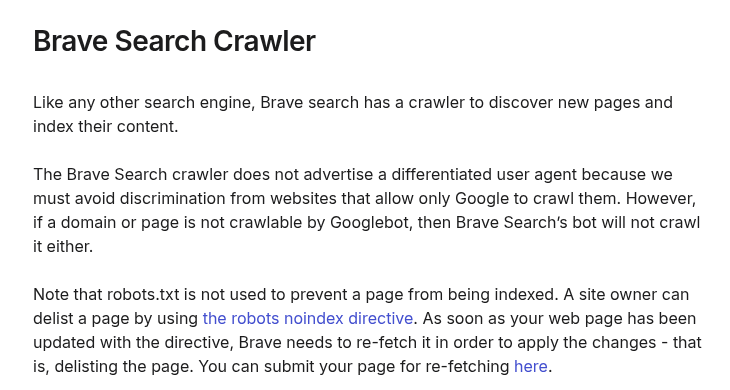
So a site can’t let Google in and keep Brave out; it gets both or neither. The same page says “robots.txt is not used to prevent a page from being indexed” and points site owners to the noindex tag instead, which also removes the page from Google. It adds that the crawler is partly fed by users who opt in to Brave’s Web Discovery Project in the browser.
Slobodan Manić, who flagged the case for site owners in a Search Engine Journal column, ran the check on his own site. A Brave search for site:nohacks.co returned 16 of his pages, along with a homepage description he’d already replaced, so Brave was serving a stored copy. His robots.txt names 13 AI bots. “There’s no line I could add for Brave. It’s hard to block a name that doesn’t exist,” he wrote. Anyone can repeat the test by searching site: and their domain on search.brave.com.
Brave’s side of the argument
Brave hasn’t answered this complaint yet, but it has argued the point before. After a cease-and-desist letter from News Corp, Brave sued the Wall Street Journal publisher in California, arguing that it was simply indexing website content, “which all search engine operators must do to exist”, and that this was fair use. News Corp hit back in July with copyright claims of its own, alleging that Brave masks its web crawlers so publishers can’t detect or block them.
The crawler page gives Brave’s reasoning on naming: a separate user agent would let sites that whitelist only Google shut out a smaller rival. The Times calls that a “refusal to release the name of its web crawler bot”.
The other side was just as blunt. “While we believe in the ethical and responsible use and development of AI, Brave has flouted established copyright law and ignored repeated requests by The Times to stop its infringing conduct,” Times spokesperson Graham James told The Verge. “We filed this lawsuit to hold Brave accountable for stealing our content to power its own products and to provide it to some of the most prominent and well resourced generative AI companies in the world.”
“AI giants are now desperate to avoid getting caught red-handed stealing news from publishers, so Brave Software is selling them a back door to the journalism they know they have no right to,” said Steven Lieberman, a lawyer for the Daily News group. “Buying stolen goods secondhand doesn’t make them legitimate. Brave must be held responsible for laundering pirated reporting for the AI industry.”
IP lawyer Ariel Givner said on X that the suit goes after the middleman rather than a model maker, and that the paywall setting matters most legally.
What site owners can do now
Under Brave’s published rules there are two levers, and both are blunt. Blocking Googlebot in robots.txt keeps Brave’s crawler out too, at the cost of Google traffic. Adding noindex delists a page from Brave, but also from every other search engine that honours it. Brave says it has to re-fetch a page before a noindex takes effect, and it offers a form to request that.
What happens next is up to the court. Brave’s answer is due on 25 November, and the outcome in New York and California will help decide whether a search index sold to AI companies counts as ordinary search or something publishers can charge for.
Discover more from Sulat AI & Tech News
Subscribe to get the latest posts sent to your email.