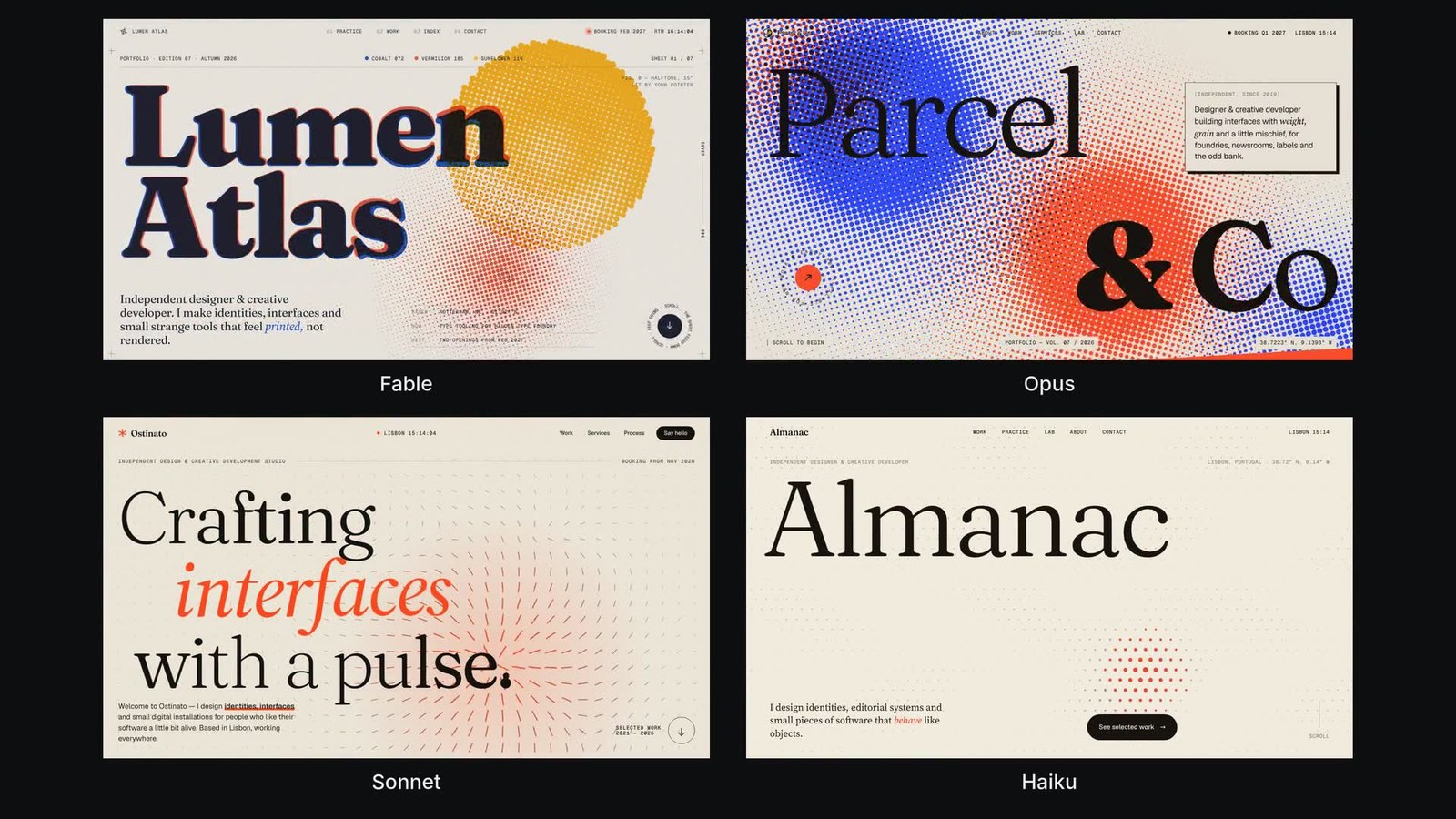
Anthropic has published a guide to picking between its four generally available Claude models, and its main advice is not to reach for the newest one first. “The quick answer is that you should start most work on Opus 5.5 at its default effort level, medium,” the guide says. Claude Fable 5.2, released the same day, is kept for the hardest technical projects, long unattended runs, and cases where Opus 5.5 at high effort still falls short.
The guide, “Which Claude model should you build with?”, was written by Addy Osmani, who works on Claude Code at Anthropic, and posted to the claude.dev blog. Besides the model picks, it covers when to raise effort instead of switching models, how to put subagents on cheaper models, and the API differences that can break a request when you swap one model name for another. Our Fable 5.2 launch coverage has the release itself.
Which model for which job
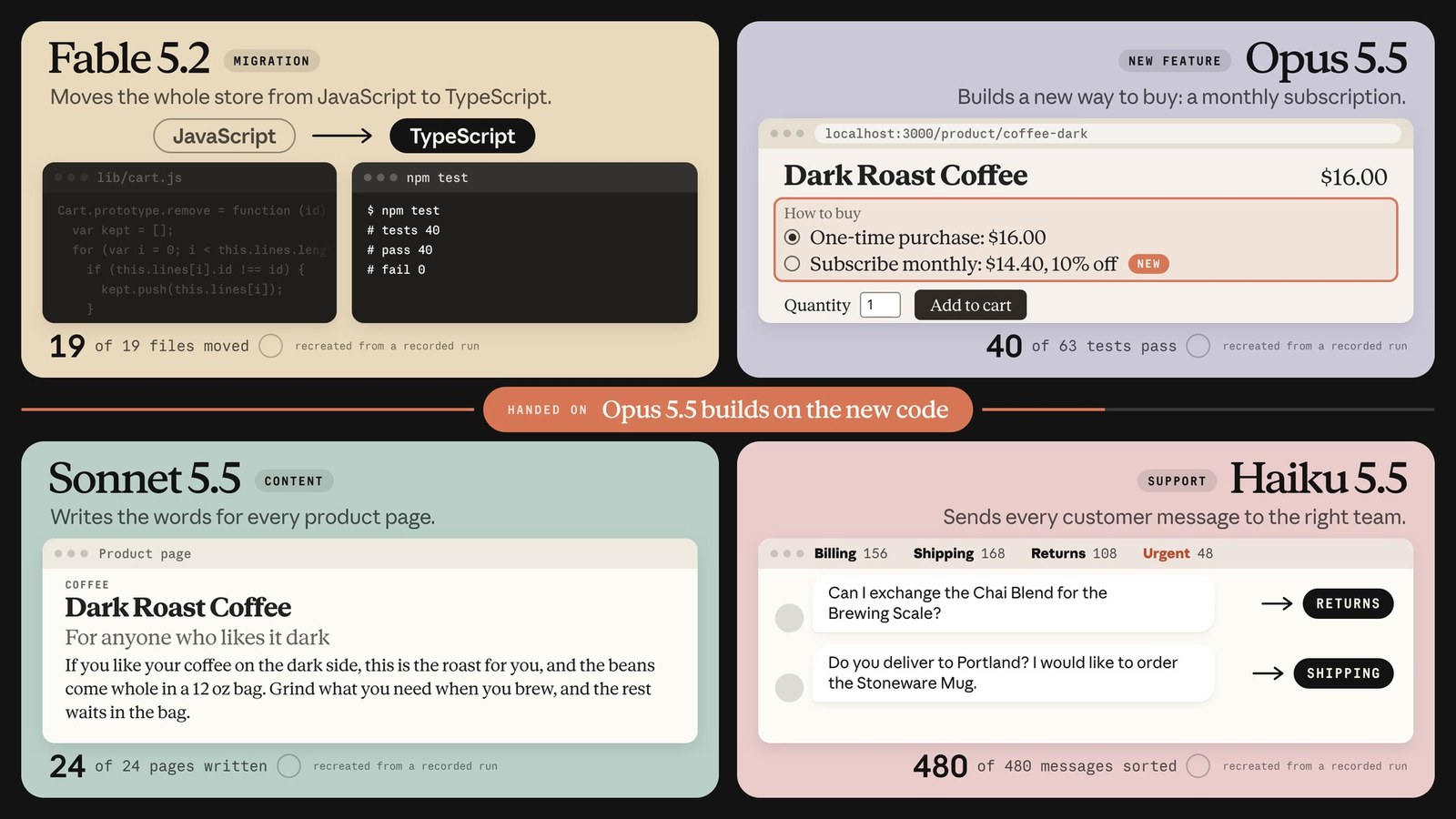
The guide works down from Opus 5.5. Sonnet 5.5 is for well-scoped work such as a bug fix or a feature built against a spec, though it warns that a migration or a performance job “can have clear specs and still be difficult enough to warrant Opus 5.5, or Fable 5.2 for a major one.” Haiku 5.5 is for classification, routing and extraction at volume, and for subagents doing a bigger model’s side tasks. Fable 5.2 goes on top, for “the hardest technical projects in coding, finance and the sciences.”
| Work | Starting model | Starting effort |
|---|---|---|
| Everyday engineering, debugging, multi-PR features | Opus 5.5 | medium, then high |
| Well-scoped coding: bug fixes, spec-driven work | Sonnet 5.5 | medium, then high |
| Chat and interactive sessions | Sonnet 5.5 (Haiku 5.5 for simple chat at volume) | low or medium |
| Documents, slides and spreadsheets | Sonnet 5.5 | high (medium in Claude Code) |
| Classification, routing, tagging, extraction | Haiku 5.5 | medium |
| Subagents that search files, read logs or summarise | Haiku 5.5 or Sonnet 5.5 | model default |
| Computer use and vision-heavy workflows | Opus 5.5 | medium |
| Major refactors, migrations, leading many subagents | Fable 5.2 | medium, then high |
| Deep research, scientific or quantitative analysis | Fable 5.2 | medium, then high |
| Not sure yet | Opus 5.5 | medium |
All four models have a 1M-token context window and a 128K-token output limit. From Sonnet up, the per-token price roughly doubles at each tier, and Haiku 5.5 is the only one whose price depends on prompt length.
| Haiku 5.5 | Sonnet 5.5 | Opus 5.5 | Fable 5.2 | |
|---|---|---|---|---|
| Input / output per million tokens | US$0.10 / US$0.50 up to 100K tokens; US$0.50 / US$2.50 above | US$2 / US$10 | US$4 / US$20 | US$8 / US$40 |
| Cache reads per million tokens | US$0.01 up to 100K; US$0.05 above | US$0.10 | US$0.20 | US$0.20 |
| Default API effort | medium | high (medium in Claude Code) | medium | high (medium in Claude Code) |
| Fast mode | No | No | Yes | Yes |
Turn the effort dial before you switch
The guide treats effort as a finer control than model choice. One level down can get the same result for less, and one level up helps when a model needs to think longer, call more tools or check its own work. But it says higher effort “won’t give a model knowledge or skill it doesn’t have”, and past high, one more level can cost as much as the next model up. Its advice there is to test the bigger model at a lower effort instead.
Anthropic backs this with its own benchmark runs, which haven’t been checked independently. On SWE-bench Pro, Opus 5.5 at medium scored about 2.5 points lower than at high for about 70% of the cost, while xhigh added about 1.4 points for 2.5 times the cost. On Terminal-Bench 3.0, Fable 5.1 at max scored 58.0% and Opus 5.5 at high scored 58.9% with half the tokens. On the hardest work the order flips: on FrontierCode 2.0, Fable 5.2 at high roughly matched Opus 5.5 at max, 45.3% against 45.5%, for about half the cost per task.
Before touching either dial, the guide says to check the model can verify its own work, “with a test, a build or a script that calls the endpoint.” Then raise effort one level, and only then move up a model. Where results can be checked automatically, it suggests running everything at low effort and re-running only the failures at high. On a SWE-bench Pro subset, that approach with Opus 5.5 passed about 97% of tasks for about US$0.17 each, against 95.3% at US$0.29 each with every task on high.
Context gets the same cost treatment. Each turn resends the conversation, though on long runs most of it bills as cache reads. Fable 5.2 and Opus 5.5 charge the same US$0.20 per million tokens for those, so on a long, cache-heavy run the gap between them comes down to uncached input and output, where Fable costs twice as much. The guide’s takeaway is to keep the expensive model’s context for decisions “and let cheaper subagents do the verbose reading.”
Mixing models in Claude Code
Switching models mid-task has costs the guide spells out. The prompt cache belongs to the model that wrote it, so the first turn on a new model pays to write the whole conversation into cache again. Running /compact first, or starting fresh with a short written plan, makes that turn smaller. Thinking blocks are also tied to models: a model never reads the reasoning of one above it, so moving down a tier loses it, and the guide says a move from Fable 5.2 to any other generally available model drops its reasoning.
For subagents, which run in their own context and bill at their own model’s rates, Claude Code takes a model field in the agent definition, and the CLAUDE_CODE_SUBAGENT_MODEL environment variable sets a default. The guide’s example puts a log reader on Haiku:
---
name: log-reader
description: Reads test output and logs, and reports each failing case. Use after a test run.
tools: Read, Grep, Glob, Bash
model: haiku
---
Read the logs you're given. For each failure, report the file, the test name and the first error line. Don't edit any files.
It draws the line at code edits and judgment calls, which stay on the main model. “When a small model misreads a search result, the main model opens the wrong file and spends tokens on it.” It also flags a quiet change: Claude Code’s built-in Explore subagent now runs on the session’s model instead of always on Haiku. To keep exploration cheap, define your own subagent called Explore with model: haiku. On the Anthropic API the haiku alias now points to Haiku 5.5, which needs Claude Code v2.1.293 or later, while Amazon Bedrock, Google Cloud, Microsoft Foundry and Claude Platform on AWS still resolve it to Haiku 4.5.
The guide is cooler on two other options. Claude Code’s opusplan alias plans with Opus and carries out the plan with Sonnet, which puts code edits on the smaller model, the reverse of the guide’s own advice, so it says to measure it before making it a default. The advisor tool, in beta, lets a cheaper executor ask a stronger model for help. Of the four pairings in the platform’s cost guide, none clearly beat its executor alone. One, Opus 5.5 at high with a Fable 5.1 advisor, scored 1.7 points higher for about 2.1 times the money, a gain the guide calls “at the edge of run-to-run noise”.
Splitting big jobs fared better. On an internal defect-search benchmark over about 22 million tokens of source code, an Opus 5.5 lead with up to 25 Sonnet 5.5 workers at a time cost about a third less than Opus 5.5 alone and scored about the same.
What breaks when you swap model names
The last practical section is a migration checklist, because “you can’t always change the model name and nothing else.”
- Preserved thinking. Fable 5.2 extends it to every API account, and the API returns a 400 error if anything before a Fable 5.2 thinking block has changed, including the system prompt or tools, unless you opt in to dropping that thinking. Claude Code, the Claude Agent SDK and Claude Managed Agents handle this already; code that edits history should stay append-only.
- Thinking can’t be turned off on Opus 5.5 or Fable 5.2; a request that tries returns an error.
- Forced tool use. A
tool_choiceofanyortoolreturns a 400 error on Sonnet 5.5, Opus 5.5 and Fable 5.2. Sendautowith the tool markedstrict: true. - Haiku 4.5 to 5.5. Replace
budget_tokenswith an effort level, drop non-defaulttemperature,top_pandtop_kvalues, and end messages on a user turn. - Safety fallbacks. In Claude Code, requests flagged by the classifiers on Opus 5.5, Sonnet 5.5 and Fable 5.2 can re-run on an older model, with a notice in the transcript. Flagged cybersecurity requests fall back to Opus 4.8 and biology requests to Opus 5.
Its closing advice is to test on your own tasks: write an outcome check for each, run each candidate at two or three effort levels in separate sessions, plot score against spend, and keep a multi-model setup only “if it beats every single-model point on that chart.”
How developers took it
Osmani added a caveat on X about Fable 5.2’s lower price: because the model uses a lot of tokens, it has tended to cost about the same per task as Fable 5.1 in Anthropic’s testing.
Anthropic’s Alex Albert, who said Fable 5.2 “feels like a major step above Opus 5.5” on big, open-ended work, gave tips in the same direction as the guide, including starting on medium or high effort and saving xhigh for the hardest problems. Vox, an AI builder account, turned the guide into a prompt asking Fable 5.2 to audit a Claude Code setup against it, starting with the Explore subagent change.
Not everyone wanted the homework. “Why is it that we’re still having to read documents on ‘Which Claude model should you build with?’ and not having AI able to automatically choose for us?” one developer replied to the announcement.
Discover more from Sulat AI & Tech News
Subscribe to get the latest posts sent to your email.