OpenTable’s ChatGPT integration seated 190,000 diners in September, according to Booking Holdings, the travel group that owns the restaurant reservation network. Chief financial officer Ewout Steenbergen gave the figure on the company’s third-quarter earnings call on 3 November, saying OpenTable’s “native integration with OpenAI” had, in September, “190,000 seated covers”. A cover is a restaurant term for one diner who actually sits down.
September was the first full month after OpenAI added restaurant reservations to ChatGPT on 10 August, with OpenTable, Resy and Yelp as the three booking providers. Chief executive Glenn Fogel opened the same call with a line about the channel’s growth.
“OpenTable’s native integration with OpenAI has become one of the brand’s fastest-growing channels from a small base, and OpenTable recently debuted as the first dining partner with Meta’s Muse personal agent.”
Glenn Fogel, chief executive, Booking Holdings, Q3 2026 earnings call
Steenbergen listed the OpenTable number under “incrementality”, one of four areas where Booking says its AI work is showing early results, alongside engagement, conversion and booking value. His next sentence was about a different group of assistants: “OpenTable’s agentic interactions with Muse and other horizontal agents have brought a significant number of completely new customers to our platform.” He didn’t say how many of the 190,000 September diners were new to OpenTable, and Booking gave no earlier month to compare against. The figure is company-reported.
OpenAI president Greg Brockman shared the number on X with the comment “integrating with OpenAI can drive a lot of business”, quoting ecommerce analyst Juozas Kaziukėnas, who wrote that the integration “drove 190,000 people to restaurants in just the month of September”.
What a diner does in ChatGPT
The diner’s side is a conversation. OpenAI’s 10 August release note says people can ask with “where and when you’d like to eat, your party size, and any preferences, such as cuisine, budget, dietary needs, or atmosphere”, and that “you’ll see available reservation times directly in the response.” Follow-up questions can narrow the list, and selecting a time starts the booking. ChatGPT’s own account announced it with “Ask. Book. Eat. Repeat.”
OpenTable’s launch post said diners could “search for restaurants, check availability, compare options, and book a table, all within ChatGPT” across its network of more than 70,000 restaurants worldwide. Booking Holdings repeated that on X. Sebastian San Juan, who works on global commercial strategy and partnerships at OpenTable, wrote on LinkedIn that diners book “just by naturally asking what you want to eat”, adding: “There are no apps to invoke or connectors to link.”
How the connection works
That absence of setup for the diner rests on work the booking provider does in advance. OpenAI documents it in a public developer guide, the restaurant reservation conversion spec. The guide says these plugins are “currently in beta and being tested with approved partners”, with applications through a ChatGPT merchants form. It describes two separate pieces.
“Once partners provide us with a feed for search, we can connect their MCP servers for bottom-of-funnel conversion actions.”
OpenAI, Restaurant reservation conversion spec
The first piece is a business feed: a list of every restaurant the provider can book, served through a paginated listing API (an address OpenAI’s systems can call to fetch the list one page at a time). Each record needs a stable ID, name, address, latitude and longitude, phone number, website and a link to the restaurant’s page on the provider’s platform. The feed also has to report whether anything has changed since OpenAI’s last sync, so OpenAI can skip a full download when nothing is new. OpenAI says it treats the feed “as a search index”, matching restaurants by name and location and removing duplicates when someone asks about places to eat.
The second piece handles the booking. MCP, the Model Context Protocol, is an open specification for connecting AI assistants to outside tools and data; OpenAI’s developer docs describe an MCP server’s tools as “functions the model can call with structured inputs.” When a diner selects Reserve on a restaurant card in ChatGPT, ChatGPT calls a tool on the provider’s server named restaurant_reservation, which must open a booking window registered as ui://widget/restaurant-reservation.html. The only input ChatGPT is guaranteed to send is the restaurant’s ID from the feed.
_meta.ui.resourceUri = "ui://widget/restaurant-reservation.html";

{
  "restaurant_id": "string"
}restaurant_reservation tool must accept, excerpted from OpenAI’s conversion spec.OpenAI may also send the restaurant’s name, image and address, which the provider can use to draw the booking window straight away instead of showing a loading state. For “full end-to-end in-chat completion”, the spec recommends three more tools: refresh_availability, make_reservation and reservation_confirmation. The illustrations in OpenAI’s guide show the Reserve button on a restaurant card and an OpenTable-branded booking window opening over the chat.
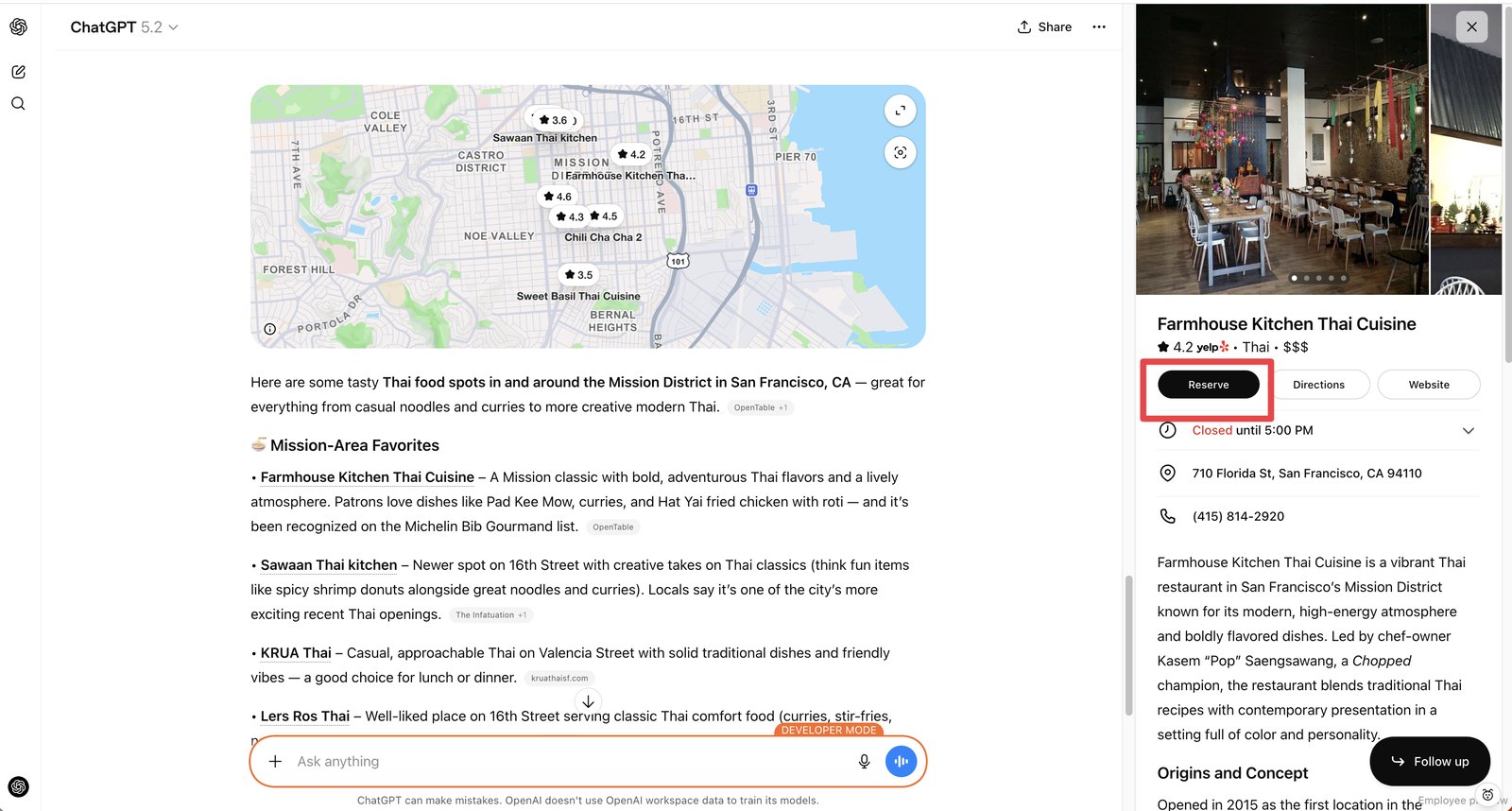
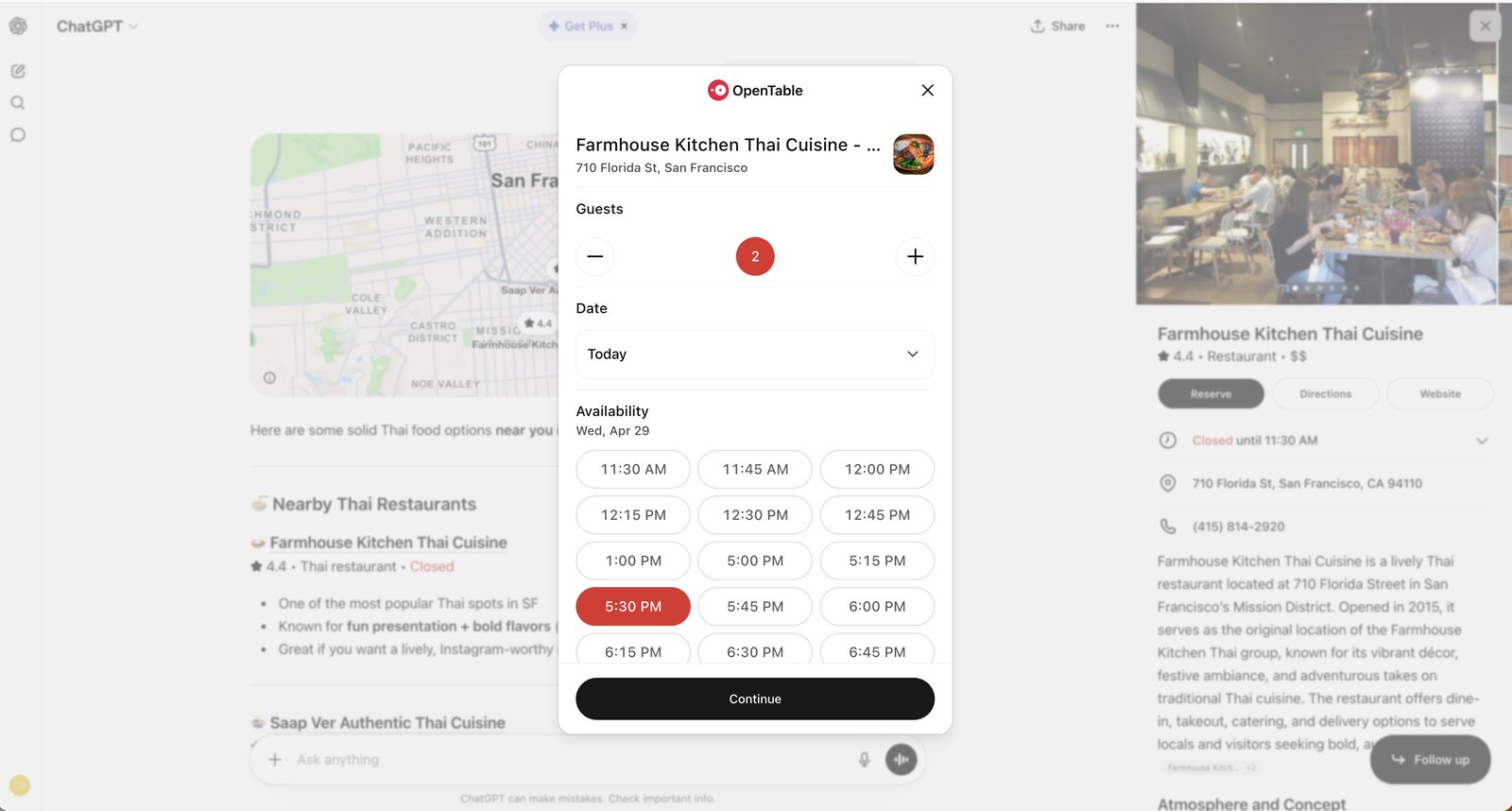
The spec is the public contract all reservation partners build to. OpenTable hasn’t published how its own server is built. OpenAI uses the same feed-then-tool design for other categories: a product checkout spec lets ChatGPT open a seller’s plugin “inline for checkout instead of punching out to an external website”, and a local services spec adds a Get Quote button for tradespeople and other service businesses.
Why a feed and a booking tool
ChatGPT has another way to get things done on the web. Its cloud browser, part of ChatGPT Work on paid plans, can “read web pages, click buttons, enter information into forms, and carry out steps” on websites, and OpenAI lists checking restaurant availability among its example tasks. The same help page says: “When a connected app or plugin can complete the task directly, ChatGPT may use that instead.” Its safety advice starts with “Prefer a connected app or plugin when it supports the task directly”, and it notes that some websites restrict automated browser agents, which can block a task “even if the same website works normally in your own browser.”
Under the reservation spec, the restaurant list comes from the provider’s feed and the booking window from the provider’s own server. OpenTable’s link to ChatGPT also predates this launch. It was one of the first companies to build a ChatGPT plugin when OpenAI opened plugins in March 2023, alongside Expedia, Instacart, KAYAK and others; OpenAI said then that plugins were “designed for calling backend APIs”. OpenTable’s ChatGPT page for restaurants, online since at least early 2025, still describes the company as “an exclusive launch partner” and cites “13 million daily users”, wording that predates the August launch. That launch had three booking providers.
On the call, Steenbergen gave Booking’s view of why AI companies connect to large booking platforms instead of individual businesses. He was talking about Booking.com’s accommodation listings.
“…very expensive for them to connect to 4.7 million properties directly and get all the information about real-time data, pricing, availability, so they can get that through us.”
Ewout Steenbergen, chief financial officer, Booking Holdings, Q3 2026 earnings call
Yelp, the third provider, described its own approach in its launch post: “Through robust APIs, MCP apps, and data partnerships, we’re helping large platforms and emerging AI innovators alike enhance their answers and user experiences.”
OpenTable, Resy and Yelp compared
Coverage is where OpenTable differs from the other two launch providers. OpenAI’s help centre says OpenTable reservations are available globally, while Resy and Yelp are limited to North America.
| Provider | Where it works in ChatGPT | How booking finishes | After booking |
|---|---|---|---|
| OpenTable | Global; more than 70,000 restaurants in its network | In ChatGPT; if the booking needs a credit card, the diner is sent to OpenTable to finish | Confirmation email from the provider; changes and cancellations through the provider |
| Resy | United States | Diner enters details and confirms with Resy in ChatGPT, using Resy’s own account sign-in | Confirmation email from the provider; changes and cancellations through the provider |
| Yelp | United States and Canada; reservations and waitlists at “thousands of top restaurants” | Book a table or join a waitlist without leaving the chat | Yelp says changes are made “directly through Yelp” |
When a provider’s booking form has empty name and email fields, ChatGPT may ask permission to fill them from the diner’s account. The diner can allow it once, allow it for future bookings or type the details themselves. Resy’s sign-in means ChatGPT doesn’t fill those fields for Resy bookings.
The 190,000 in context
OpenTable published broader AI figures in a 26 August product announcement. It said that this year, “LLM integrations drove 17x more seated diners year-over-year”, and that those diners included people who spent on average 20% more than diners from other channels. OpenTable footnotes both figures as based on internal data.
The 17x and 20% figures cover all of OpenTable’s AI assistant and search integrations together: Google Search, Maps and Gemini, ChatGPT, Microsoft Copilot, Perplexity and Amazon’s Alexa+. They aren’t ChatGPT figures. The 190,000 seated diners in September is the only number Booking has given for the OpenAI integration on its own.
The same announcement said OpenTable has more than 200 partners across discovery, demand generation and restaurant operations, and that it has seated 3 million diners through voice AI booking partners. Its own AI Concierge chat tool has more than 500,000 monthly active users, according to the company.
Against OpenTable’s total volume, September’s ChatGPT diners are a small share. The company’s standard description says it helps more than 65,000 restaurants “fill 1.9 billion seats a year”, which averages about 158 million a month. On that basis, 190,000 is roughly 0.12% of a month’s seated diners, or about one in every 830. Booking didn’t give a percentage itself. For Booking.com, Steenbergen said referrals from large language models still made up significantly less than 1% of room nights, though they’d picked up in recent weeks, and he described traffic from chatbots and newer AI agents as still very small overall.
OpenTable’s US plans and pricing page charges restaurants a per-cover fee, from $1 on its Core and Pro plans, for diners who find them through OpenTable’s website, app or affiliate network. The page doesn’t list ChatGPT or other AI assistants as a separate booking source.
Who can use it
OpenAI’s August release note said reservations were “rolling out across all ChatGPT plans”. Its current help article is narrower: reservation search works on eligible consumer plans on web, mobile and desktop when using GPT-5.6 Sol or GPT-5.6 Luna, and “is not available in ChatGPT Work or on Business, Enterprise, or Edu plans.” It isn’t available in voice conversations either. People using ChatGPT through an employer’s Business or Enterprise workspace won’t see the Reserve button there.
Once a table is booked, the reservation belongs to the provider. OpenTable, Resy or Yelp sends the confirmation email, and OpenAI’s help centre says ChatGPT “does not save, modify, cancel, or display existing reservations.” To change or cancel a booking, diners use that email or contact the provider directly.
Discover more from Sulat AI & Tech News
Subscribe to get the latest posts sent to your email.