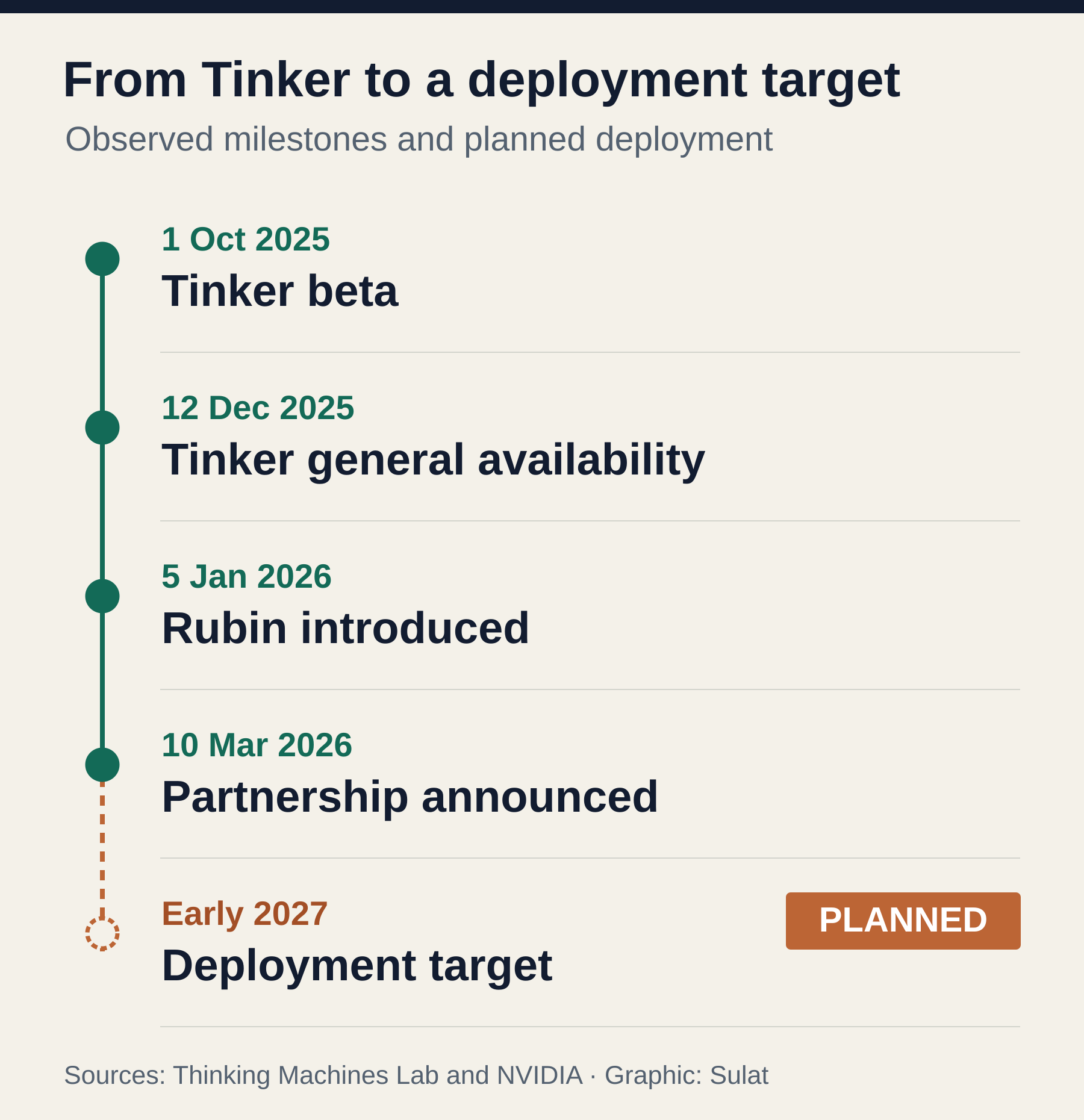
Thinking Machines Lab plans to deploy at least one gigawatt of Nvidia Vera Rubin systems under a multiyear partnership announced on 10 March 2026. Deployment is targeted for early 2027.
Nvidia has invested an undisclosed amount. The planned systems will support frontier-model training and customisable AI platforms. The companies also intend to work together on training and serving systems for Nvidia hardware.
The announcement identifies no site or full-capacity completion date.
Rubin’s rollout comes first
Nvidia introduced the Rubin platform on 5 January, bringing together its Vera CPU, Rubin GPU and networking chips. It said partner products would become available in the second half of 2026. Thinking Machines was already among the AI companies listed as prospective users.
That puts the lab’s early-2027 target after the platform’s announced initial commercial rollout. Nvidia’s January statement that Rubin was in full production referred to the hardware platform, not an operational Thinking Machines installation.
More infrastructure for customisable AI
The lab already offers a way for developers to adapt models. Its Tinker service, launched in October 2025, gives users control over training algorithms and data while the company handles distributed training, scheduling and failure recovery. It supports fine-tuning open-weight models rather than requiring customers to manage their own training clusters.
Tinker became generally available in December, when Thinking Machines removed the waitlist and added vision-input support. The partnership announcement includes no immediate Tinker pricing or availability change.
Hero illustration: Sulat, using the official Thinking Machines and NVIDIA marks. Logos remain the trademarks of their respective owners.
Discover more from Sulat AI & Tech News
Subscribe to get the latest posts sent to your email.