OpenAI agreed on 4 November 2026 to acquire Pierre Computer Company, a developer-tools business.
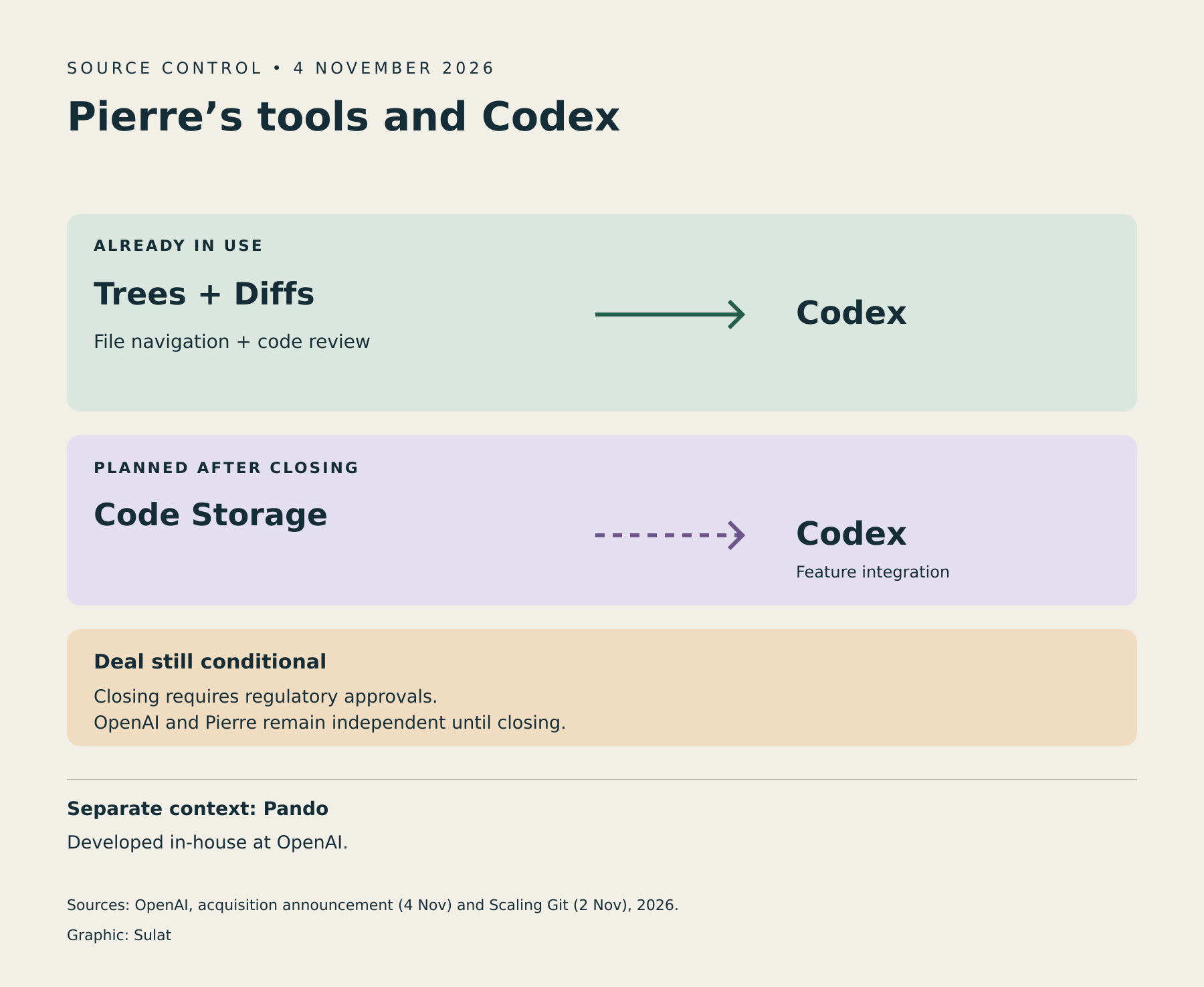
Goodwin, Pierre’s legal adviser on the deal, confirms the agreement and says OpenAI already uses Pierre’s libraries for browsing files, editing code and reviewing changes.
The announcement discloses no price or closing date. Completion remains subject to conditions, including regulatory approvals.
From reviewing changes to storing code
Trees and Diffs already support Codex. OpenAI plans to integrate Code Storage features after closing. Existing customers can keep using the service, and Pierre’s open-source projects will remain so.
The work around an agent’s output
Pierre’s 29 May engineering article explains the problem its CodeView component addresses: reviewing changes spread across many files can strain a browser’s rendering, memory and processing. CodeView uses virtualisation to render the portion of a review near the reader’s position, rather than putting every line on screen at once.
That work matters to code review regardless of who wrote the change. An agent can produce an implementation, tests and supporting files together, leaving a developer with a large set of changes to inspect.
Pierre also released Highlights on 15 September, a syntax highlighter built in WebAssembly Text. It supports streaming code and incremental edits, keeping colours and token markings up to date as content changes. Its published performance comparisons come from Pierre’s own tests.
A separate push to scale Git
Two days before the acquisition announcement, OpenAI described Pando, its internally built Git backend. Pando already supports development in the company’s monorepo, a repository containing many projects. It keeps compatibility with existing Git clients while handling parallel writes to different branches and high volumes of downloads.
OpenAI reports nearly a fivefold reduction in median push latency and nearly a petabyte of Git data delivered per day. Those are company-reported production results. Pando was developed in-house at OpenAI. The engineering post does not announce general public availability.
Hero illustration: Sulat, using the official OpenAI and Pierre marks. Logos remain the trademarks of their respective owners.
Discover more from Sulat AI & Tech News
Subscribe to get the latest posts sent to your email.