OpenCode is advertising $100 of DeepSeek V4.1 Flash usage inside a $10-a-month subscription. That allowance is spread across a month, with separate five-hour and weekly limits. It does not tell you how many useful changes a coding agent will finish.
OpenCode calls the offer Operation Cheepseek Phase 4. Its message was brief: “$100 of usage for DeepSeek V4.1 Flash”. The current OpenCode Go documentation supplies the conditions that make the offer worth comparing with Claude Code, Codex, Cursor and paying DeepSeek directly.
The plans are hard to compare because some pay for model access, while others bundle an editor or a wider subscription. OpenCode Go can even supply models to some of the tools it appears to compete with.
First separate the agent from its model bill
A coding agent is software that can inspect a project, change files and run tools such as tests. The model is the AI system it asks to decide what to do next. A provider runs that model, while a gateway can route requests to providers and handle billing. Buying a gateway subscription is not the same as buying a new coding application.
OpenCode is the application: it offers desktop and terminal interfaces and supports outside providers, including local models. Its MIT licence allows people to inspect, modify and redistribute the software under its terms. OpenCode Go is an optional hosted-model subscription. OpenCode Console, documented at the older Zen URL, also sells metered access: you pay for what you use.
You do not need Go to use OpenCode. Nor must you use the OpenCode application to consume Go. Its docs list validated clients including Claude Code and Codex, subject to session support and compatibility caveats. A session identifier tells the service which requests belong to the same conversation, helping it route work and reuse previously processed input.
Client compatibility does not mean every model swap preserves all the features or behaviour of the tool’s native service.
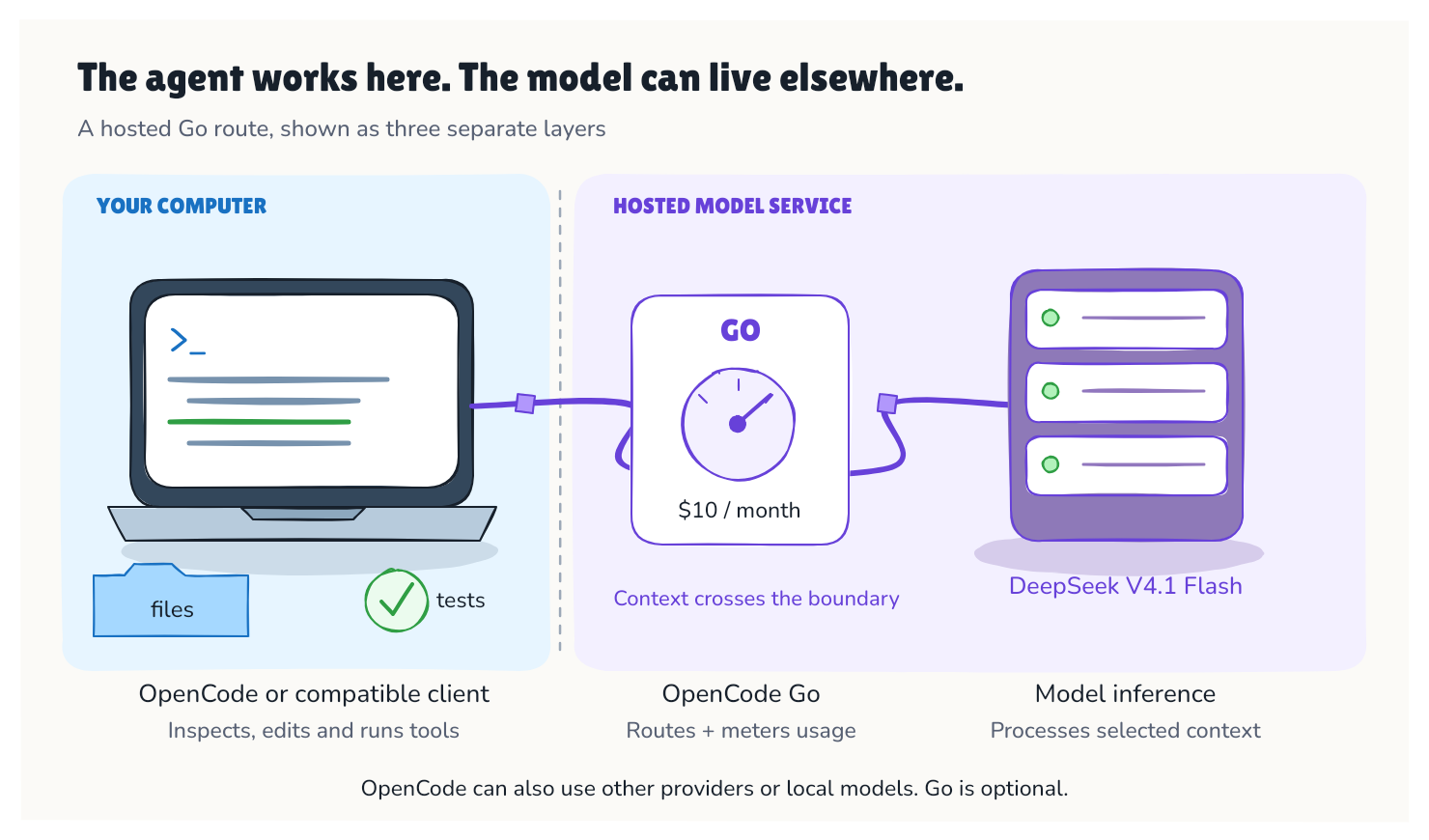
What the $100 buys, and what it does not
Go costs US$10 per month for a single-member workspace. Its DeepSeek V4.1 Flash allowance is US$100 per month, measured using the service’s token prices. Tokens are the fragments of text and other information that models process and generate. The allowance is not cash, a refund entitlement or a transferable balance with DeepSeek.
Each model has its own allowance. A US$100 DeepSeek limit does not become US$100 you can spend on whichever model you like. Go’s current catalogue includes models from several developers, and their limits differ.
The short-window caps are 20% of a model’s monthly allowance every five hours and 50% per week. For DeepSeek on Go, that means US$20 of counted usage per five-hour window and US$50 per week. There is still a US$100 monthly ceiling.
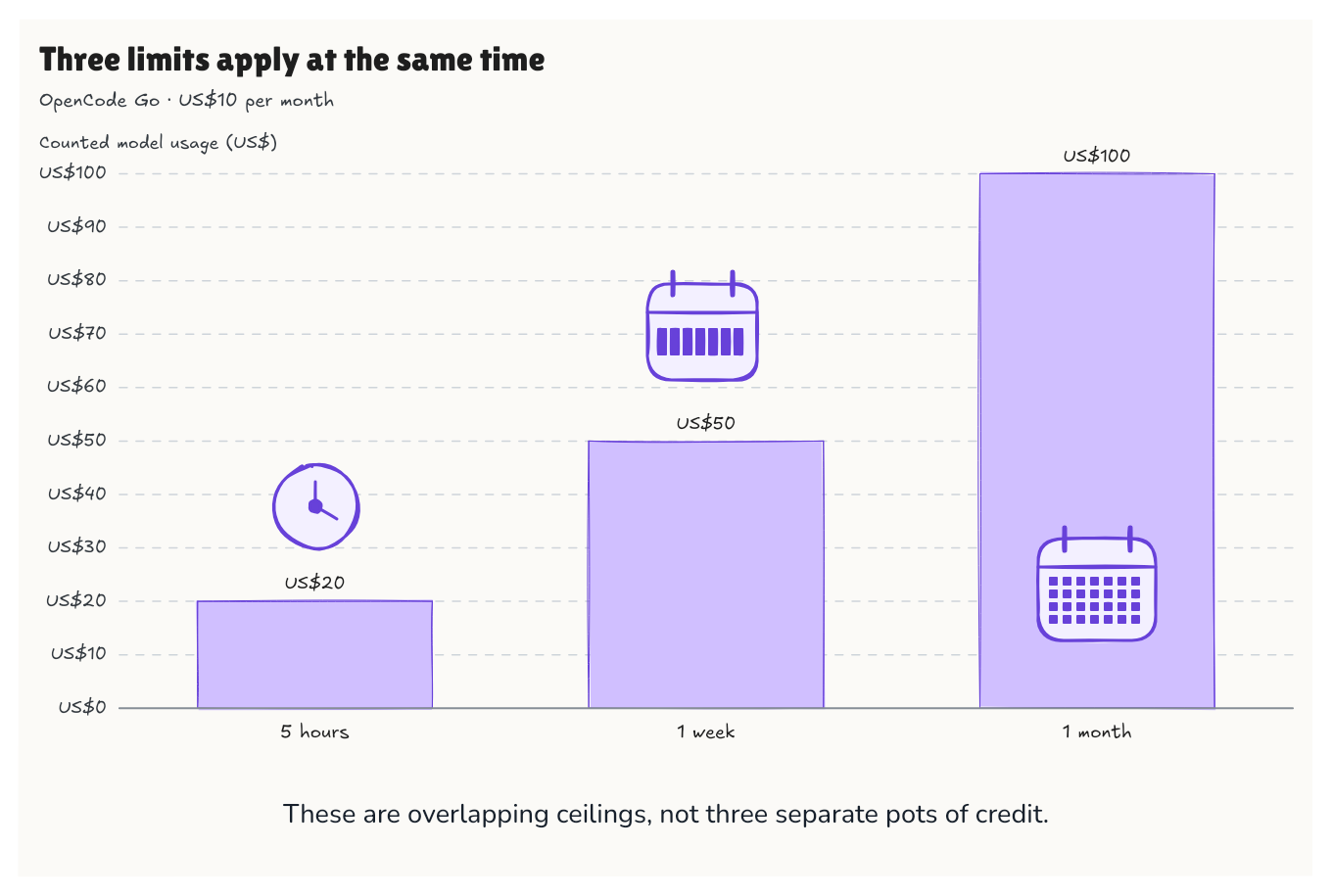
Go Plus costs US$40 a month and lists US$200 of DeepSeek Flash usage. Paying four times the subscription price doubles this particular allowance; some other models receive different increases. Go Teams costs US$20 per member per month and gives each member US$105 for DeepSeek Flash. It is not a shared US$105 pool, and service accounts are not covered.
If Extra Usage is enabled and a Console balance is available, Go can draw on that separate pay-as-you-go balance after the subscription limit is reached. Teams starts with Extra Usage on.
OpenCode says bulk discounts and reserved computing capacity help it provide higher allowances. That is the company’s explanation of the economics, not an independently audited account of its margins or a guarantee that the limits will never change. Its docs explicitly say limits may change.
The same dollar allowance can buy different amounts of text
Go currently counts DeepSeek Flash usage at US$0.30 per million uncached input tokens, US$0.006 per million cached input tokens and US$1.20 per million output tokens during peak hours. Off-peak rates are half those amounts.
Caching means reusing input the service has already processed, such as the unchanged beginning of a long conversation. It can make repeated context much cheaper. It does not mean the model has already solved the next task.
OpenCode lists weekends as off-peak. DeepSeek’s direct service also exempts Chinese public holidays; OpenCode’s Go note does not explicitly repeat that exception, so the documentation does not establish identical holiday treatment.
OpenCode estimates about 216,670 DeepSeek requests per month on Go, but its example assumes just 410 new input tokens, 71,300 cached tokens and 310 output tokens per request. That is a specific, cache-heavy mix, not a promise of 216,670 completed software changes. A single coding task can require many requests, longer answers and repeated failed attempts.
How the alternatives compare
The table compares currently documented individual entry options and a direct-provider route, not equivalent quantities of intelligence. All amounts are US dollars. Taxes and applicable fees can add to the bill; annual discounts are not mixed into monthly prices.
| Route | Price and what is included | Workflow and main boundary |
|---|---|---|
| OpenCode Go | $10/month; $100 monthly DeepSeek Flash allowance, with other model-specific allowances | Hosted models for OpenCode and compatible coding agents; DeepSeek capped at $20 per five hours and $50 per week |
| OpenCode Go Plus | $40/month; $200 monthly DeepSeek Flash allowance | Same service family with higher limits; $40 per five hours and $100 per week for this model |
| DeepSeek directly | No Go subscription; Flash uncached input/output costs $0.15/$0.60 per million off-peak, $0.30/$1.20 peak; cached input $0.003/$0.006 | Metered API access for a compatible client; no Go monthly bundle or Go five-hour allowance. Provider limits still apply |
| Claude Pro with Claude Code | $20/month; Claude Code and the wider Claude subscription | Claude-model workflow with five-hour and weekly limits shared across Claude and Claude Code; not $100 of transferable API credit |
| ChatGPT Plus with Codex | $20/month; expanded Codex usage alongside ChatGPT features | Local and cloud coding workflows; model/task-dependent allowance, possible weekly limits and separately purchased credits |
| Cursor | Plus $8/month, Grok models only; Premium $30/month, with third-party models billed separately | Editor and agent workflow; included usage shared with Grok and refreshed weekly. Premium third-party API-list-price usage is not included in the subscription |
Sources are linked in each row. Model allowances, API rates and completed tasks are different units and cannot be ranked as though they were the same.
Where each approach makes sense
The docs currently require enabling Global in workspace region settings to use DeepSeek. If your organisation permits only European or US processing, that is a purchasing constraint, not a minor setup detail.
Direct DeepSeek access avoids paying a fixed Go subscription when actual usage is low. Its current model page explicitly maps deepseek-flash to DeepSeek-V4.1-Flash-1017 and advertises a one-million-token context window. The context window is how much information fits into a request, not a guarantee that every detail will be used correctly.
Go’s reviewed documentation names DeepSeek V4.1 Flash without pinning a dated model revision or detailing its serving hardware and precision. Its published Flash token rates match the direct provider’s peak and off-peak rates, but that is not proof of an identical endpoint or identical performance.
Claude Code offers an integrated Claude workflow, including local execution and cloud sessions. Anthropic’s current pricing puts Pro at US$20 monthly, Max at US$100 and Ultra at US$200. Fable is paid through usage credits on Pro; Max and Ultra include it within a separate limit. The higher plans’ advertised API credits are not the same thing as ordinary Claude Code subscription usage.
Codex CLI can inspect, edit and run code locally, review changes and hand work to cloud environments. Its Apache 2.0 licence also makes the CLI open source. OpenCode is not uniquely open source among these tools, although its provider-oriented design differs from buying Codex through a ChatGPT subscription.
Codex is available in several ChatGPT plans, including limited Free access; Plus is a paid comparison point, not a prerequisite for trying it. OpenAI’s pricing page says local messages and cloud chats share a Codex allowance, with weekly limits possible. A separate announced change will combine ChatGPT and Codex allowances starting in December. That change is not yet in force.
Cursor is the alternative for people who want the agent inside an editor and value its surrounding workflow. Its current entry plan is US$8 Plus, limited to Grok models. Premium at US$30 adds cloud agents and third-party model access, but those third-party requests cost extra at API list prices.
Open source and local execution do not mean private inference
An open-source client can still send repository contents to an outside model provider. Running commands on your machine is different from keeping every prompt there.
Go’s privacy table says DeepSeek data is not used for training and is retained for zero days under an agreement renewed monthly, currently valid through 30 November 2026. That is a published service commitment, not a privacy audit we performed. It does not establish a US-only or EU-only route.
Nor is it a blanket promise for every Go model. The same table lists 30-day retention for some models and training-enabled Contributor offerings. A free DeepSeek option also exists separately in OpenCode’s Console catalogue, but is advertised for a limited time; free-tier chat models require OpenCode, unlike Go’s compatible-client arrangement.
Anthropic’s Claude Code policy distinguishes consumer and commercial accounts. For consumer plans, data can be used for training when the user allows it; retention is five years with model-improvement sharing and 30 days without it. Commercial use is not trained on by default, with exceptions for opted-in programmes. Those terms are not equivalent to Go’s DeepSeek-specific zero-retention agreement.
OpenAI’s policy lets personal users opt out of training on new Codex tasks through ChatGPT’s model-improvement control. Codex also has a separate Include environments setting for training on full environments. Business and API data are not used for training by default. Cursor’s pricing page says Privacy Mode prevents code data being used for training by Cursor or its model providers; that statement alone is not a universal zero-retention guarantee.
OpenCode’s current v2 documentation says the base policy broadly allows actions, with exceptions such as asking about environment files. It also warns that shell commands run with the host user’s authority.
Retention terms and testing limits
Paras Madan’s 31 October explanation also drew attention to the five-hour cap and the difference between allowance and cash. Some details have since changed: that article recorded the DeepSeek retention agreement through October, while the current official documentation extends it through November.
We have not independently tested Go’s latency, reliability or coding accuracy.
Discover more from Sulat AI & Tech News
Subscribe to get the latest posts sent to your email.