Meta has introduced Muse Ember, a model aimed at the repeated, relatively narrow jobs inside an AI agent: choosing a tool, extracting information, routing a request or handling a coding subtask. Announced on 9 November, it is available through the Meta Model API and Muse Code.
The pitch is economical. An agent that delegates dozens of steps can accumulate a substantial bill even when each step looks small. Ember gives developers another model to assign those steps to, with headline API prices of US$0.10 per million input tokens and US$0.50 per million output tokens.
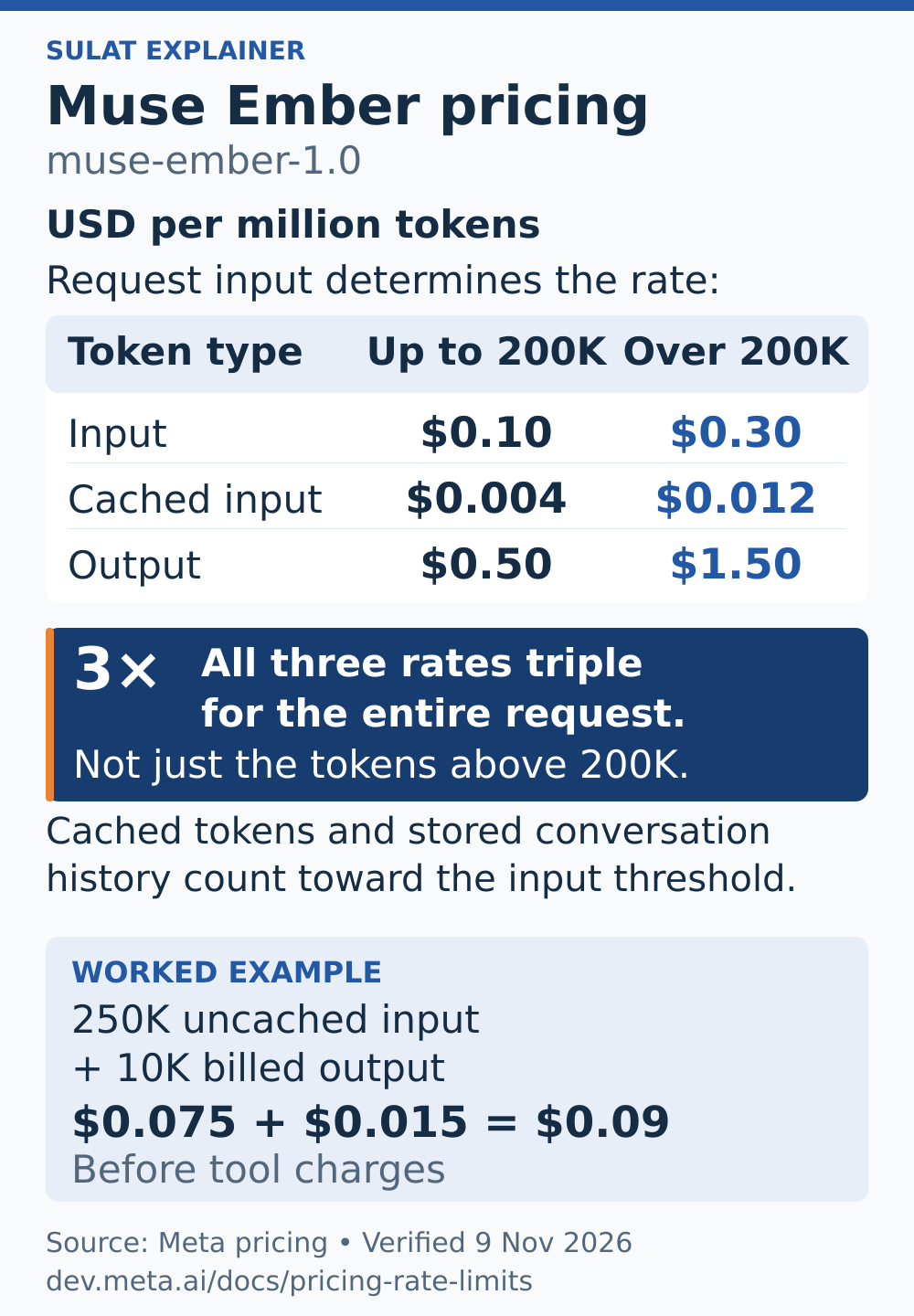
There is a significant qualification in the pricing documentation: once a request exceeds 200K input tokens, all three token rates triple for the entire request. A million-token context window and a low short-context price describe different parts of the product.
The price changes at 200K
Meta’s published rates, in US dollars per million tokens, are:
- Up to 200K input tokens per request: $0.10 for input, $0.004 for cached input and $0.50 for output.
- Above 200K input tokens per request: $0.30 for input, $0.012 for cached input and $1.50 for output.
The threshold includes cached input and the history of a stored conversation. The higher rate applies to the whole request, not just the tokens beyond 200K. For illustration, 250,000 uncached input tokens plus 10,000 billed output tokens would cost $0.09 at the long-context rates, before any tool charges. Applying the headline rates would incorrectly produce $0.03.
That makes context management an economic decision. Passing a complete document collection or an ever-growing conversation into every subtask can move a workload into the higher tier. A shorter, carefully selected context may avoid that jump, provided it still contains what the task needs. Search grounding is separately priced at $2.50 per 1,000 queries.
A small model with a large input allowance
The model documentation lists a 1,048,576-token context window and up to 524,288 output tokens. Ember accepts text, images, audio, video and PDFs, but produces text. It supports tool calling, computer use, structured output and search grounding, with reasoning settings from minimal to max. Max is the default.
Developers can call muse-ember-1.0 through Responses, Chat Completions or Messages endpoints. API access uses Standard mode; there is no Contributor-mode variant. Muse Code includes Ember across its subscription plans and pay-as-you-go access, although long-context requests consume subscription allowances faster.
This does not automatically distribute work between models. Meta’s developer examples leave model selection and context handoffs to the application or agent framework. The application also executes tools requested through a direct API call. Teams still need to decide which tasks Ember can handle reliably and when to escalate.
What the benchmark savings establish
Meta’s published presentation of Artificial Analysis results puts Ember at 35.8 on the Intelligence Index, compared with 36.2 for Claude Haiku 5.5, both using max reasoning. Both round to 36. The associated estimated benchmark costs are $0.136 and $0.411 per task respectively.
That is a close aggregate result at a lower estimated cost, rather than a universal performance lead. Meta’s own table gives Ember 27.2 on FrontierCode 2.0, below Haiku’s 34.9. The cost chart describes Ember’s figures as estimates at proposed pricing. They are not fixed charges for arbitrary production tasks, and the reviewed material does not establish whether those estimates include the documented long-context tier.
The evaluation report also matters. Some comparisons use different agent frameworks. Its computer-use results distinguish partial credit from complete success: Ember’s OSWorld score is 69.5% under partial-credit scoring, but 33.8% under strict full-credit scoring. Sulat could verify Meta’s presentation, but not a corresponding live Ember result on Artificial Analysis’s own listings at the time of review.
Meta calls Ember its smallest model and says it was trained using Muse Wonder Full. The reviewed release material does not disclose a parameter count or establish downloadable weights. Earlier Muse memory and focus improvements described specialised models without naming them; that announcement does not establish that Ember powered those changes.
For a team building agents, the useful test is cost per successfully completed workflow, including retries, longer contexts and escalation to another model. Ember’s published rates make that test inexpensive to start. The result will depend on the work assigned to it.
Featured image: Meta’s headquarters sign, photographed by LPS.1 on 27 March 2022. CC0 1.0. Cropped for display.
Discover more from Sulat AI & Tech News
Subscribe to get the latest posts sent to your email.