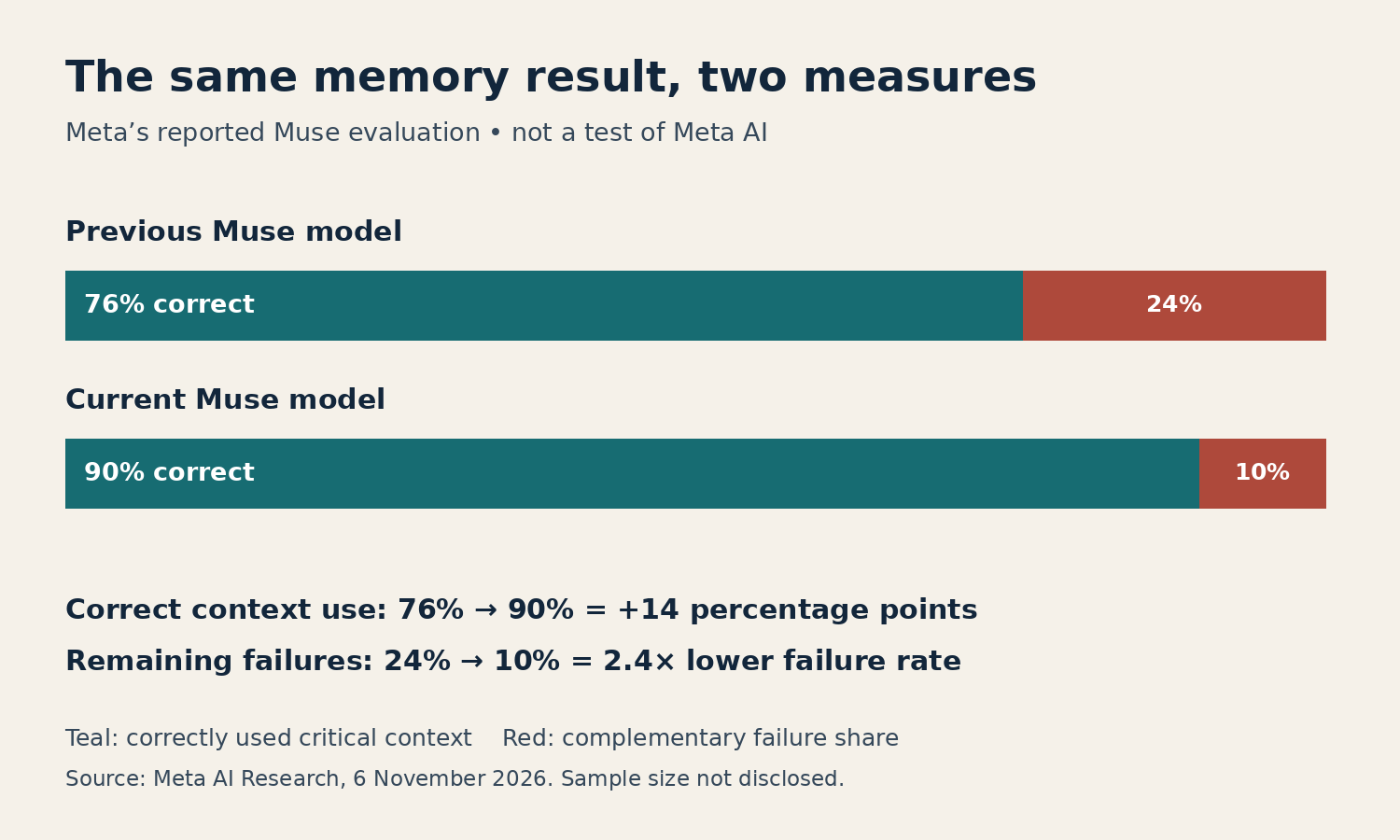
Meta says Muse now uses critical information correctly in 90% of tasks on its memory evaluation, up from 76%. That is the concrete result behind Mark Zuckerberg’s promise that people should have to repeat themselves less often to the company’s AI assistants.
The 6 November announcement brings specialised models trained using Muse Wonder to Muse and Meta AI. They inherit two capabilities Meta calls Active Memory and Active Focus: remembering relevant information over time, and recovering when a task runs into trouble.
This is not an announcement that everyone now gets the full Muse Wonder model. Nor does it establish that Meta AI achieves the same measured improvement as Muse. The distinction matters because the release combines a change to the models behind two products with performance figures published for only one of them.
What changed, and what was already there
Muse is Meta’s personal AI agent: an assistant that can work through tasks using tools, rather than only reply with text. Meta’s September account of its design describes a cloud computer with files and a browser, background tasks and connections to outside services. Meta AI is the company’s broader assistant product. Sharing model capabilities does not mean the two products have identical tools, permissions or privacy rules.
Meta introduced Muse Wonder and Muse Wonder Full on 12 October. Its launch post made Wonder available through the Meta Model API, which lets software call the model, and Muse Code. Wonder Full was available to Muse Code subscribers. It also promised to use Wonder to develop specialised models for everyone using Muse.
The November release follows through on that last step. Meta describes the new systems as specialised versions of existing models, trained using Wonder. It does not give their names, sizes or the training recipe. In particular, the announcement does not establish that they are smaller copies of Wonder, or that users are being routed to Wonder itself.
Training one model using another can mean several things, such as learning from examples the other model produces. The broad technique is often called distillation. Meta describes the variants as “trained using Wonder” without specifying the method.
Memory itself is not new to Meta AI. A January 2025 announcement described remembering details from one-to-one conversations, with an initial US and Canada rollout. Muse’s September design post already described memory that persists across conversations. This update is about improving how models use context and respond to obstacles, not inventing saved preferences.
Zuckerberg says the capabilities are coming to everyone; the research post says they are rolling out. Neither supplies a country-by-country schedule, language list or account-level completion date for this update. The post also announces no new price or developer endpoint for these specialised variants.
Active Memory is about choosing what still matters
An assistant can keep a transcript and still fail to use the right fact. Active Memory is Meta’s name for recognising which earlier information matters now, distinguishing temporary information from lasting preferences and noticing when something has become stale.
Meta’s older example was a user correcting an omelette recommendation by saying they are vegan. Remembering that preference makes the next recipe suggestion more useful. The new claim goes beyond storing a fact: the assistant is meant to reason about when information remains relevant.
Meta has not published enough implementation detail to say how the new models choose, store, retrieve or retire each memory.
It is also different from a model’s context window: the amount of material it can consider in one request. Tokens are the fragments of words and other data used to measure that capacity. The October Wonder model card lists a one-million-token context window for Wonder and Wonder Full. It does not establish the context limit of the newly deployed specialised models. More room for text is not, by itself, proof of better judgement about which text matters.
The numbers need their denominators
Meta’s “2.4x” memory claim sounds larger than the change from 76% to 90% because it measures the remaining failures, not the rise in successful tasks. On the published percentages, the share failing to use critical context falls from 24% to 10%. Divide 24 by 10 and the old failure rate is 2.4 times the new one.
That is a 14-percentage-point increase in correct use of critical context, or about a 58% relative reduction in the complementary failure rate. This measures forgetting on one evaluation, not general intelligence. It does not mean Muse never forgets.
| Measure reported by Meta for Muse | Published result | What it does not establish |
|---|---|---|
| Correct use of critical context | 76% previously; 90% now | Perfect recall, or the same result in Meta AI |
| Personal Superintelligence Index | 38% previously; 47% now | 47% success at everything a person might ask |
| Everyday tasks with unexpected issues | 67% improvement in completion | An absolute completion rate; the baseline is not supplied |
Source: Meta’s 6 November release. These are company-reported evaluations, not Sulat tests or an independent audit of the rollout.
The Personal Superintelligence Index rises nine percentage points, not simply nine per cent. Meta’s Wonder model card defines that index as an internal composite of seven evaluations covering personal and knowledge work. A composite combines different tests into one score. The November post does not provide the new models’ individual component results or enough detail to reconstruct the reported change.
The model card separately describes MemoryBench, an internal test involving long conversations, distracting information and later updates to facts. But the rollout labels its chart “Active Memory Eval”. Without an explicit link between the two, it would be wrong to import MemoryBench’s setup into the 90% claim.
The November post does not disclose the memory evaluation’s sample size, uncertainty range or full task set. Its 67% task-completion improvement also lacks the old and new completion rates. These omissions limit what an outside reader can verify and how confidently the results can be generalised.
Active Focus tackles the point where a plan breaks
Active Focus is the second half of the update. Meta says it trained the models on bottlenecks reflecting the real world so that they can recover, try alternatives or keep working towards a goal. It also says Muse can better handle corrections while a task is running and decide when to work independently or collaborate with the user.
Meta’s October launch described Active Focus as asking for clarification and checking before important actions. The Wonder model card recommends additional safeguards, including human confirmation for actions that cannot easily be undone. These are design requirements around the model, not guarantees supplied by a higher completion score.
For Meta AI, the November post frames the benefit more conversationally: breaking problems into steps, asking better follow-up questions and adapting when someone changes direction. It publishes no separate Meta AI benchmark. The Muse figures should not be presented as measured results for every Meta AI surface.
More memory makes deletion and control matter more
Muse’s privacy policy distinguishes deleting a message from removing a memory.
Deleting a message or disconnecting a service may leave information in Muse’s memories. The policy says users can ask the Forget skill to remove information about particular topics or people, which it will do “to the best of its ability”. Users can ask what Muse remembers or inspect files such as MEMORY.md. The policy also says resetting Muse deletes all Muse data.
These are existing controls, not new deletion guarantees announced with Active Memory. A model deciding that a detail is stale is also not the same as deleting that detail from storage.
The same policy says use of Muse interactions for model training is enabled initially, with a Data controls toggle to change it; changes also apply to previous interactions. It says Muse conversations and cloud-computer data are not shared with Meta ad systems, even when accounts share an Accounts Center. Those are Muse-specific policy commitments. They should not be extended to Meta AI just because both products receive related model improvements.
Muse’s policy says many connections to services can be configured to retrieve information without taking actions.
The 2025 MINJA research showed how malicious interactions could poison stored examples and influence later behaviour in tested agents. The work studied particular memory arrangements, principally a shared memory bank, not this Muse rollout. Muse’s policy instead says each user’s cloud computer is isolated. The paper is evidence of a broader design risk, not evidence that Muse has the demonstrated vulnerability.
What the outside response does, and does not, tell us
WebProNews’ coverage also notes that Meta has not named the specialised models or supplied a timetable for every account. Its report highlights the absence of new memory-review or deletion controls in the release. That is different from saying Muse has no such controls: its existing privacy policy describes them.
On X, TestingCatalog’s reaction described the two score increases as 9% and 14%. Meta’s charts show nine and 14 percentage points.
Discover more from Sulat AI & Tech News
Subscribe to get the latest posts sent to your email.