ElevenLabs has launched Campaign Manager for ElevenAgents, extending its voice-agent platform from individual calls to ongoing outreach. Announced on 9 November, the feature is available now in the Campaigns sidebar and uses customers’ existing agents and phone numbers.
A business supplies contacts through CSV or an API and defines an outcome. The system then tracks attempts, requested callbacks and redirects, carrying information from earlier conversations into subsequent calls. A failed first attempt no longer has to become a separate follow-up task assembled outside the platform.
The supported channels need distinguishing. Phone calls get retries, callbacks and redirects. WhatsApp voice uses a permission request followed by retries and callbacks, while WhatsApp text sends an approved message template without retries. Email and SMS are still forthcoming.
The campaign becomes the unit of work
ElevenLabs says operators can inspect a campaign funnel and a timeline of decisions for each contact, export records, and review cases sent to a needs-attention queue. Its documentation says campaigns replace batch calling.
That changes what an operations team needs to configure. Beyond the words an agent says, the team is setting how often it returns, what it remembers and when it stops. The documentation puts responsibility for consent, scripts and applicable calling rules on the customer.
Three limits matter before launch
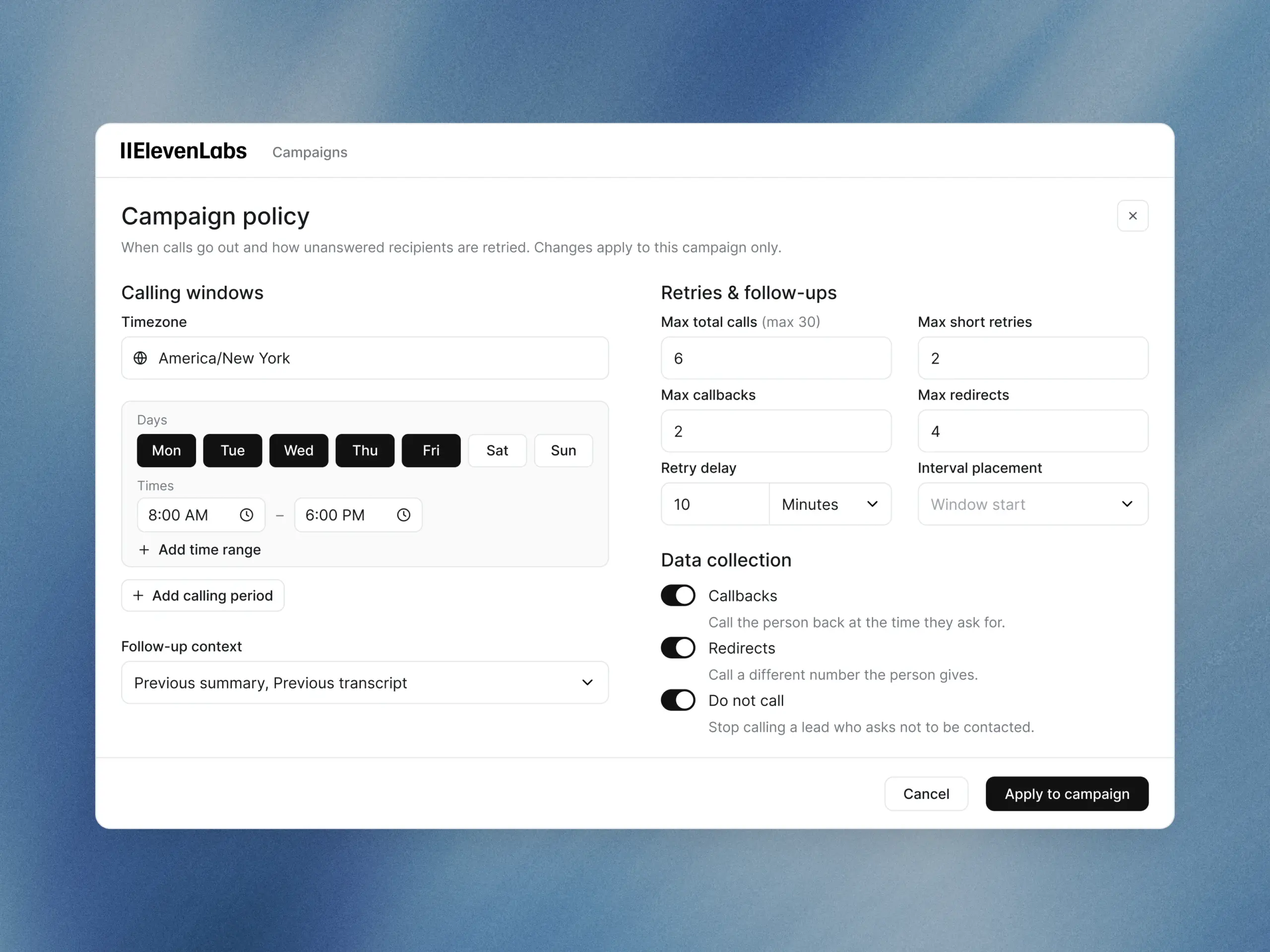
First, a campaign takes a copy of its policy when created. Changing workspace defaults does not update a running campaign. To change its policy, the documentation says to stop it and create another.
Second, a callback explicitly requested for a particular time can fall outside the normal calling window. Each campaign also has one timezone, so geographically mixed contact lists need separating if they require different local hours.
Third, do-not-call state belongs to the campaign. It is not described as a workspace-wide suppression list: the same recipient can exist in multiple campaigns. The agent must also capture the relevant callback, redirect or stop-calling signal for the workflow to act on it.
Follow-up memory has a retention cost
Campaigns are unavailable to agents or workspaces using Zero Retention Mode. ElevenLabs says durable call state and conversation analysis are necessary for follow-up decisions. Teams that selected zero retention therefore cannot simply switch this feature on while keeping that configuration.
The announcement presents customer experiences, rather than a controlled comparison of campaign results. It also does not give a separate Campaign Manager price. The practical launch is an orchestration feature: it reduces the work of connecting one call to the next, while leaving the customer responsible for the contact policy across the whole operation.
Featured image: ElevenLabs official brand artwork, cropped to its ElevenAgents panel. Original artwork retained.
Discover more from Sulat AI & Tech News
Subscribe to get the latest posts sent to your email.