SIQA, the Sonic Intelligence Academy, held the first AI Music Awards at The Mayan in Downtown Los Angeles on Friday 13 November. There were 25 categories, a global livestream and a ballot cast by AI artists, according to SIQA’s event page. It’s the first show of its kind. It isn’t the first time an AI entry has been handed a prize meant for people.
What SIQA built
The 25 awards are headed by AI Song of the Year, AI Artist of the Year, AI Album of the Year and AI Producer of the Year. Ten genre categories cover songs, six cover artists, and two sort entries by how much AI was involved: Best AI-Assisted Song and Best Human+AI Hybrid Song. SIQA also presents its first Visionary Award, Music Business Worldwide reports.
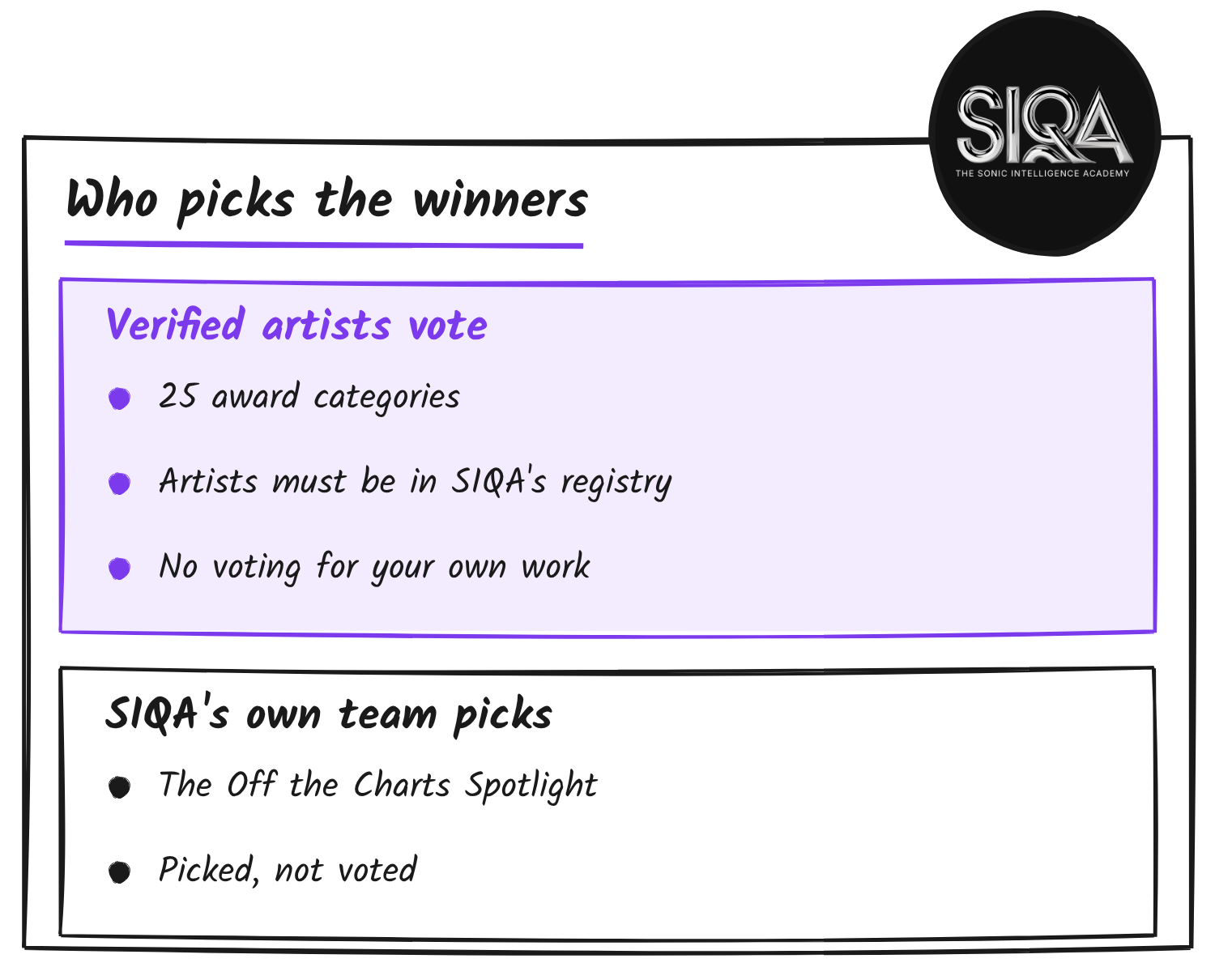
Every nominee is a verified artist in the SIQA Registry, and verified artists vote. They can’t vote for their own work. The one exception is the Off the Charts Spotlight Award, which SIQA’s own team decides. SIQA’s pitch is “No anonymous polls. No black-box algorithms. Peers honoring peers.” The nominees and the electorate come from the same registry.
Getting into the registry is a matter of telling SIQA how a track was made. SIQA calls its process “disclosure, not detection”. Each registered track lands in one of three buckets: Fully AI-Generated, AI-Assisted, or Human + AI Hybrid, EDM.com reports. The same outlet noted that SIQA’s press release says the awards are the first stage where AI artists are “judged as artists, not experiments”, from a company whose own system has a “Fully AI-Generated” label.
The show itself is billed as “hybrid human + AI showcases” with a live band and immersive visuals. Xania Monet, Olivia B. Moore, Chaisen Hale, EJ Rogers and Sheena Taylor were announced as performers, with the creators behind each act “directing the stage”. SIQA hasn’t said how the vocals of acts that exist only as AI-generated recordings would be delivered on the night, Music Business Worldwide notes. Tickets were US$250 for a room capped at 600 seats, and fewer than 100 went on public sale.
Xania Monet is nominated for AI Song of the Year with “How Was I Supposed To Know?”. She’s the act behind the first AI-generated song to enter a Billboard radio airplay chart, created by the songwriter Telisha “Nikki” Jones, and she reportedly signed to Hallwood Media for US$3 million, DJ Mag reports. SIQA is backed by 1517 Fund, and its sponsors include Deepgram, Morrison Foerster and Symphonic.
The earlier prizes
Before there was a stage built only for AI music, there were human contests that AI work walked into. The timeline starts in 2018.
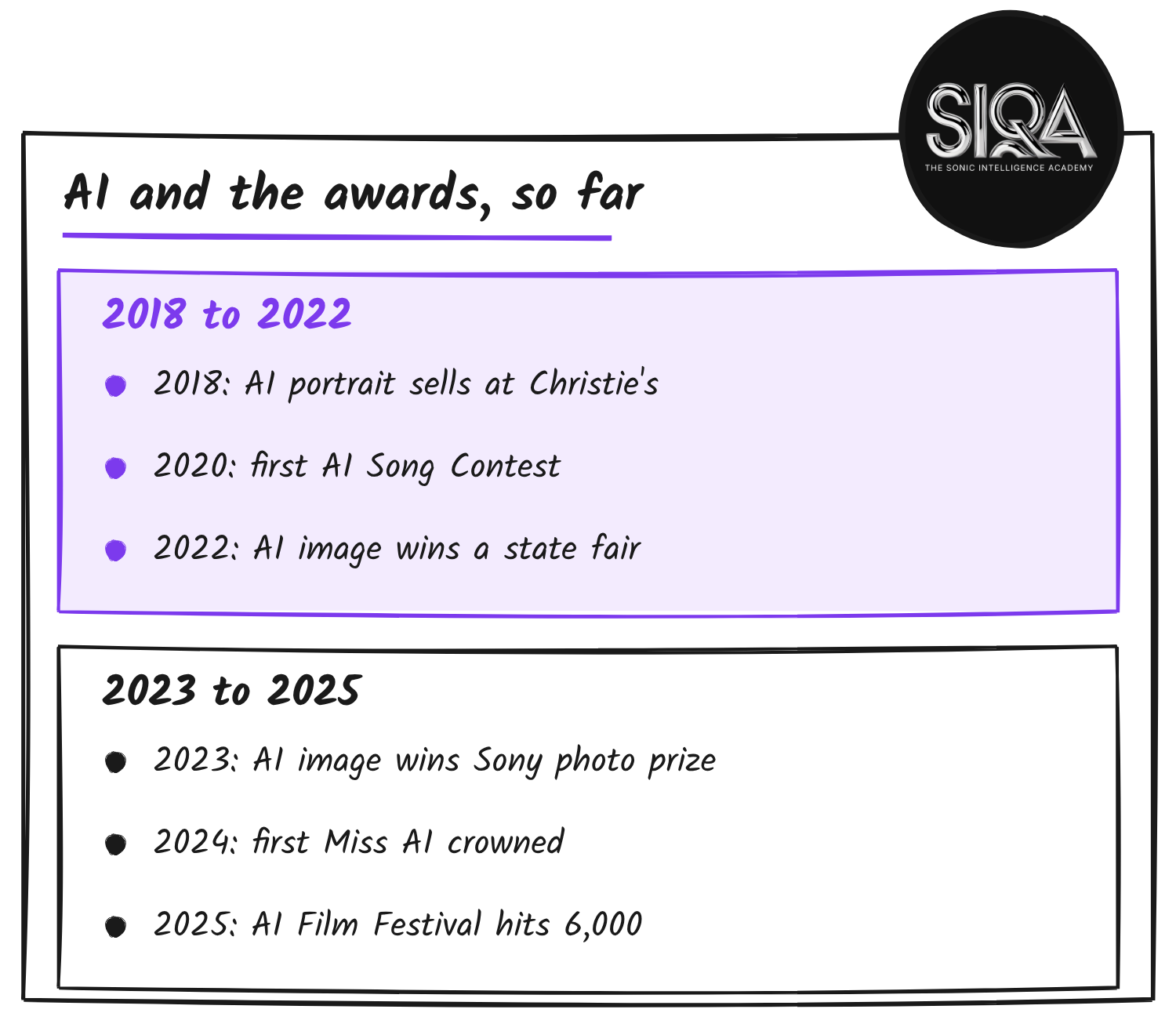
2018, Christie’s. “Edmond de Belamy”, a portrait made by the Paris collective Obvious with a generative adversarial network, sold for US$432,500 including fees on 25 October, against an estimate of US$7,000 to US$10,000. Christie’s calls it the first work made by an algorithm to be offered at auction.
2020, the AI Song Contest. The Dutch broadcaster VPRO ran a Eurovision-style contest on 12 May. Teams had to compose a song of up to three minutes using AI, and the jury gave more points the more AI was used. Thirteen entries competed, and Uncanny Valley from Australia won with “Beautiful the World”.
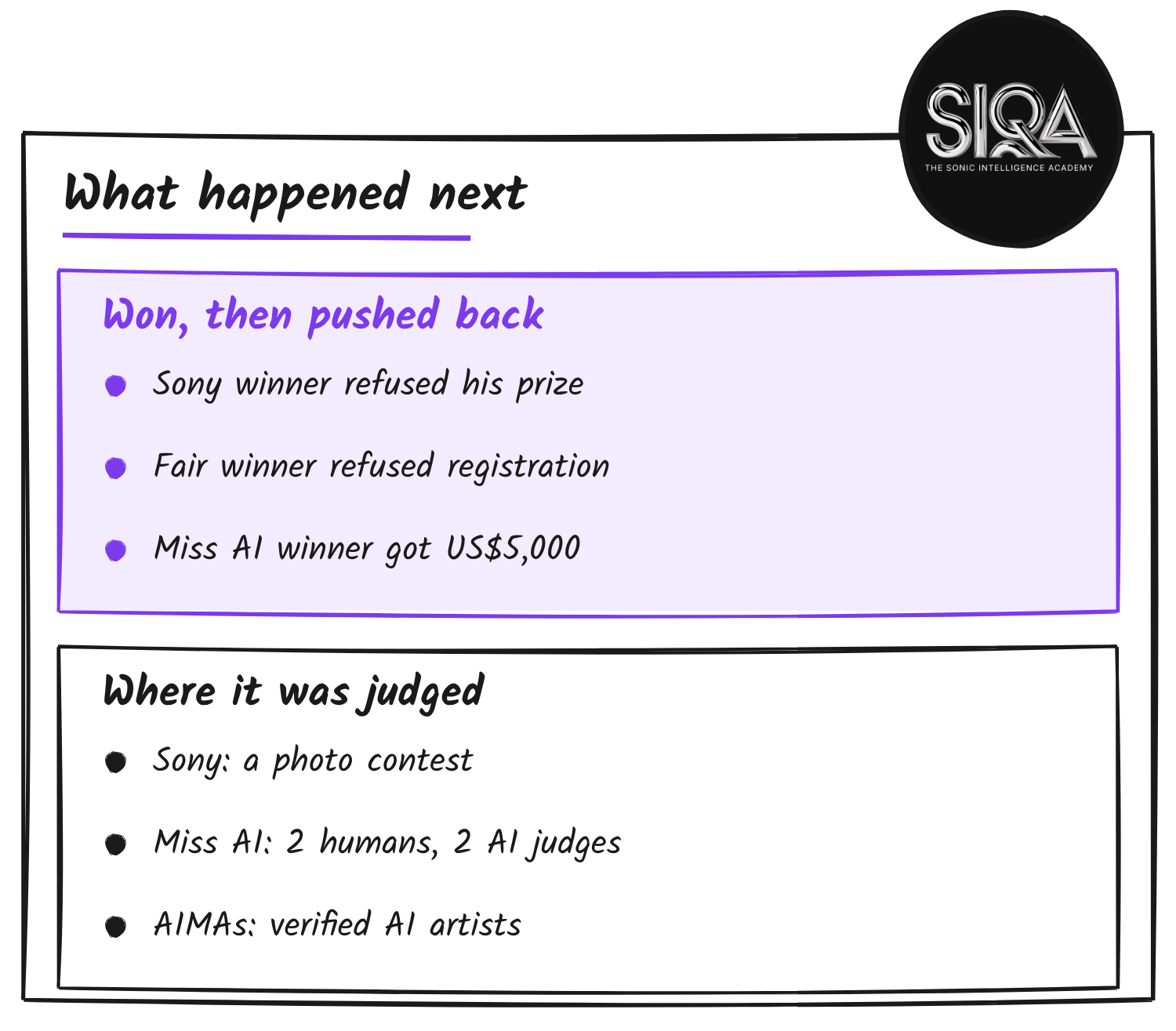
2022, the Colorado State Fair. Jason Allen won first place with “Théâtre D’opéra Spatial”, an image made with Midjourney. The fair’s communications director told Hyperallergic the entry didn’t appear to break the contest’s rules. In September 2023 the US Copyright Office’s review board upheld its refusal to register the work because Allen wouldn’t disclaim the AI-generated content.
2023, the Sony World Photography Awards. Boris Eldagsen’s “Pseudomnesia: The Electrician”, generated with DALL-E 2, was named winner of the Creative open category on 14 March. He refused the prize in April, saying AI images and photography shouldn’t compete against each other. The organisers removed him from the competition, Artnet reports. The prize was US$5,000 and Sony camera gear.
2024, Miss AI. The Fanvue World AI Creator Awards crowned the first Miss AI in July. Kenza Layli, a Moroccan AI persona, beat 1,500 other entries, took US$5,000 plus mentoring and PR support, and was scored on realism, tech and social clout by a panel of two humans and two AI-generated models, Euronews reports. Euronews said the pageant felt like “a dystopian stunt”.
2025, Runway’s AI Film Festival. The third festival ran at Lincoln Center on 5 June with more than 6,000 submissions. Jacob Adler’s “Total Pixel Space” took the Grand Prix, and Deadline reports the festival is backed by Runway, the AI company.
What’s different this time
Eldagsen and Allen entered AI work into contests built for photographers and painters, and the rows that followed were about who belonged in the room. The AIMAs and the AI Film Festival skip that argument by building the room for AI work. The difference with the AIMAs is that the people who judge are also the people being judged, and the registry that decides who counts runs on what artists say about their own tracks.
Discover more from Sulat AI & Tech News
Subscribe to get the latest posts sent to your email.