Mistral sells Vibe, its chat and coding product, in four tiers: a free plan, Pro at US$14.99 a month, Team at US$24.99 per user and a custom Enterprise plan, according to its pricing page. Verified students pay US$5.99 a month for Pro-level access on the Education plan, and Mistral’s subscription docs say every plan includes one monthly allowance shared across Vibe Code, Studio and the API.
The pricing page lists API credits for two plans: US$25.50 a month on Pro and US$15 on Education. It doesn’t list a dollar figure for Vibe Code, the coding agent that runs in the terminal, in editors and on the web. Mistral’s models, funding and compute plans sit behind that price list, and they’re covered below.
What each plan includes
Mistral states Pro’s limits as multiples of the free plan instead of fixed counts: up to 6 times the messages, 5 times the web searches and 40 times the image generations. Pro adds 15GB of document storage, unlimited scheduled tasks and all-day coding in the command line, the editor or on the web. Pro and Team users can opt out of model training. The FAQ puts Flash answers at 150 a day on Pro and 200 a day on Team.
| Plan | Price | API credits per month | Also listed |
|---|---|---|---|
| Free | US$0 | None listed | Limited messages, searches and coding sessions; up to 5 scheduled tasks |
| Education | US$5.99 | US$15 | Pro features for verified students |
| Pro | US$14.99 | US$25.50 | 15GB storage, unlimited scheduled tasks |
| Team | US$24.99 per user | None listed | US$50 monthly minimum, 30GB per user, domain verification, data export |
| Enterprise | Custom | None listed | Custom models, SAML single sign-on, audit logs, private deployments |
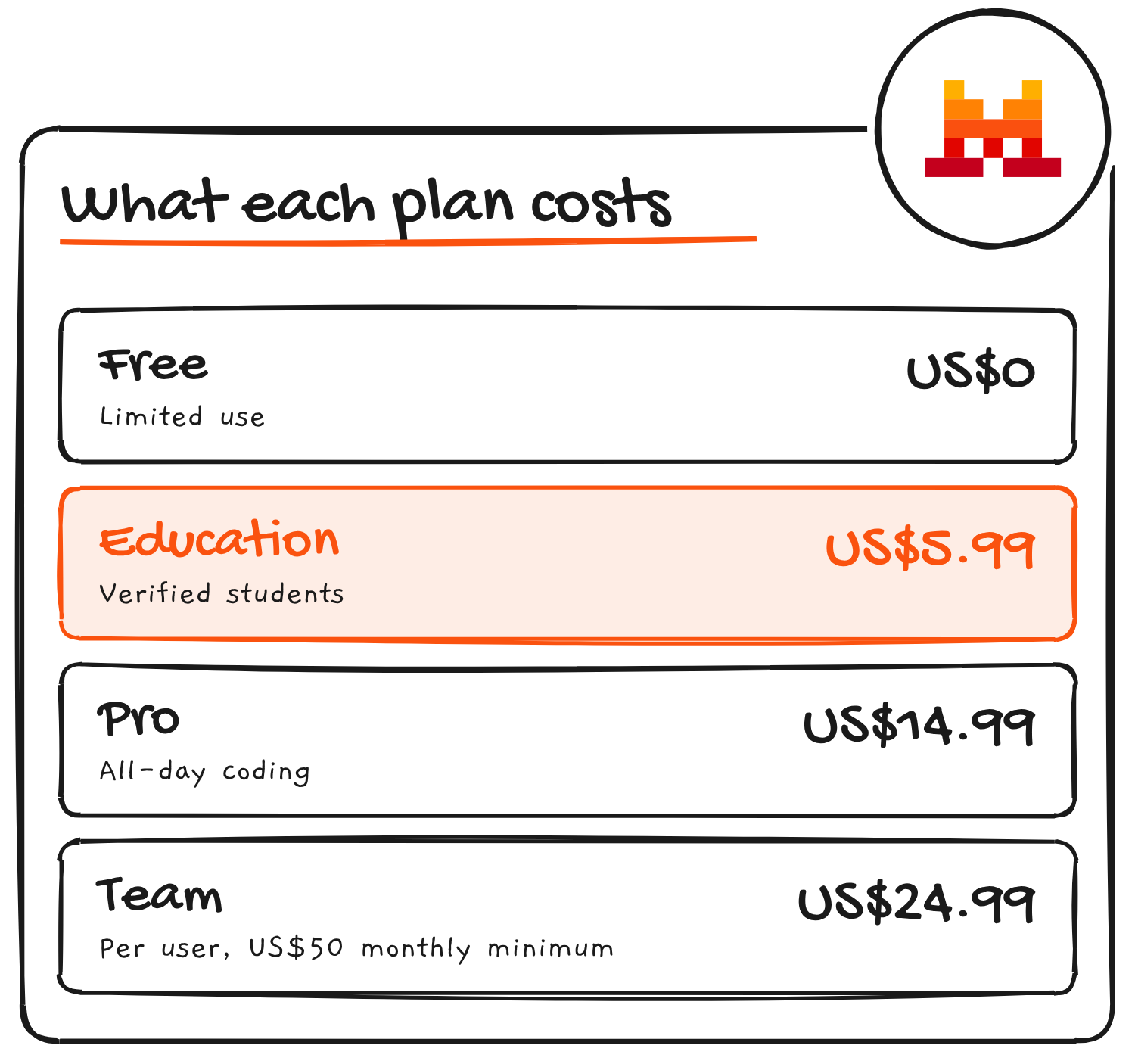
The Education plan is Pro with a discount, per Mistral’s help centre. It requires a verified institutional email address. Gmail, iCloud and Outlook addresses aren’t accepted, and neither are student IDs or enrolment letters.
The French site IA Technologie reports that an Education subscriber’s account page shows US$150 of monthly Vibe Code usage alongside the US$15 of API usage. It took those figures from subscriber screenshots and says it doesn’t hold an Education plan itself. Mistral hasn’t published the US$150 figure.
One usage pool for chat, code and the API
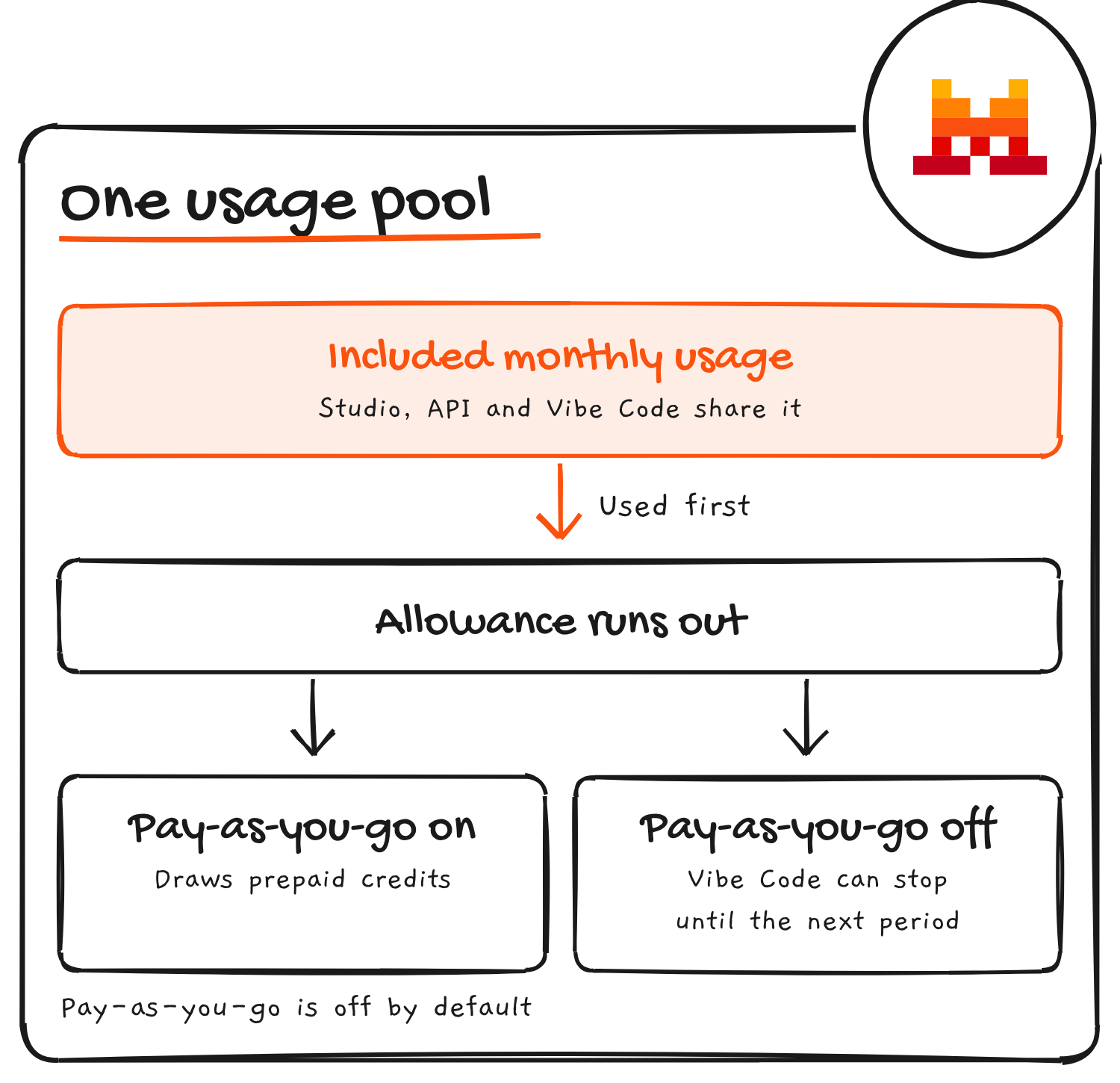
Mistral’s docs say usage is spent from the plan’s included monthly allowance first. When it runs out, what happens depends on pay-as-you-go, a prepaid top-up that is off by default. With it on, further usage draws from prepaid credits, and when the balance reaches zero, requests beyond the allowance fail with HTTP 402. With it off, Vibe Code can stop until the next billing period. The Vibe CLI docs add that some Pro plans bought through Google, Apple, Free Mobile or Orange can’t enable pay-as-you-go at all.
Mistral issues API keys in types: Studio keys for the standard API, Vibe keys for Vibe Code, and legacy Mistral Code keys. Its API key docs say keys aren’t scoped to plans, so each key uses the organisation’s plan and pay-as-you-go settings. The free plan has its own usage budget for trying Vibe and Studio, and the usage docs say it doesn’t include API access; creating API keys on it requires billing activation and pay-as-you-go.
DeepSeek and GLM run on the same infrastructure
Mistral hosts third-party open models next to its own. Its 11 August announcement said the platform would support them, starting with Z.ai’s GLM-5.2, on the same infrastructure, regional controls and service commitments as its own models. The model page for DeepSeek V4.1 Flash 1017, added on 28 October, calls it a third-party open-weight model, hosted by Mistral and “served without Mistral modifications”. It’s in public preview, has a 1 million token context window and a 128,000 token output limit, and takes text and image input.
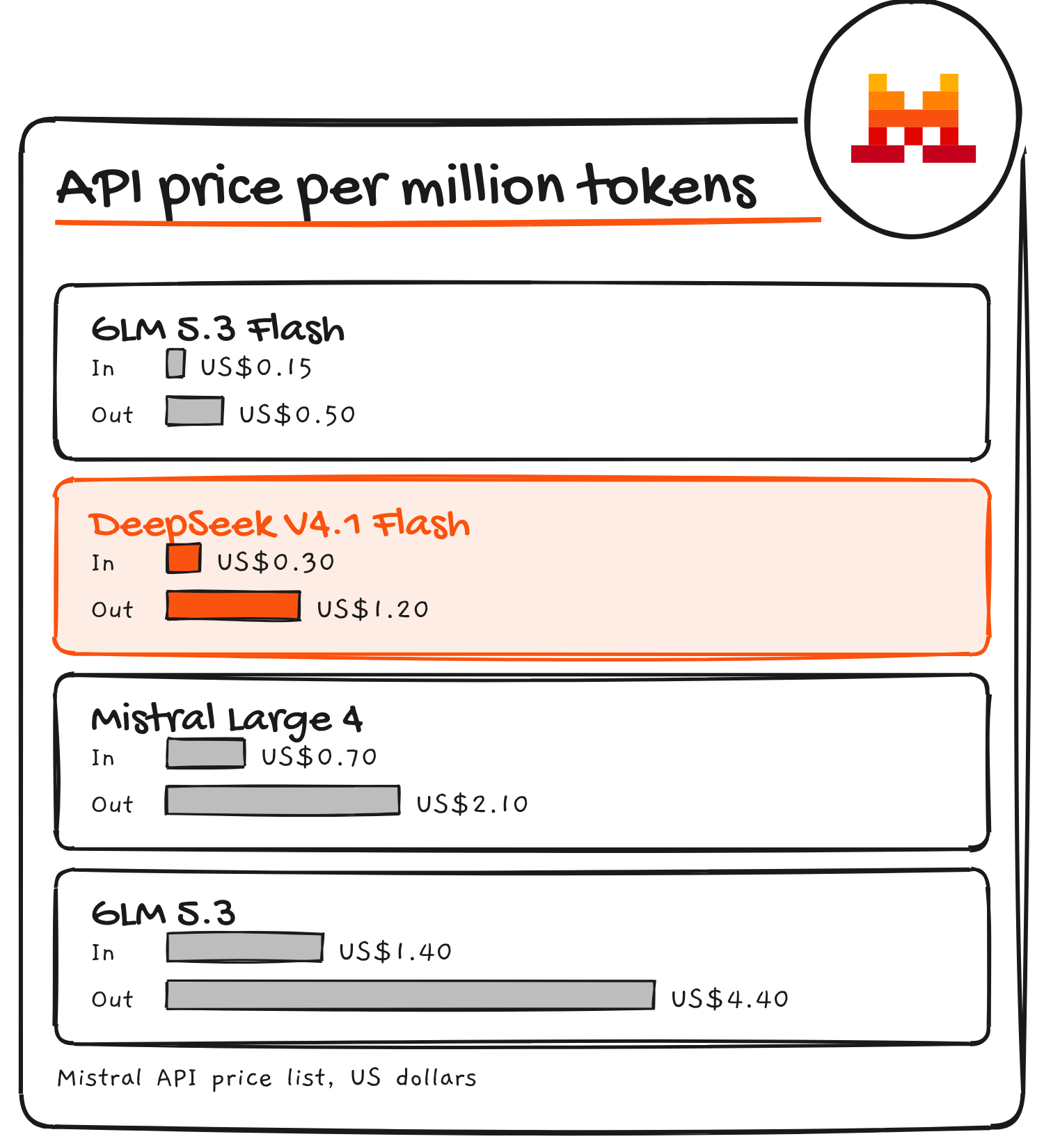
The API price list puts DeepSeek V4.1 Flash at US$0.30 per million input tokens, US$0.007 for cached input and US$1.20 for output. GLM 5.3 Flash costs US$0.15 in and US$0.50 out, and Mistral Large 4 costs US$0.70 in and US$2.10 out. Mistral’s pricing page and subscription docs don’t give a per-model rate for how Vibe Code usage counts against a plan’s allowance.
The funding and compute behind the plans
Mistral announced a €3 billion Series D on 8 September at a post-money valuation of more than €21 billion, the largest equity round by a European technology company, it says. Samsung Electronics led, with the Scaleup Europe Fund, managed by EQT, and existing investor PSG Equity as co-leads. Advent, funds managed by BlackRock and the Grand Duchy of Luxembourg joined as new investors, and NVIDIA, ASML and a16z were among those who returned. Reuters converted the valuation to about US$24 billion and reported Mistral’s chief financial officer saying the company is on track for US$1 billion in annual recurring revenue by the end of the year. Earlier coverage of the round: Mistral raises €3B.
The money feeds compute. Mistral says it trained Mistral Large 4, a model with 1 trillion parameters, on 3,800 NVIDIA Grace Blackwell GPUs in its own data centres in Europe, and that the round funds the roadmap that starts with that model. It released the weights on 29 October, covered in an earlier report on the release. Its compute page targets 1 gigawatt of sovereign AI capacity across the EU by 2030 and lists a Sweden site with EcoDataCenter. VentureBeat reports that a coalition of European enterprises is making multi-year commitments, called European Compute Units, that Mistral says will underwrite 200 megawatts by the end of 2027 and a full gigawatt by 2030.
Europe, partners and where the models run
Mistral pitches itself as the full stack for what it calls sovereign AI: open-weight models, the infrastructure they run on and the products that use them. Its Regional Endpoints, generally available since 11 August, let customers choose whether inference runs in Europe or the US. Mistral says processing stays in the chosen region, subject to limited, safeguarded transfers to sub-processors that may sit outside it. A Priority Tier with an uptime SLA is in public preview.
Recent partnerships span regions. Mistral and HUMAIN announced a collaboration in Saudi Arabia on 24 August that Mistral describes as worth hundreds of millions of euros. Mozilla and Mistral are bringing private, multilingual AI to Firefox Smart Window, announced on 16 September. Mistral is developing AI-native engineering workflows with NVIDIA, announced on 21 October, and it opened a Munich hub for industrial and physics AI on 28 September.
Mistral wrote in its 6 October Large 4 announcement that the reinforcement learning run behind the preview was still in progress and that “much more is coming online in the months ahead” as it scales compute.
Discover more from Sulat AI & Tech News
Subscribe to get the latest posts sent to your email.