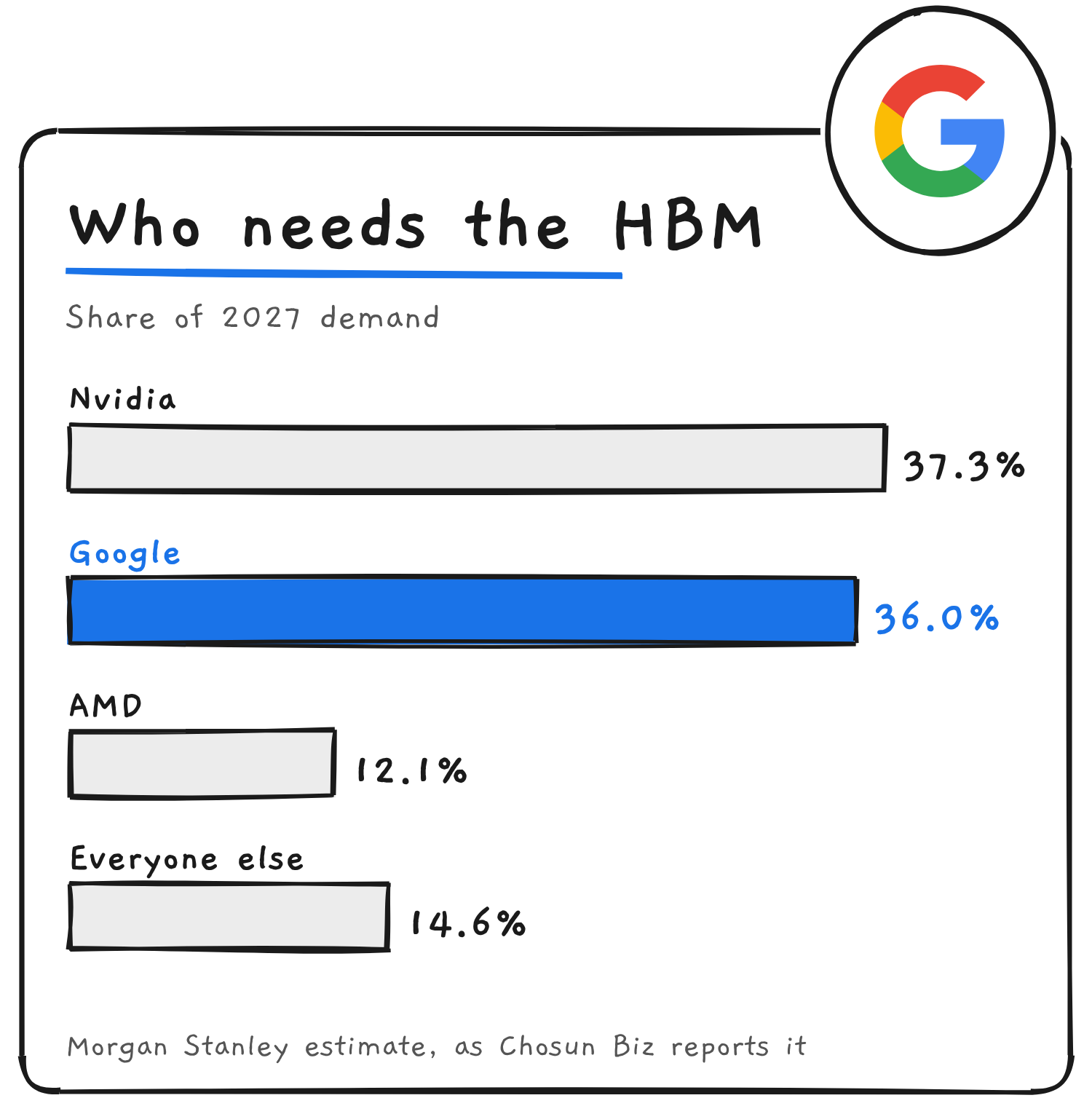
Morgan Stanley estimates Google’s AI chips will account for 36.0% of global high-bandwidth memory (HBM) demand in 2027, 1.3 percentage points behind Nvidia’s 37.3%, Chosun Biz reports. HBM is the stacked memory that sits beside an AI accelerator chip and feeds it data.
Chosun Biz says the bank projects 2027 HBM demand for GPUs and ASICs (custom chips built for one customer’s workloads) at 48.618 billion gigabits (Gb), about 6.077 billion gigabytes. Chosun Biz says that’s roughly 60% more than this year. Nvidia accounts for about 18.125 billion Gb, Google about 17.507 billion Gb and AMD about 5.9 billion Gb, or 12.1%.
Edaily, citing semiconductor industry data, reports the same Nvidia and Google figures and puts the two at 73.3% combined. Add AMD’s 12.1% and the top three buyers take 85.4% of the demand, which leaves 14.6% for every other buyer.
How Google’s share breaks down
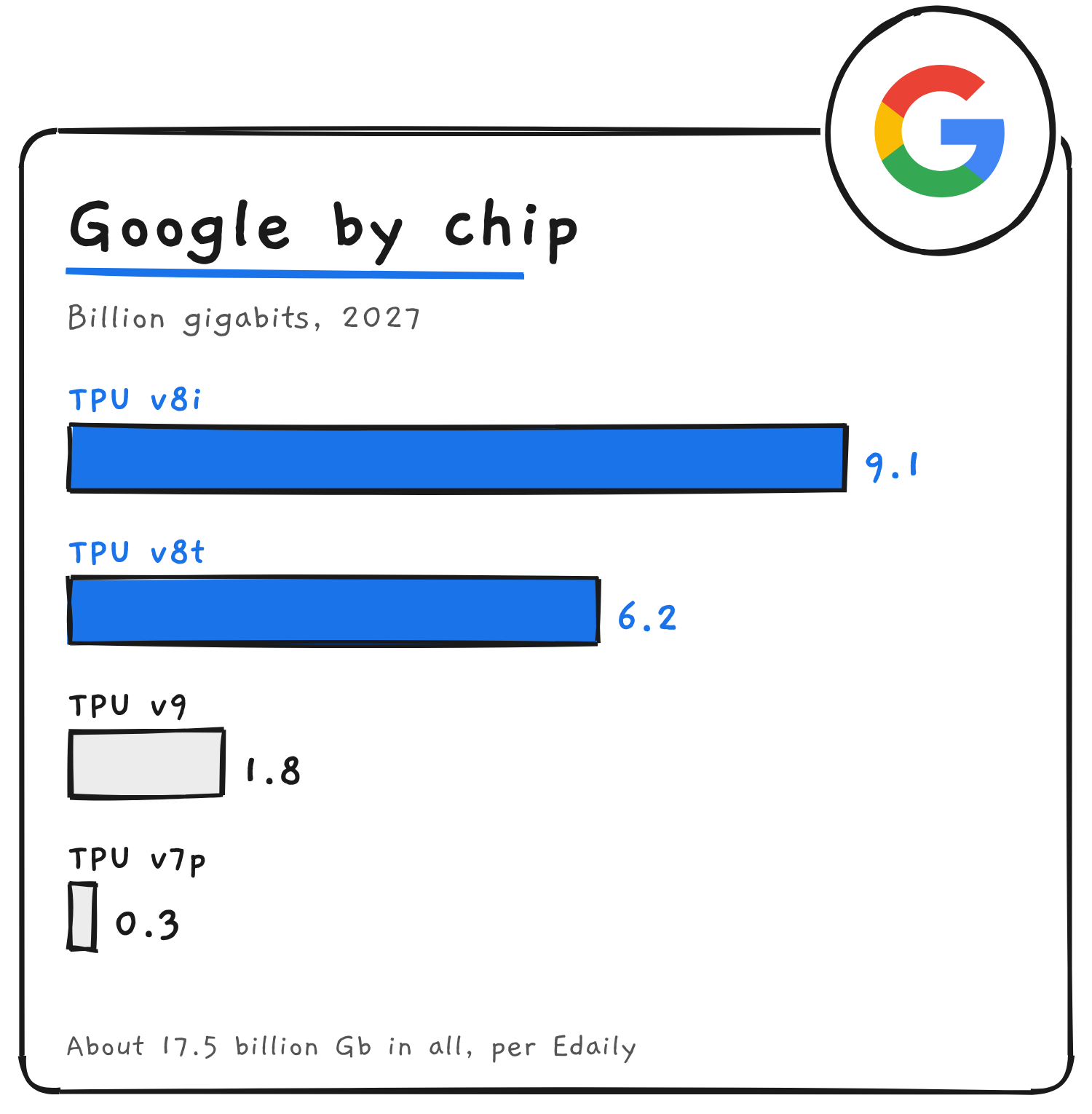
Edaily splits Google’s demand by chip. The TPU v8i, designed with MediaTek, accounts for about 9.1 billion Gb and the TPU v8t, designed with Broadcom, for about 6.2 billion Gb. The TPU v9 adds about 1.8 billion Gb and the v7p about 300 million Gb. Edaily says the v8i and v8t use 12-layer HBM3E memory, and the v9 will use 12-layer HBM4E.
Both reports are from early August. Google announced two more eighth-generation chips, the TPU 8tx and TPU 8i Max, on 9 November. Google says the 8i Max has double the compute, double the SRAM and double the HBM bandwidth of the TPU 8i.
Who supplies the memory
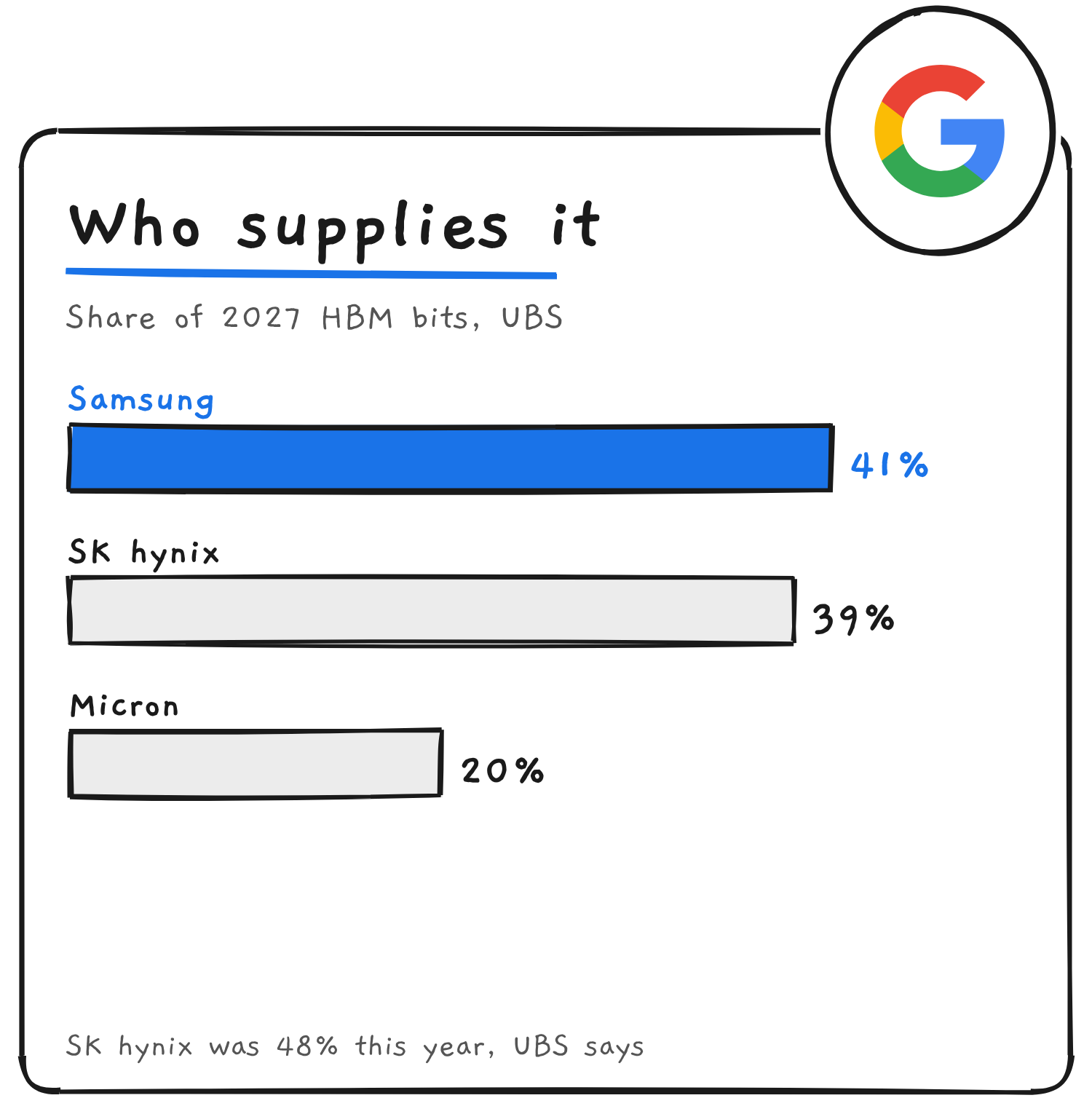
Edaily also reports a UBS client note on the suppliers. UBS expects Samsung Electronics to take 41% of HBM bit shipments in 2027, SK hynix 39% and Micron 20%. SK hynix held 48% this year, according to the same note. Edaily says Samsung, SK hynix and Micron are all named as possible suppliers for Google’s TPUs, and the split of Google’s volume between them hasn’t been confirmed.
For Nvidia’s Rubin accelerator, Edaily says industry estimates put SK hynix at 60% to 70% of the initial HBM4 shipments and Samsung at 25% to 30%.
What the figures cover
The numbers are Morgan Stanley’s estimates of how much HBM each buyer’s chips will need, measured in bits. They aren’t orders, supply contracts or revenue, and neither report links the Morgan Stanley note.
Gate News reported a different split on 11 August: Nvidia 36%, Google 35% and AMD 16%. Those shares don’t match the gigabit totals that Chosun Biz and Edaily give, which work out to 37.3%, 36.0% and 12.1%.
Discover more from Sulat AI & Tech News
Subscribe to get the latest posts sent to your email.