Red Hat is working on a way to let QEMU virtual machines keep their idle memory on SSDs instead of RAM. Peter Xu, a Red Hat virtualization engineer, gave a talk called “QEMU memory tiering” at KVM Forum 2026 in Vancouver on 12 November. The abstract says the work started because “memory is getting much more expensive nowadays due to AI deployments”.
The goal is to save RAM without slowing the VM down. Xu’s abstract names SSDs and CXL memory as the cheaper tiers, and Phoronix reported on 14 November that the aim is to put NVMe SSDs to work in more QEMU scenarios.
Let Linux do the tiering
Xu’s starting point is that Linux already has a two-tier memory system: swap. It has run for decades, and per-VM memory cgroups (memcg) give each VM its own limit. QEMU can hand all the tiering logic to the kernel and pick up whatever Linux adds next, such as MGLRU, the kernel’s multi-generational page reclaim.

Live migration is where it breaks
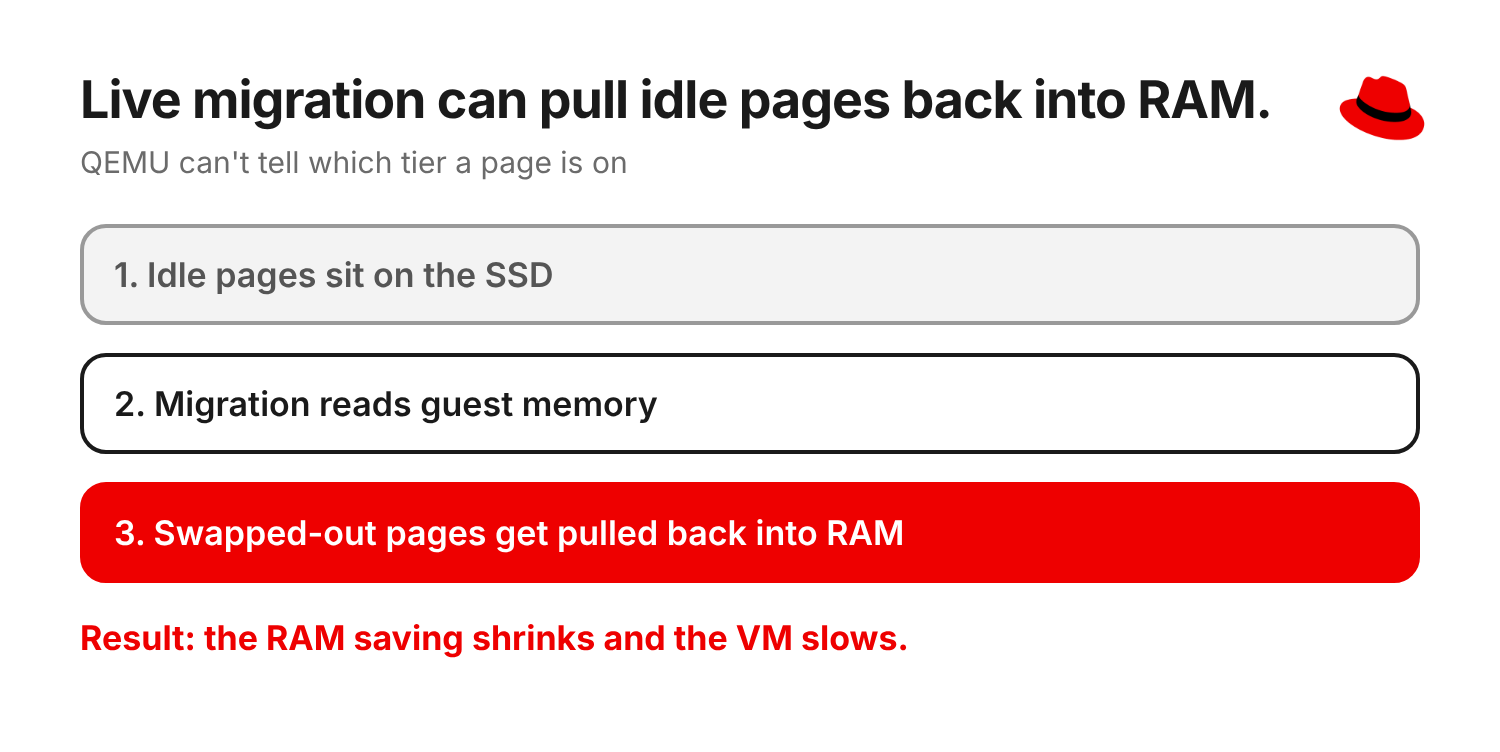
The catch is that QEMU doesn’t know which tier a page is on. The abstract says some operations, live migration in particular, “can cause severe performance issues” for that reason. Migration reads guest memory to send it to the destination host, and reading a swapped-out page makes the kernel bring it back into RAM. That undoes the saving and puts load on the SSD at the worst moment.
The abstract says Xu would share numbers showing the slowdown. The talk page doesn’t publish them.
Three ways to fix it
Xu’s talk compares three approaches:
- A new system call. Linux would gain a way for userspace to access memory in a tier-aware way.
- QEMU does the tiering itself. Linux already has idle page tracking for hotness and userfaultfd for handling page access, so QEMU could manage both tiers. The abstract lists the costs: duplicated work, because both the app and the kernel track hotness, lower efficiency, and conflicts with other features.
- Existing kernel interfaces.
mincore(), which reports which pages of a range are in memory, plusMADV_PAGEOUT, which asks the kernel to reclaim a range. Xu says this cuts the migration problem “to a large extent” with small QEMU changes. Phoronix calls it the lead contender and says it needs no kernel changes.

One small kernel change left
Xu says the existing-interfaces route still leaves one problem: swap overshoot, caused by MADV_PAGEOUT reclaiming pages asynchronously. His fix is a “relatively small kernel change”, a new flag called MADV_PAGEOUT_FULL that he says “almost fixed the whole problem”. The talk page says numbers will be provided for the final approach, and it links no patch for the flag.
The talk ran from 3:45 pm to 4:15 pm on 12 November in the Harbour B room, and the KVM Forum schedule lists Xu as a Red Hat engineer working on QEMU, KVM and Linux. The abstract ends with an open call: “comments will be more than welcomed”.
Discover more from Sulat AI & Tech News
Subscribe to get the latest posts sent to your email.