Cap, the open-source screen recorder, has opened the video pipeline behind its app to outside developers as Cap Infra, a video and speech API. Cap says uploading and encoding are free, storage starts at US$0.85 per 1,000 minutes a month and delivery costs US$0.95 per 1,000 minutes.
Cap founder Richie McIlroy announced it in a launch post on 13 November. “The infrastructure we built to run Cap is now open to everyone,” the post says. Cap’s account shared the link, and McIlroy called it “the infra behind Cap” that is “now for everyone”.
Introducing Cap Infra
— Cap (@cap) November 13, 2026
Cheap, fast & reliable video infrastructure https://t.co/XGGpKzxGCm
Really proud of this one 🥹
— Richie (@richiemcilroy) November 13, 2026
The infra behind Cap… now for everyone.
What Cap Infra does
Every Cap recording is uploaded, encoded on Cap’s own GPU farm, transcribed and served from a CDN, usually within seconds of pressing stop, Cap says. Cap Infra gives developers the same path through a REST API. A developer uploads a video and gets back adaptive HLS streaming (the format that lets a player switch quality as a viewer’s connection changes) in up to five renditions from 360p to 4K, never above the source resolution. The upload also returns an MP4, a poster frame, a hosted player page and an iframe embed.
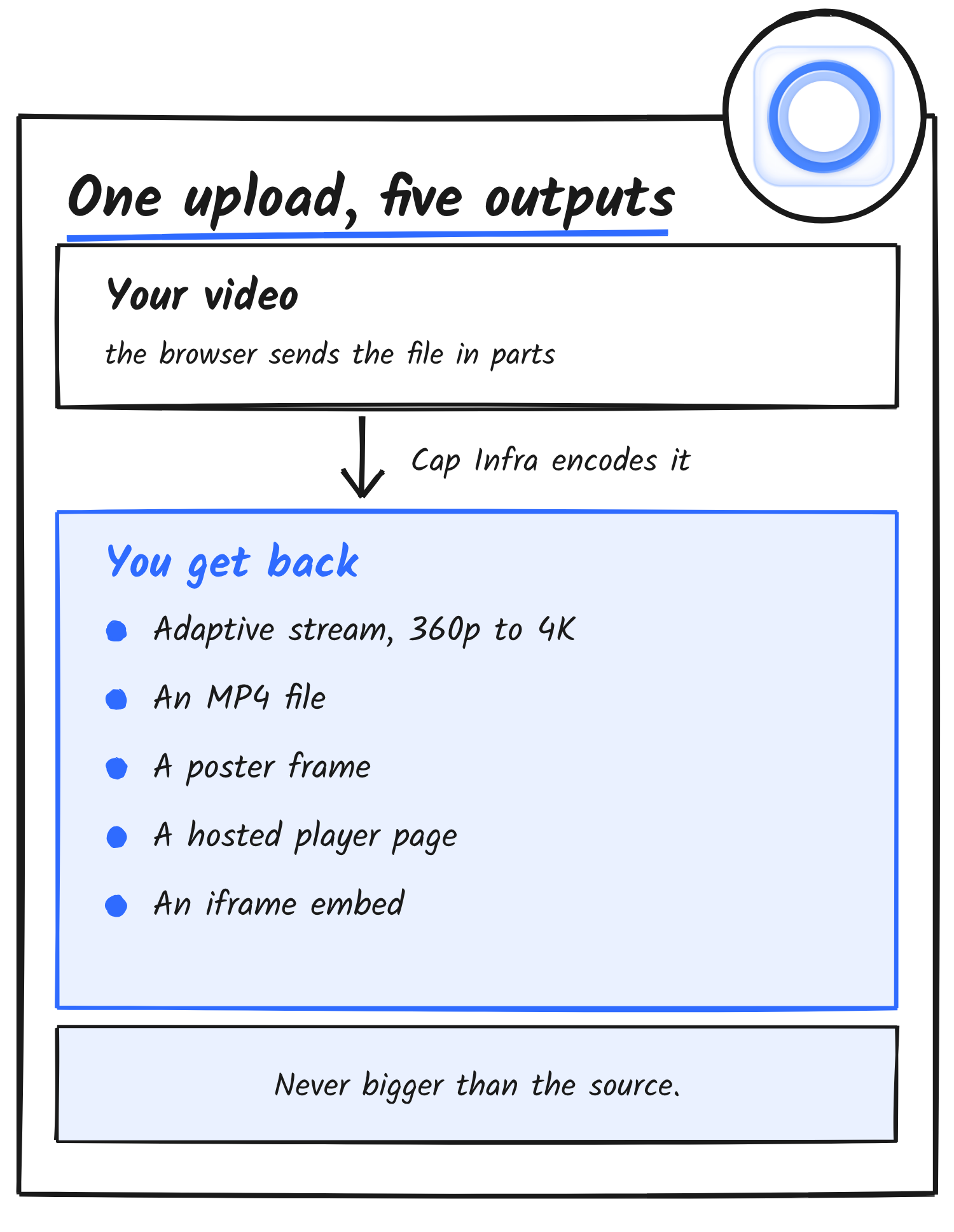
Speech to text works on its own. A developer sends a public URL or uploads an audio or video file and gets a transcript with word and segment timings. The video doesn’t have to be hosted on Cap. Cap says an hour of audio takes under 24 seconds on its GPUs in its own tests.
How an upload works
A developer’s server calls POST /api/developer/v1/uploads with a secret key that starts with csk_. Cap’s getting-started docs say the key stays on the server. Cap returns a video ID and an upload token that starts with cut_ and works for one hour by default. The browser sends the file in parts straight to storage with that token, and the server polls a status endpoint until the video is ready or errored.
Two options limit what a token can do. corsOrigin restricts uploads to one site’s origin, and maxBytes caps the file size. Without maxBytes, the docs say, a token can upload a file of up to 36 GB into storage the developer pays for.
Videos are encoded up to 1080p by default, and 1440p and 4K are set per upload. A ready video has HLS and MP4 URLs that need no API key, so any player can use them. A secret key allows 300 requests a minute across every endpoint, and an over-limit call gets a 429 reply with a Retry-After header.
Cap says a video plays as soon as its first output is done: under five seconds after the upload finishes for an hour of 4K, with every rendition following in about two minutes. Those are figures from Cap’s own tests.
Cap Infra also has a hosted MCP server at cap.so/api/developer/mcp that takes the same secret key. Its tools create and complete uploads, wait for a video, list and delete videos, create and read transcripts, and check usage. The docs show setup for Claude Code, Cursor and Codex, and Cap’s Infra page offers a single prompt that a coding agent can follow to wire up uploads and playback.
What it costs
Cap charges for stored video, delivered video and transcription. Uploading, encoding and the hosted player are free.
| Meter | Up to 1080p | 1440p | 4K |
|---|---|---|---|
| Uploading and encoding | Free | Free | Free |
| Storage, per 1,000 minutes a month | US$0.85 | US$1.45 | US$2.80 |
| Delivery, per 1,000 delivered minutes | US$0.95 | US$0.95 | US$0.95 |
| Speech to text, per audio hour | US$0.10 | US$0.10 | US$0.10 |
| Player page and iframe embed | Included | Included | Included |
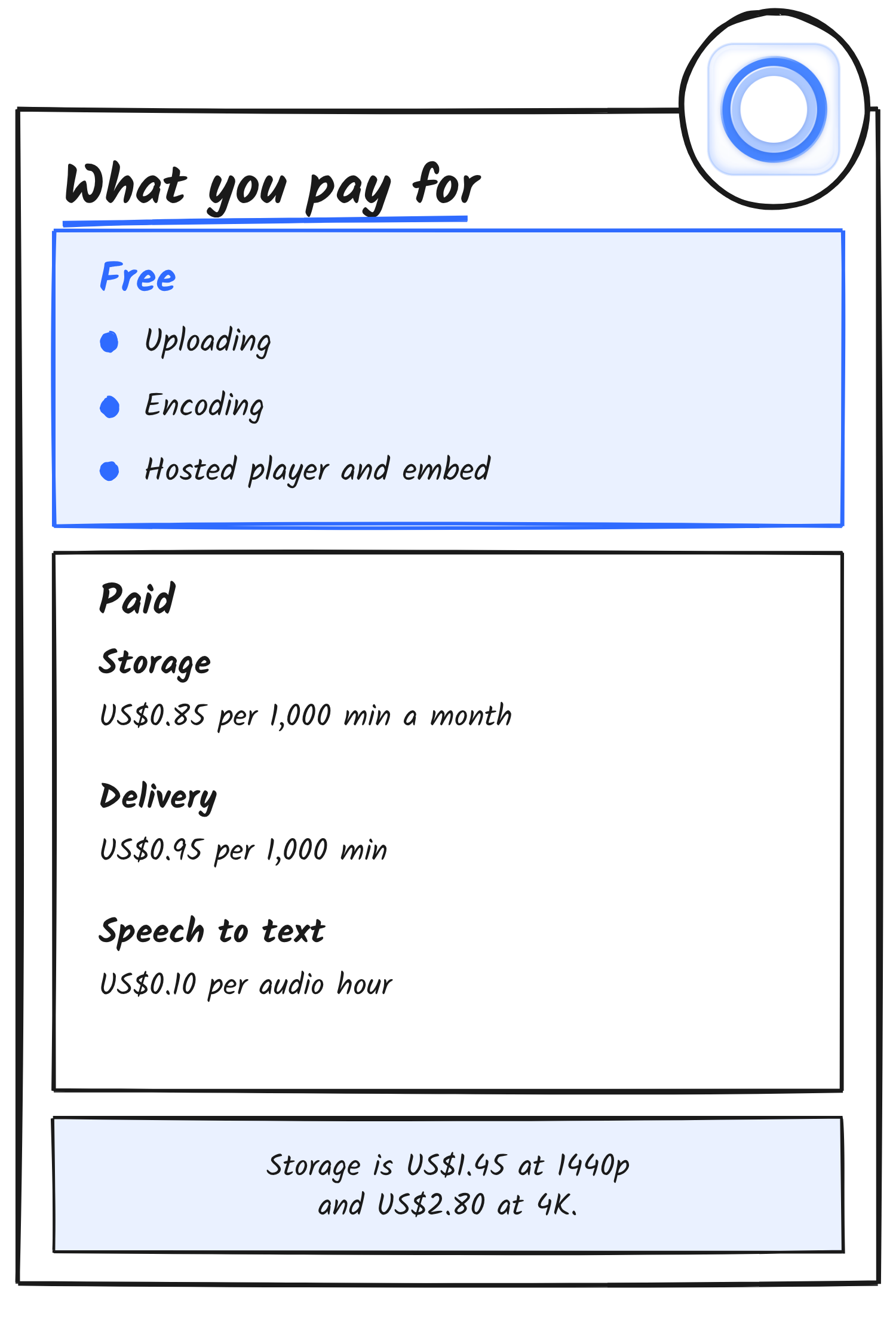
Billing runs on prepaid credit. Each app has its own balance, auto top-up is optional, and there are no seats or plans. An app with no credit can’t upload. A video is charged one month of storage when it first becomes ready, then daily after that month. The docs give an example: a 10-minute 1080p video costs US$0.0085 when it becomes ready, then US$0.00028 a day after its first month.
Delivery is billed from 14 November 2026, the launch post says, and a delivered minute is a minute of video that viewers’ players download. Cap’s Infra page lists storage and speech to text as its two charges and doesn’t list delivery. Cap Pro, the paid tier of the Cap app, includes US$5 of Cap Infra credit a month, which Cap says covers 5,800 minutes stored at 1080p for 30 days or 50 hours of transcription.
How Cap compares itself with Mux and Cloudflare Stream
Cap’s launch post includes a table of list prices taken from each provider’s pricing page on 13 November, before volume discounts and free allowances.
| What | Cap Infra | Mux | Cloudflare Stream |
|---|---|---|---|
| Encoding | Free | Free on basic | Free |
| Storing 1080p, 10,000 minutes for a month | US$8.50 | US$30.00 | US$50.00 |
| Storing 4K, 1,000 minutes for a month | US$2.80 | US$9.60 | US$5.00 |
| Delivering 1080p, 1,000 delivered minutes | US$0.95 | US$1.00 | US$1.00 |
| Delivering 4K, 1,000 delivered minutes | US$0.95 | US$3.20 | US$1.00 |
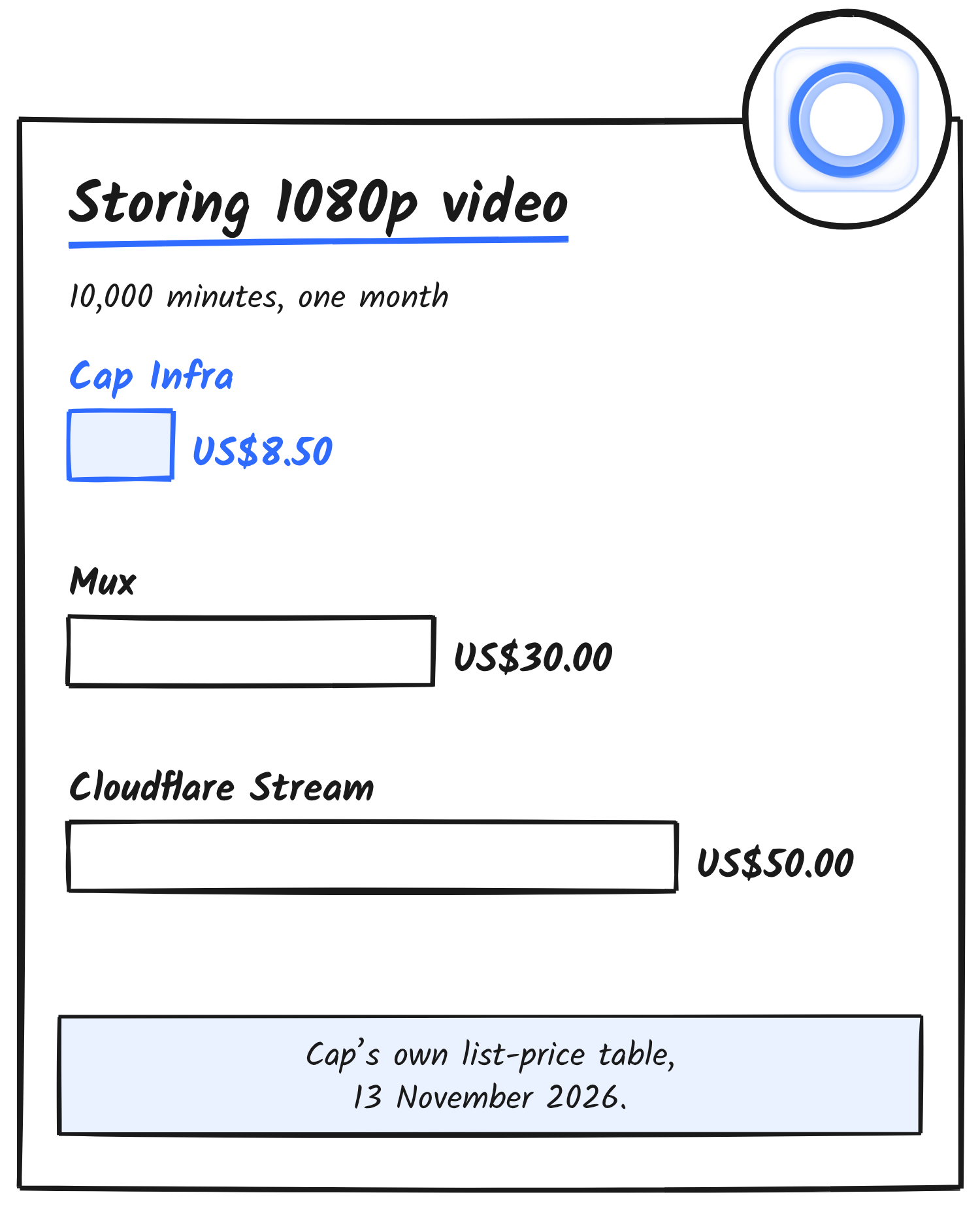
Mux’s pricing page matches the 1080p storage line: it lists US$0.003 per minute a month for 1080p basic quality, which is US$30 for 10,000 minutes. It also lists delivery at US$0.001 per minute after 100,000 free delivery minutes each month. That free allowance isn’t in Cap’s table. The Mux 4K and Cloudflare Stream figures in the table are Cap’s.
Compliance and licence
Cap says it’s HIPAA compliant and holds SOC 2 Type II and ISO 27001 certifications, and that Cap Infra runs on the same infrastructure. Organisations can buy a signed business associate agreement, the contract HIPAA requires when a vendor handles health data, from their organisation settings in the Cap dashboard.
The API, media server and player are on GitHub in CapSoftware/Cap. Cap’s product reference says most of the repository is licensed under AGPLv3, with commercial terms described at cap.so/docs/commercial-license.
The speed and transcription figures come from Cap’s own tests, and the launch post doesn’t describe the test setup. Developers can create an app and a secret key in the Cap Infra console, with the API reference in the docs.
Discover more from Sulat AI & Tech News
Subscribe to get the latest posts sent to your email.