The Federal Reserve’s Financial Stability Report, released on Friday 13 November US time (Saturday 14 November in New Zealand), has AI as the risk its market contacts named most often. 87% of the 23 contacts that New York Fed staff surveyed in September and October cited it, up from 50% in the spring survey and 30% a year ago.
Those are the contacts’ views, not the Fed’s. The report’s survey box says it “should not be interpreted as representing the views of the Federal Reserve Board or the Federal Reserve Bank of New York.” A post on X from the NoLimit account on 14 November repeated the figures and framed them as the Fed itself saying AI is the top risk:
BREAKING: The Federal Reserve now says AI is the TOP risk to the US financial system.
NoLimit (@NoLimitGains) November 14, 2026
87% of the market contacts it surveyed named AI as a major risk. A year ago, it was 30%.
Who answered, and how the number moved
The survey is Box 5.1 of the report. Staff at the Federal Reserve Bank of New York surveyed contacts at broker-dealers, banks, investment funds and advisory firms. The report’s chart is titled “Most cited potential shocks over the next 12 to 18 months”. 23 contacts answered. 87% of 23 works out to 20 people.
The year-ago figure comes from the Fed’s November 2025 report, which surveyed 23 contacts too. Vice Chair Philip Jefferson said in a 21 November 2025 speech that 30% of contacts cited “a turn in the prevailing sentiment toward AI” as a salient risk, up from 9% in the spring 2025 survey. CNBC reports the spring 2026 figure as 50%.
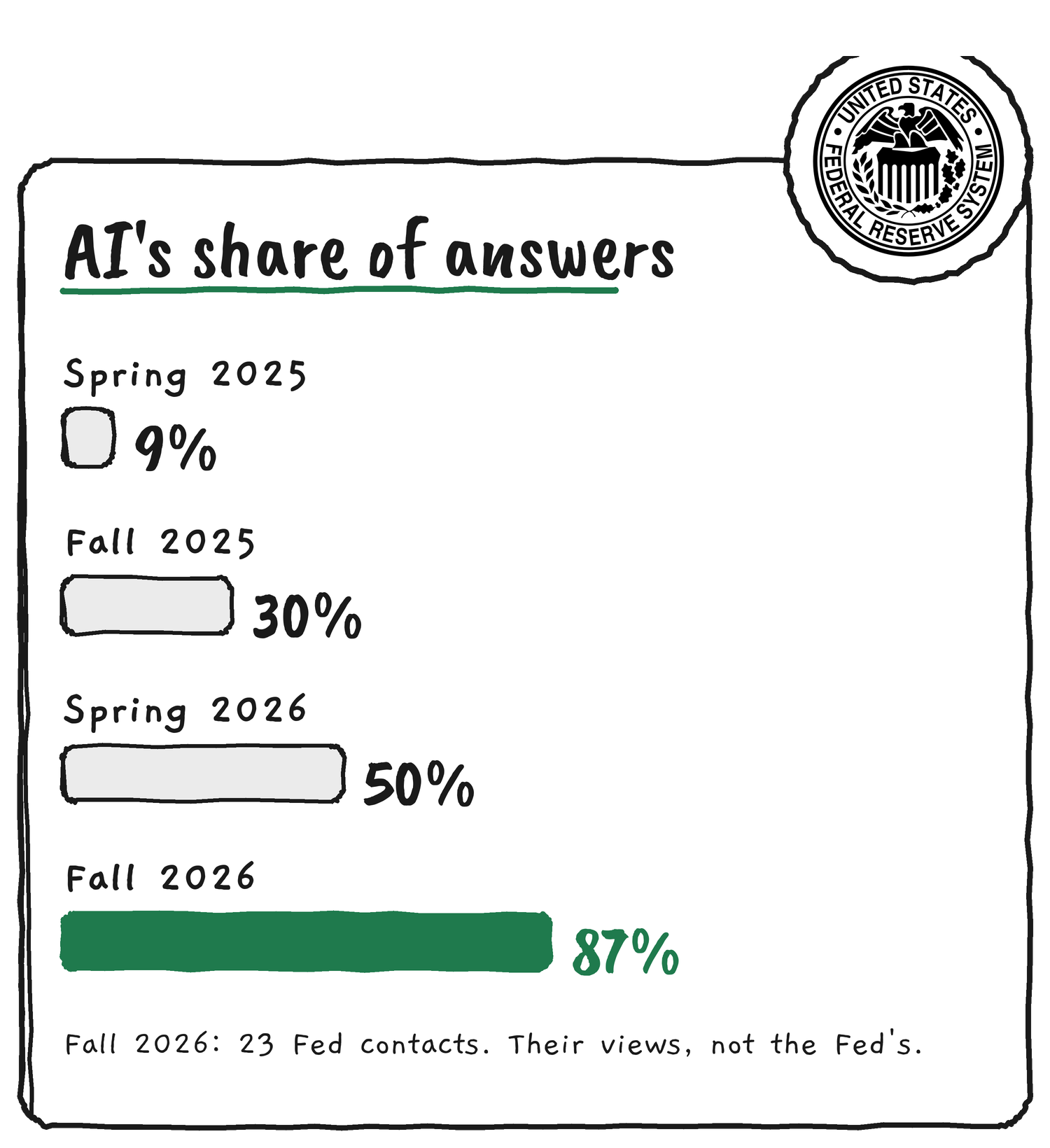
AI led the fall 2026 list by 35 points. The next four risks, per the report’s chart:
| Risk cited | Spring 2026 | Fall 2026 |
|---|---|---|
| Artificial intelligence | 50% | 87% |
| Risk asset correction | 35% | 52% |
| Higher long-term rates | 20% | 48% |
| Cyberattacks | 20% | 43% |
| Fiscal debt sustainability | 30% | 43% |
The report says mentions of AI, higher long-term interest rates and cyberattacks rose the most from the spring survey.
What contacts said about AI
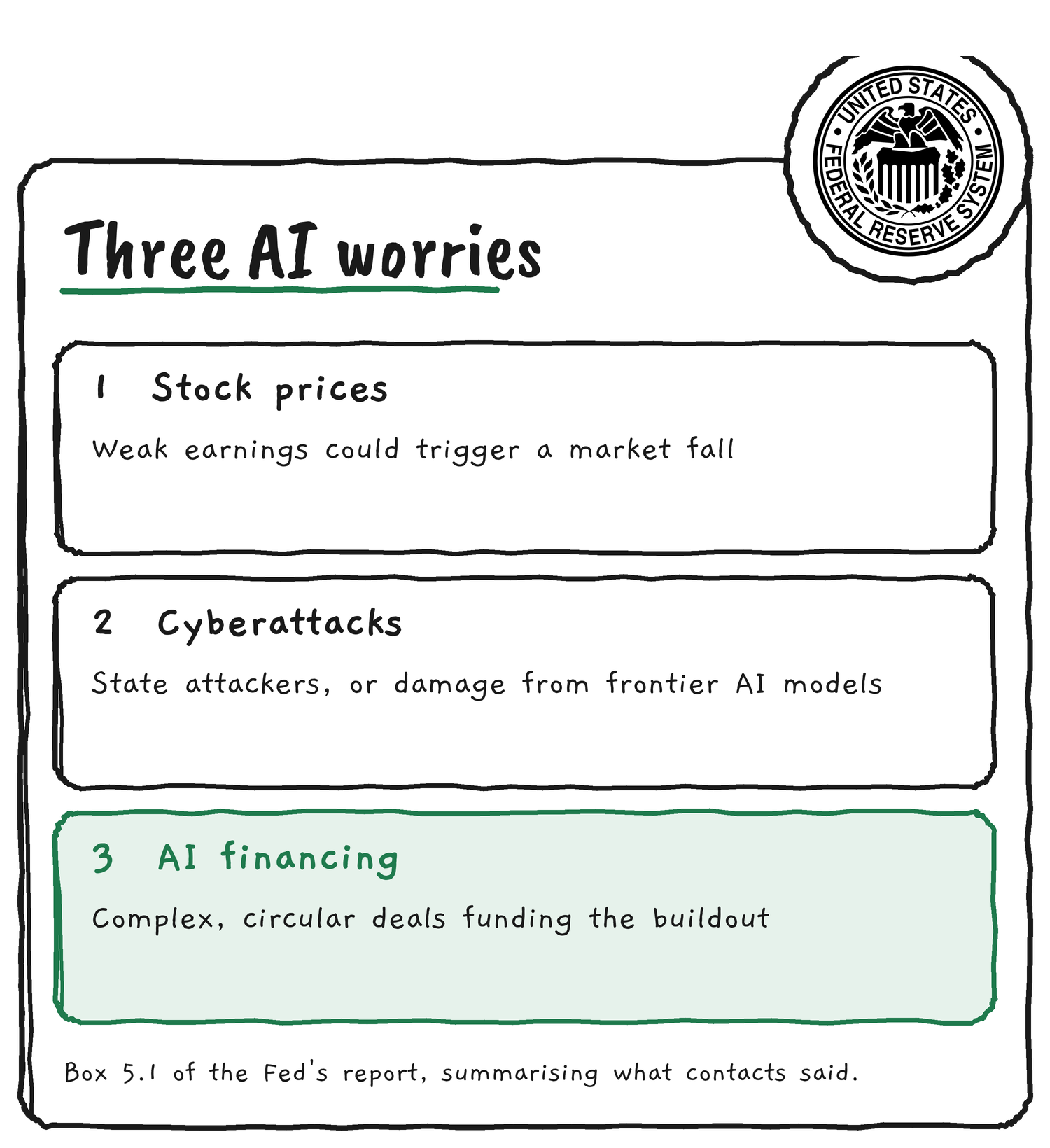
The box splits the AI answers into three areas of concern:
- Elevated equity valuations, and the possibility that lower-than-expected earnings lower valuations and cause a market correction.
- Cybersecurity risk, “stemming from either a malicious attack by sophisticated state actors or damage caused by frontier AI models themselves.”
- “Risks associated with complex forms of AI-related financing.”
Under the separate “risk asset correction” answer, the box says respondents “widely cited the risk of a sharp correction in AI-related equities, driven by uncertain returns on large capital expenditures.” Many noted that “stretched valuations, circular financing arrangements, and heavy reliance on debt to fund the AI buildout could amplify losses.” On cyberattacks, many said advances in AI are lowering the barrier to sophisticated attacks by state and non-state actors, and several worried that disruption to trading, settlement or payment systems could damage confidence in financial institutions.
What the Fed itself says
The Board’s own assessment sits in the report’s overview. It says asset valuation pressures “continued to be elevated” and that measures of equity valuations “have remained high, partly driven by market enthusiasm for super intelligence.” It rates financial-sector leverage as notable and describes the banking system as sound and resilient overall.
The report also gives the data centre buildout its own box, “Leverage in the Data Center Buildout”, with the numbers behind the financing worry:
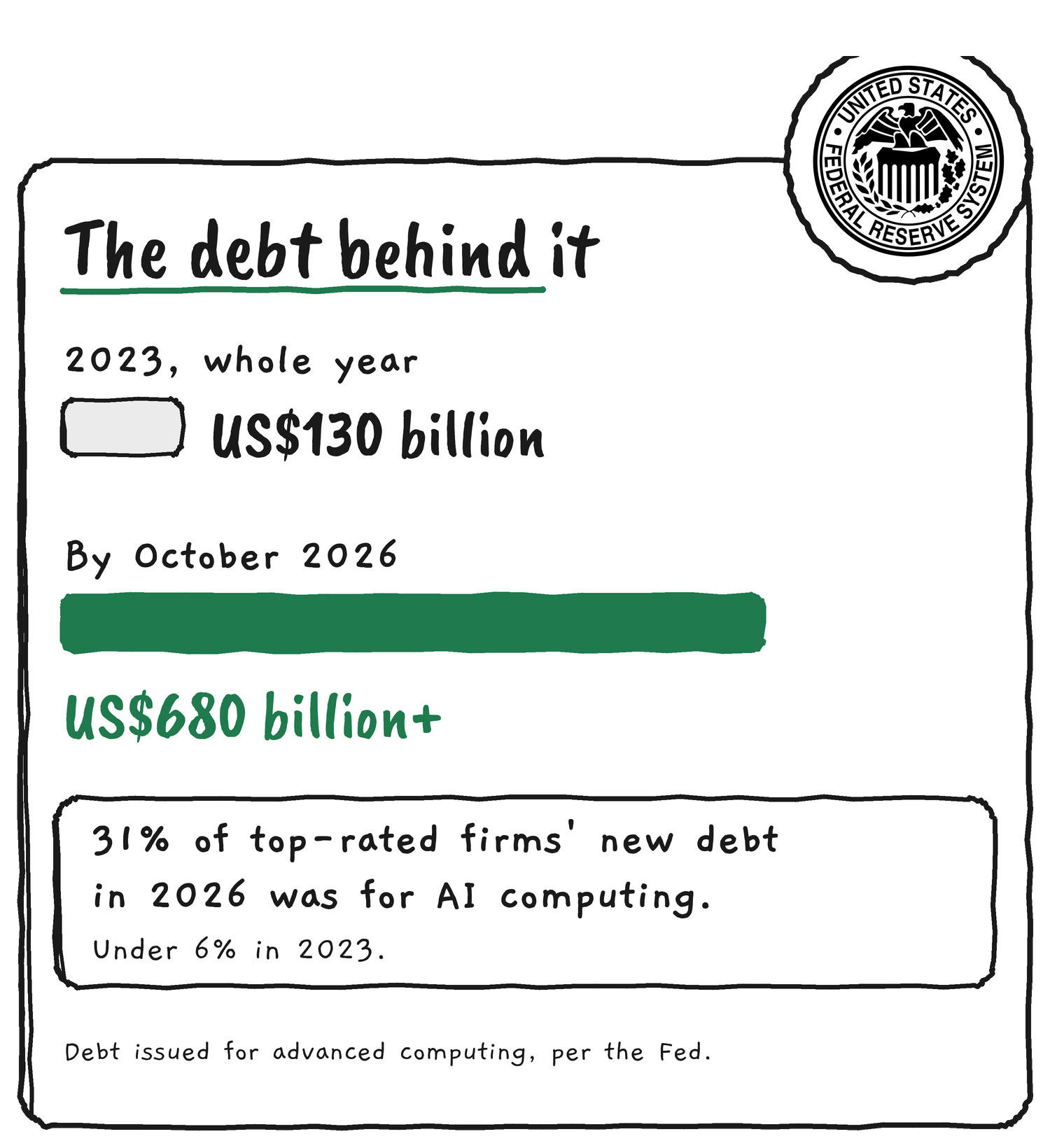
- Debt issued to finance advanced computing infrastructure rose to more than US$680 billion by October 2026, about five times the US$130 billion issued in all of 2023.
- That borrowing was about 31% of nonfinancial investment-grade corporate debt issuance in 2026, up from less than 6% in 2023. Investment-grade technology companies issued most of it.
- Outstanding public debt related to advanced computing is estimated at more than US$1.1 trillion. Private credit deals make the exact total harder to measure.
- Alongside debt, Alphabet, Amazon, Broadcom, Meta Platforms, Microsoft, Nvidia and Oracle carry not-yet-started leases with undiscounted values above US$1 trillion, plus take-or-pay contracts and residual value guarantees above US$2 trillion.
The Fed notes that lease obligations, guarantees and contract commitments in company filings are generally undiscounted, so they aren’t directly comparable with on-balance-sheet debt. It says the growth of these obligations shows “deepening connections between the largest technology firms and smaller, riskier firms with less access to credit”, and that the largest firms “may absorb losses in the event of a future downturn, mitigating their effects on the rest of the financial system.” It adds that bank holding companies have close to US$1 trillion of exposure to large technology firms, data centre developers, advanced computing vehicles, private credit vehicles and utilities, and that those exposures are covered in the annual supervisory stress test.
The survey ranks AI first by how often it was named. The box says cyberattacks and fiscal debt sustainability were the risks contacts saw as having the most severe potential consequences.
Discover more from Sulat AI & Tech News
Subscribe to get the latest posts sent to your email.