OpenAI says the scientists in its ChatGPT for Academic Researchers program estimate the same work would have taken 1.9 times as long without AI. The company’s Economic Research team published its report, Science at the Frontier, on 16 November, based on more than 580,000 messages from 1,819 scientists and a survey of 251 of them.
OpenAI announced the report on X, saying scientists reported nearly doubling their productivity and that it used privacy-preserving methods to see how they use ChatGPT across their work.
Scientists reported nearly doubling their productivity with AI in our study of more than 1,800 participants in the ChatGPT for Academic Researchers program.
— OpenAI (@OpenAI) 16 November 2026
Using privacy-preserving methods, we looked at how they use ChatGPT across their work—from developing ideas to analyzing data and writing code—and what it could mean for scientific discovery. openai.com/index/science-…
What the study measured
The team looked at messages sent between 20 August and 22 September 2026 by scientists in biology, chemistry, mathematics, computer science, physics, engineering and earth science. OpenAI used automated classifiers to sort each message by research activity, such as reviewing literature, writing code or analysing data. Its researchers saw the categories, not the messages or ChatGPT’s replies. By default, OpenAI doesn’t train its models on data from the program.
The survey of 251 participants covered how much time AI saves, what they expect it to do for discovery, and what would still slow research down.
What scientists use it for
Four activities make up 85% of the average scientist’s messages: understanding unfamiliar concepts, drafting papers, analysing results and writing research code. Data gathering, peer review and end-to-end autonomous research are far less common, according to the report’s key findings.
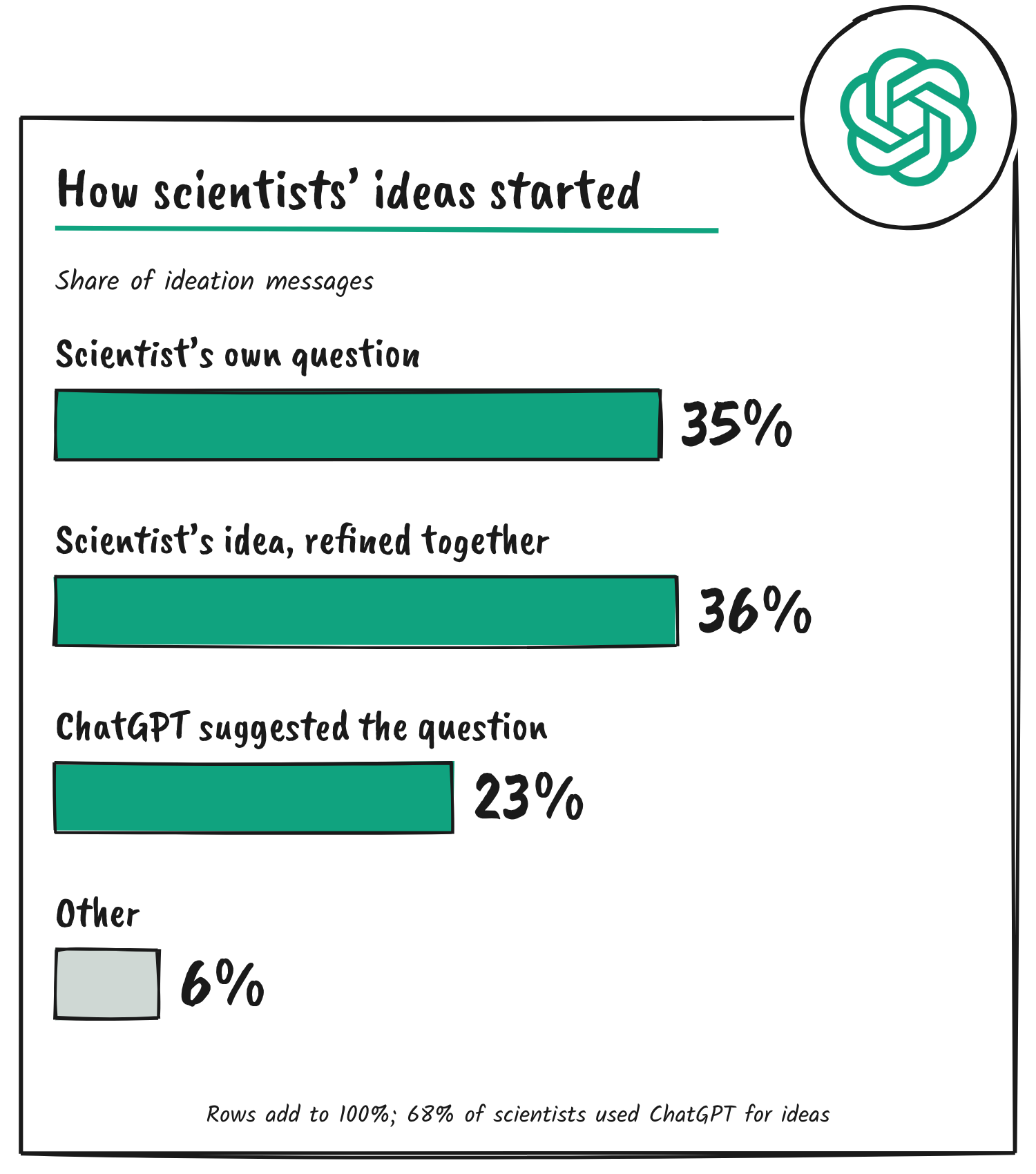
Ideas are a big part of it. OpenAI says 68% of the scientists used ChatGPT to develop research ideas. Across those messages, 35% started with the scientist’s own question, 36% started with a scientist’s idea that ChatGPT helped refine, and 23% had ChatGPT suggest the question. During brainstorming, scientists often treat ChatGPT as a source of ideas; when they develop a research question, they usually bring the first idea themselves.
How much time it saves
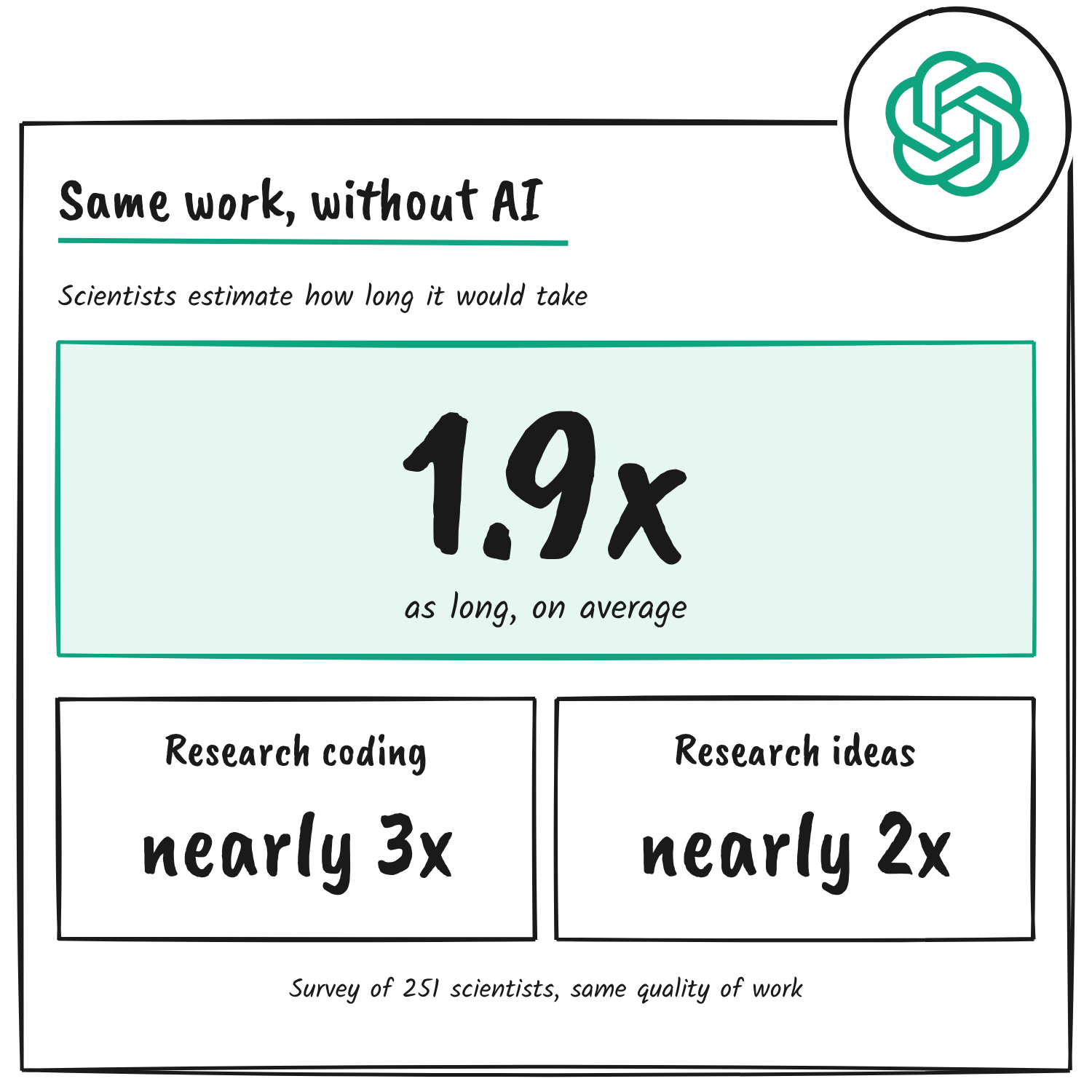
The survey asked scientists to estimate how long the same work, at the same quality, would take without AI. On average they said 1.9 times as long. For research coding they put it at nearly three times, and for research ideation at nearly twice.
Scientists kept checking the answers. After a request, they followed up within a week to ask for explanations, checks or revisions about once every three messages, and that held in coding and data analysis too. OpenAI reads that as scientists still exercising their own judgment.
The report also asked which limits would remain even with capable AI tools. Limited time or staffing came up for 51.8% of scientists and funding for 43.8%, and 71% picked at least one of the two.
What scientists expect
Of the 250 scientists who answered the question about discovery, 98% expect AI to speed it up in their field, and 22% say a discovery that would take 10 years without AI could happen within three. Among 224 written explanations, OpenAI counted 367 reasons: 52% were about getting research done faster, 23% about finding more promising questions and 14% about pursuing a wider range of questions.
César de la Fuente, who works on antimicrobial research, is quoted on the study page: “Tools like ChatGPT are helping us accelerate scientific discovery. It’s really a playground for a scientist like myself.”
Free access opens up again
OpenAI published a second post the same day, Broadening access to AI for scientists. Applications for the next round of the program open on Monday 23 November. OpenAI will award 50,000 new grants on a first-come, first-served basis, and each one gives the recipient and up to two collaborators free ChatGPT Plus. That supports up to 150,000 researchers, and OpenAI’s goal for the program as a whole is 200,000, double the target it set when the pilot launched in July.
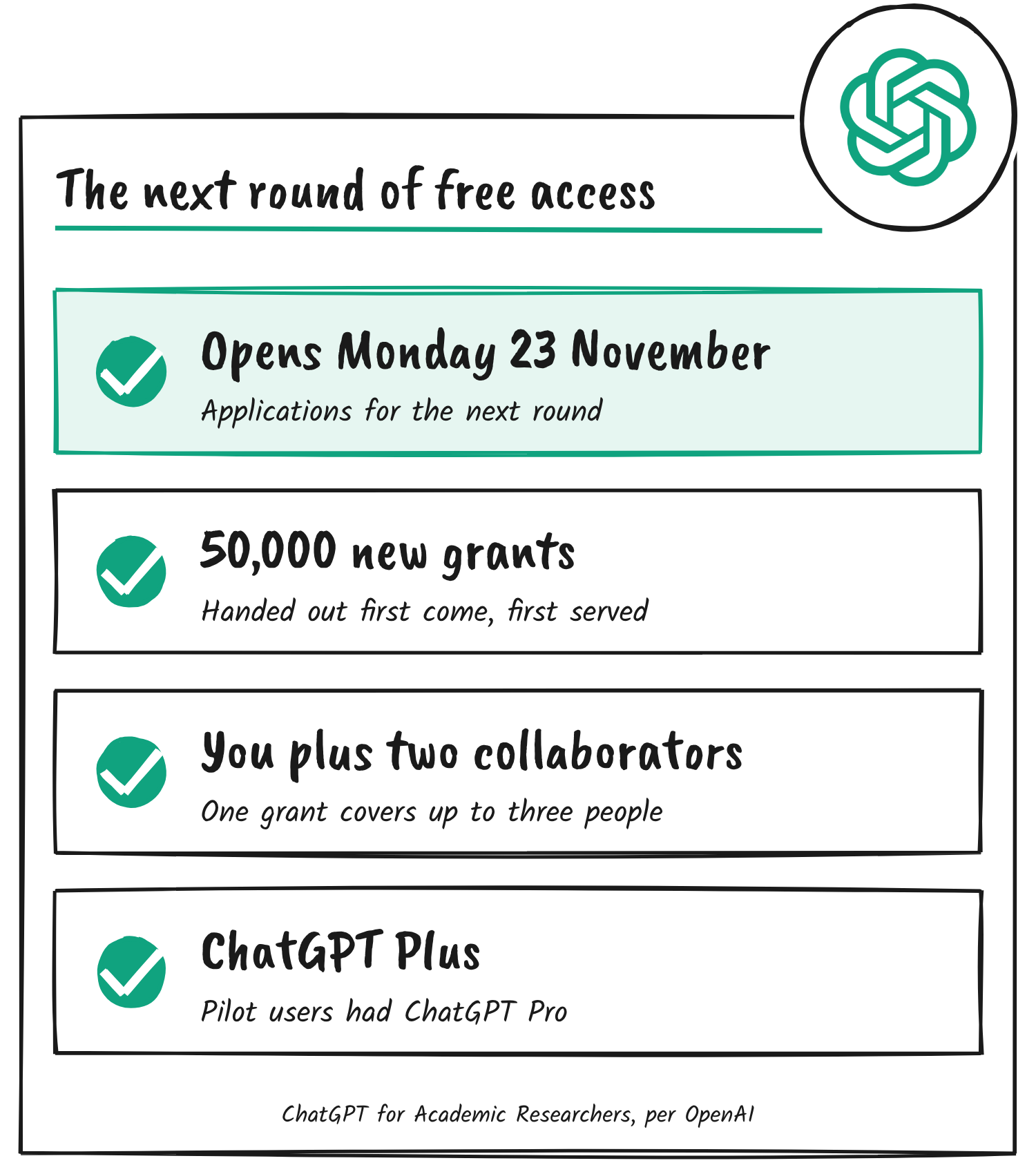
The pilot gave researchers ChatGPT Pro. OpenAI says its review of pilot usage showed most participants would have stayed within Plus limits, which is why new grants use Plus, and that it’s moving away from lottery-based selection. About 20,000 researchers in 33 countries have joined since July. If you’re already on the waitlist and qualify, OpenAI will email you before applications open with instructions for activating your account.
Universities can also use ChatGPT Edu, and biology labs at US universities can apply for the Rosalind Academic Plan, which gives eligible labs up to 30 GPT-Rosalind seats at no cost for up to 12 months. GPT-Rosalind access needs approval through OpenAI’s trusted-access process.
Applications open at chatgpt.com/academic-researchers/apply.
Sources
- OpenAI on X, 16 November 2026
- Science at the Frontier, OpenAI
- Science at the Frontier, full report (PDF)
- Broadening access to AI for scientists, OpenAI
Disclosure: I’m an OpenAI, Firecrawl and Devin ambassador.
Discover more from Sulat AI & Tech News
Subscribe to get the latest posts sent to your email.