Bending Spoons has signed a definitive agreement to buy Mailchimp from Intuit for $3.68 billion. Federico Simionato, who leads product at Bending Spoons, announced it on X: “BREAKING: we’ve officially entered a deal to acquire Mailchimp for $3.68 billion!” The post carries a screenshot of the company’s Business Wire release.
The deal hasn’t closed. Both companies expect it to in early 2027, subject to regulatory approvals and customary closing conditions, and until then Intuit runs Mailchimp. Neither release says anything about pricing, plans or headcount. This piece sets out what’s confirmed, what Bending Spoons did at the products it bought before, and what that could mean for Mailchimp customers.
What’s confirmed
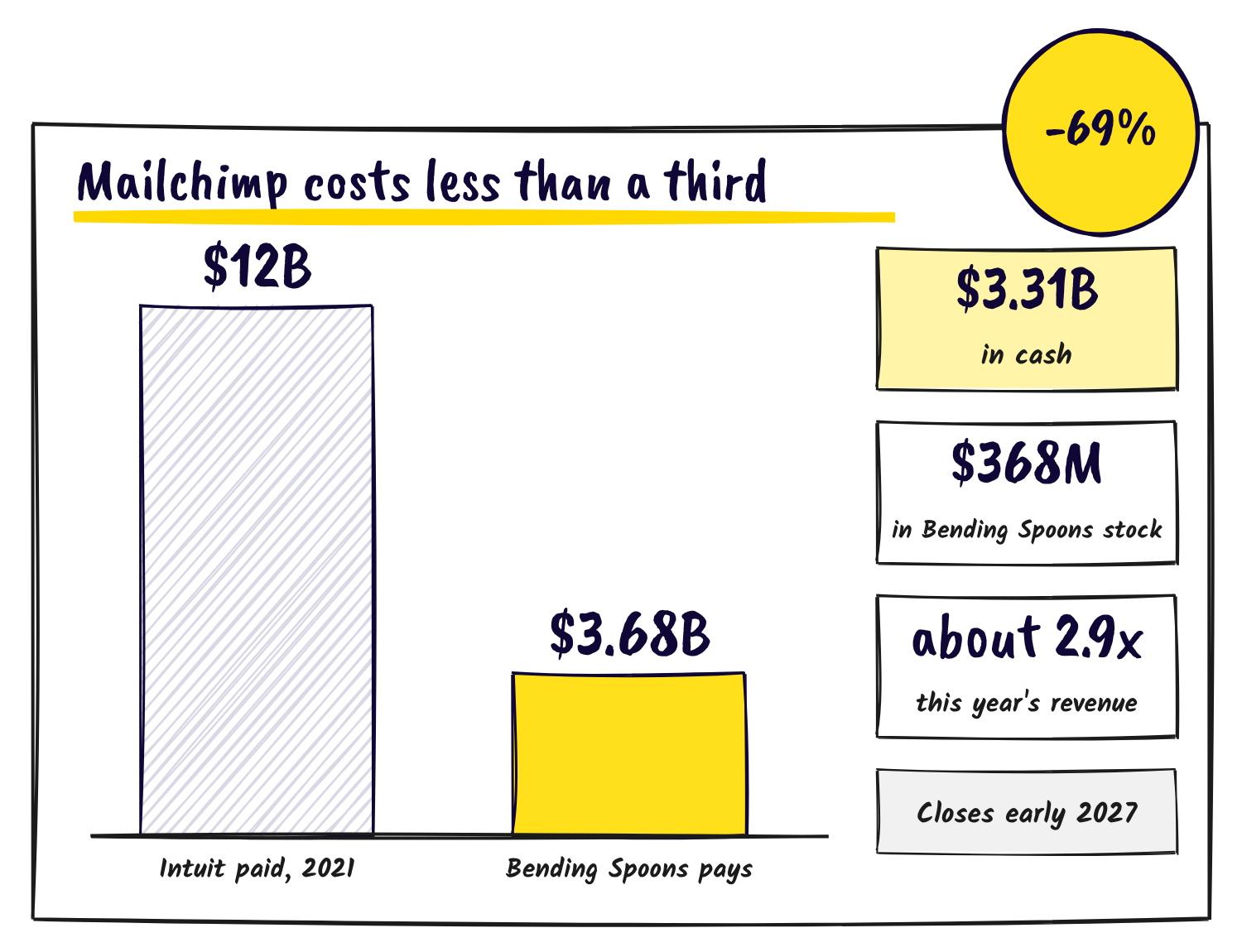
The price is an enterprise value of $3.68 billion. Intuit’s release splits it into $3.31 billion in cash and $368 million in Bending Spoons stock. Bending Spoons’ release calls it an all-cash deal in which Intuit puts $368 million of its proceeds into newly issued Bending Spoons equity. That’s the same money described two ways. Bending Spoons buys 100% of The Rocket Science Group, LLC, the company behind Mailchimp, plus other assets and liabilities of the business.
Intuit paid about $12 billion for Mailchimp in 2021, Reuters reports, which was its largest acquisition at the time. The new price is less than a third of that, a drop of 69%. Mailchimp’s revenue for Intuit’s first quarter, which ended 31 October, was $313 million, down 1% on a year earlier. Intuit guides fiscal 2027 Mailchimp revenue at $1.256 billion to $1.266 billion, down 1% to flat. By my arithmetic, the price is about 2.9 times that guidance.
Luca Ferrari, Bending Spoons’ CEO, said: “After closing, we’ll invest substantially in the business, building on the powerful, easy-to-use tools customers already value and rely on.” Jack Tam, an Intuit senior vice president, said Intuit is “focused on ensuring a smooth transition for Mailchimp’s customers, partners, and employees.” Intuit says it will use the cash to buy back shares in fiscal 2027, after the deal closes.
What Bending Spoons says it does
The release describes the method plainly. A transformation “is typically deep and entails reorganizing teams, overhauling technology, redesigning user interfaces, accelerating product development, and enhancing marketing and monetization.” It adds that Bending Spoons “has never sold a material business.”
Its Nasdaq filing is blunter. Quoted by the San Francisco Inquirer, it says the company took on 1,830 full-time staff through AOL, Eventbrite and Vimeo and that “we expect only a few hundred to remain.” Ferrari told Follow the Money: “I agree that we often increase prices for users who use an application most frequently, but I would like to add that we almost every time greatly increased the value for free users.”
What happened at each product it bought
Every row below comes from a company statement, a regulatory filing or named press coverage. Where I couldn’t source a figure, the cell says so.
| Product (deal closed) | People | Pricing and plans |
|---|---|---|
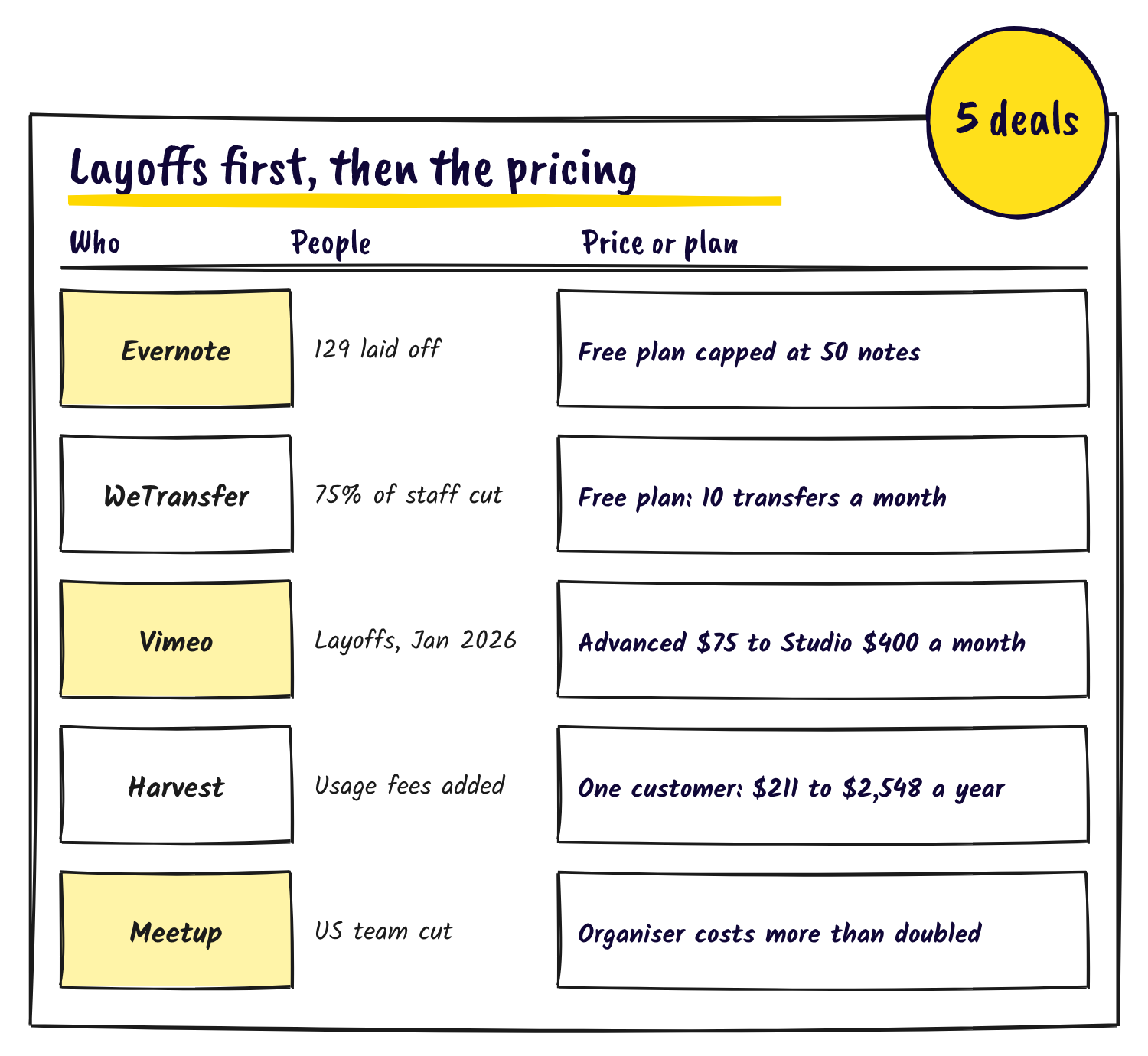
| Evernote (January 2023) | 129 laid off on 17 February 2023, per TechCrunch. US and Chile offices closed in July 2023, per Evernote. | From May 2023, Personal rose to $129.99 a year and Professional to $169.99, the first rise in almost seven years by Evernote’s account. Free accounts were capped at 50 notes and one notebook on 4 December 2023. Personal and Professional have since been replaced by Starter at $99 a year (1,000 notes) and Advanced at $249.99. |
| Meetup (early 2024) | Ferrari announced a layoff on 5 February 2024 that “significantly” cut the US team. | Organiser prices rose from June 2024. Follow the Money reports organiser costs more than doubled, with one organiser now paying €21 a month. Standard now starts at $29.99 a month. |
| WeTransfer (July 2024) | Ferrari said 75% of staff would go (Reuters, 8 September 2024). | In December 2024 the free plan was limited to 10 transfers a month, and the US Pro ($15) and Premium ($25) plans were merged into one $25 Ultimate plan. |
| StreamYard (2024) | Not sourced. | A monthly plan went from $25 to $44.99 when old plans were replaced in August 2024, per a Cheqq roundup citing StreamYard and Podnews. |
| Brightcove (February 2025, $233 million) | A state notice listed 198 layoffs from a workforce of 600-plus. Rethink puts the cut at over 50%, from around 700 to under 300. | No price change documented. |
| Komoot (March 2025) | Roughly 85% of staff, about 150 people, within the first weeks, per DC Rainmaker and BikeRadar. | BikeRadar reported a price rise alongside a redesign in September 2025, then updated the piece at Komoot’s request to correct subscription details. I couldn’t source a before-and-after price, so there isn’t one here. |
| Harvest (31 July 2025) | No headcount published in anything I found. | Flat per-seat plans (Pro $11, Premium $14 a month) became Teams ($9) and Enterprise ($14) plus usage fees on active projects, clients, tasks and invoicing, with rates unpublished. Reported renewals: $211.20 to $2,547.60 a year (Bloomberg); a UK consultancy from $130 to $2,110 a month, later offered $1,309; a US customer from $2,800 to $23,000 a year (both BBC). Harvest told the BBC customers on legacy plans, some from 2011, saw larger rises. |
| Vimeo (24 November 2025, $1.38 billion) | Layoffs announced 20 January 2026, confirmed by Bending Spoons with no number given. Former staff told press most of the company went, including the video team. | In 2026 Vimeo replaced its plans with Creator ($9), Core ($24.50) and Professional ($71) a month on annual billing, and Studio at $400 a month for accounts it classes as business use. PetaPixel reports Advanced customers at $75 a month moved to Studio. Vimeo also made public videos free and unlimited. |
| AOL (2 January 2026) | A state notice on 17 February listed 108 layoffs tied to the Reston office. | No price change documented. |
| Eventbrite (10 March 2026, about $500 million) | Reuters reported on 13 April that a large portion of the pre-deal workforce was cut. Eventbrite had 636 staff at the end of 2025, per heise. | Ticket fees were unchanged as of 24 October, per an independent tracker. The Pro plan closed to new subscribers and a $69-a-month Premium plan arrived. |
| Airtable (4 September 2026, $1.285 billion) | A “large part” of the team was cut on 12 October. A state notice lists 190 layoffs at San Francisco headquarters, effective 15 January 2027. | No change. Team is $20 and Business $45 per editor a month on annual billing as of 13 November, per ToolsGavel. Airtable’s product lead wrote that “for customers, nothing changes regarding your plan, price, or service offering.” |
The pattern in dates
This section is my arithmetic on the table above. Layoffs came fast. From closing to the first announcement, Eventbrite took 34 days, Airtable 38, AOL 46 and Vimeo 57. Evernote took about five to seven weeks. Every one of them landed inside eight weeks.
Pricing took longer, from about three months to a year. Evernote’s new prices took effect about four months after closing, and its free cap came 11 months after. WeTransfer’s plan changes landed about five months in. Vimeo’s business reclassification followed in mid-2026, seven months after it closed. Harvest closed on 31 July 2025, and the usage-fee renewals began reaching customers in July 2026.
It wasn’t uniform. Eventbrite’s ticket fees and Airtable’s prices haven’t moved. Vimeo widened its free plan while it raised the top of the range, and Ferrari says Meetup now has more non-paying organisers than paying ones. The documented increases land mostly on the heaviest users: Harvest accounts with many clients and projects, Vimeo accounts classed as businesses, Evernote users who wanted more than 50 notes.
Mailchimp today
Mailchimp prices by contact count. The free plan allows 250 contacts and 500 sends a month, with a daily cap of 250, according to Mailchimp’s help centre. Paid plans start at $13 a month (Essentials) and $20 (Standard) for 500 contacts, and Premium starts at $350 for 10,000 contacts. At 10,000 contacts Standard is $135 a month, and at 100,000 it’s $800, according to comparison sites that read the pricing page in November. Unsubscribed contacts count toward your total unless you archive them. Annual billing is offered only on Standard and Premium at 10,000 contacts or more, so most accounts pay month to month.
Intuit changed the product too. Mailchimp told free customers the new limits would start on 17 February 2026; the free plan had been 500 contacts and 1,000 sends. The Classic Automation Builder was retired in June 2025, and free accounts have had no automations since. Archived copies of the pricing page checked by newsletterpricing.com show the paid starting prices unchanged from October 2023 to this month. Several comparison sites also report an average 11% to 13% rise on pre-2019 legacy plans from 13 April 2026, though I couldn’t find a Mailchimp notice that confirms it.
Analysis: what this could mean for Mailchimp customers
Everything here is my projection from the documented pattern. Nothing in it has been announced, and neither company has said a word about Mailchimp pricing.
Timing. Nothing changes before closing, which both companies put in early 2027. After that, the record points to layoffs within about eight weeks and the first pricing or plan changes three to twelve months in.
Who’s most exposed. Large lists on Standard and Premium come first. Mailchimp’s price already climbs with contact count, and Ferrari says outright that prices go up for the heaviest users. Legacy-plan holders come second, since Harvest’s biggest jumps hit legacy accounts. Free users come third. Evernote and WeTransfer both tightened free plans, and Mailchimp’s is already down to 250 contacts. Vimeo and Meetup show the other outcome, where free gets more generous to feed upgrades.
The likeliest shape of a change. Harvest and Vimeo suggest a restructure, not a headline rate rise: new plan names, a usage or classification layer, and old plans retired at renewal. Mailchimp already has contact tiers, send multiples and overage charges to build on. I can’t tell you the figure, because Bending Spoons hasn’t published one and the record doesn’t support a number.
What would prove this wrong. Airtable and Eventbrite are the counter-examples. Neither has seen a price change yet, and Ferrari has promised to “invest substantially” in Mailchimp.
What to do now
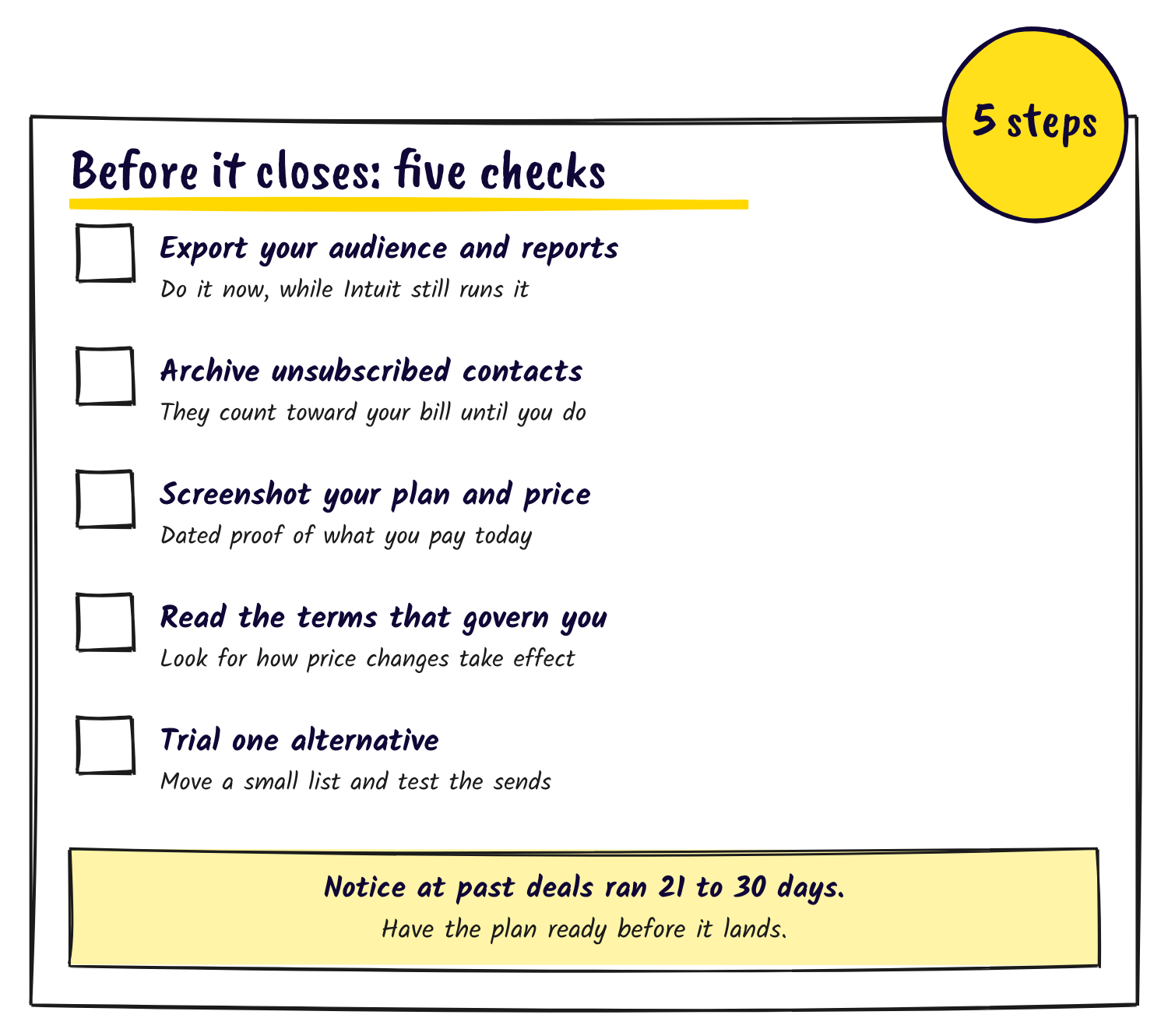
Nothing is urgent, and nothing needs to be rushed. Notice at past deals ran about a month: 28 days at Evernote, 21 to 28 at WeTransfer, 30 at Vimeo, and 30 and 10 days at Harvest. A migration that can finish inside 30 days is a safe target.
- Export your audience and campaign reports from your Mailchimp account now, while Intuit still runs it.
- Archive unsubscribed and inactive contacts. Archived contacts don’t count toward your plan, so this can drop you a tier today.
- Screenshot your plan, contact tier and price, with the date. The pricing page you see now may not exist in a year.
- Read the terms that govern your account, whether that’s the standard terms or an order form, and look for how a price change takes effect. If you’re on a sales agreement, ask for a renewal cap in writing.
- Trial one alternative on a small list. ActiveCampaign, Brevo, MailerLite, beehiiv and Kit all publish list-size pricing.
I’ll update this piece when regulators, Intuit or Bending Spoons say more.
Discover more from Sulat AI & Tech News
Subscribe to get the latest posts sent to your email.