
Context.dev has launched Enrichable, a free, open-source AI spreadsheet that builds a lead list from a prompt and researches every row on the live web. Context.dev announced it on X on 19 November as “the open-source Clay alternative”. The code is under the MIT licence, and you can use the hosted copy at enrichable.io or run your own.
What Enrichable does
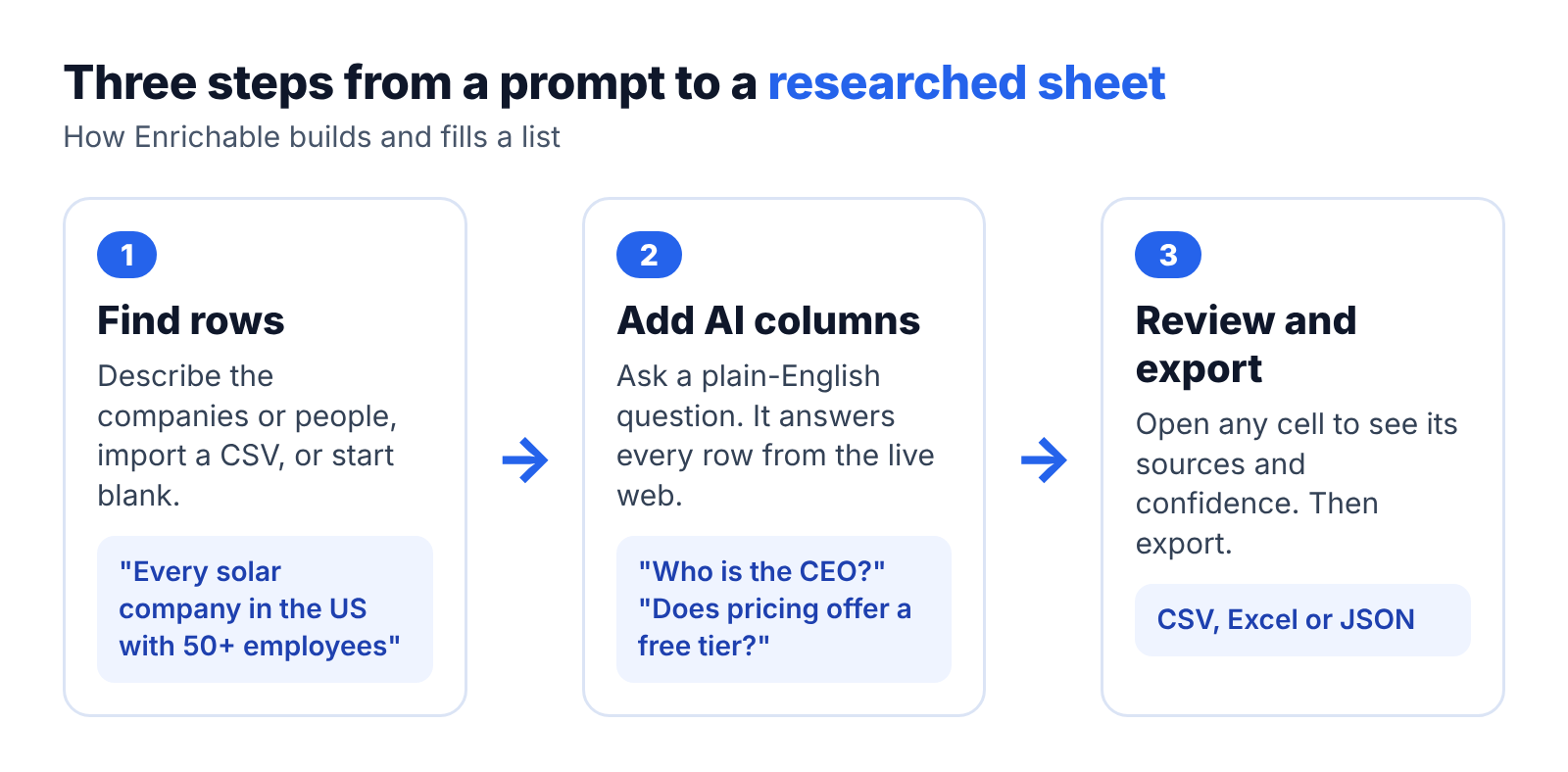
You describe the list you want, such as “every solar company in the US with 50+ employees”, and matching companies or people stream into a sheet, deduplicated by domain. Then you add columns by asking questions in plain English, like “Who is the CEO?” or “Does the pricing page offer a free tier?”. Enrichable answers each one for every row by searching the web, reading pages and pulling company and contact data. The post says the data covers 1 billion people and more than 100 million companies.
Every cell keeps its sources, a probability or confidence, the reasoning, the credits used and the timing, according to the usage docs. You can also add true or false checks, categories and scores, write a personalised email or branded PDF for each row, and run spreadsheet formulas such as SUM, IF and VLOOKUP in the browser through IronCalc, with no API calls. Sheets export as CSV, Excel or JSON.
The work email waterfall
One column tries your email providers in the order you set (Hunter, Prospeo, Apollo, QuickEnrich and ContactOut) and keeps the first work email it finds. The email docs say it stops at the first usable result whatever its verification status and makes no extra verification calls, though the provider’s status is kept in the result details. Lookups are billed to your own provider accounts, and unsuccessful lookups can still be charged.
What you pay for
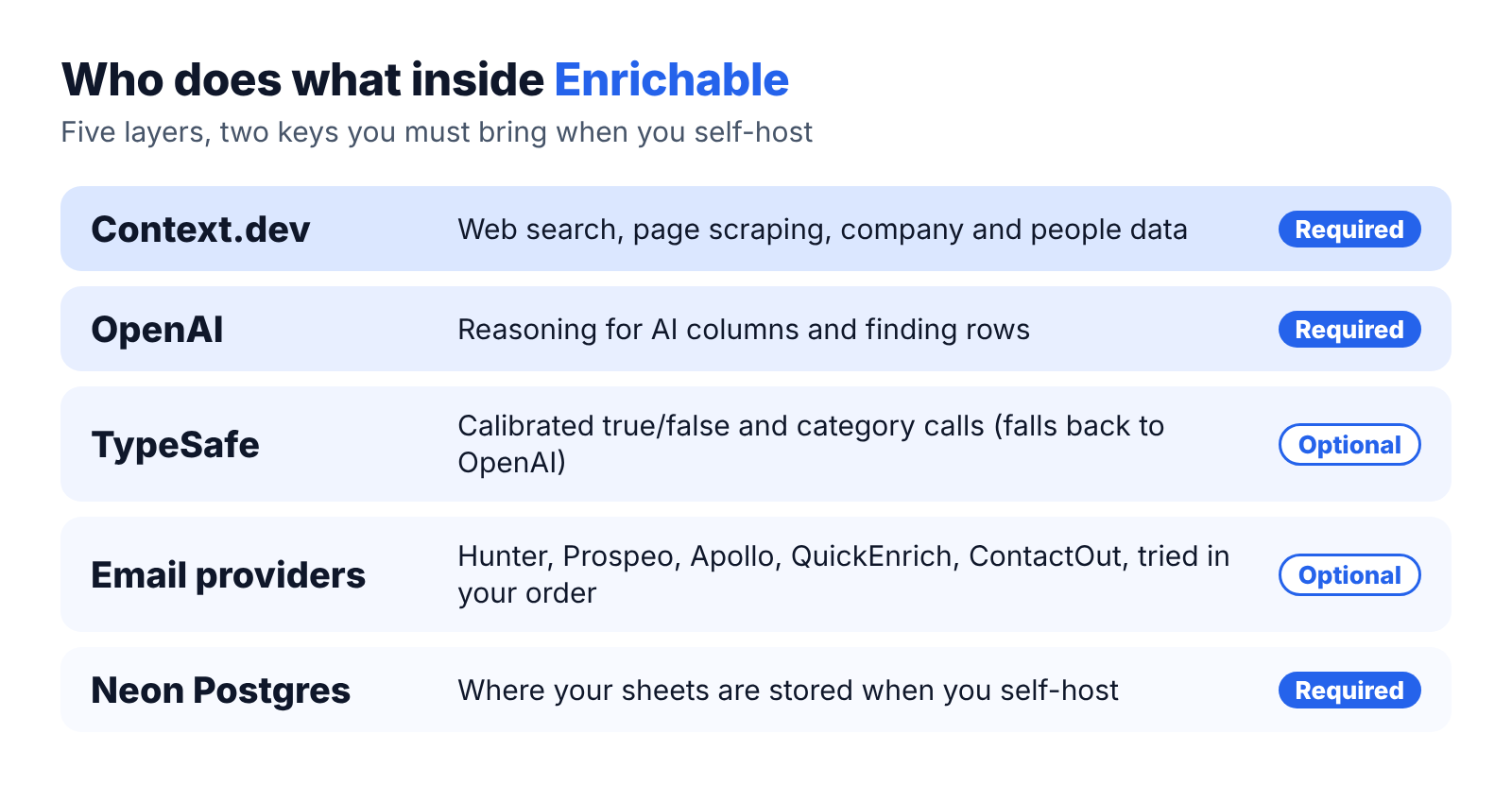
The software is free, but the services behind it aren’t. A self-hosted copy runs on your own Context.dev and OpenAI API keys, so you pay those two providers directly. You also need a Neon Postgres database, and the README says the Vercel deploy takes about five minutes. You can run it locally on Node.js 22 instead. The hosted version at enrichable.io uses your Context.dev account, and the post says 1,000 credits a month are free. Runs of more than 50 cells, or roughly 100 credits, ask for confirmation with a cost estimate first.
How it compares with Clay
Enrichable’s own FAQ calls it an alternative to Clay for the core workflow: building lead lists, enriching them with AI research and running an email provider waterfall. The launch post says it’s “much, much cheaper than Clay” but doesn’t give a price comparison.
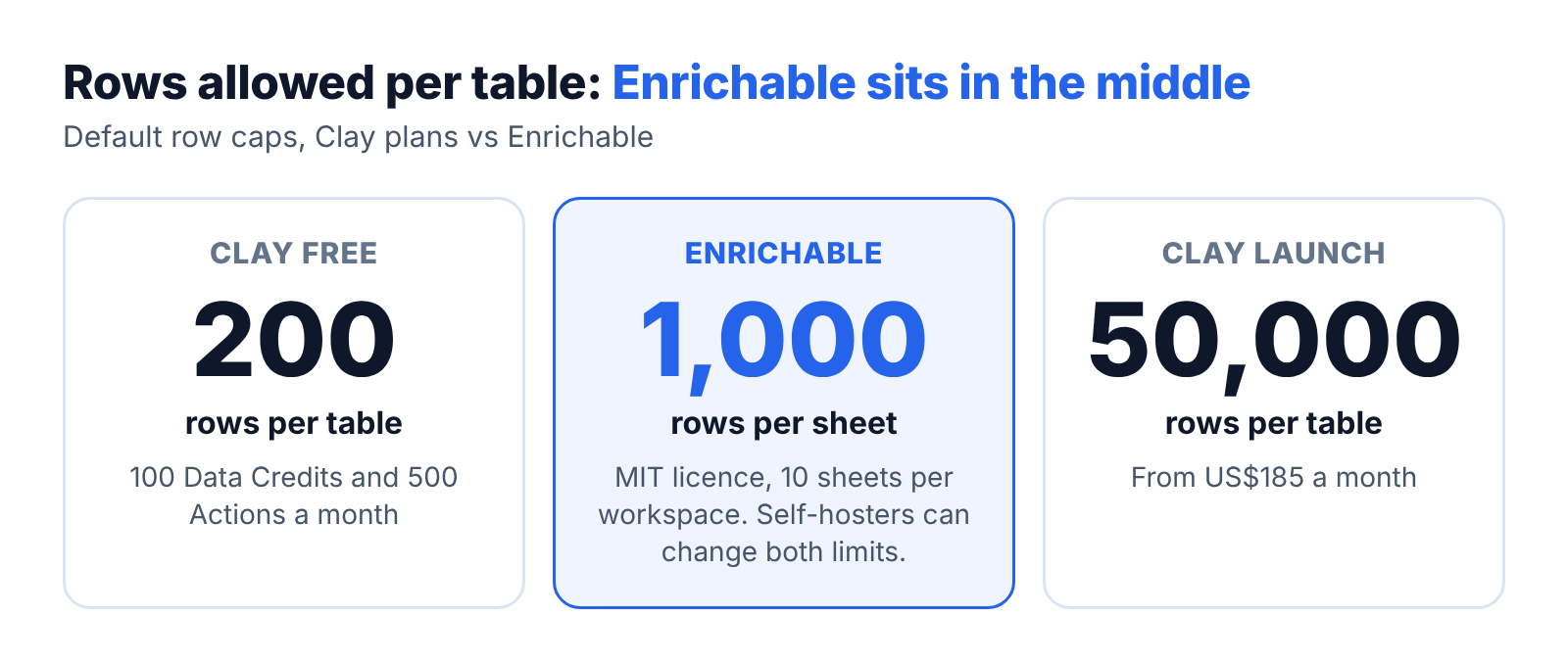
Clay’s pricing page lists a Free plan with 100 Data Credits and 500 Actions a month and up to 200 rows per table. Launch starts at US$185 a month with 2,500 Data Credits, 15,000 Actions and up to 50,000 rows per table. Growth starts at US$495 a month and adds CRM auto-sync, HTTP API integrations and webhook automation. Enrichable’s defaults are 10 sheets per workspace and 1,000 rows per sheet, and self-hosted copies can change both limits.
Agents can drive it
Enrichable includes an MCP server, so Claude Code, Cursor and other MCP clients can list sheets, read rows, add columns and run enrichment in the same workspace you use in the browser. You create an agent key under Configuration, then Agent access. The MCP docs set the limits: the enrich tool runs up to five rows per call, one batch at a time per organisation, and stops starting new cells after three minutes. There’s no background worker or durable job queue, so the agent has to request each batch itself. The hosted sign-in grant for Context.dev lasts 14 days, while a manually connected organisation API key supports unattended use.
Who’s behind it
The README credits Yahia Bakour and Nikhil Rado, with the Context.dev team, and says every lookup runs on the Context.dev API, so the repo doubles as a reference for building your own research tools. Bakour’s company is the one that gave away 10,000 free API credits for his birthday earlier on 19 November. The app is built with Next.js 16, React 19, TypeScript, Tailwind CSS 4, Neon Postgres and the Vercel AI SDK, and the GitHub repository was created on 30 October.
Hero illustration features the Enrichable logo, which remains the trademark of its owner.
Discover more from Sulat AI & Tech News
Subscribe to get the latest posts sent to your email.