Cloudflare Radar now labels each autonomous system with a type, so you can tell whether traffic or attacks come from home and mobile connections or from data centres. The three types are Access ISP, Hosting/Cloud/Content and Organization. Radar posted the change on X on 19 November, and Cloudflare’s developer changelog has the detail.
The types are inferred automatically, and Cloudflare says an individual AS can be misclassified. Neither the changelog nor the glossary explains how the inference works. A wrong type can be reported to [email protected].
The three types
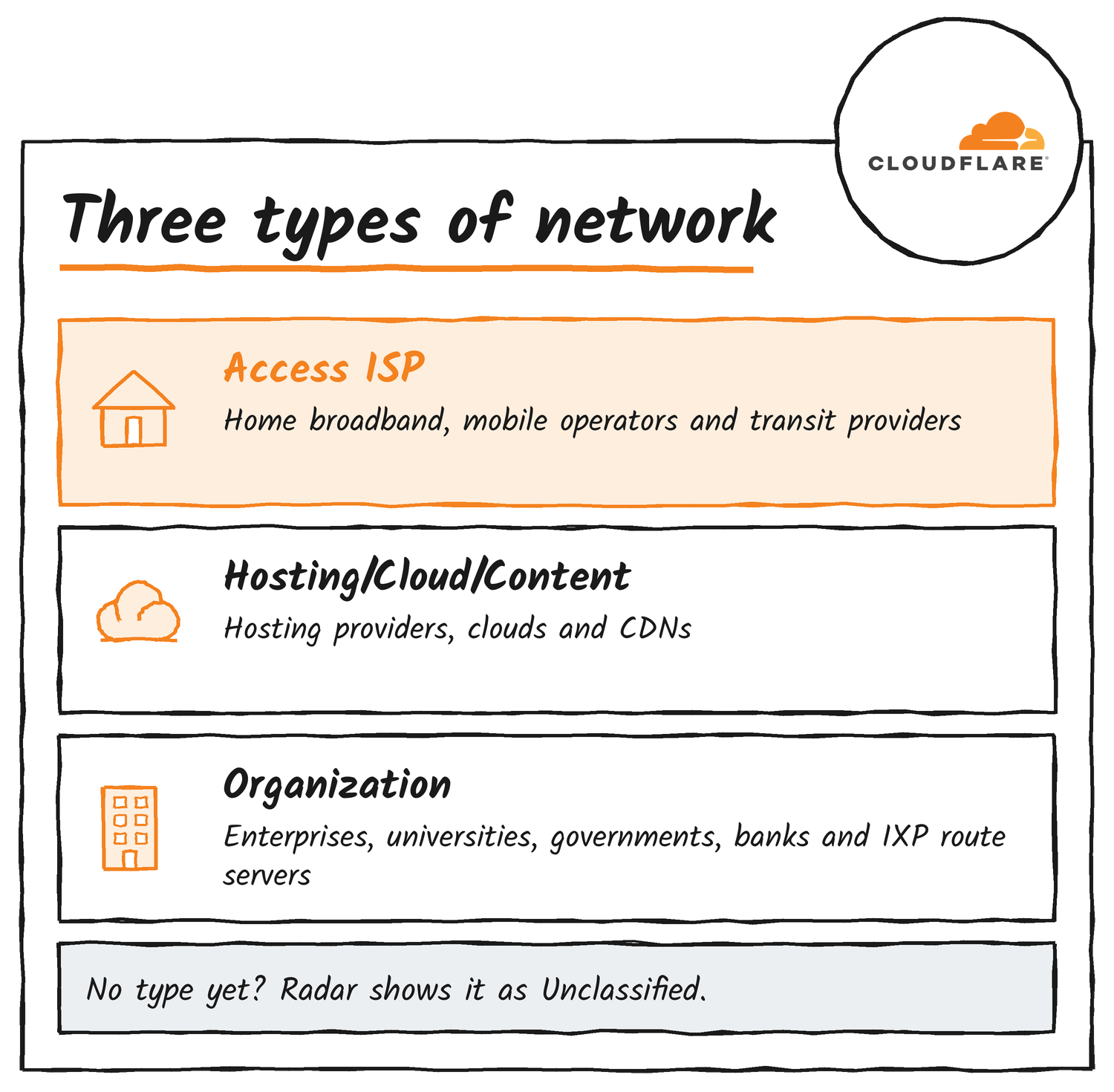
An autonomous system, or AS, is a network with its own routing policy, such as an ISP, a cloud provider or a university. Radar’s glossary defines the types like this:
- Access ISP: networks that connect end users, such as home broadband and mobile operators, plus transit providers.
- Hosting/Cloud/Content: hosting providers, cloud platforms and content delivery networks.
- Organization: enterprises, universities, governments, banks and IXP route servers. The glossary says this is unrelated to the organisation name that identifies an AS’s owner.
- Unclassified: an AS with no type. Its category is null in the API.
Where the type shows up
AS pages, such as AS7922, show the type in the AS information card. An icon before the AS number shows it across Radar: a house, a cloud or a building, with the full name on hover. The Data Explorer can break down and filter HTTP, NetFlows, DNS and layer 7 attack data by AS type.
The labels belong to individual ASes, not companies. AS7922 is Comcast’s main network, and Radar’s API lists it as Access ISP. The API lists Comcast’s related ASes under all three types, and some under none. Cloudflare’s own AS13335 is Hosting/Cloud/Content.
What the split looks like
I queried Radar’s API for the 28 days to 19 November. Access ISP networks sent 65.6% of HTTP requests, Hosting/Cloud/Content networks sent 32.8%, Organization networks sent 1.4% and unclassified traffic made up 0.2%. That matches the 66% and 33% in Cloudflare’s own Data Explorer chart.
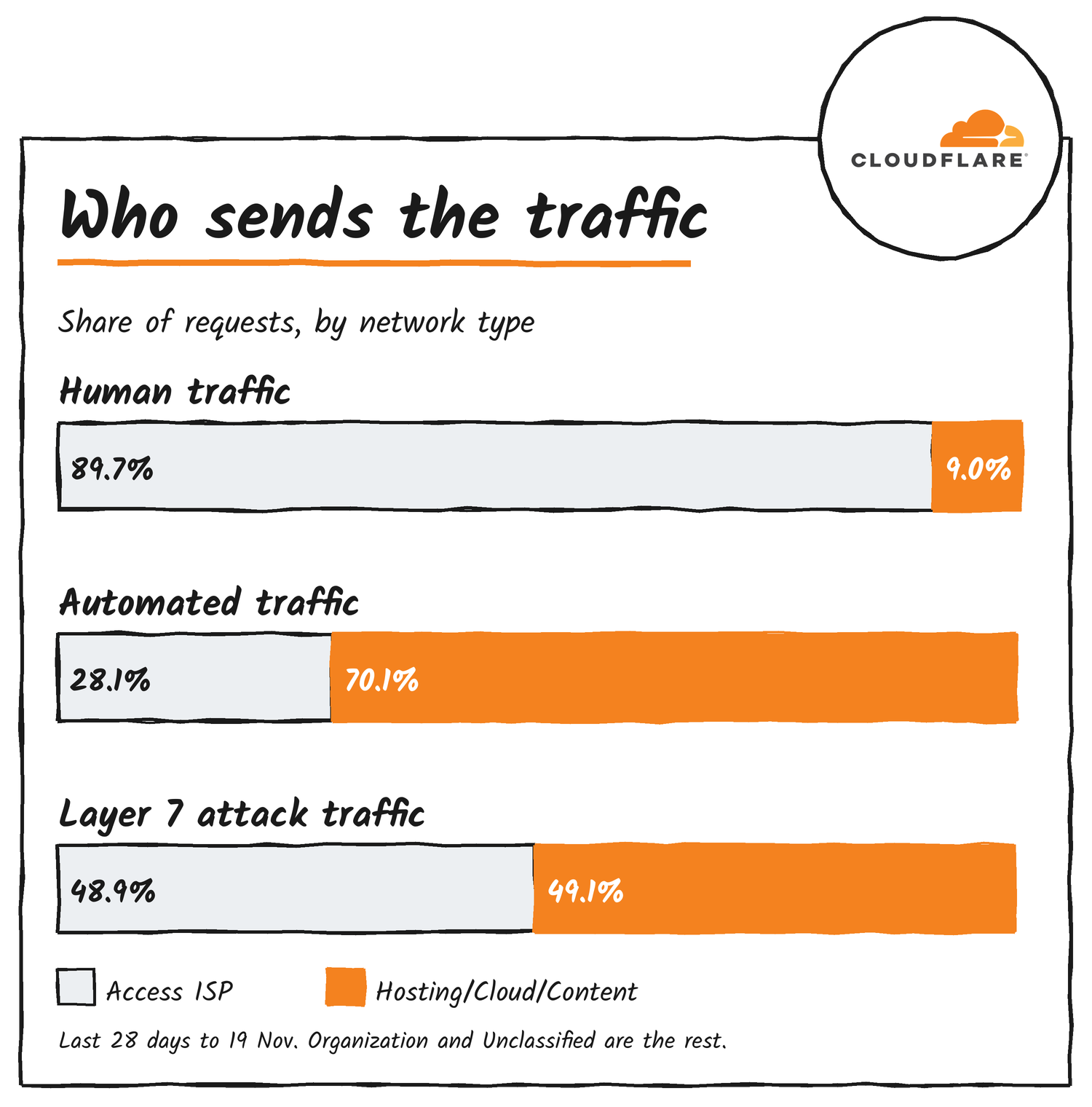
The mix flips once you split by who’s sending. Requests Radar classes as likely human came 89.7% from Access ISP networks and 9.0% from Hosting/Cloud/Content. Likely automated requests came 70.1% from Hosting/Cloud/Content and 28.1% from Access ISP. Layer 7 attack requests that Cloudflare mitigated were nearly even by source network, with 49.1% from Hosting/Cloud/Content and 48.9% from Access ISP.
In the API
Three endpoints return a new category field with the AS type, or null when the AS isn’t classified: Get AS details, List ASes and Get AS details by IP address. The HTTP, NetFlows, DNS and layer 7 attacks endpoints accept a new asCategory filter, and their summary and timeseries groups endpoints add an AS_CATEGORY dimension. Both take ACCESS_ISP, HOSTING_CLOUD_CONTENT, ORGANIZATION and UNCLASSIFIED, where UNCLASSIFIED also covers traffic that couldn’t be mapped to an AS. For HTTP they work for date ranges starting on or after 1 May 2023. The global search endpoint now returns the matched AS’s details, category included.
Cloudflare’s example gets the share of HTTP requests by AS type over the last week:
curl "api.cloudflare.com/client/v4/radar/http/summary/AS_CATEGORY?dateRange=7d" \
  --request GET \
  --header "Authorization: Bearer $CLOUDFLARE_API_TOKEN"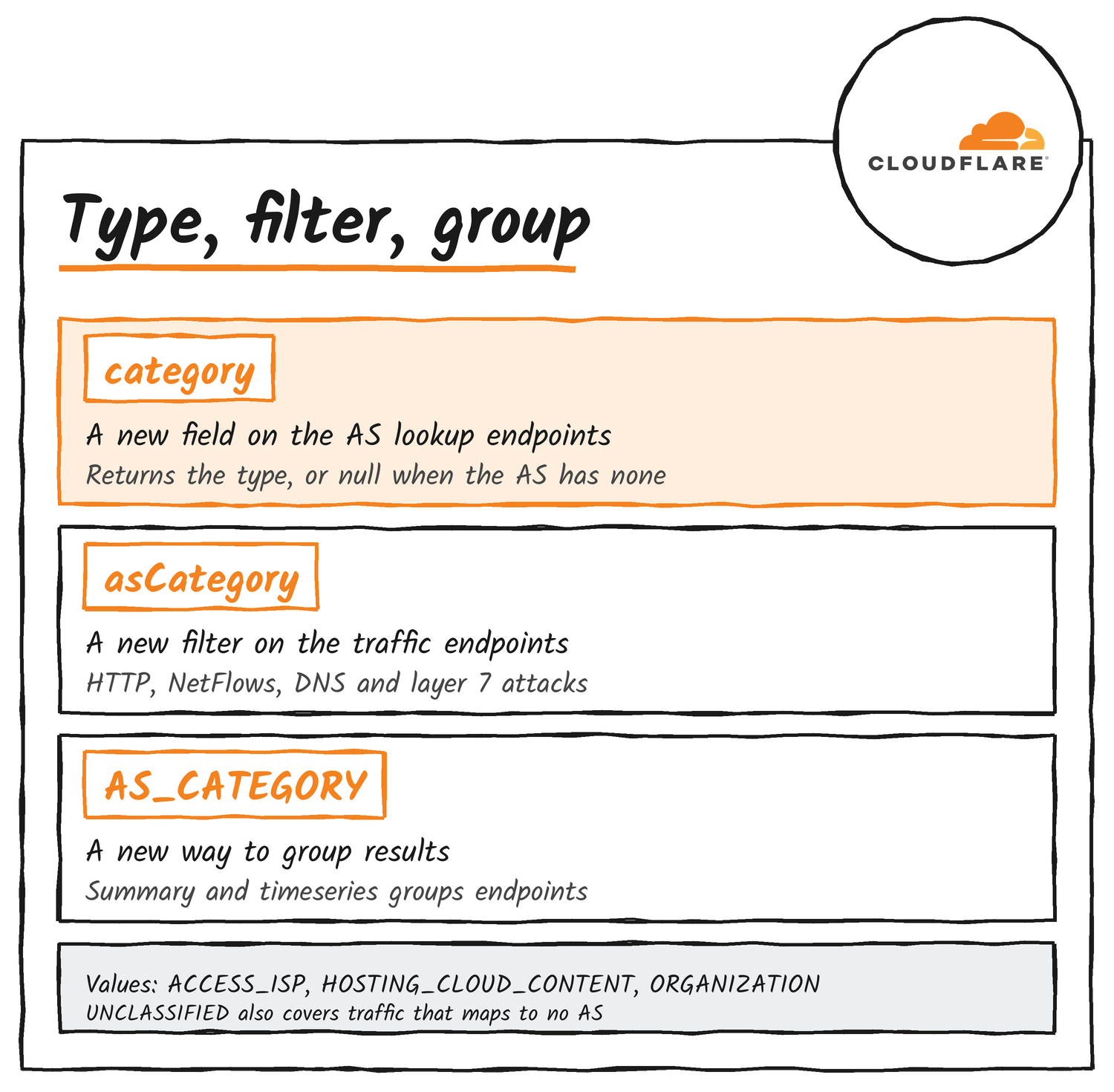
Discover more from Sulat AI & Tech News
Subscribe to get the latest posts sent to your email.