
Google has put a Static runtime for Cloud Run into Preview, so a folder of built HTML, CSS and JavaScript can go live on a managed Nginx server without a Dockerfile. The entry in Cloud Run’s release notes is dated 23 November 2026, and the runtime’s ID is static24.
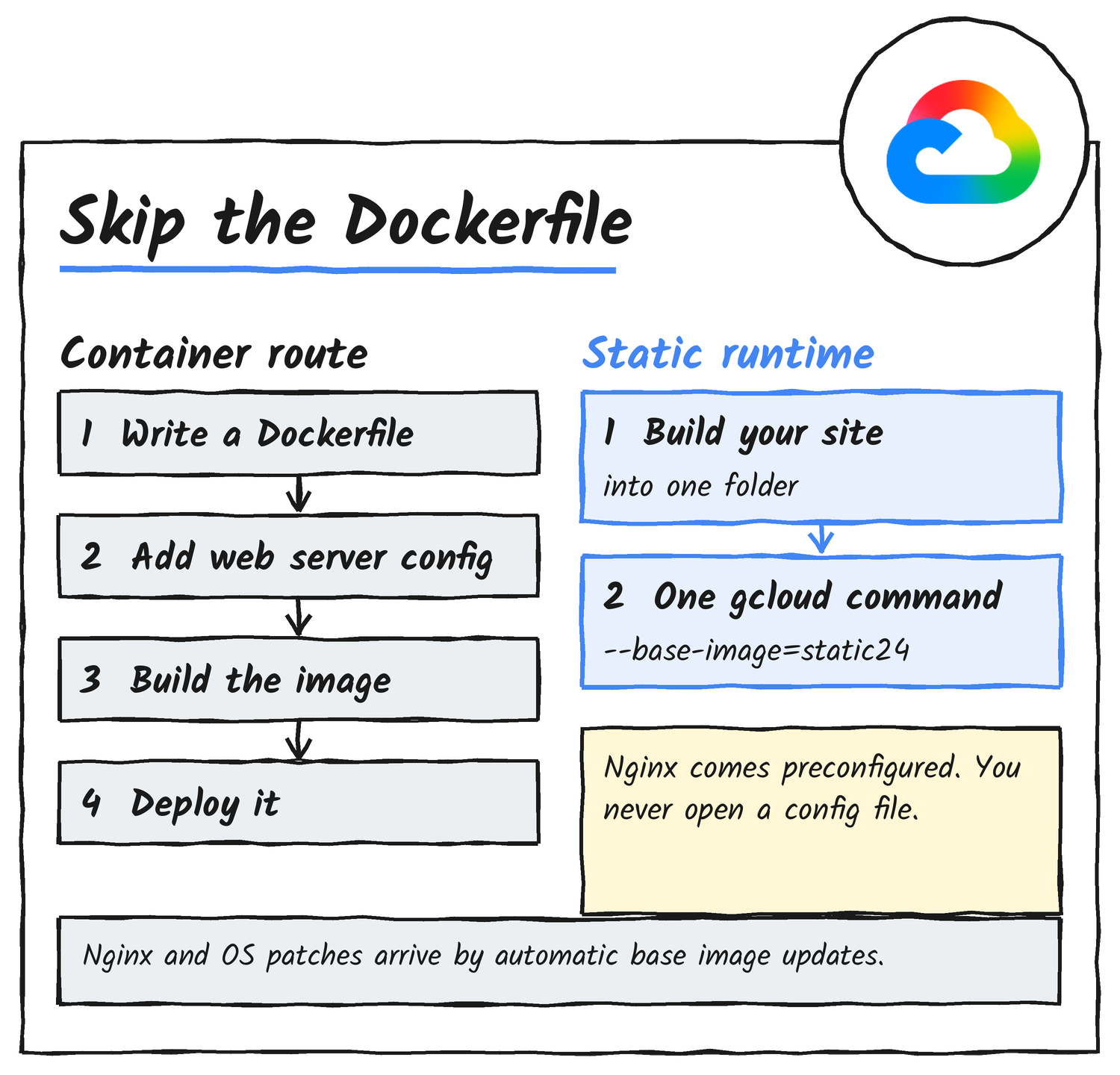
The Static runtime lets you deploy static websites, single-page applications (SPAs), and static site generator outputs (HTML, CSS, and JavaScript) directly from source using a preconfigured Nginx web server, without a Dockerfile.
Google, Cloud Run release notes, 23 November 2026
A service goes up with one gcloud command that names the folder holding index.html and the static24 base image. Google’s Configure the Static runtime page, last updated 24 November 2026 (UTC), carries the rules. The same release notes entry also lists the Node.js 26 runtime as generally available.
Google names React, Vue and Angular builds as targets, along with the output of Astro, Hugo, Jekyll and Eleventy, and static exports from Next.js and Nuxt.
What the runtime does by default
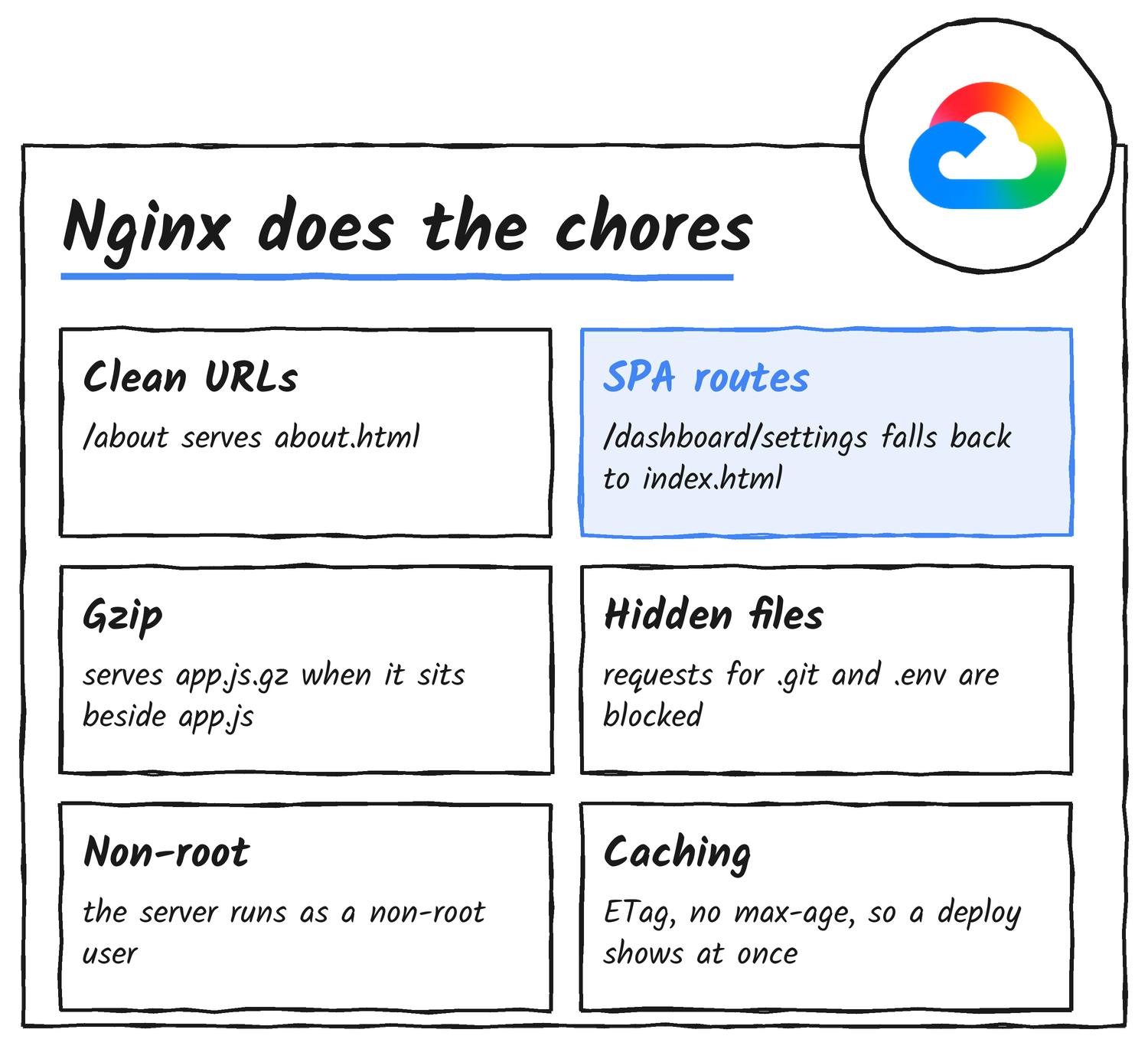
Google’s page lists these built-in behaviours. The only setup is a directory with an index.html file in it.
- Clean URLs. A request for
/aboutis served fromabout.html. - Single-page app routing. A path that matches no file, directory or
.htmlfile gets/index.htmlas a fallback without the browser URL changing, so a client-side router can resolve it. - Compression. Nginx compresses eligible responses on the fly and serves precompressed files (
gzip_static on). A request for/app.jsreturnsapp.js.gzwhen that file sits next to the original and the client accepts gzip. - Security. It sends
X-Content-Type-Options: nosniff, blocks requests for hidden files and directories such as.gitand.env, and runs as a non-root user. - Caching. It sends
ETagandLast-Modifiedheaders and no defaultCache-Control: max-age, so new deployments take effect immediately. - Tuned serving. The Nginx configuration uses
sendfile,tcp_nopush,tcp_nodelayand open-file caching. - Patching. Nginx and OS security patches arrive through automatic base image updates.
How a deploy works
There are two paths, and both take the folder that holds index.html. The without-build path, which Google recommends for prebuilt files, uploads the files onto the static24 base image and skips Cloud Build. The with-build path runs Cloud Build and Google Cloud’s buildpacks, then stores a container image in Artifact Registry before deploying.
gcloud beta run deploy SERVICE \
  --source ./dist \
  --no-build \
  --base-image=static24 \
  --project PROJECT_ID
Dropping --no-build switches to the build path. Both commands use gcloud beta.
The runtime doesn’t scan subdirectories. If index.html sits in dist/ and the command says --source . instead of --source ./dist, the no-build service returns a 403 Forbidden and the build path fails to detect the files.
The recommended path also leans on a second Preview feature. Google’s source-deploy page lists deploying prebuilt source as Preview, limited to Cloud Run services, with no Dockerfile support and a 250 MiB cap on the .tar.gz source archive.
Do .gitignore and .gcloudignore apply to a no-build deploy?
Google’s two pages differ. The Static runtime page says gcloud run deploy respects .gitignore and .gcloudignore, and warns that standard frontend repositories ignore dist/ and build/, so output files can be excluded by accident. The source-deploy page says --no-build ignores .gitignore so local dependencies are included, and that every file in the --source directory, including .env files, private keys and local credentials, is uploaded to Cloud Storage and mounted into the container unless a .gcloudignore excludes it or the deploy comes from a dedicated build output directory.
What it won’t do
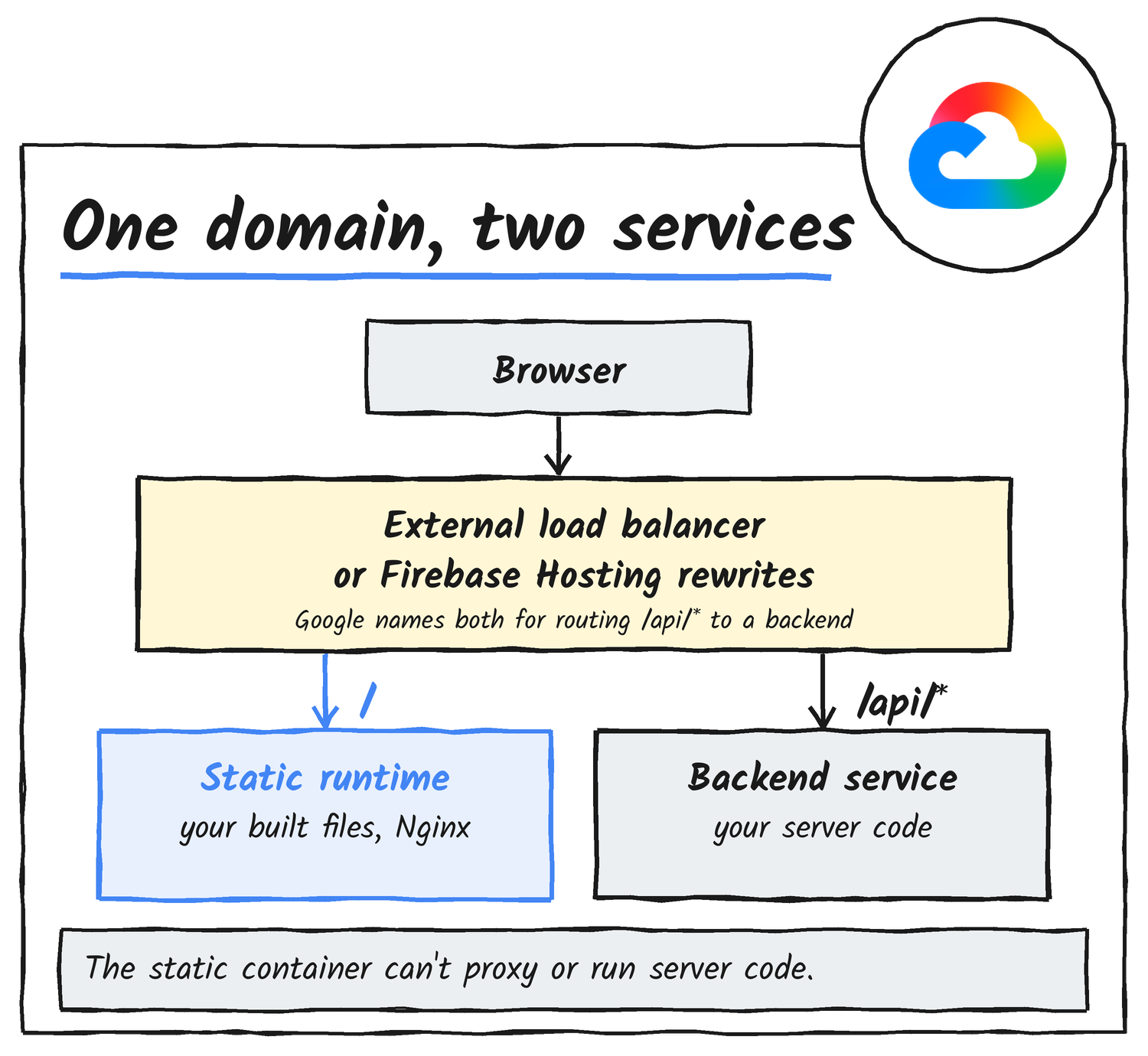
Google’s page says the runtime serves static files only. It doesn’t support custom server-side code, custom nginx.conf overrides or reverse-proxying requests to backend Cloud Run services from inside the container.
For a site with an API on the same domain, Google points to an external Application Load Balancer or Firebase Hosting rewrites to route /api/* to a backend service.
Where it sits among the alternatives
Static hosting on Google’s side already ran through Firebase Hosting and through Cloud Storage behind a load balancer. Outside Google, Cloudflare Pages does the same job. Each vendor measures its free allowance in different units.
Preview
launch stage of the Static 24 runtime
2 million
Cloud Run requests a month in the free tier
250 MiB
cap on a prebuilt source archive
10 GB
Firebase Hosting free transfer a month
| Option | What the vendor’s own page says |
|---|---|
| Cloud Run Static 24 | Preview. Free tier on request-based billing: 2 million requests, 180,000 vCPU-seconds and 360,000 GiB-seconds a month, on us-central1 pricing. No custom nginx.conf, no proxying. |
| Firebase Hosting | 10 GB of storage and 10 GB a month of transfer at no cost. On the Blaze plan, extra storage is US$0.026 a GB and extra transfer US$0.15 a GB. Off Blaze, a site is disabled after a short grace period once transfer passes 10 GB, until the next month starts. |
| Cloud Storage behind a load balancer | Cloud Storage doesn’t support custom domains with HTTPS on its own, so an external Application Load Balancer and an SSL certificate sit in front of the bucket. |
| Cloudflare Pages | Free plan: 500 builds a month, up to 20,000 files per site and 25 MiB per file. |
Past the free tier, Cloud Run’s pricing page lists US$0.40 per million requests, US$0.000024 per vCPU-second and US$0.0000025 per GiB-second of active time at the default rate. Cloud Run’s overview says a service with no minimum instances isn’t charged when nobody is using it. The Static runtime page lists no price of its own.
What came before
Static sites on Cloud Run aren’t new; the container was the chore. Google’s 22 March 2024 post on volume mounts showed the stock NGINX image from Docker Hub serving files from a mounted Cloud Storage bucket. That route needed no custom image, but it needed a bucket, a mount and caching set up by hand, and the post warned that without caching every request triggers a Cloud Storage get request.
The OS-only runtime reached Preview on 18 December 2025 and general availability on 11 February 2026. It already deploys binaries such as Go and Dart onto a base image through the same --base-image flag, and Static 24 applies that idea to web files.
What Google hasn’t published
Static 24 has no general availability date, and the runtime table lists no deprecation date for it. The Static runtime page carries no throughput or latency figures for its Nginx setup and no pricing section of its own.
Discover more from Sulat AI & Tech News
Subscribe to get the latest posts sent to your email.