Katelyn Lesse’s list of four unsolved problems for multiagent systems is a month old. She published it on her own site on 25 October and as an X article on 26 October, so this is a revisit, not breaking news. It’s worth the revisit because her four items (infrastructure, identity, isolation and halting) are a usable checklist, and enough has shipped since to test each one. Each is checked here against what Google, Microsoft, AWS, Vercel and Anthropic have published, before and after she wrote.
Lesse is head of platform engineering at Anthropic and leads the Claude Platform, according to Every’s profile of her. She previously led Connect engineering at Stripe and product engineering at Betterment. Her post is an X article, and the same text sits on her blog.
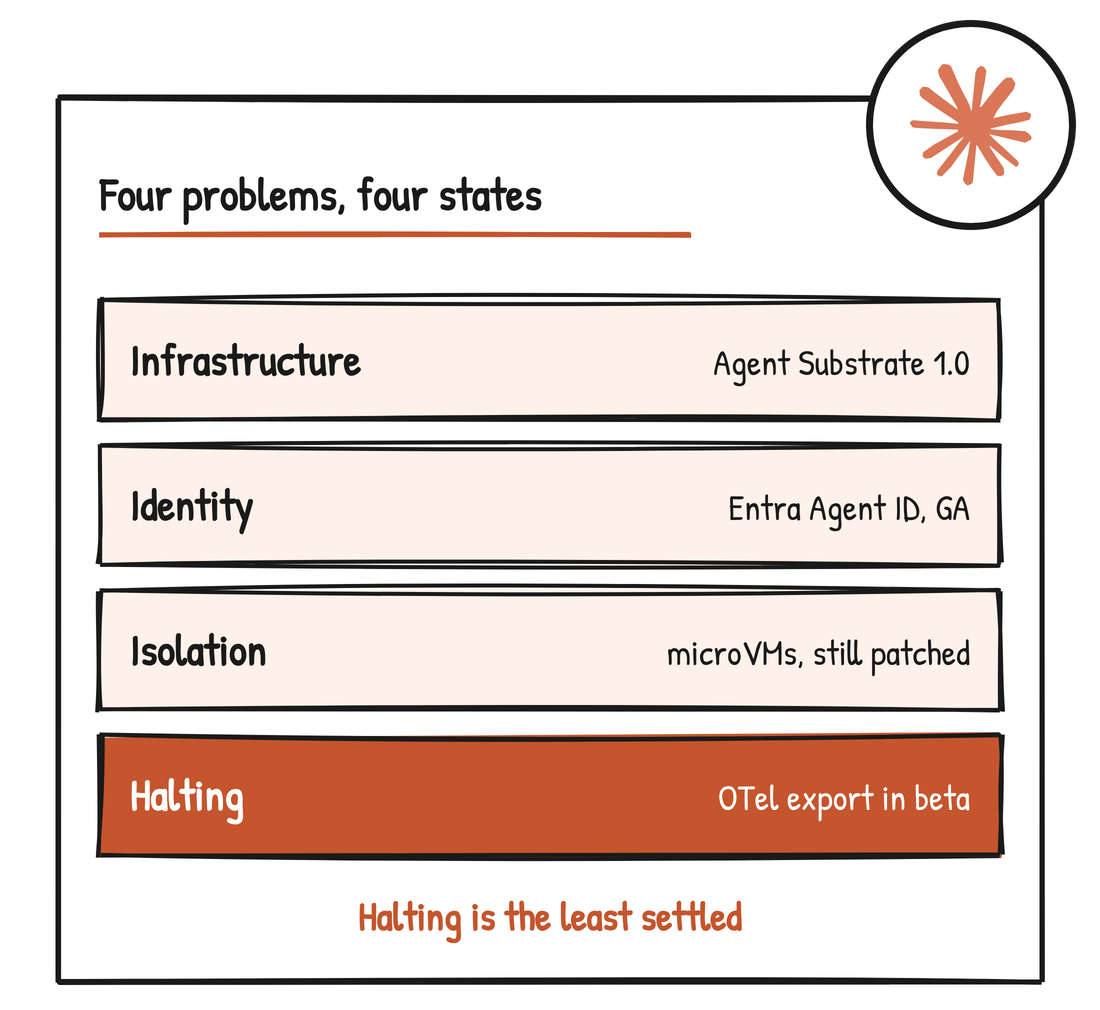
Infrastructure and identity now have shipped products with named limits. Isolation has a strong default in microVMs, but Vercel’s bug bounty showed it still rests on a patched host kernel. Halting is the least settled: Lesse wants kill switches that cut credentials and traces an agent can’t edit, and Anthropic’s own tracing documentation calls its export beta and best-effort.
- What Lesse argued
- What has changed since 26 October
- Infrastructure: agents are not stateless apps
- Identity and access: who did it, and who allowed it
- Security and isolation: what Vercel’s challenge showed
- Monitoring and halting: the open problem
- Who is already running agents at this scale
- What to check before relying on any of it
What Lesse argued
Her case starts from a claim about the job. She writes that “a lot of software engineers are going through what can only be described as an identity crisis”, and that AI can’t deliver what it’s capable of unless engineers solve a specific set of problems. Those problems come from multiagent systems: an orchestrator spawning subagents, or agents given jobs such as grading and advising, and now “thousands of agents, persistently working” on research, discovery and hardware design.
AI just isn’t going to be able to create the incredible outcomes it’s capable of creating unless software engineers solve problems to make it possible.
Katelyn Lesse, head of platform engineering at Anthropic
She names four problem areas, in her words:
- Infrastructure needs to handle burstier workloads, because agents are isolated, stateful, single-instance and often idle.
- Identity and access needs authentication to identify an agent, and authorization to decide what it may do, including when it acts for a human.
- Security and isolation must treat agents as writers of untrusted code and readers of untrusted content, and limit the blast radius of one compromised agent.
- Monitoring and halting needs tracing across agents that no agent can edit, and kill switches that stop the whole system and cut off its credentials.
She doesn’t claim any of these are solved, and her closing line says “so much of this problem space is wide open”. That makes them testable: for each one, the question is what has shipped, who says so, and what it still leaves out.
What has changed since 26 October
| Date | What happened | Why it matters here |
|---|---|---|
| 14 October | Vercel publishes the results of its sandbox bug bounty | The isolation evidence, 11 days before her post |
| 26 October | Lesse posts her X article | The checklist this piece tests |
| 5 November | Google says Agent Substrate reached 1.0, went generally available on GKE and joined the CNCF Sandbox | The infrastructure answer she pointed to |
| 12 November | Anthropic opens a private beta of self-hosted Managed Agents | Sandboxes and credentials move into customer clouds |
| 17 November | Microsoft’s Entra Agent ID page describes the product as generally available | The identity answer from the largest enterprise directory |
| 25 November | The Pragmatic Engineer publishes an episode on how Anthropic builds software, repeating the identity-crisis theme | The message is still circulating a month on |
On 12 November Anthropic opened a private beta of self-hosted Claude Managed Agents, which lets customers run the harness, sandboxes, credentials and session history in their own cloud. The Pragmatic Engineer episode on 25 November repeated her identity-crisis message.
Infrastructure: agents are not stateless apps
Lesse’s claim is that Kubernetes was designed for stateless, replicated apps or stable numbered sets of stateful pods, while agents are “isolated, stateful, single-instance workloads” that go idle for arbitrary stretches. Some need fast starts, others need to avoid wasting compute, and others need scale. She names Google’s Agent Substrate as one effort.
Substrate was already out when she wrote, and it has moved since. Google announced it on GKE on 15 September, and on 5 November it reached 1.0, went generally available on GKE and joined the CNCF Sandbox. It’s open source under Apache-2.0. Its units are an Actor (the agent), an ActorTemplate, a Worker and a WorkerPool, and it snapshots an agent’s memory and files when the agent goes idle, then restores the snapshot onto a warm worker when a request arrives.
Google’s performance claims are its own: 10 times the density, more than 500 activations a second, resume in under 500 milliseconds, and a 200,000-agent benchmark. The GKE documentation is more specific about the limits:
- It needs GKE Standard with control plane and node pools on version 1.37 or later. Autopilot clusters aren’t supported.
- Open network connections, such as database sessions or MCP server connections, aren’t preserved when an agent suspends, so agent code has to reconnect on resume.
- Past roughly 800 concurrent sandboxes on one node, the default Linux limits for file monitoring and the ARP neighbour table need raising.
- Snapshot credentials are issued per Actor, so one agent’s save or restore can reach only its own snapshots.
Substrate isn’t the only answer, and Kubernetes itself has moved. The Kubernetes project described Agent Sandbox, a SIG Apps effort built on a Sandbox resource, in a post dated 20 March. Anthropic’s own design attacks the start-up problem a different way. Its engineering post says that once the harness stopped living inside a container, and containers were provisioned only when a tool call needed one, median time to first token fell about 60% and the 95th percentile fell over 90%.
| Option | Isolation unit | Notable detail | Status |
|---|---|---|---|
| Google Agent Substrate | Container or microVM runtime, per Actor | Snapshots memory and files on idle, restores on request | 1.0, GA on GKE Standard 1.37+, CNCF Sandbox |
| Kubernetes Agent Sandbox | Sandbox resource | A Sandbox custom resource for isolated agent workloads | SIG Apps project, announced 20 March |
| Vercel Sandbox | Firecracker microVM | Per-workload guest kernel | Public bounty run in August and September |
| Docker Sandboxes | microVM with its own kernel per agent | Cloud sandboxes cost US$0.07 to US$1.12 an hour, per Docker | Covered in our Docker report |
| Anthropic Managed Agents | Sandbox as a tool the harness calls on demand | Brain, hands and session are separate parts | Beta; self-hosted in private beta |
Identity and access: who did it, and who allowed it
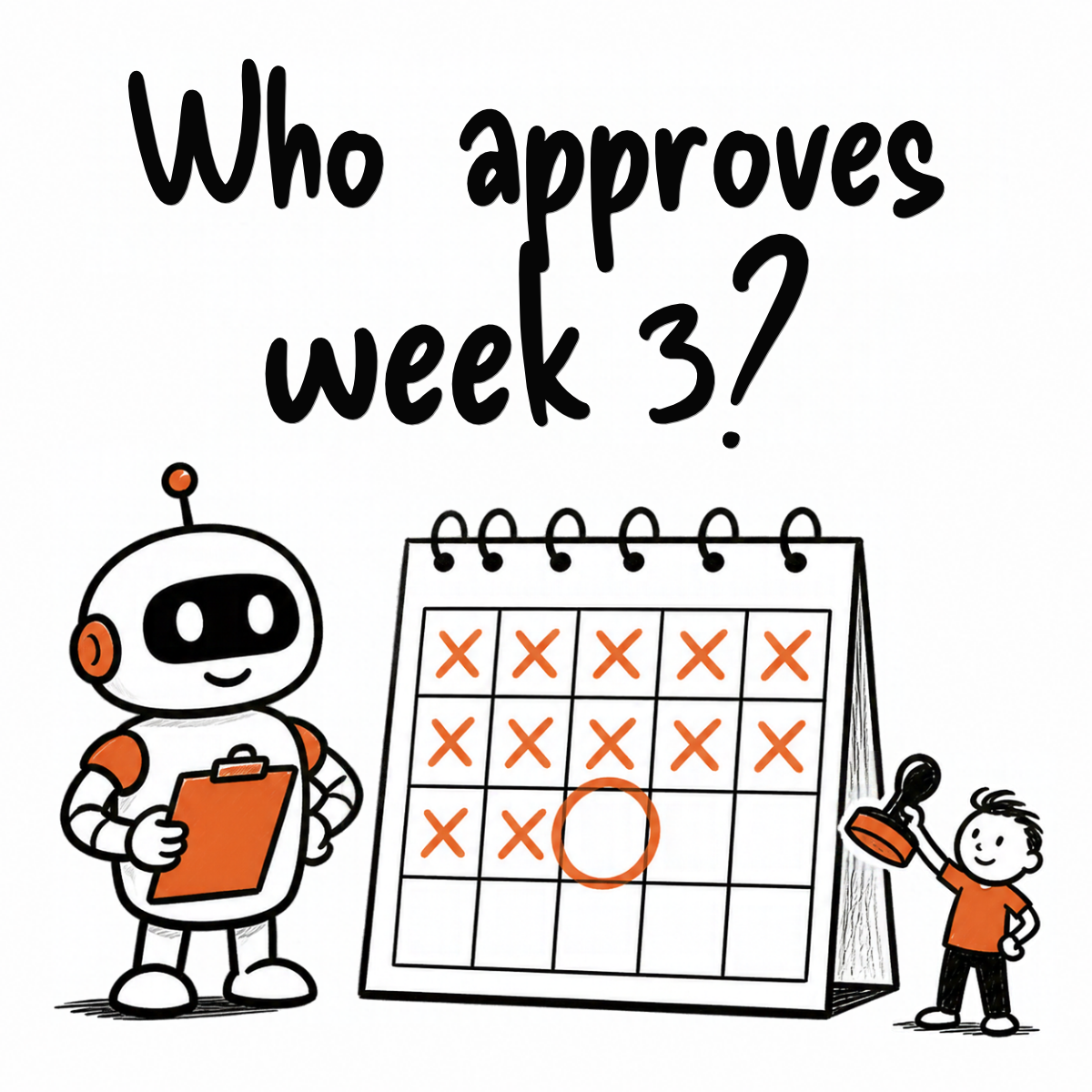
Lesse splits this in two. Authentication, identifying the agent that acted, can lean on workload identity with short-lived certificates instead of static keys, a pattern from microservices. Authorization is “much more wide open”. Many agents act on behalf of a person using that person’s credentials, which makes it hard to tell the agent from the human in the logs. And if a system runs for weeks, she asks, “how does the human meaningfully approve what their agent can do?”
On authentication the building blocks are visible in shipped products. GKE’s Substrate docs say it needs the Pod certificate and trust bundle APIs that GKE serves from version 1.37. Microsoft’s Entra Agent ID page, dated 17 November, says the product is now generally available. It lists three newer features in preview: sign-in for local agents using the authorization code flow with PKCE, blueprints that can make one Agent ID or a fleet per tenant, and Client ID Metadata Documents so MCP clients can reach Entra-protected servers without prior registration.
Other vendors document the on-behalf-of case directly. AWS publishes an on-behalf-of token exchange for AgentCore, and Google documents an agent identity for its Gemini Enterprise Agent Platform. The headline items on Microsoft’s page are sign-in, blueprints and client registration. Consent that holds up over a multi-week run, and one agent deciding whether to trust a request from another, aren’t among them, which matches where Lesse says the work is.
Guidance on limiting an agent is in the same territory. The OWASP guide we covered earlier limits an agent to the overlap of permission, capability and intent, which is a narrower rule than a human approving each step.
Security and isolation: what Vercel’s challenge showed
Lesse’s argument here has two parts. Vulnerabilities in core software such as kernels, browsers, runtimes and common libraries have been surfacing “faster than the industry can patch them”, and thousands of persistent agents writing untrusted code sit on top of that software. Then there’s the multiagent twist: a compromised agent can pass injected instructions to its peers, or into memory that later agents trust. Her answer is strongly isolated, sandboxed execution, and she wrote more on it in an earlier post on secure agent architecture and sandboxing.
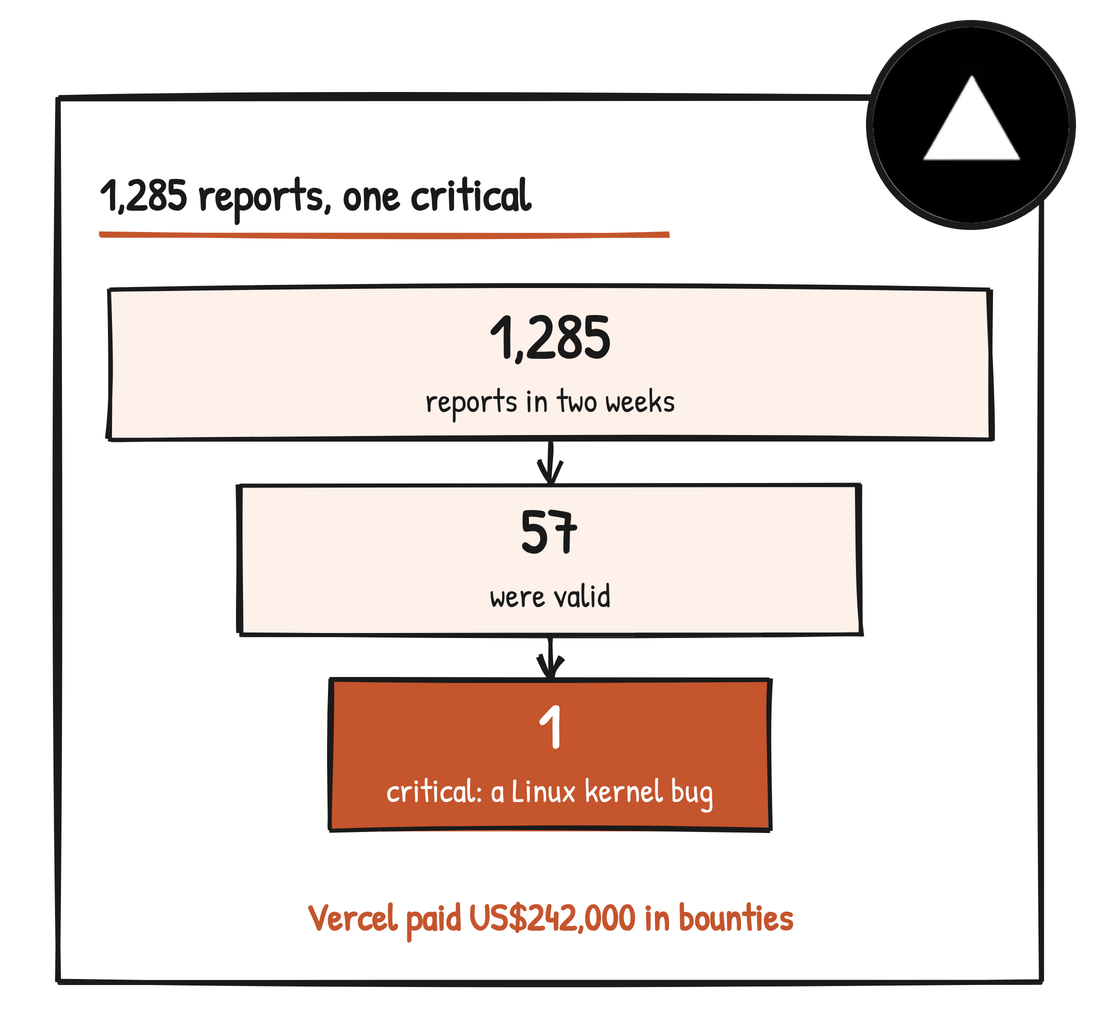
The best public test of that stack is Vercel’s sandbox challenge, which ran from 18 August to 1 September against its Firecracker microVM sandboxes. Vercel’s findings post, dated 14 October, gives the numbers.
1,285
reports in two weeks
57
valid, of which 1 critical and 5 high
877
were duplicates
US$242k
paid in bounties
The most serious report came on day three from Paulos Yibelo of pwn.ai, a HackerOne researcher. He found a defect in the Linux kernel’s networking stack that let specially crafted packets sent from inside a microVM leak host memory over the network, crash the host or execute code on it. Vercel says the memory leak was demonstrated against its production sandboxes. It says no report showed anyone reading a customer’s files, secrets or application data.
Vercel drew three lessons that apply well beyond Vercel:
- Stop trusting the guest. Its control plane accepted values returned by software inside the microVM, and every such value is tenant input. Anything crossing the boundary should be derived server-side or signed with a key the guest can’t reach.
- One policy, one decider. Egress rules were split across subsystems that each parsed the same network policy and didn’t always agree.
- Assume the next zero day. Keep host and guest kernels current, shrink the kernel attack surface, disable nested virtualisation and use Firecracker’s jailer to restrict each microVM process.
This supports Lesse’s first point and qualifies her answer. A microVM gives each tenant a separate guest kernel, and the bounty found its worst bug in the shared host networking path anyway. Her second point, a compromised agent seeding shared memory, has no counterpart in these results, because the challenge tested escapes from the sandbox and not agent-to-agent trust.
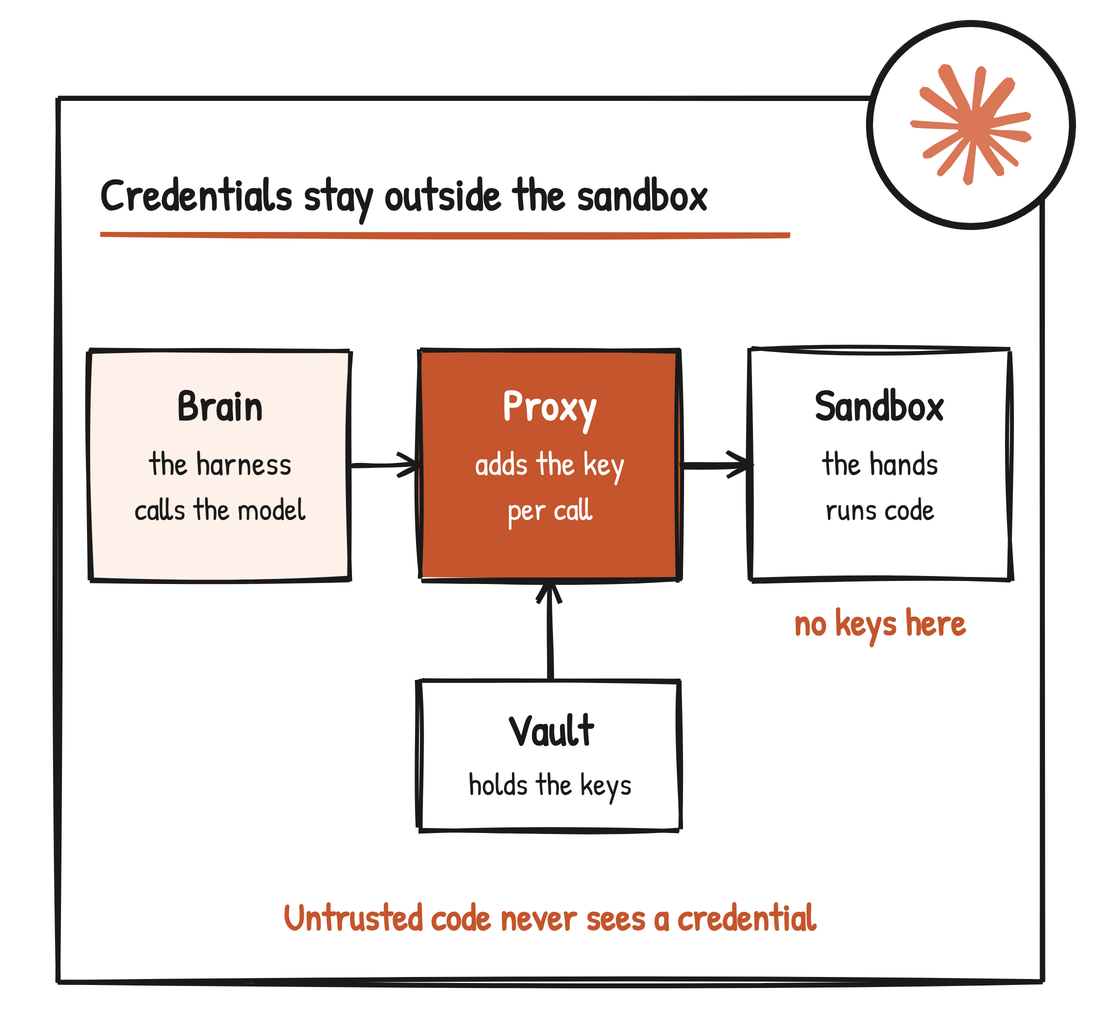
Anthropic’s published design addresses a different layer. In its Managed Agents engineering post, it describes the harness, the session log and the sandbox as separate parts. Credentials are never reachable from the sandbox: Git tokens are wired into the remote at start-up so push and pull work without the agent handling the token, and MCP calls go through a proxy that fetches OAuth tokens from a vault. The post gives the reason plainly: when code and credentials shared a container, a prompt injection only had to convince Claude to read its own environment.
Anthropic’s other published containment example is its 1,000-agent Fermat run. As we reported from Lance Martin’s talk, each agent got its own lightweight VM with no network access beyond a gateway to the Claude API, Git and a shared database, and a blocking classifier checked every tool call. One shared machine hit its limits at about 100 agents, and more than half of Anthropic’s 100-agent runs were stopped or restarted. Peers publish too: Baseten says it holds 100+ GPU clusters on 20+ clouds to four trust boundaries and per-cluster credentials.
Monitoring and halting: the open problem
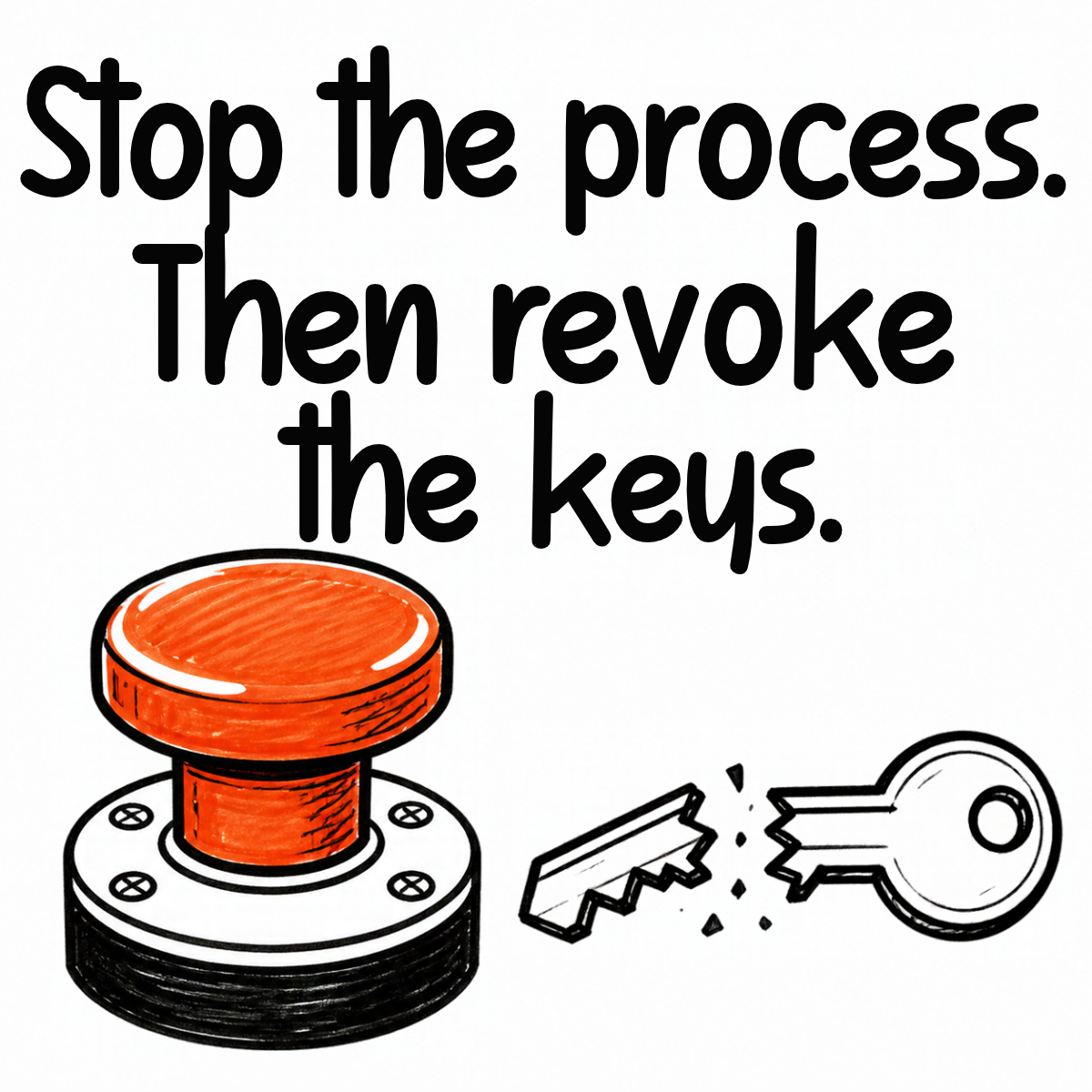
Lesse asks for OpenTelemetry tracing across agents, with a guarantee that an agent “can never modify its own trace or another agent’s trace”, and for kill switches that monitoring can trigger, “that truly stop the whole system at once and cut off its creds”. She adds that the hard part is knowing when a system is heading the wrong way, because well-intentioned persistence “can look a lot like maliciousness”, such as repeated attempts to reach a domain that isn’t on its allowlist.
The public record is thinnest here. Anthropic’s OpenTelemetry documentation describes its export as beta and best-effort, and notes that spans can be suppressed through the sampled flag on the incoming traceparent. The OpenTelemetry generative AI semantic conventions are still at Development status. On GKE, the Substrate limitations page lists TLS as unsupported in Managed OpenTelemetry for GKE.
None of those facts says an agent can edit its own trace, and none says it can’t. They show that the tamper-resistance Lesse asks for is a requirement to design for and not something the documentation promises.
On kill switches, Anthropic’s vault-and-proxy layout makes revocation a vault operation, because the sandbox never held the keys. That is an inference from the architecture: the post doesn’t describe a kill switch, and a stopped process leaves any credential it already minted valid until someone revokes it.
Who is already running agents at this scale
The scale Lesse describes isn’t hypothetical. Stanford Medicine’s Virtual Biotech, led by associate professor of biomedical data science James Zou, put tens of thousands of agents to work on drug discovery, and Nature puts it at as many as 37,000 agents reporting to a “chief scientist”. Stanford says they catalogued some 50,000 clinical trials in under a week. In one finding, reported in Science, drugs aimed at switch-like genes were 48% more likely to reach market and had 32% fewer adverse events than those with broad activity.
Stanford says the next step is to test the new findings in real labs. Nature reports the system ran on Claude, and Zou told it that any capable language model would do. A system that size depends on the same scheduling, identity, isolation and halting layers Lesse lists, and the reported results say nothing about how any of them held up.
What to check before relying on any of it
A five-point check for teams running long-lived agents
1. Host kernel patching. Vercel’s worst bug sat in the host kernel. Find out how fast the host kernel under your sandboxes gets patched.
2. Where credentials live. If the sandbox can read its own environment, a prompt injection can too.
3. Revocation, not just a stop. Confirm a kill switch revokes minted tokens and doesn’t only end the process.
4. Trace ownership. Check whether an agent, or its sandbox, can drop or alter its own spans.
5. Resume behaviour. Substrate doesn’t preserve open connections on suspend, so test reconnection to databases and MCP servers.
Tallied against the evidence, two of Lesse’s items have shipped products with stated limits, one has a strong default that a recent bounty tested, and one is still mostly a requirement. Anthropic moved the next step to customers on 12 November, when it opened a private beta that lets them run the sandboxes, credential vault and session history in their own cloud.
Sources: Katelyn Lesse / Lesse on sandboxing / Anthropic, Managed Agents / Google Cloud, Agent Substrate 1.0 / GKE Agent Substrate docs / Vercel challenge findings / Microsoft Entra Agent ID / Anthropic OpenTelemetry docs / Science, Virtual Biotech
Discover more from Sulat AI & Tech News
Subscribe to get the latest posts sent to your email.