Thorsten Ball, who works on the coding agent Amp, posted a note on X on 26 November listing 14 habits he says stop people getting value from coding agents. The list includes reading every diff line by line, hiding production logs from the agent, treating model choice as a fidget toy and worrying about how full the context window is.
Most of it isn’t new. Ball and Amp co-founder Quinn Slack have said versions of these points on Amp’s podcast and in Ball’s newsletter over the past year, and some of the earlier statements point the other way. I’ve set each habit against that record, then against how Andrej Karpathy, Addy Osmani, Simon Willison, Armin Ronacher and others have moved. Our earlier coverage covers Amp’s weekly meeting, the model selector that replaced its Dial, Boxes and running Amp on a WordPress VPS.
14
habits in Ball’s note
21
people on Amp’s team, per the 20 October episode
~90
deploys a day, same episode
7.7 min
from main to live, same episode
- What the note says
- What Ball and Amp said before
- What other voices have changed
- Selected readings from Ball and Slack
- Amp’s own model reversal
- The wider field
- Where the advice fits
What the note says
The note is an image of 14 short items, each something people do that Ball says wastes what an agent can do. I transcribed it and grouped the items into five themes of my own: prove it, close the loop, models and tools, make it legible, and work habits. Models and tools is the biggest group, with four items.
| Habit, in his words | Theme | His point |
|---|---|---|
| 1. “Review code before the agent even ran it and tested it.” | Prove it | Let the agent run and test the change before anyone reads it. |
| 2. “Think that reviewing code line by line in a diff viewer is the only way to gain confidence.” | Prove it | Confirmation tests, videos of end-to-end runs, an 8×8 test matrix with screenshots, visualisations, traces, logs, benchmarks and audit trails. “Agents can give you all of that now.” |
| 3. “Use model picking as a fidget toy.” | Models and tools | “Busywork.” He can’t prove it’s useless, but you also can’t prove it does anything. |
| 4. “Blindly throw massive amounts of skills and tools at an agent,” | Models and tools | He mocks the line “I use the write-good-code skill”. |
| 5. “Give the agent no way to exercise the codebase.” | Close the loop | “Maintenance shafts for agents”: build tooling and scripts just for the agent. |
| 6. “Use cheap models without running the numbers.” | Models and tools | Ask how many more turns the cheaper model needs than Opus 5.5. |
| 7. “Treat the agent like an autonomous typewriter.” | Close the loop | Build, verify end to end, ship, watch the error rate, alert on a spike, turn it on for yourself, then the team, then raise the rollout in 10% steps. “Yes, that works now.” |
| 8. “Hide production logs and errors from the agent.” | Close the loop | “It’s done when the agent has verified in production that it works.” |
| 9. Say “It feels like they nerfed the model.” | Models and tools | “Learn how LLMs work.” |
| 10. “Keep “how things are done” only in your head.” | Make it legible | Storybooks and style guides, in the codebase and not in prompts. |
| 11. “Manually split up work for agents.” | Work habits | “The current frontier models are fantastic at dividing up and tackling big problems.” |
| 12. “Run agents only on your laptop.” | Work habits | “Agents sing in headless machines.” |
| 13. “Worry about what % of the context window is used.” | Work habits | “Compaction works now. Use it. Not manually.” |
| 14. Think “the agent can’t write the code I can write” and do nothing about it. | Make it legible | It can write “tremendous tooling to help you write better code.” |
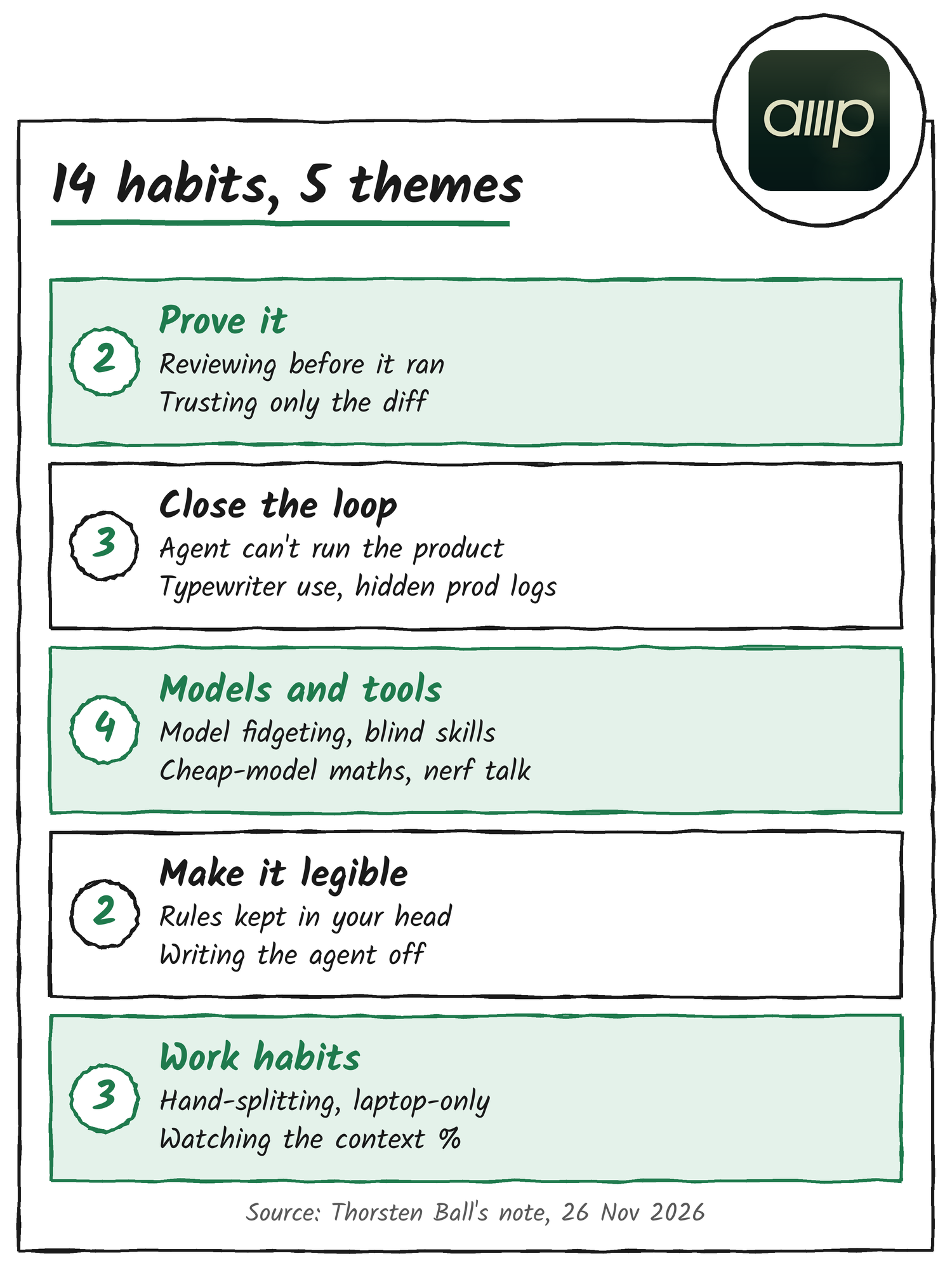
The first two items carry the most weight. Ball doesn’t tell people to stop reading code. He says reviewing before the agent has run and tested the change is backwards, and that a diff viewer is one route to confidence among several. The evidence he lists is specific, and every item on it is something the agent can produce on request.
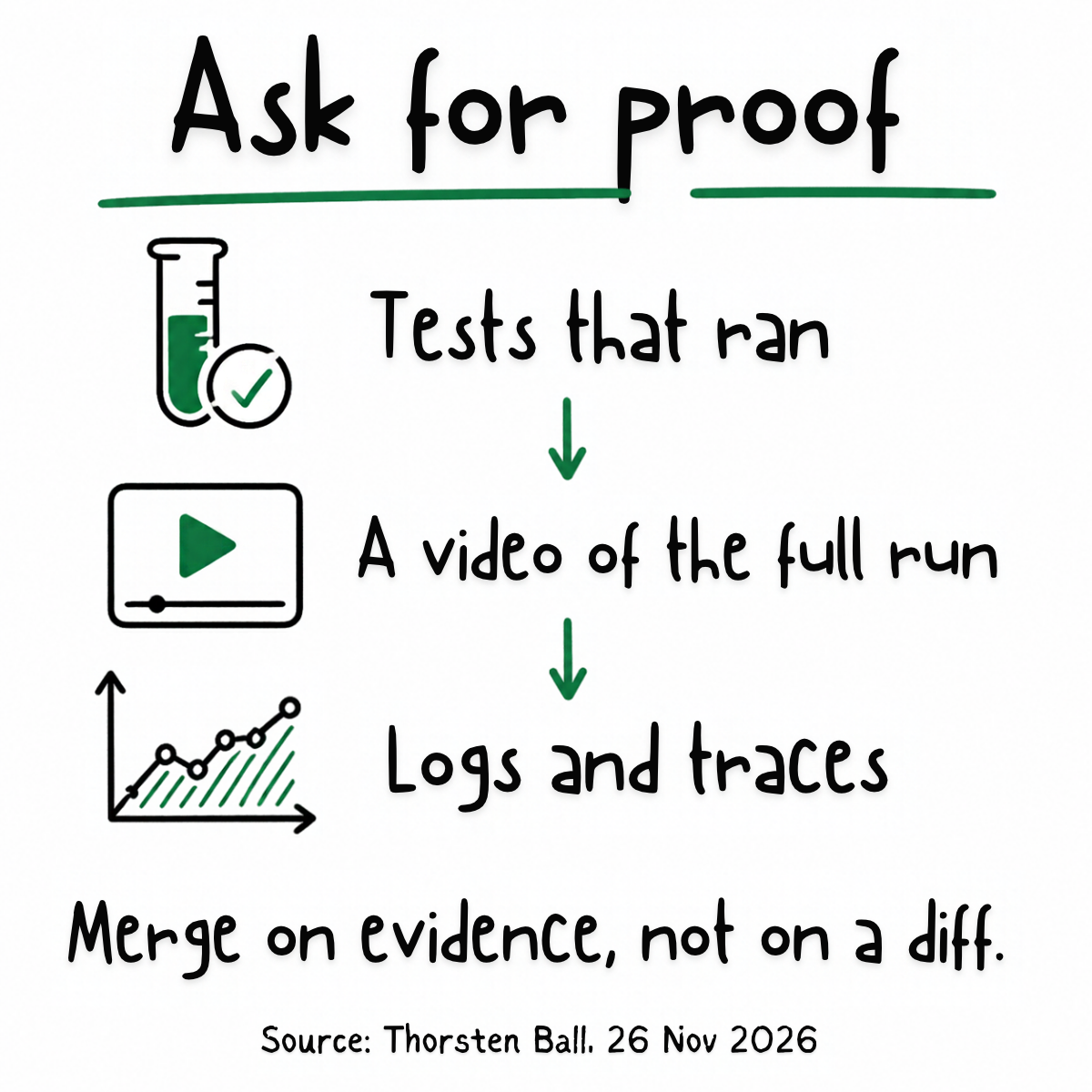
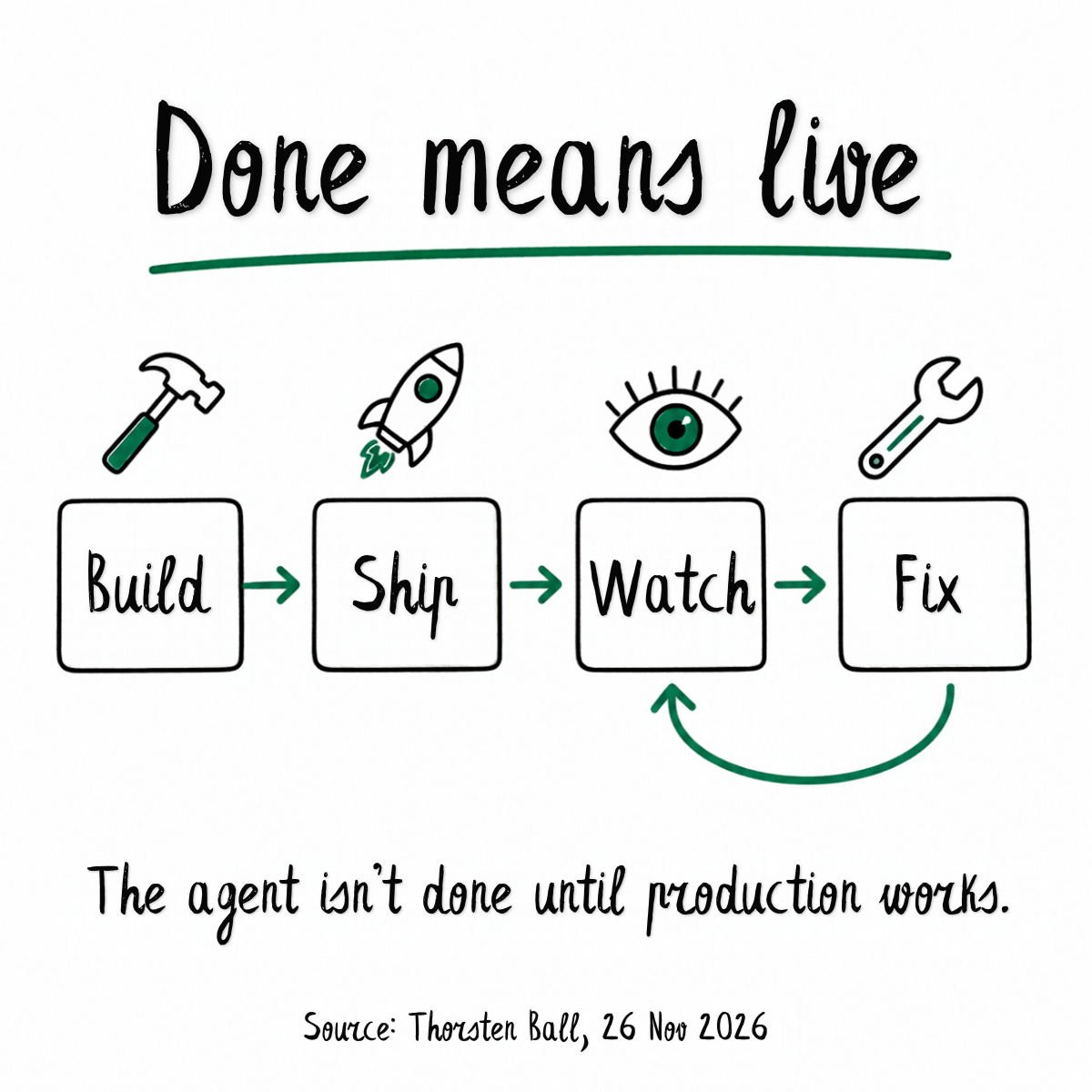
Items 5, 7 and 8 describe a workflow rather than a habit. Give the agent scripts that exercise the codebase, let it ship behind a staged rollout, and let it read production logs. The end state, in his words, is “It’s done when the agent has verified in production that it works.” That only works if the surrounding machinery exists: feature flags, fast deploys and error monitoring someone trusts. Amp describes that loop, with about 90 deploys a day and 7.7 minutes from main to live on a team of 21, according to season 2, episode 6 of Amp’s podcast.
Four items go after model and tool fiddling: switching models for sport, piling on skills, picking cheap models without counting turns, and blaming “nerfed” models. Item 6 is the only one that points to a test anyone can run. Count the turns and the tokens the cheaper model burns on a real task, against the dearer one, before deciding which is cheaper.
Items 10 and 14 say the same thing from two ends. Put how things are done into the codebase, and have the agent write the tooling you wish you had. Items 11 to 13 treat splitting work by hand, laptop-only runs and context-percentage anxiety as leftovers from weaker models.
What Ball and Amp said before
The note compresses a year of shifting positions. Here they are in order, with Amp’s own pages as the source.
| Date | Source | What was said |
|---|---|---|
| 28 Mar 2025 | Raising an Agent, S1 ep 3 | Amp’s own description of the episode: “reviews are still very much needed when using AI to code”. |
| 15 Apr 2025 | How to Build an Agent | Ball: “It’s an LLM, a loop, and enough tokens.” A working agent in under 400 lines of code. |
| 14 May 2025 | S1 ep 5 | Slack: “If there’s 10 times as much code being written, you think humans are gonna do a good job of reviewing all that?” |
| 22 Jan 2026 | S1 ep 9 | Ball: “the assistant is dead, long live the factory”. Slack: having no model selector lets Amp switch to the best model. |
| 25 Jan 2026 | Joy and Curiosity #71 | Ball: “But do I know every line of code? Not if I don’t have to.” He tests it every way and spot-checks. |
| 19 Feb 2026 | The Coding Agent Is Dead | Amp: “The current generation of coding agents is dead.” Editor extensions to self-destruct on 5 March, 8pm Pacific. |
| 17 Jul 2026 | S2 ep 1 | Ball: “I’m never gonna manage context manually again.” The episode is titled “The Local Dev Env is Dead”. |
| 27 Jul 2026 | Time Capsule 1 | Slack: “it’s very rare that I will ship something without reviewing the code”. He dictates 95% of his prompts. |
| 25 Sep 2026 | S2 ep 5 | Ball: “Don’t wait for your agent. You’re wasting time. Let them wait for you.” Slack: “code review, in so many companies, it’s a farce now. Nobody can review the volume of code”. |
| 13 Oct 2026 | Time Capsule 6 and docs page | Ball asks for “irrefutable proof that it works” and says “I don’t read all the code and for a lot of changes I don’t read it at all.” |
| 20 Oct 2026 | S2 ep 6 | Slack: “there is no mandatory pull request, code review by another human.” |
| 8 Nov 2026 | Joy and Curiosity #105 | Ball: “the game has changed three times this year”. |
| 12 Nov 2026 | Bye Bye, Dial | Amp drops the Dial for a model selector. |
| 26 Nov 2026 | Ball’s note | 14 habits, including “Use model picking as a fidget toy.” |
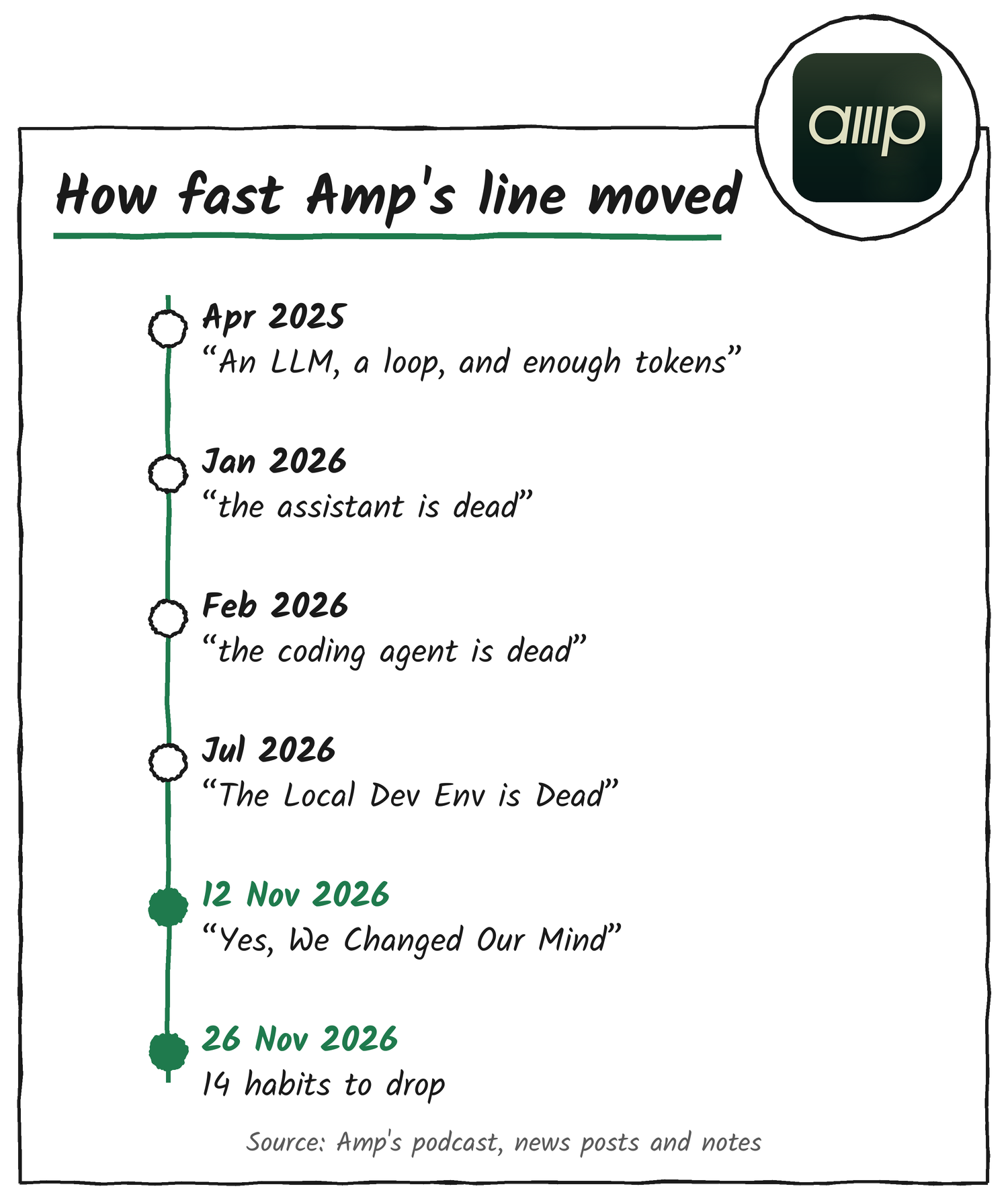
In his 8 November newsletter Ball names the three changes. The first was going all-in on remote development in orbs, Amp’s remote environments. The second was asking for “irrefutable proof”, which he calls the 10x game changer: “If there’s a 10x game changer, it’s this one”. The third was letting the agent control the whole software lifecycle, because “The models have become too good to keep them boxed in as smart typewriters.” The note’s item 7 repeats that last phrase almost word for word.
Some earlier Amp lines cut against the note. In March 2025 Amp’s own episode description said reviews were still very much needed. In July 2026 Slack said he rarely ships without reviewing the code. Both sit awkwardly beside item 2, though neither is a contradiction: Slack reviews his own work, and Ball doesn’t say nobody should.
What other voices have changed
Karpathy’s 26 January post is the cleanest before-and-after in the sweep. He wrote that he went from “80% manual+autocomplete coding and 20% agents in November to 80% agent coding and 20% edits+touchups in December”. In the same post he said that for code you care about, he’d “watch them like a hawk, in a nice large IDE on the side”, and called the agent-swarm and no-IDE hype “too much for right now”.
| Voice | Earlier | Latest |
|---|---|---|
| Andrej Karpathy | 26 Jan 2026: 80% agent coding, but “watch them like a hawk” for code you care about. | Apr 2026, Sequoia Ascent: “Vibe coding raises the floor. Agentic engineering is about extrapolating the ceiling.” (as reported by Mavday) |
| Addy Osmani | 28 Jan 2026: The 80% Problem on comprehension debt, citing Faros AI data on review load. | 28 Sep 2026: The Code Nobody Reads: “you don’t need to read all the code”. |
| Simon Willison | Mar 2025: not all AI-assisted programming is vibe coding. | 6 May 2026: the two are getting closer than he’d like. 19 Nov 2026: in a Turing Post interview he dates the coding-agent inflection to November 2025. |
| Armin Ronacher | Dec 2025: in his own Pi sessions the 90th-percentile run took about 2.5 minutes with Opus 4.6. | Nov 2026, AI Engineer CODE talk: about 14 minutes with newer models, with the harness unchanged for a year. |
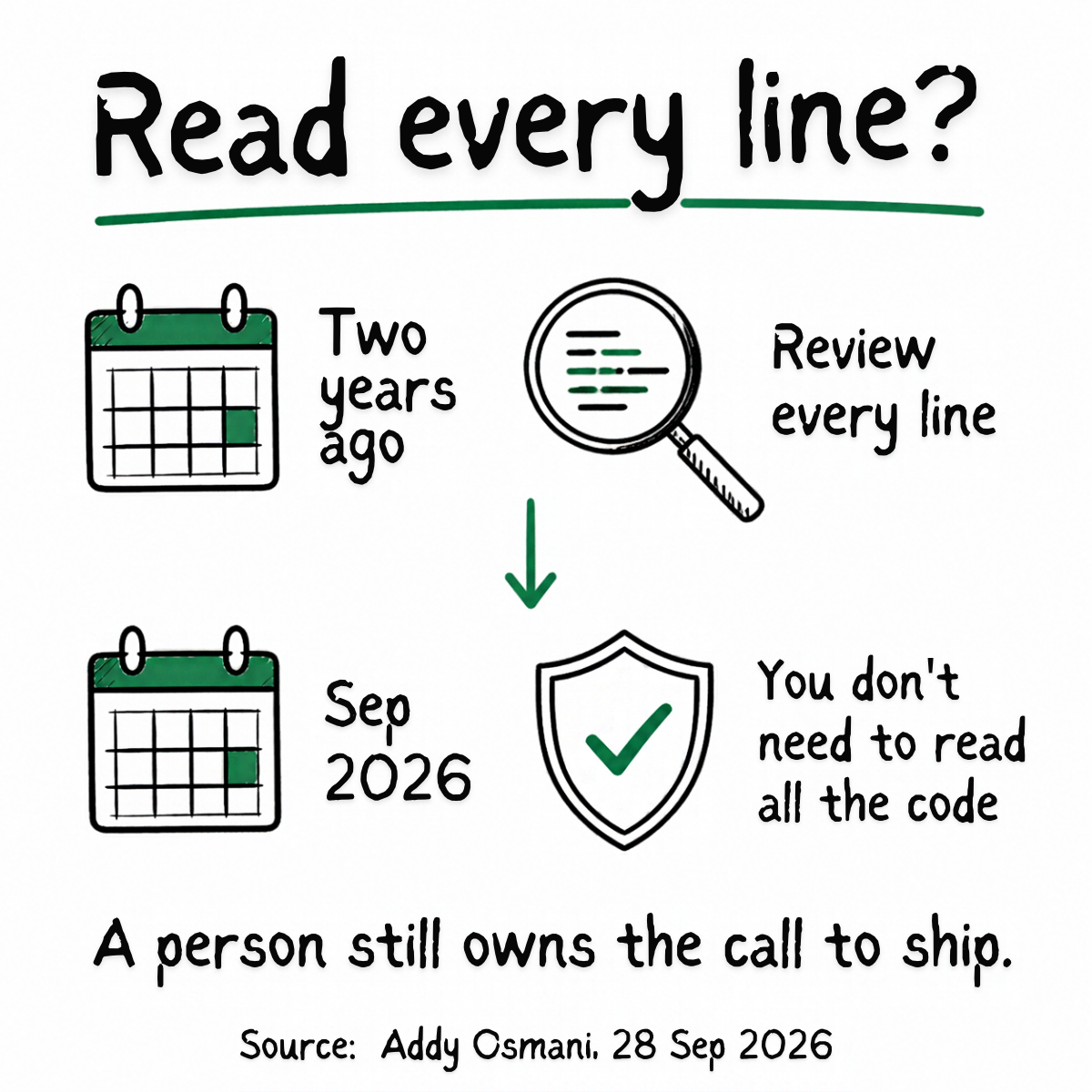
Osmani’s move is the one that most directly mirrors Ball’s. In September he wrote: “Two years ago I wrote an essay about AI-assisted coding, and one of my tips was to review every line of generated code. I’d give that advice very differently today.” He then drew a line short of Ball’s: “Every change still needs some review and every change still needs a person who owns the decision to ship it.” He keeps line-by-line reading for regulated and safety-critical software.
Ronacher supplies the closest thing to data. In his own Pi sessions, a summary of his talk by Orply reports corrections per 100 prompts falling from 8.8 with GPT-5.3 Codex to 1.0 with Opus 5.5, and aborts from 13.1 to 7.2. The talk’s own page calls these observations from his usage, not a controlled benchmark. He also started 141 repositories and kept 10 to 15 in regular rotation, which is his evidence that human attention, not output, is the limit.
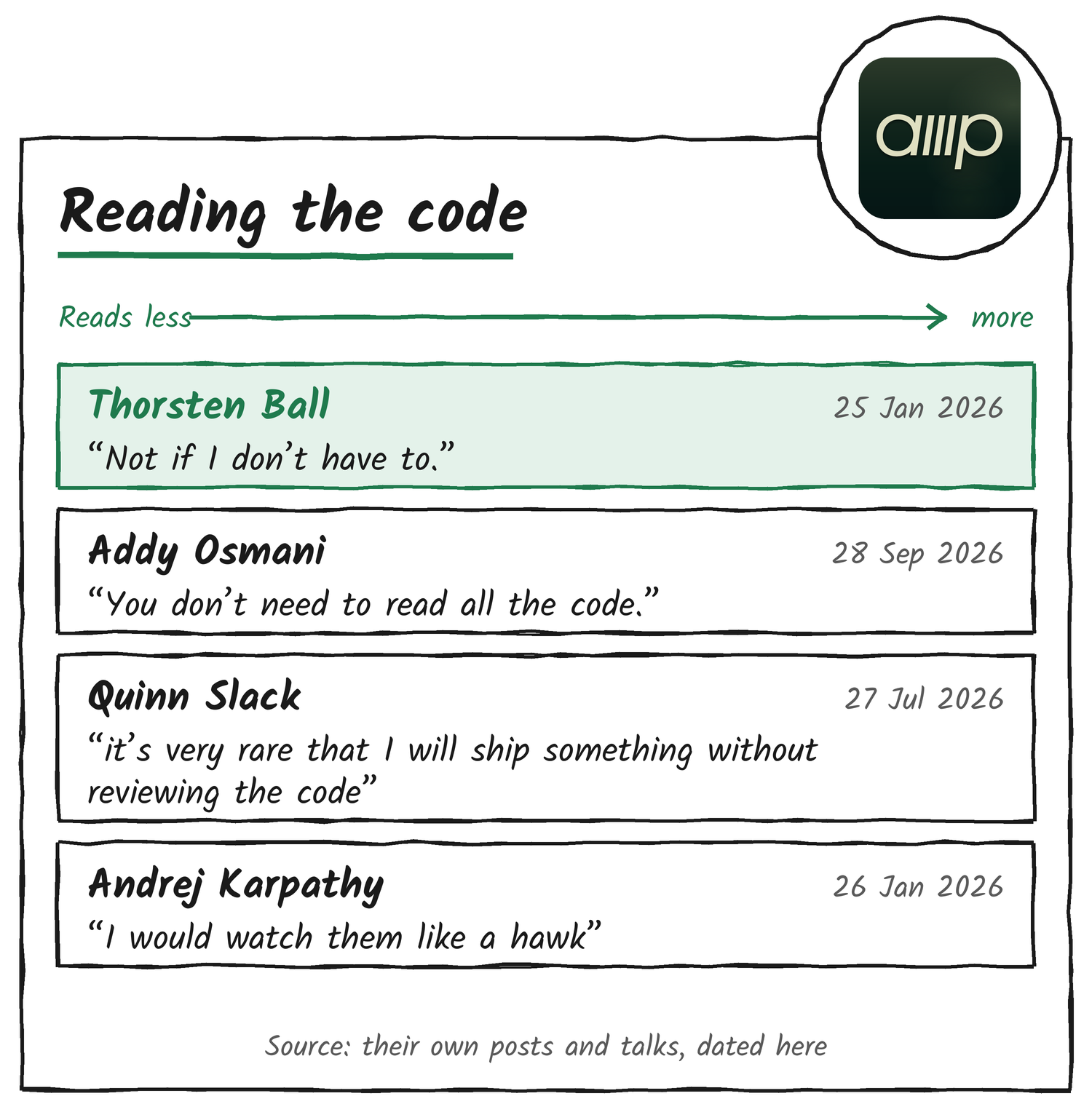
| Question | Ball | Others |
|---|---|---|
| Do you read the code? | Mostly no. He wants proof the agent produced. | Karpathy (Jan): watch “like a hawk”. Osmani (Sep): some review, and a person who owns the ship decision. Slack (Jul): rarely ships unreviewed. |
| Run many agents at once? | Let the agent divide big problems; don’t wait on it (item 11). | Kent Beck (Apr): “Nobody wants agents. Nobody wants agent swarms.”, as reported by Mavday. Karpathy (Jan): swarm hype too much for now. Mitchell Hashimoto (Feb): “always have an agent running in the background”, per Pragmatic Engineer. |
| Does model choice matter? | Picking is a fidget toy. | Ronacher’s sessions show corrections falling by model generation. That compares generations, not day-to-day switching, so it doesn’t test Ball’s claim directly. |
| Can checks replace review? | Yes: proof first, then verification in production. | Geoffrey Huntley (12 Nov): “Engineer away much of the need for code review with checks like these”, in the answer to ai is engineering. |
Selected readings from Ball and Slack
If you read nothing else behind the note, read these. Each is verbatim and links to the full page.
But do I know every line of code? Not if I don’t have to.
Thorsten Ball, Joy and Curiosity #71, 25 January 2026
That post asks whether you have to know every line your agent writes. Ball tests the change every way he can and spot-checks, and keeps a mental list of areas that earn closer reading: data storage, anything boxed in, security, and anything that touches other functionality. It’s the template for the 26 November note, ten months earlier.
I don’t read all the code and for a lot of changes I don’t read it at all.
Thorsten Ball, How Thorsten Ball uses Amp, October 2026
The same page says he asks the agent to test everything and to give him “irrefutable proof that it works”, and that he hasn’t developed locally in eight weeks. The matching video has chapters titled “Give Me Irrefutable Proof”, “Review Only Load-Bearing Code”, “Make the Codebase Legible”, “Let Agents See Production” and “Push to Main, No PRs”. Those five chapter titles are the note’s themes, a month early.
Don’t wait for your agent. You’re wasting time. Let them wait for you.
Thorsten Ball, Raising an Agent S2 ep 5, 25 September 2026
That episode also describes a shift from a vertical view of the job (one agent, one task) to a horizontal one that covers the whole software lifecycle. It’s the episode where Slack says code review, “in so many companies”, is “a farce now”.
If there’s 10 times as much code being written, you think humans are gonna do a good job of reviewing all that?
Quinn Slack, Raising an Agent S1 ep 5, 14 May 2025
it’s very rare that I will ship something without reviewing the code
Quinn Slack, Time Capsule 1, 27 July 2026
Slack’s two positions fit together better than they first read. He has doubted since May 2025 that humans can review the volume agents produce, and in September said many companies’ review is a farce because nobody can review that volume. Yet he still reviews his own code, and on 20 October he said “there is no mandatory pull request, code review by another human” at Amp. Ball’s note sits to the right of him: Slack reads code, Ball reads less, and neither requires anyone else to.
Amp’s own model reversal
Item 3 is where the record bites hardest. On 12 November Amp dropped the Dial and its four modes, low, medium, high and ultra, and replaced them with a model selector. Amp’s own page is blunt: “Yes, We Changed Our Mind.” It says it explained in January why Amp has no model selector, shipped the Dial in July, then added bring-your-own subscriptions and keys, which made it hard to tell who was paying for which model.
Fourteen days later, Ball called model picking a fidget toy. The two aren’t strictly in conflict. Amp’s reason for the selector is billing clarity, and new threads start on Staff Pick, which is Claude Opus 5.5 today, so nobody has to choose. Models can also be switched mid-thread now, at the price of an uncached first message after the switch. But the plain reading is that the company’s product now has a model picker and its own engineer is telling users not to play with it. Our earlier piece on the selector covers the product change.
The wider field
Amp isn’t the only team that has stopped treating the diff as the main gate. The table sets out how others handle proof and review, so you can see how far Ball’s note sits from the pack.
| Who | How they handle proof and review | Source |
|---|---|---|
| Amp | Team of 21, no mandatory human review, about 90 deploys a day, 7.7 minutes from main to live, feature flags. | S2 ep 6, docs page |
| Anthropic (Boris Cherny) | 20 to 30 pull requests a day across five parallel Claude instances. Verification layers include Claude reviewing its own code, automated lint rules, best-of-n passes and human review. | Pragmatic Engineer, 4 Mar 2026 |
| Geoffrey Huntley | Automated checks in place of much human review. | 12 Nov 2026 |
| Addy Osmani | Review stays, but a person owns the ship decision. Regulated software keeps line-by-line reading. | 28 Sep 2026 |
| Faros AI data | High-adoption teams merged 98% more pull requests while review time rose 91%, as Osmani cites them. | 28 Jan 2026 |
A merge checklist built from Ball’s evidence list
This is my adaptation, not Ball’s. It turns the evidence he names into a request you can paste into an agent’s task.
- Run the confirmation tests and show the output.
- Record an end-to-end run and attach it.
- Show the traces and logs for that run.
- Report benchmarks before and after, where speed could change.
- Name the load-bearing parts a person should still read: data storage, security, and anything touching other features.
- Irrefutable proof
- Ball’s phrase for evidence an agent produces that a change works, so the reader checks the evidence instead of the code.
- Compaction
- The agent summarising older conversation to free space in its context window.
- Dial
- Amp’s four-mode control, retired on 12 November. Low ran GLM-5.3-Flash, medium Claude Opus 5.5, high GPT-6 Astra and ultra Claude Fable 5.2.
- Staff Pick
- The model Amp would choose itself, the default for new threads. It is Claude Opus 5.5 as of 12 November.
- Orb
- Amp’s name for the remote environments its agents work in, as Ball describes them in his 8 November newsletter.
Where the advice fits
Ball’s note works for a team like Amp’s: 21 people, about 90 deploys a day, feature flags and a main branch that reaches users in under eight minutes. Proof from the agent and verification in production only count if that loop exists. A team without fast deploys, rollout controls or error alerts people trust can copy the vocabulary and none of the safety.
Three limits are worth stating flatly. First, the note is opinion with no measurements, and the nearest data, Ronacher’s, is one person’s sessions showing corrections falling by model generation. It doesn’t show that proof-first beats review. Second, the Faros AI figures Osmani cites run the other way on volume, because more merged pull requests meant more review time, and asking for proof only helps where the proof is cheaper to check than the diff. Third, Ball works on a product that runs agents on remote machines, and several items (headless runs, production access, no manual context management) describe features that product ships. That doesn’t make him wrong. It means the advice comes from a practitioner at a vendor, and the sensible test is to try it on your own repository before adopting it.
Sources
- Thorsten Ball on X, 26 November 2026
- Amp, Bye Bye, Dial, 12 November 2026
- Amp, The Coding Agent Is Dead, 19 February 2026
- Amp docs, How Thorsten Ball uses Amp
- Thorsten Ball, Joy and Curiosity #105, 8 November 2026
- Thorsten Ball, Joy and Curiosity #71, 25 January 2026
- Raising an Agent, S2 ep 6, 20 October 2026
- Raising an Agent, S2 ep 5, 25 September 2026
- Amp Time Capsule 1, Quinn Slack, 27 July 2026
- Addy Osmani, The Code Nobody Reads, 28 September 2026
- Andrej Karpathy on X, 26 January 2026
- Armin Ronacher, The Software Atelier, AI Engineer CODE 2026
- The Pragmatic Engineer, Building Claude Code with Boris Cherny, 4 March 2026
- The Pragmatic Engineer, Mitchell Hashimoto, 25 February 2026
- Geoffrey Huntley, the answer to ai is engineering, 12 November 2026
- Simon Willison, 6 May 2026 and the Turing Post interview, 19 November 2026
- Addy Osmani, The 80% Problem in Agentic Coding, 28 January 2026
- Orply summary of Ronacher’s talk, 22 November 2026 and Mavday on Karpathy and Beck, April 2026
Discover more from Sulat AI & Tech News
Subscribe to get the latest posts sent to your email.