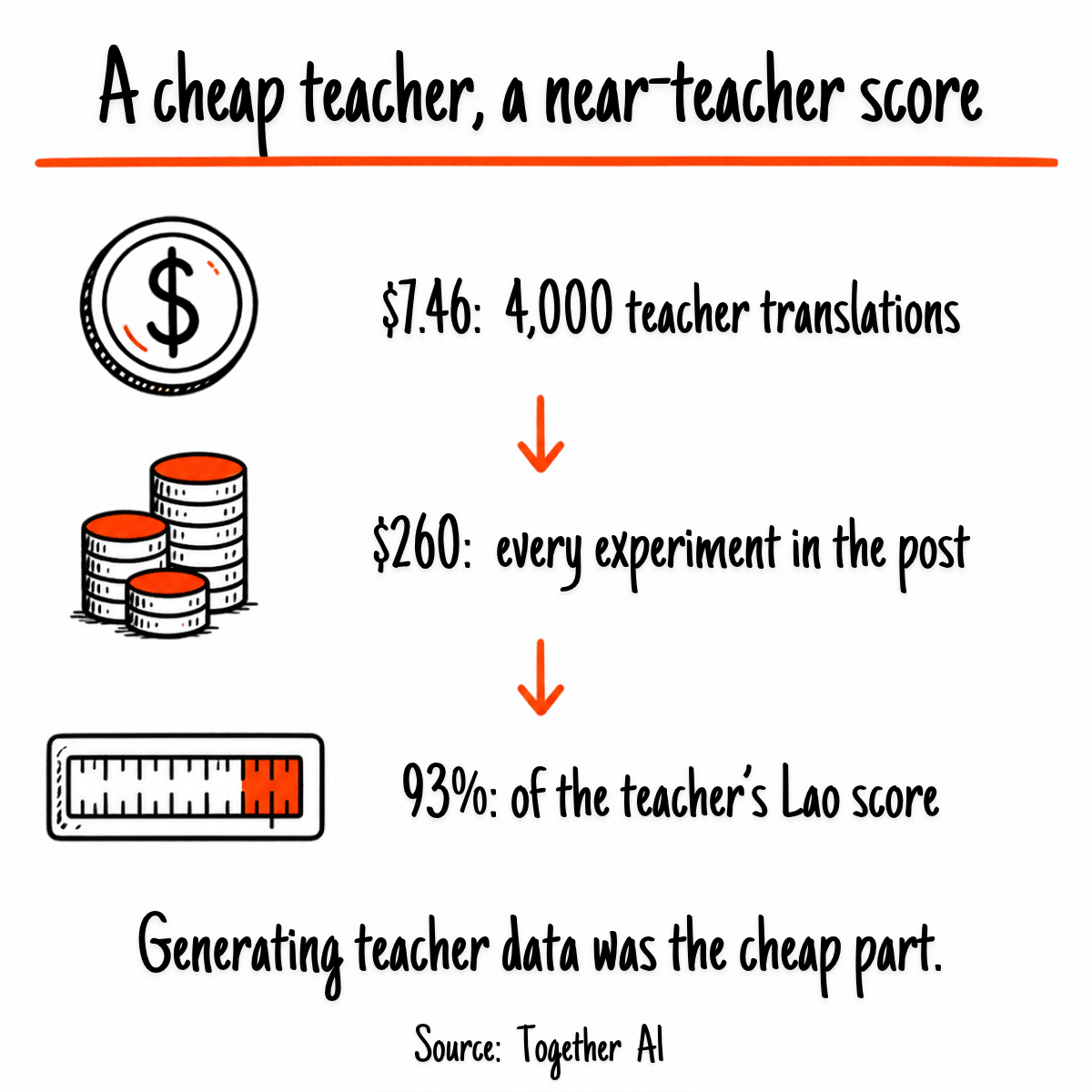
Qwen3.8-27B answers in Thai when you ask it for Lao. Together AI measured it: on the full 1,012-sentence FLORES-200 Lao test set the model scores 5.5 chrF++, and only 11% of its answers are in Lao script. Together then fixed it with about 4,000 translations from Kimi-K3.1-Pro and a LoRA adapter. The best run reached 44.3, which is 93% of Kimi’s 47.5, and every experiment in the write-up cost US$260 in all.
The write-up reports its failures. The first fix broke a second language, and it says which choices didn’t pay. I read the post, the cookbook scripts, the model licences and the work around it, and I checked the arithmetic. What follows is what held up and what the post doesn’t show.
- The gap: right meaning, wrong script
- How the distillation works
- The surprise: fixing Lao broke Thai
- More data beat more passes
- Five languages, one adapter
- What it cost
- Where this sits
- What the post doesn’t show
- If you have a gap like this
93%
of Kimi-K3.1-Pro’s Lao score reached by the best distilled run
US$7.46
for the teacher to translate all 4,000 Lao training sentences
US$260
for every experiment in the write-up, on B200 GPUs
The gap: right meaning, wrong script
Lao and Thai are close relatives with different scripts. Lao is the official language of Laos, with about 3.7 million first-language speakers and about 800,000 second-language speakers, going by the Ethnologue figures that Wikipedia cites. Ask Qwen3.8-27B for Lao and it often writes Thai.
Together found this with a quick screen: 50 sentences in each of 11 languages, scored against Kimi-K3.1-Pro. Kimi beat Qwen on all 11, and Lao had the biggest gap, 49.0 against 7.2. In the base model’s Lao output, 45 of the 50 sentences contained Thai script and only 6 contained Lao.
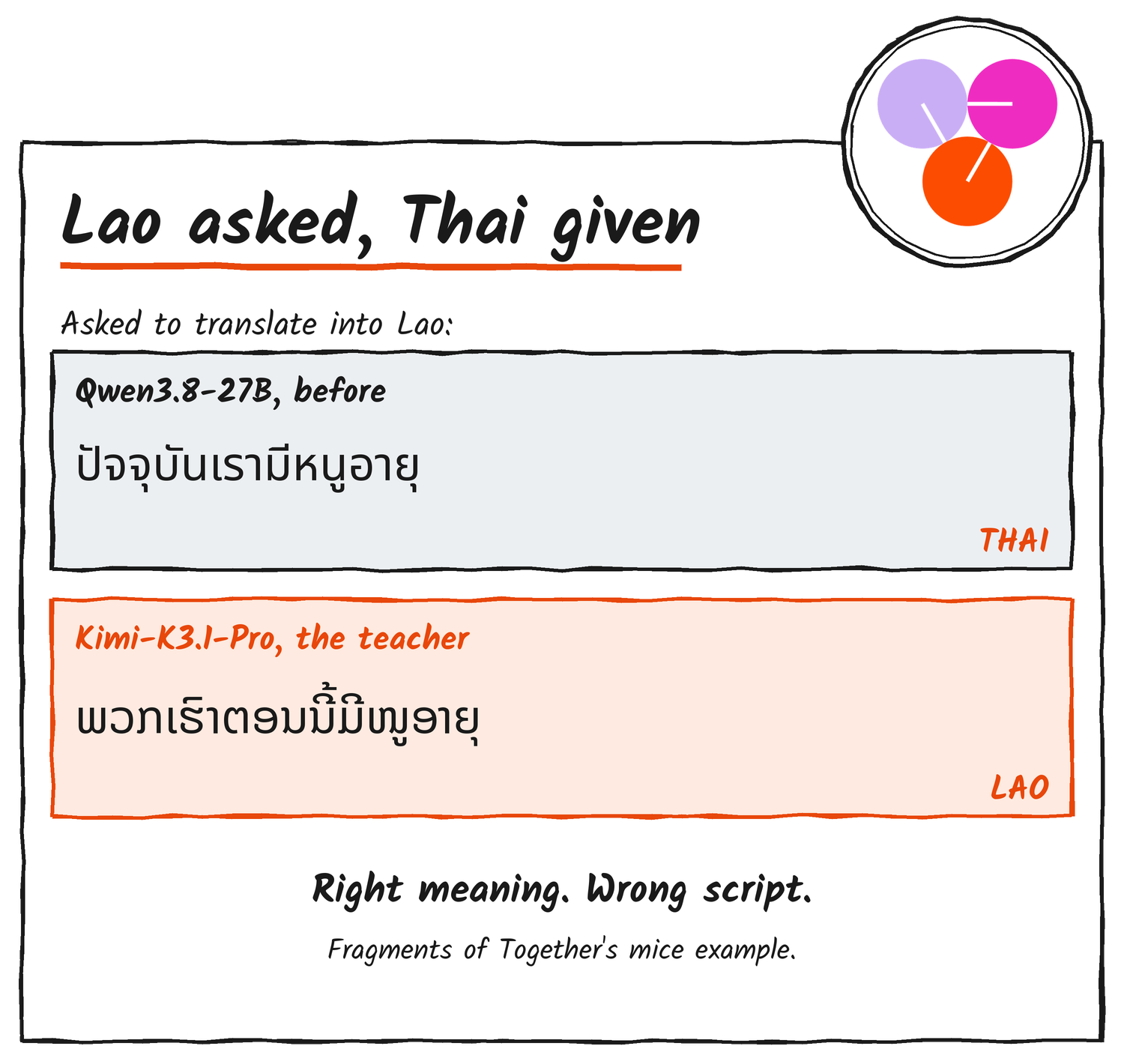
The score that matters is chrF++, a character-level overlap measure, so a Thai answer to a Lao request scores close to zero however good the Thai is. Together’s own check backs the diagnosis: when it had Kimi translate each system’s output back into English, the base model’s Thai-script answers still carried the meaning. The gap was language identity, not understanding.
What chrF++ measures
chrF++ compares a system’s translation with a human reference using overlapping runs of characters, plus single words and word pairs. It runs from 0 to 100. It rewards matching spelling and wording, which is why it punishes the wrong script so hard and why it can’t tell you whether a Lao speaker would find a sentence natural.
How the distillation works
Together used off-policy distillation: the teacher writes, and the student copies through supervised fine-tuning. The better-known on-policy route, where the teacher grades the student’s own output, needs a shared tokenizer, and Kimi and Qwen don’t share one.
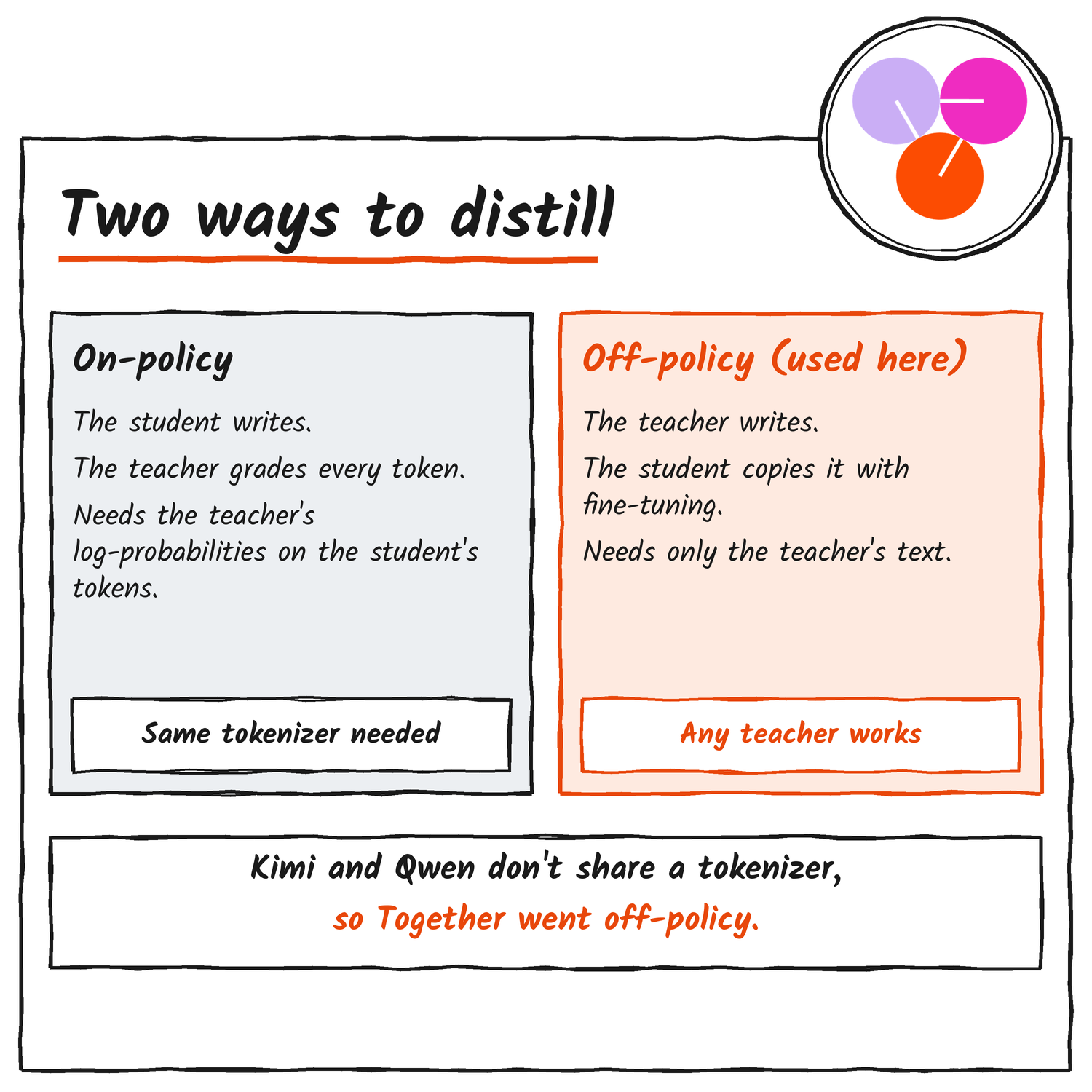
The pipeline is short. Together took the 997 English sentences in the FLORES development set and added 4,000 English Wikipedia sentences, 3,000 for Lao and 1,000 for Thai. Kimi translated them with thinking switched off. A filter kept a translation only if at least 70% of its letters were in the target script and it wasn’t an English echo; that removed 4% of Kimi’s Lao. The student then trained as a LoRA adapter and saved to the model registry.
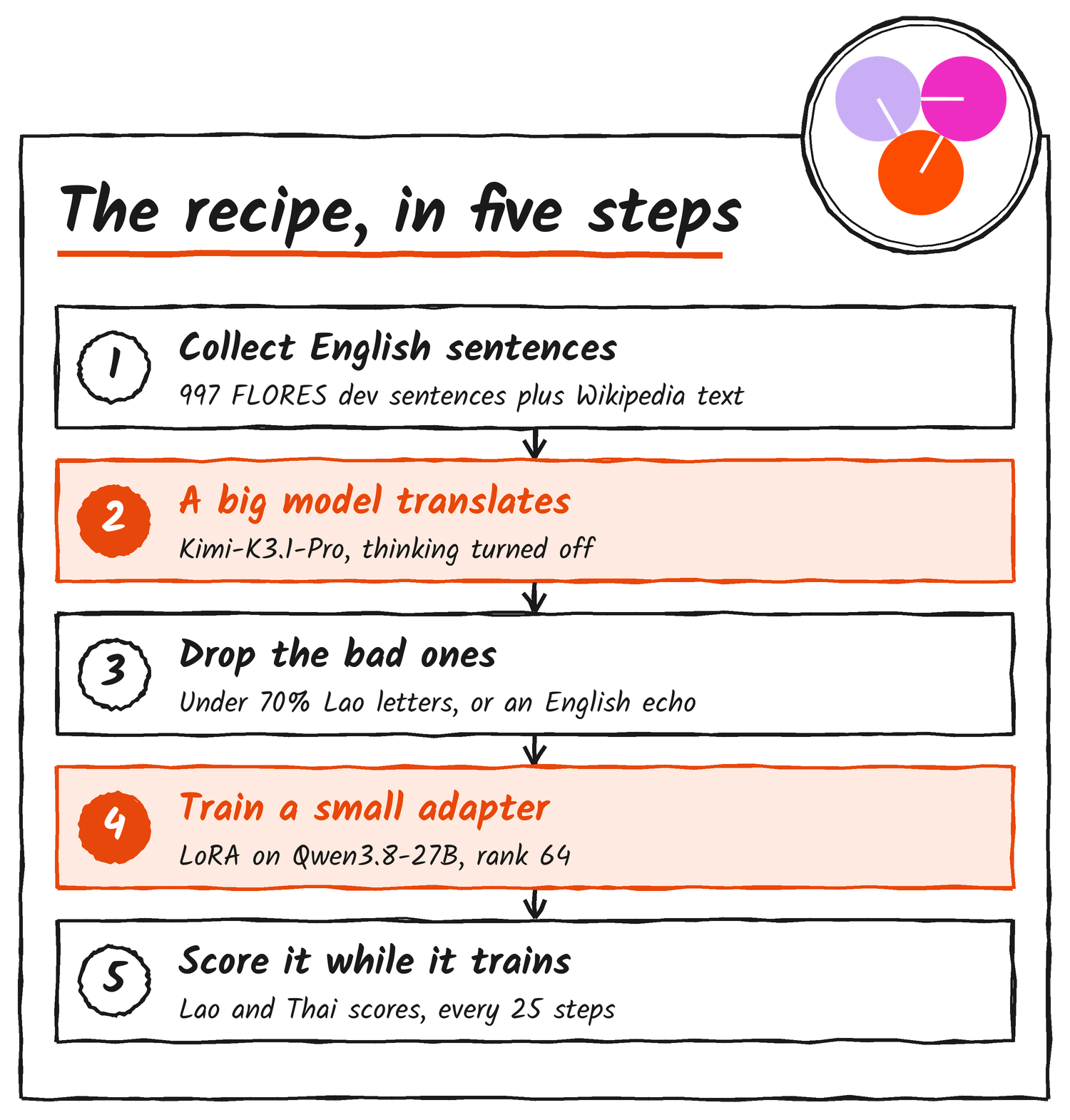
Switching thinking off was a measured choice. On 300 Lao sentences Kimi scored 47.3 without thinking and 43.5 with it, and thinking used about eight times the tokens. A Lao answer averages about 175 output tokens. The training settings are plain: LoRA rank 64, which is the maximum for Qwen3.8-27B, alpha 128, a peak learning rate of 1e-4 with 5% warmup and cosine decay to a tenth, batch size 16. Every 25 steps the run scored 300 held-out sentences, so Together could watch Lao and Thai move together.
The surprise: fixing Lao broke Thai
Together’s control run used 945 human Lao references. It fixed Lao fast, from 6.7 to 43.3 within 25 steps, and it wrecked Thai: 46.7 fell to 11.7 within those steps and ended at 5.3, with none of the Thai answers in Thai script.
The Lao-only distilled run held Thai for two epochs, then dropped it to 44.3 in the third, with 17 of 300 Thai answers written in Lao. Adding about 1,000 Kimi Thai translations fixed it. Thai ended at 47.4 and 47.8 and never went below 47.3.
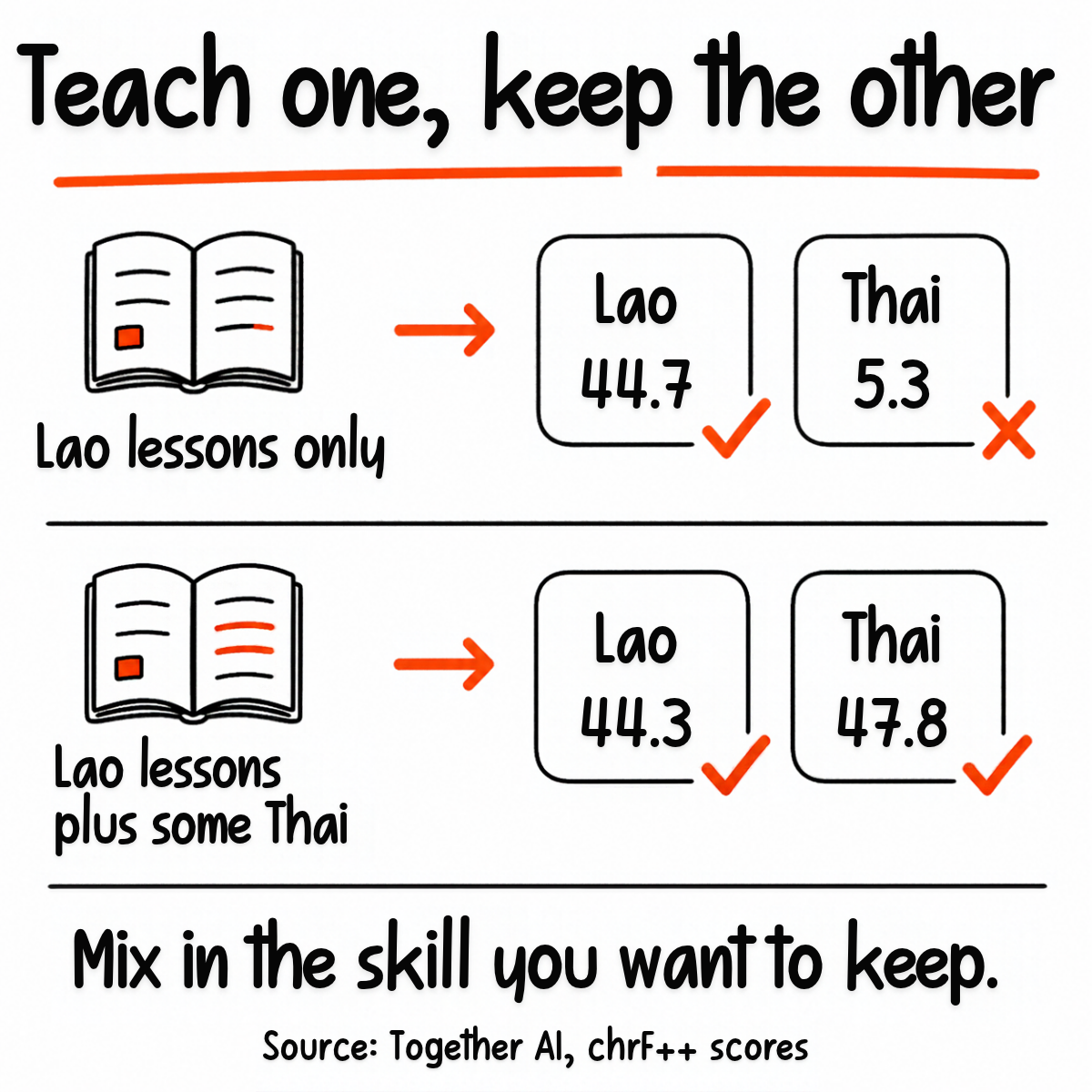
| Run | Lao chrF++ | Lao script | Thai chrF++ |
|---|---|---|---|
| Base student | 5.5 | 11% | 46.7 |
| Fine-tuned on 945 human Lao references | 44.7 | 100% | 5.3 |
| Distilled, Lao only (965 Kimi Lao) | 41.8 | 100% | 44.3 |
| Distilled, Lao + Thai (965 Lao, 989 Thai) | 41.9 | 100% | 47.4 |
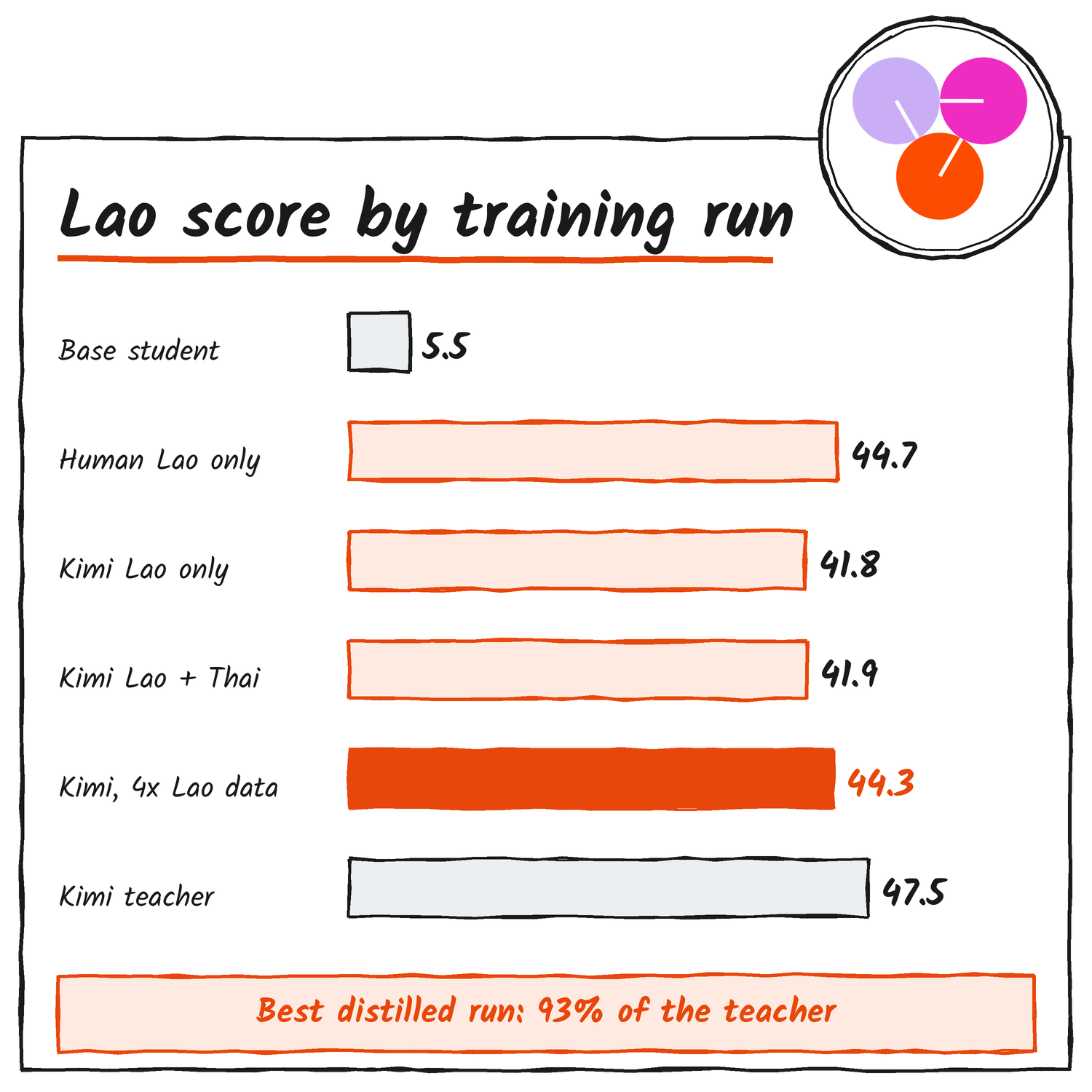
| Distilled, Lao + Thai, 4x the Lao data (3,834 Lao, 989 Thai) | 44.3 | 100% | 47.8 |
| Kimi-K3.1-Pro, the teacher | 47.5 | 100% | 49.9 |
One thing the table says plainly: the human-reference run still has the top student Lao score, 44.7 against 44.3. Distillation didn’t beat human translation on Lao. What it did was match it to within half a point while keeping Thai, from teacher output that cost a few dollars.
More data beat more passes
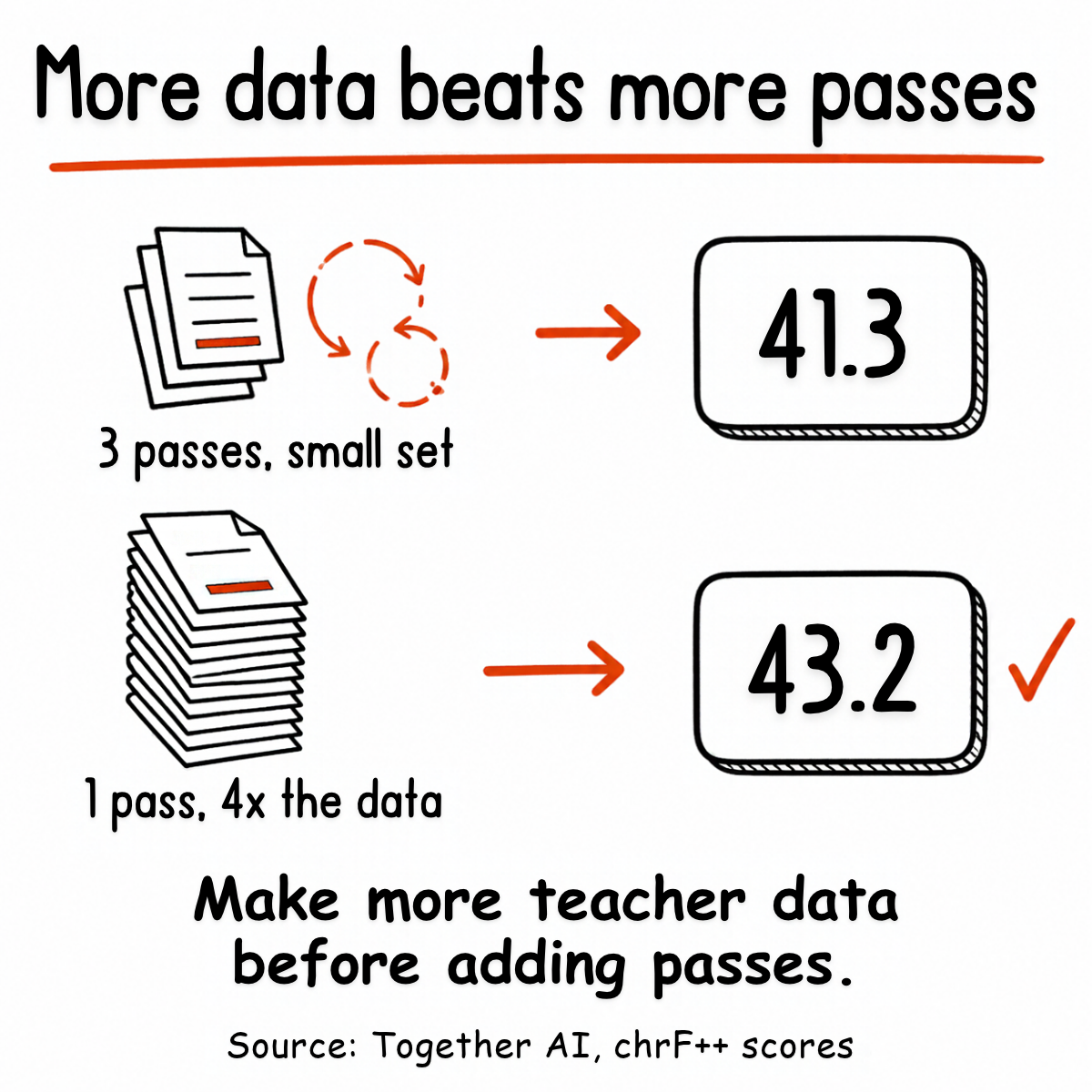
The first distilled run plateaued at 41.9. Together tried two fixes. Adding Kimi translations of 3,000 Wikipedia sentences lifted Lao to 44.3. And one epoch over the larger set scored 43.2, against 41.3 after three epochs on the smaller set. Together’s advice follows from that: make more teacher data before you add epochs.
Two more results from the post. Scored against Kimi’s own translations instead of human ones, the distilled student rose from 8 to 58 chrF++, while the human-reference student reached 47, so the distilled student copies Kimi’s style more closely, as you’d expect. And on the round-trip meaning check, the base model’s Thai output scored 64.6, the human-reference student 64.0 and the distilled student 65.7. Those are close, which is Together’s evidence that the main gap was language identity.
Five languages, one adapter
Together then trained one adapter on Lao, Northern Sotho, Zulu and Yoruba, with Thai added for retention. It used 8,871 Kimi translations, about 2,000 per language plus 1,000 Thai, over 831 steps.
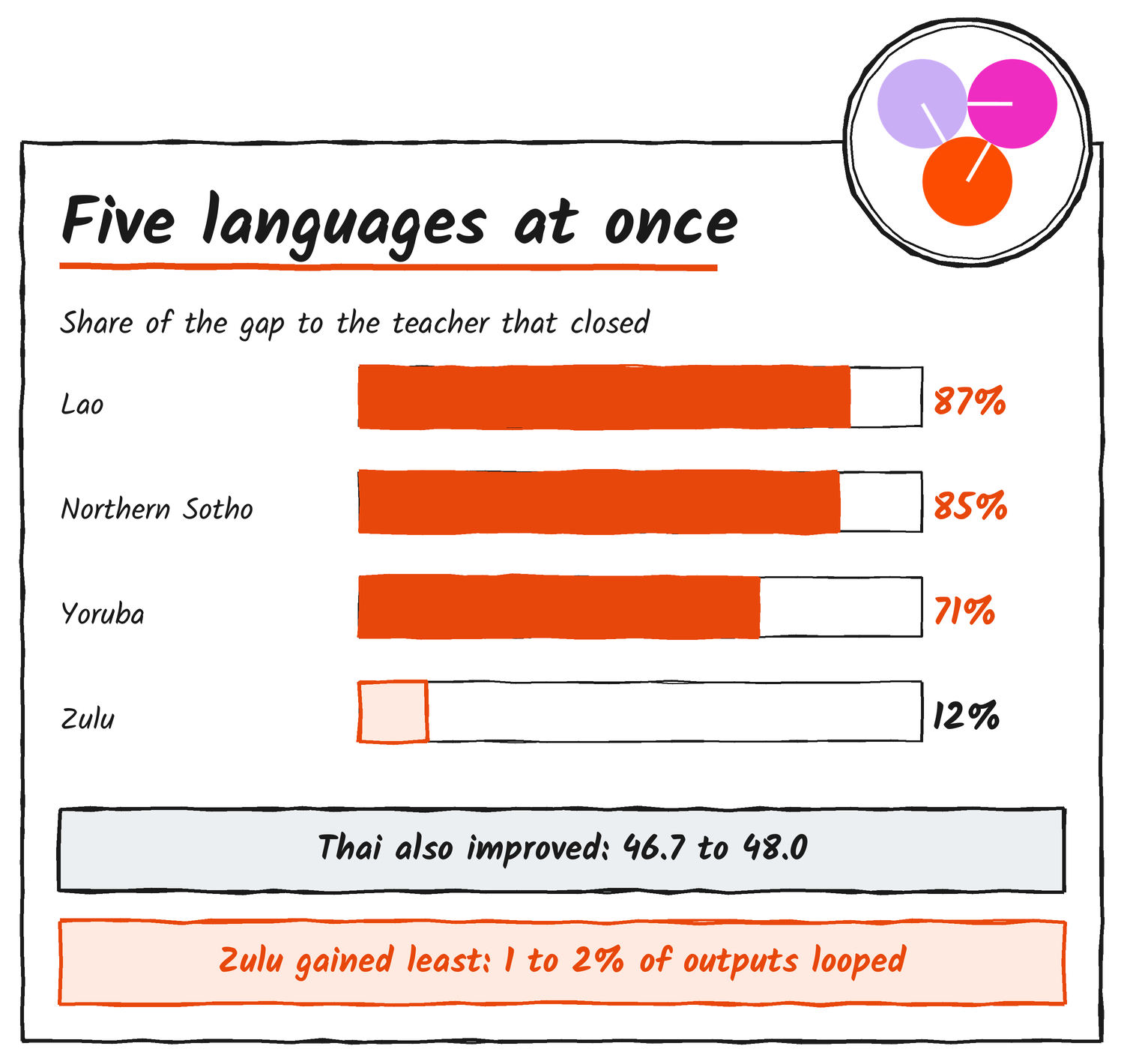
| Language | Base | Distilled | Teacher | Gap closed |
|---|---|---|---|---|
| Lao | 5.5 | 41.8 | 47.5 | 87% |
| Northern Sotho | 32.7 | 48.0 | 50.7 | 85% |
| Yoruba | 20.7 | 25.7 | 27.7 | 71% |
| Zulu | 37.7 | 39.2 | 50.3 | 12% |
| Thai (kept) | 46.7 | 48.0 | 49.9 | improved |
Zulu moved least, and the post notes that 1% to 2% of its outputs fell into repetition loops. The Yoruba gap is also the smallest in absolute terms, because the teacher itself only scores 27.7 there. There was little gap to close.
What it cost
Kimi-K3.1-Pro costs US$2 per million input tokens and US$10 per million output tokens on Together’s serverless page. At about 175 output tokens a sentence, the 4,000 Lao translations came to US$7.46. All experiments in the write-up, including the screens, failed runs and the five-language adapter, cost US$260 on B200s.
The best Lao run held its training resource for 46 minutes, 33.7 of them training and 7.1 evaluating. The first step took 2.5 to 3 minutes, later steps a median of 2.6 to 3.2 seconds, and starting a resource takes about 4 to 5 minutes. Together’s pricing docs bill per GPU-minute only while a resource is READY, and their worked example for Qwen3.8-27B with LoRA is US$88 an hour. At that example rate, my arithmetic puts one 46-minute run at about US$67. The docs tell you to rely on estimate_cost for the current rate, so treat that as a ballpark. I covered the billing model in my earlier piece on Together opening DeepSeek V4.1 Flash to post-training.
Where this sits
Together launched its Post-Training service on 19 October 2026, with LoRA and full-weight training on model resources and a one-line migration path for code written for Tinker, Thinking Machines’ training API. This write-up is Together showing what a small team can do with that service in a day.
| Approach | What the student learns from | Shared tokenizer needed | Source |
|---|---|---|---|
| Off-policy distillation (this piece) | The teacher’s finished translations, copied by supervised fine-tuning | No | Together AI |
| On-policy distillation | The teacher grading the student’s own samples, token by token, with reverse KL | Yes | Thinking Machines, 27 October 2025 |
| Purpose-built regional models (SEA-LION) | Pretraining and tuning aimed at 11 Southeast Asian languages, Lao, Thai, Khmer and Burmese among them | Not applicable | AI Singapore, arXiv 2504.05747 |
Thinking Machines’ on-policy distillation post reports a roughly 9x cost reduction against its baseline, and about 30x if you count teacher sampling, and it cites the Qwen team’s 74.4 on AIME’24 at a tenth of the cost of reinforcement learning. On-policy is the stronger method where it applies. Together’s route is the one that works when the teacher and student come from different families, and Kimi and Qwen do.
The two models are recent. Alibaba unveiled Qwen3.8-27B on 17 August 2026 as a 27-billion-parameter dense, natively multimodal model under Apache 2.0, with a 262K context extendable to 1M, and says it matches Qwen3.7-plus, a mixture-of-experts model ten times its size. Together’s page lists it for dedicated endpoints with pricing on request, with fine-tuning supported. Kimi-K3.1-Pro is Moonshot’s post-trained version of Kimi K3; Together’s page gives it 3 trillion parameters and a 1M context.
On licences, I read the Kimi K3.1-Pro licence. It grants use, modification and fine-tuning. Operators of model-as-a-service products with more than US$20 million in revenue over 12 months need a separate agreement, and very large products must display the model name. Outputs are covered only by the warranty disclaimer, and I found no clause that restricts training another model on them. Together’s post doesn’t discuss the licence, so that reading is mine, and anyone building on this at scale should have their own lawyer read the text. Qwen3.8-27B’s Apache 2.0 terms are looser.
On evaluation, FLORES-200 is Meta’s benchmark of 3,001 English sentences from Wikinews, Wikijunior and Wikivoyage, professionally translated into 200 languages, now maintained as FLORES+ under CC-BY-SA-4.0. Wider Lao evidence is thin. LaoBench, an ACL 2026 benchmark of more than 17,000 expert-curated samples, finds that even strong multilingual models lag human experts, especially on culturally grounded reasoning and translation fidelity. That’s the part a translation-overlap score can’t see.
What the post doesn’t show
- The evaluation is English to Lao only. Nothing tests Lao to English or Lao-to-Lao tasks such as summarising.
- It rests on one overlap metric, chrF++, and the post reports no review by Lao speakers.
- The round-trip meaning check uses Kimi, the teacher, as the back-translator, so it can’t be fully independent.
- The post scores Lao, Thai and round-trip meaning only. It reports no general benchmark after training, so it doesn’t show what the adapter did to everything else the model can do.
- The training translations came from English Wikipedia sentences, while FLORES text comes from other Wikimedia sources, so the two sets differ in style even though both are encyclopaedic.
None of that sinks the result. The script gap is real, large and measurable, and the fix is cheap enough to try. It does mean 44.3 is evidence that the model now writes Lao, not that it writes good Lao.
If you have a gap like this
Together’s recipes are in its post-training cookbook, Apache-2.0, under recipes/distillation: screen_languages.py, lao_from_kimi_k31_pro.py and multilingual_from_kimi_k31_pro.py. A finished checkpoint deploys on dedicated model inference, and per the docs a LoRA can be merged at deployment so it serves at base-model speed. Together’s own advice comes to four rules:
- Screen first, with about 50 sentences per language.
- Look at what the base model gets wrong before you train. Here it was the script, not the meaning.
- Generate more teacher data before you add epochs.
- Mix in data for the nearby skill you want to keep, and score it during training.
Sources
- Distilling Kimi-K3.1-Pro into Qwen3.8-27B: Teaching a model a new language, Together AI
- Post linking the write-up, Together AI on X
- Post-training cookbook, Together AI on GitHub
- Together Post-Training launch, Together AI
- Kimi K3.1-Pro licence, Moonshot AI on Hugging Face
- Alibaba unveils Qwen3.8-27B, Alibaba Cloud
- On-Policy Distillation, Thinking Machines
- LaoBench, arXiv 2511.11334
- SEA-LION, arXiv 2504.05747
Discover more from Sulat AI & Tech News
Subscribe to get the latest posts sent to your email.