Alexey Fateev has published a script that rents a Google Colab G4 GPU, builds an inference server on it and serves an uncensored GLM-5.3-Flash through an API tunnelled to your own machine. He says it works “if you pay for a Gemini or Google AI subscription”. His own benchmark, run on 23 November, shows 102.3 tokens a second on the smallest build with a drafter model. That drafter is licensed for non-commercial use only, and without it the same build manages 71.5.
I read the repository, both model cards, the Colab FAQ and the open Colab issues, and I did the cost arithmetic myself. The launcher is real and the numbers are the author’s own. Three things don’t match the headline: which Google plans can start a G4 isn’t settled, the README calls the model “refusal-free” while its model card says refusal is “reduced, not removed”, and the speed depends on a licence that rules out paid work.
What the script does
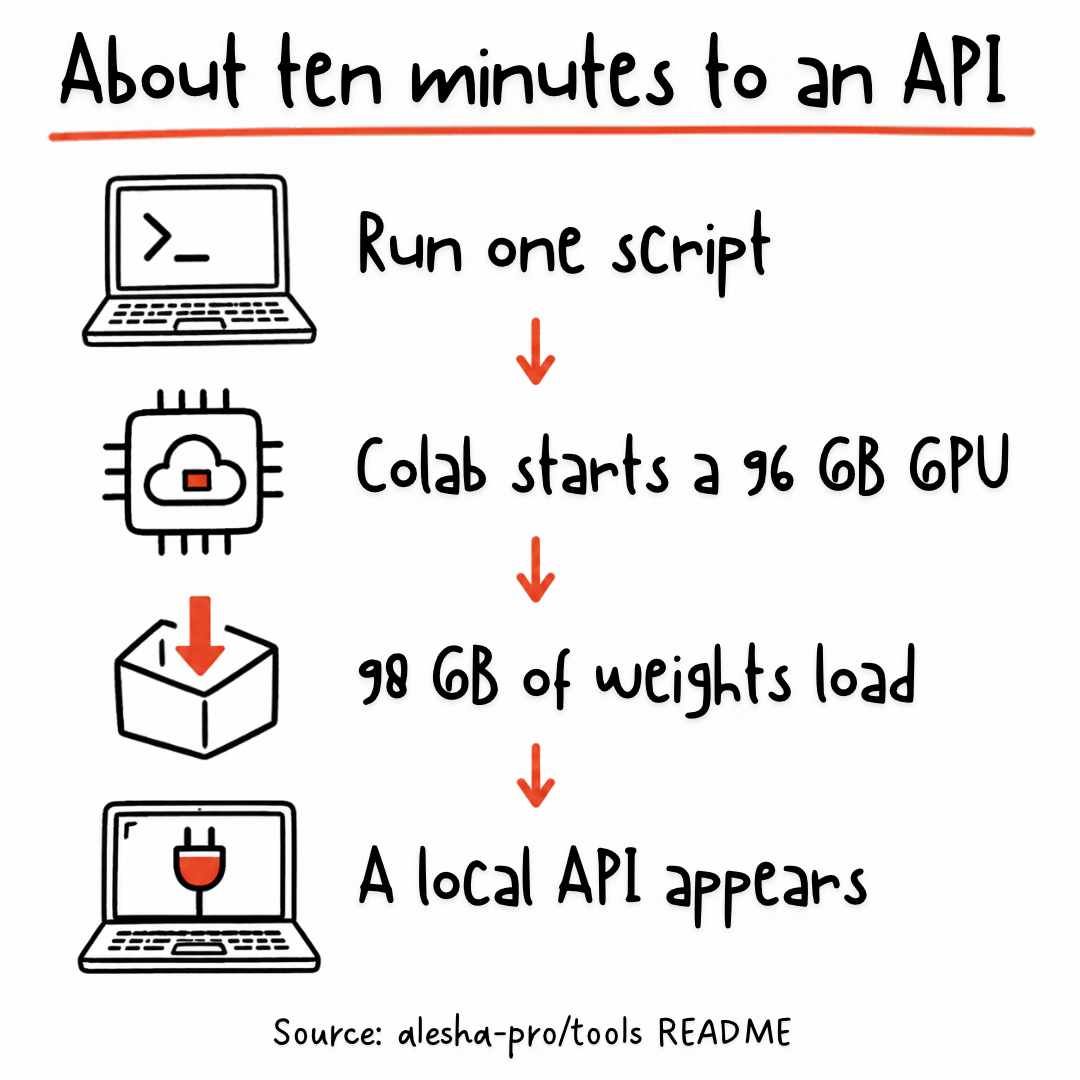
The launcher sits in the alesha-pro/tools repository as colab-g4-glm53. It drives Google’s open-source Colab command-line tool, which I covered when Aaron Ring worked out what Ultra’s 1,000 units buy. The steps are:
colab sshprovisions a G4 runtime: an RTX PRO 6000 Blackwell with 95.6 GiB of video memory, 176 GiB of system memory and 48 AMD EPYC 9B45 vCPUs.- The script builds Project Maya, an MIT-licensed inference server (v1.1.74), on the VM.
- It downloads one of three EXL3 quantisations by MikeRoz of orcarouter/GLM-5.3-Flash-Uncensored-FP8, plus the DFlash2 drafter.
- It serves an OpenAI-compatible and Anthropic-compatible API on the VM and opens an SSH tunnel to
127.0.0.1:18100, so local tools talk to it as if it were running on your laptop.
The README’s cold start is 10 to 12 minutes for the smallest build, 12 to 13 for the middle one and 18 to 20 for the largest. Most of that is the download. colab usage shows the balance and colab stop releases the machine.
The speed numbers
Fateev’s benchmarks are his own, run on a Colab G4 on 23 November. The three builds are 2.51, 3.05 and 4.05 bits per weight (bpw), which come to 98.1, 117.5 and 153.8 GiB on disk. Fewer bits mean a smaller file, more room for context and faster decoding.
| Build | Files | Tokens a second | Cold start |
|---|---|---|---|
| 2.51 bpw with drafter, 131K context | 98.1 GiB | 102.3 | 10 to 12 min |
| 2.51 bpw with drafter, 262K context | 98.1 GiB | 98.9 | 10 to 12 min |
| 3.05 bpw with drafter | 117.5 GiB | 89.0 | 12 to 13 min |
| 4.05 bpw with drafter | 153.8 GiB | 71.8 | 18 to 20 min |
| 2.51 bpw, no drafter | 98.1 GiB | 71.5 | 10 to 12 min |
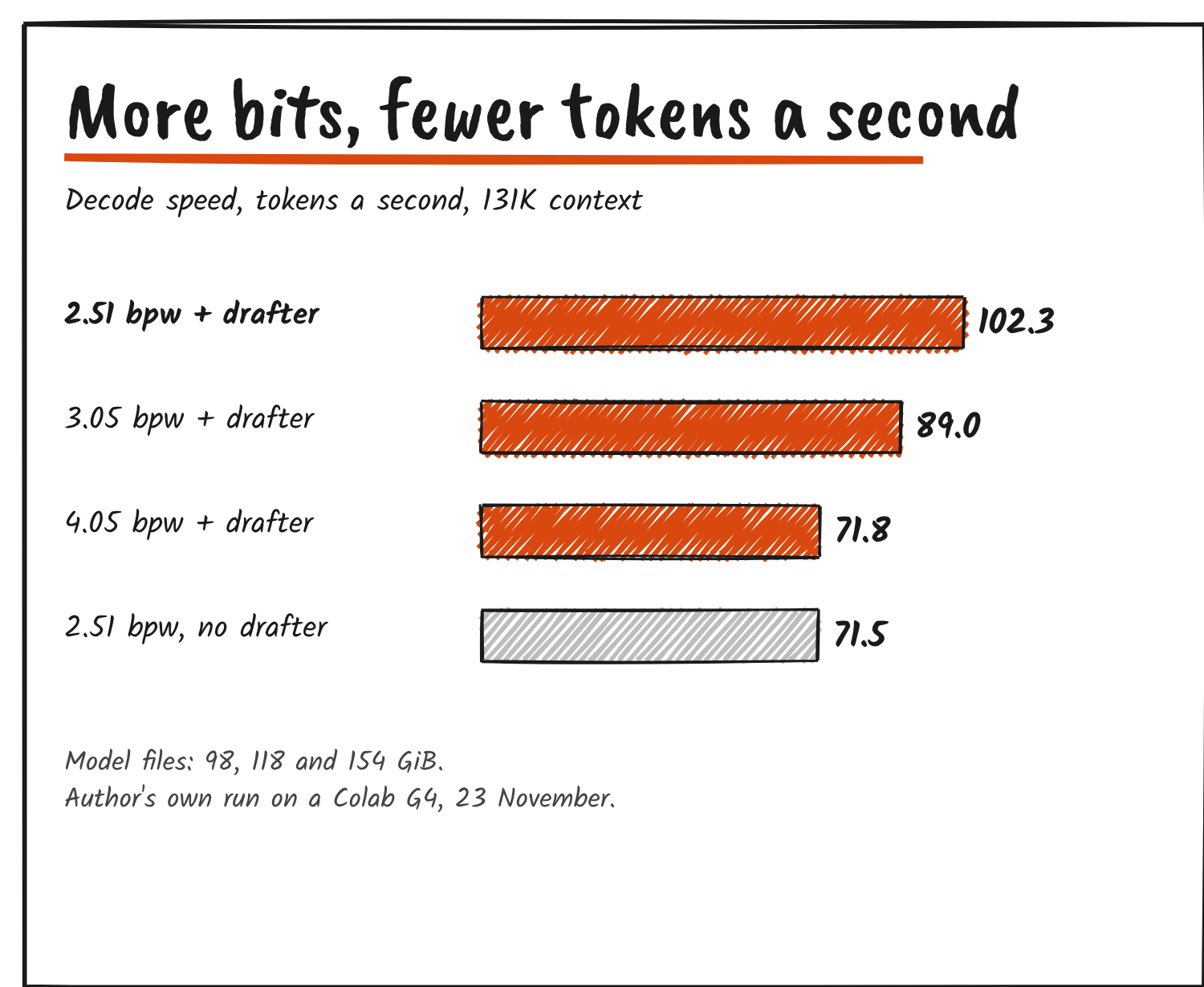
The drafter is the catch. A drafter proposes several tokens at once and the main model checks them, which is how the 2.51 bpw build goes from 71.5 to 102.3 tokens a second. The DFlash2 drafter is published under CC BY-NC-ND 4.0 and marked “for research and evaluation”. Strip it out and the 2.51 bpw build is about level with the 4.05 bpw build that uses it.
Does a Google AI subscription cover it?
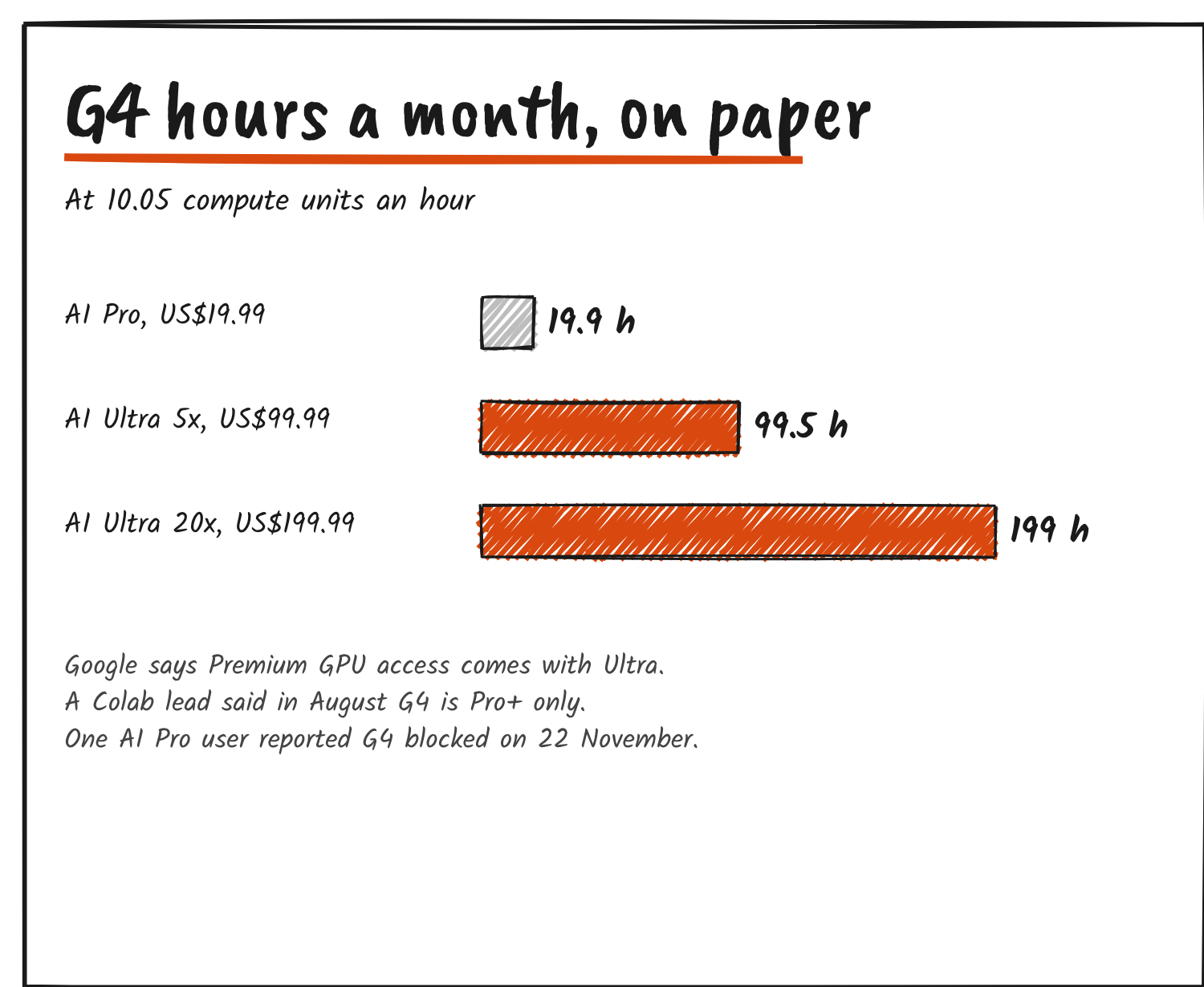
Colab compute units cost about US$0.10 each on every plan. Google publishes no rate for the G4, and users have logged about 10.05 units an hour, which makes an hour about US$1.00. At that rate a plan’s monthly units last:
| Plan | Price a month | Units | G4 hours |
|---|---|---|---|
| Google AI Pro | US$19.99 | 200 | 19.9 |
| Google AI Ultra 5x | US$99.99 | 1,000 | 99.5 |
| Google AI Ultra 20x | US$199.99 | 2,000 | 199 |
The units are only half the question. Google’s announcement says Ultra subscribers get “Premium GPU access”. A Colab product lead said in August that G4 and H100 runtimes are for Pro+ subscribers, and an open issue from 22 November reports an AI Pro account blocked from the G4. So Fateev’s line holds for the units. Google confirms G4 access for Ultra only, and I can’t confirm it for a Pro plan.
What Colab’s rules say
Colab’s FAQ and terms draw lines that the launcher sits close to:
- Offering a web service from a runtime and using it as a remote proxy are banned on every runtime. The launcher’s tunnel is bound to 127.0.0.1, so it’s meant for one person.
- SSH, remote control and using the web UI as a secondary feature are banned only when the account has no positive paid balance. The launcher depends on
colab ssh, so a zero balance is where it stops being allowed. - The terms bar giving third parties access to your runtime, so this is a single-user setup and not a way to host an API for a team.
“Refusal-free” and what the model card says
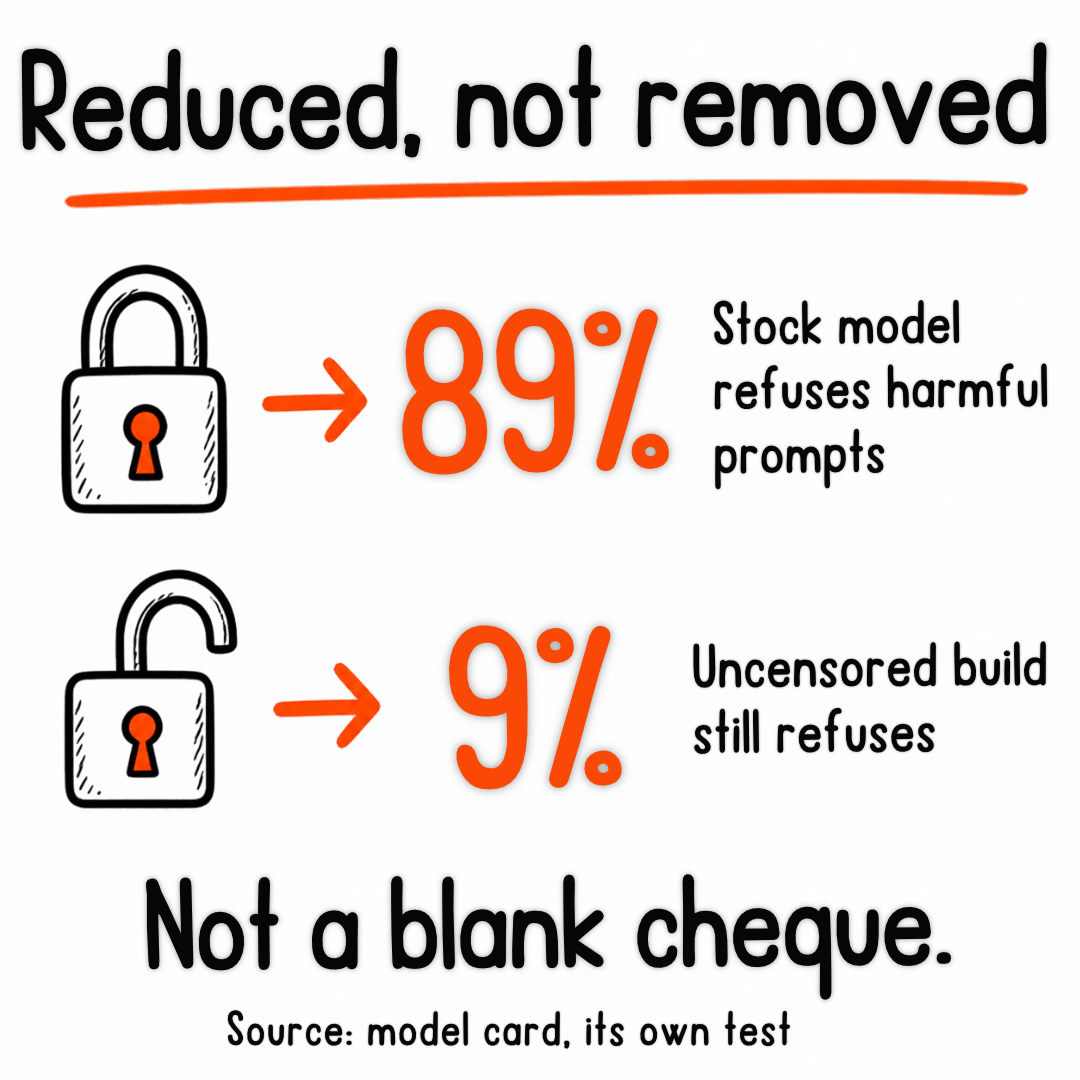
The launcher’s README calls the model “verified refusal-free”. The orcarouter model card says something weaker. It reports that the harmful-prompt refusal rate fell from 0.891 to 0.094, that the benign-prompt refusal rate fell from 0.094 to 0.000, and that “Refusal is reduced, not removed”. The method is abliteration, which finds the direction in the model’s activations that carries refusals and removes it, the technique described in Arditi et al. in 2024.
The card’s figures were measured on the FP8 model on eight H100s. The Colab build is a 2.51 bpw EXL3 quantisation of it, and nobody has published a refusal test of that file. The 9% residual refusal belongs to a different model from the one Fateev runs. The model and the launcher are both MIT-licensed.
Rent, host or run it yourself
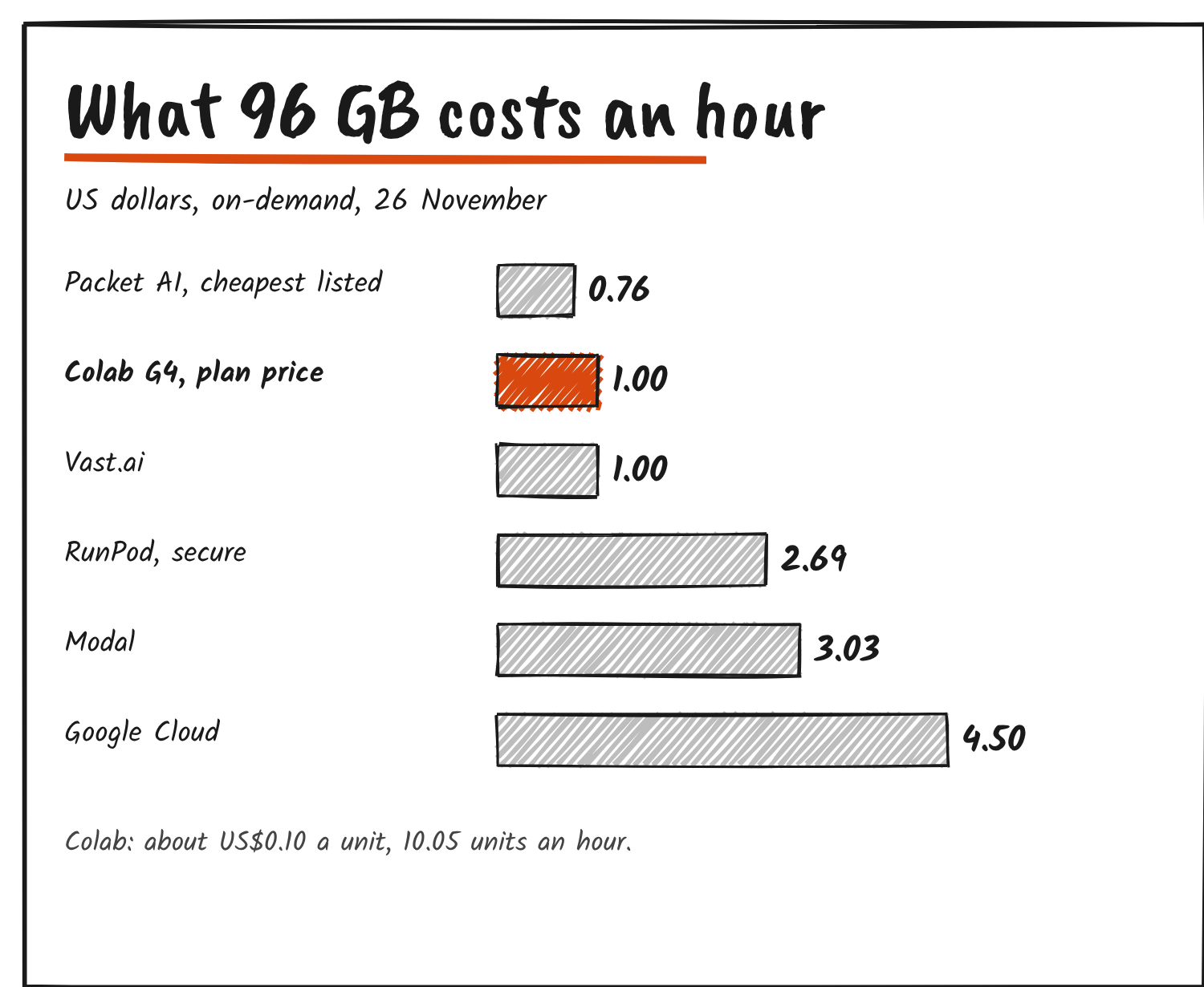
For a 96 GB card, the cheapest on-demand rental I found on 26 November is Packet AI at about US$0.76 an hour. Vast.ai lists US$1.00, which matches the Colab G4 at its measured rate. RunPod’s secure cloud is US$2.69, Modal US$3.03 and Google Cloud US$4.50. Colab’s price is the plan price, so it only competes if you already pay for the subscription, and nobody has tested it for reliability against a rental.
The alternative is to pay for tokens instead of hours. Three providers sell an abliterated GLM-5.3-Flash through an API, priced per million tokens for input and output:
| Where | Input | Output |
|---|---|---|
| Venice | US$0.17 | US$0.55 |
| Silk Compute | US$0.24 | US$1.00 |
| OrcaRouter | US$0.80 | US$1.60 |
| Colab G4, one stream, with drafter | n/a | about US$2.72 |
| Colab G4, one stream, no drafter | n/a | about US$3.88 |
Running my numbers, one stream at 102.3 tokens a second produces about 368,000 tokens an hour, so US$1.00 buys about 2.7 million tokens at best, or about US$2.72 per million. That is 1.7 to 4.9 times the hosted output prices, before any drafter licence problem. Several requests at once would cut the per-token cost, and nobody has benchmarked that setup. What Colab buys that an API doesn’t is control: your own weights, a context length you pick, and nothing logged by a third-party provider. Silk Compute’s terms are the clearest example of what a hosted provider asks in return.
What to check before you run it
- Run
colab usagefirst. It shows the balance and the live G4 rate, which is the number that decides whether your plan lasts. - Confirm your plan can start a G4. Treat Ultra as confirmed and Pro as unconfirmed.
- Skip the drafter for anything commercial and expect about 71.5 tokens a second on the 2.51 bpw build.
- Test refusals on the file you actually download. The model card’s 9% figure is for the FP8 model.
- Run
colab stopwhen you finish, because units keep draining until the runtime is released. - Keep the tunnel private to you. Sharing it breaks Colab’s terms.
Terms in this piece
- bpw: bits per weight, how much each model parameter is squeezed. Lower means a smaller file and a faster decode.
- EXL3: the quantisation format used by ExLlamaV3, built for fast GPU inference.
- Abliteration: removing the activation direction that triggers refusals, without retraining the model.
- Drafter: a small model that guesses tokens for the large model to verify, which speeds up decoding.
Sources
- alesha-pro/tools, the
colab-g4-glm53README and benchmarks, 23 November 2026 - mw00/project-maya and googlecolab/google-colab-cli
- Hugging Face: orcarouter/GLM-5.3-Flash-Uncensored-FP8, MikeRoz’s EXL3 quant and the DFlash2 drafter
- Colab FAQ, Colab is now part of your Google AI plan and colabtools issue 6289
- Arditi et al., Refusal in Language Models Is Mediated by a Single Direction, 2024
- Pricing pages: RunPod, Venice, OrcaRouter
Related coverage: Silk Compute sells abliterated models, Morph’s abliterated Kimi and Atomic Chat’s uncensored Inkling 2 Mini.
Discover more from Sulat AI & Tech News
Subscribe to get the latest posts sent to your email.