
Moxie Marlinspike, who built Signal, told Tyler Cowen that the way AI labs police misuse is “building a machinery of mass surveillance that is larger and more efficient than any other mass surveillance machinery in history.” He said it on Conversations with Tyler, recorded live at the Progress Conference on 10 October 2026 and published on 25 November (US time) as episode 297. I’ve read the full transcript. Everything quoted here comes from it, not from anyone’s summary.
10 Oct 2026
Recording date, live at the Progress Conference, hosted by the Roots of Progress Institute
297
Episode number of Conversations with Tyler
45 min
Running time. The section on private AI and mass surveillance starts at 7:31
What Marlinspike said
Cowen opened the section by asking why people tell an AI what they wouldn’t tell a priest or a therapist. Marlinspike’s answer was about the interface. “People are confessing what they would tell a priest or a therapist to an AI,” he said. “The form of AI in this sort of conversational interface that makes it really powerful is a form of technology that invites confession. You feel like you’re communicating with somebody and that it is a private space.”
You feel like you’re having this conversation with this agent or assistant that gets to know you as your friend, deeply understands you, your preferences, your memories, your history, your life experience, but actually, it’s a huge group chat with many, many more people.
Moxie Marlinspike, Conversations with Tyler
Cowen asked who could read those chats at a lab. “A lot of people are reading something,” Marlinspike said. “All of your chats end up in a data lake that’s designed for semantic understanding and extracting meaning and training loops and everything else.”
You’re building a machinery of mass surveillance that is larger and more efficient than any other mass surveillance machinery in history.
Moxie Marlinspike, Conversations with Tyler, 25 November 2026
The line came in an exchange on how to hold agents accountable. If a law needs to trace what an agent did and what the user told it, Cowen said, the chat can’t be truly private. Marlinspike’s description of the current approach: “The current approach is basically we don’t want bad people to do bad things. What we’re going to do is classify everything that everyone does on a score of badness, and we’re going to rank that from most bad to least bad. We’re going to have an army of human reviewers that just go through and are looking at everything and evaluating the badness.” He then delivered the line above and added: “That just seems like a dangerous thing to be constructing.”
His alternative: watch the models
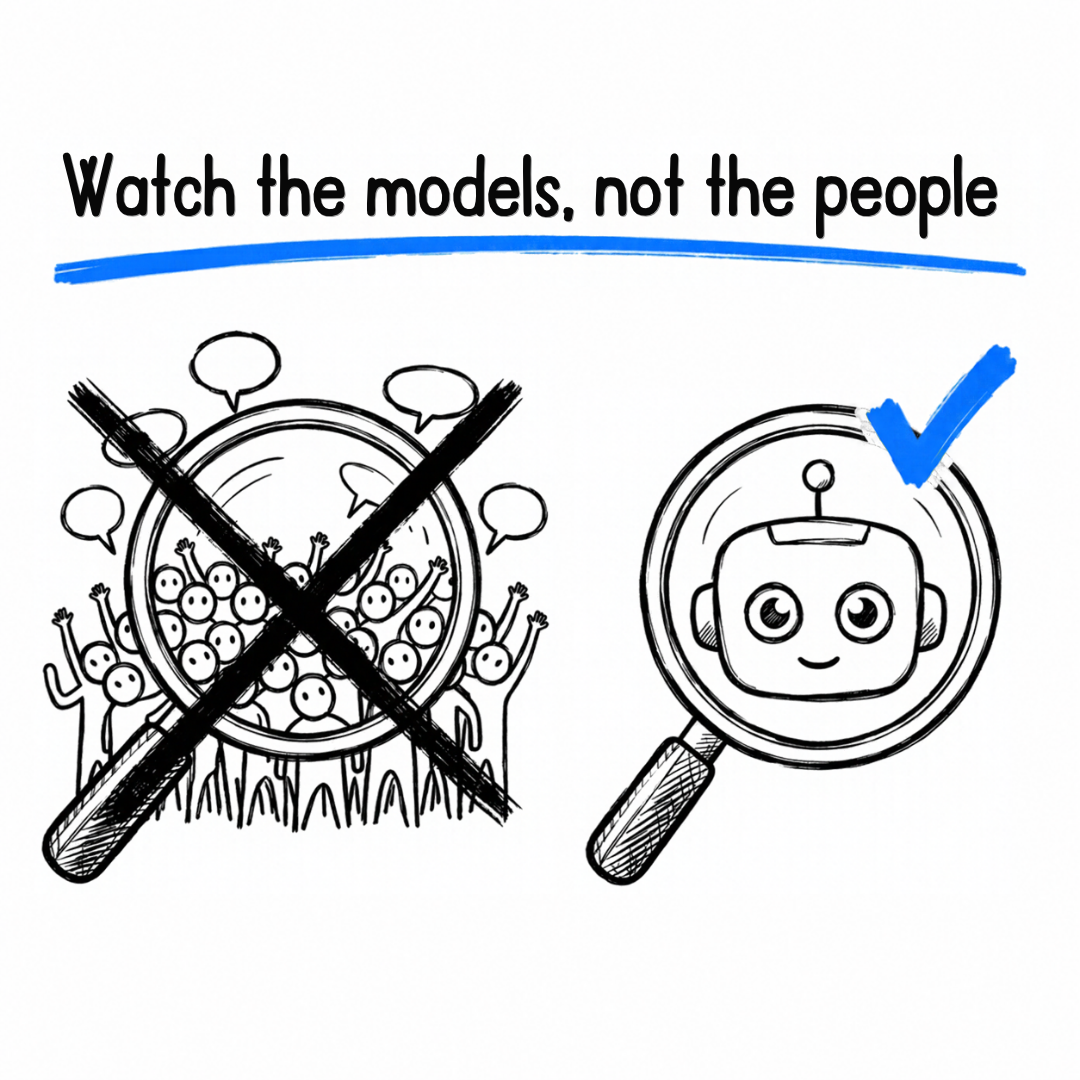
Asked what he’d do instead, Marlinspike said: “The thing that we should be surveilling is not the people, the actors that are doing things, but the models.” Rather than working out what people are up to and judging whether it’s good or bad, he wants systems “that are monitoring alignment of the models themselves. Do the models themselves show negative tendencies?”
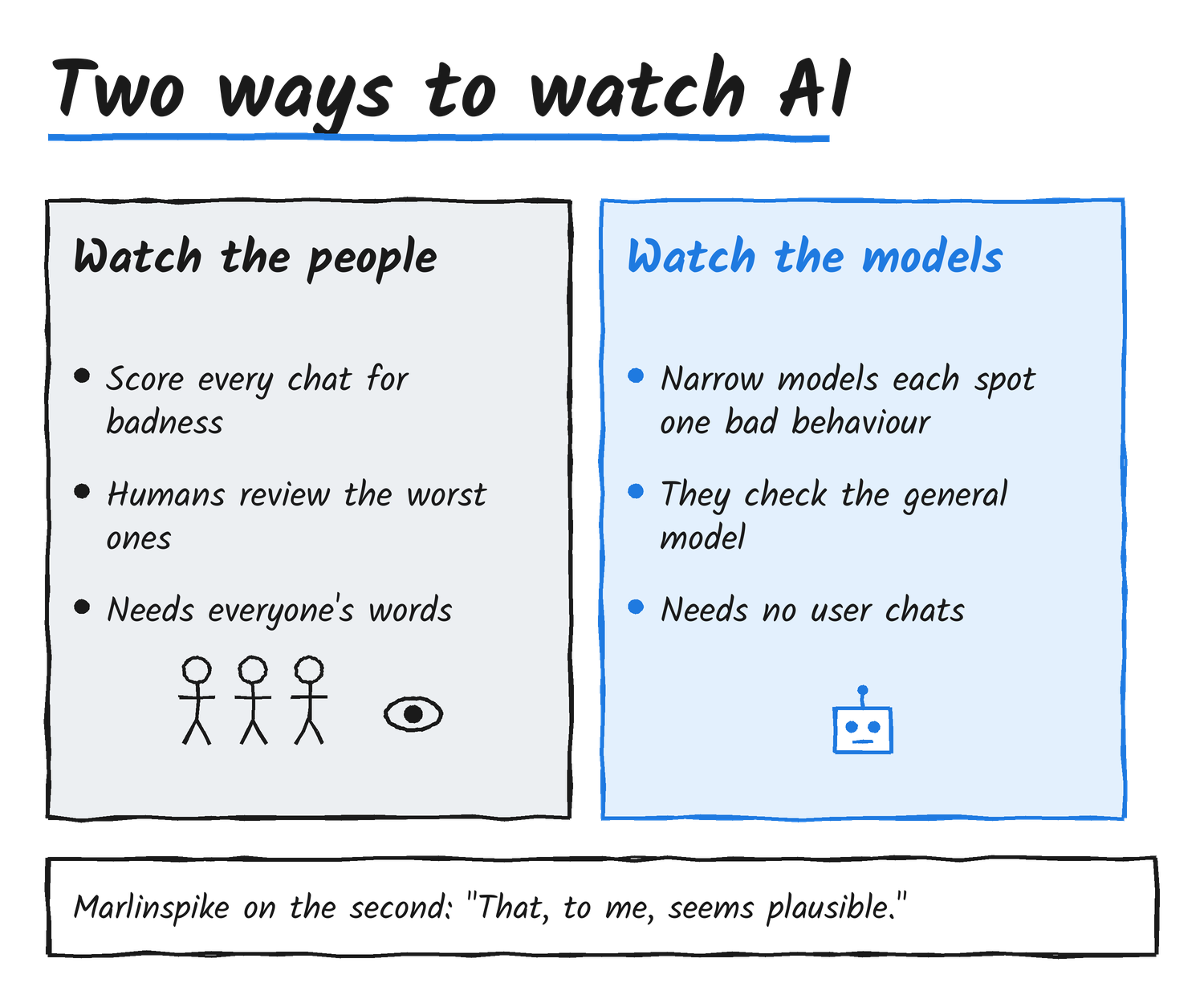
Cowen pushed on whether using AI to watch AI counts as watching the models at all. Marlinspike said it does: “You build these general capacity models, and you try to align them, but it’s difficult because they can do so many different things. There could be jailbreaks and all kinds of stuff or whatever. Then you build more specific models that classify specific behavior, and they’re good at just that. Then you use that as a monitoring system. That, to me, seems plausible.”
He called it plausible, not proven. On governments using AI to scan people’s hard drives, a prospect he said he’s also against, Cowen asked how to stop it. Marlinspike answered, “By building privacy-enhancing technology and demonstrating the possibility of another way.”
Cowen also raised the agent-accountability problem for private AI. Marlinspike’s reply was that navigating it “is just as difficult and thorny as in the nonprivate AI world.” He said it’s probably possible.
What the labs say they do
Marlinspike described reviewers “looking at everything.” The published pages I checked describe automated screening of activity, with humans reviewing what gets flagged. Here’s what each says, in its own words.
- OpenAI’s transparency page says it uses “a combination of automated technologies and human review to monitor activity on our services,” with classifiers and other systems to identify content that may break its terms, and that its “team may review flagged content.” Its help centre says a temporary chat isn’t used to improve models while it stays temporary, and that OpenAI may keep a copy for up to 30 days for safety purposes. A deleted saved chat is scheduled for permanent deletion within 30 days unless it was already de-identified or OpenAI must keep it for security or legal reasons.
- Anthropic’s consumer privacy page says it keeps inputs and outputs for up to 2 years, and trust and safety classification scores for up to 7 years, when its automated systems flag a chat or session as breaking its usage policy. For its “covered” models, Anthropic says no personnel can read retained conversations by default, and human review happens only through a controlled access path, for example when automated systems flag content.
- Google’s Gemini API terms say Google retains prompts, context and outputs for 55 days to detect and prevent policy violations, that authorised employees may assess flagged content, and that the logged data isn’t used to train models other than those used for policy enforcement.
None of those pages describes humans reading everything. The scoring and the record-keeping are the parts of Marlinspike’s description that the pages match.
Confer, and two other ways to build a sealed chat
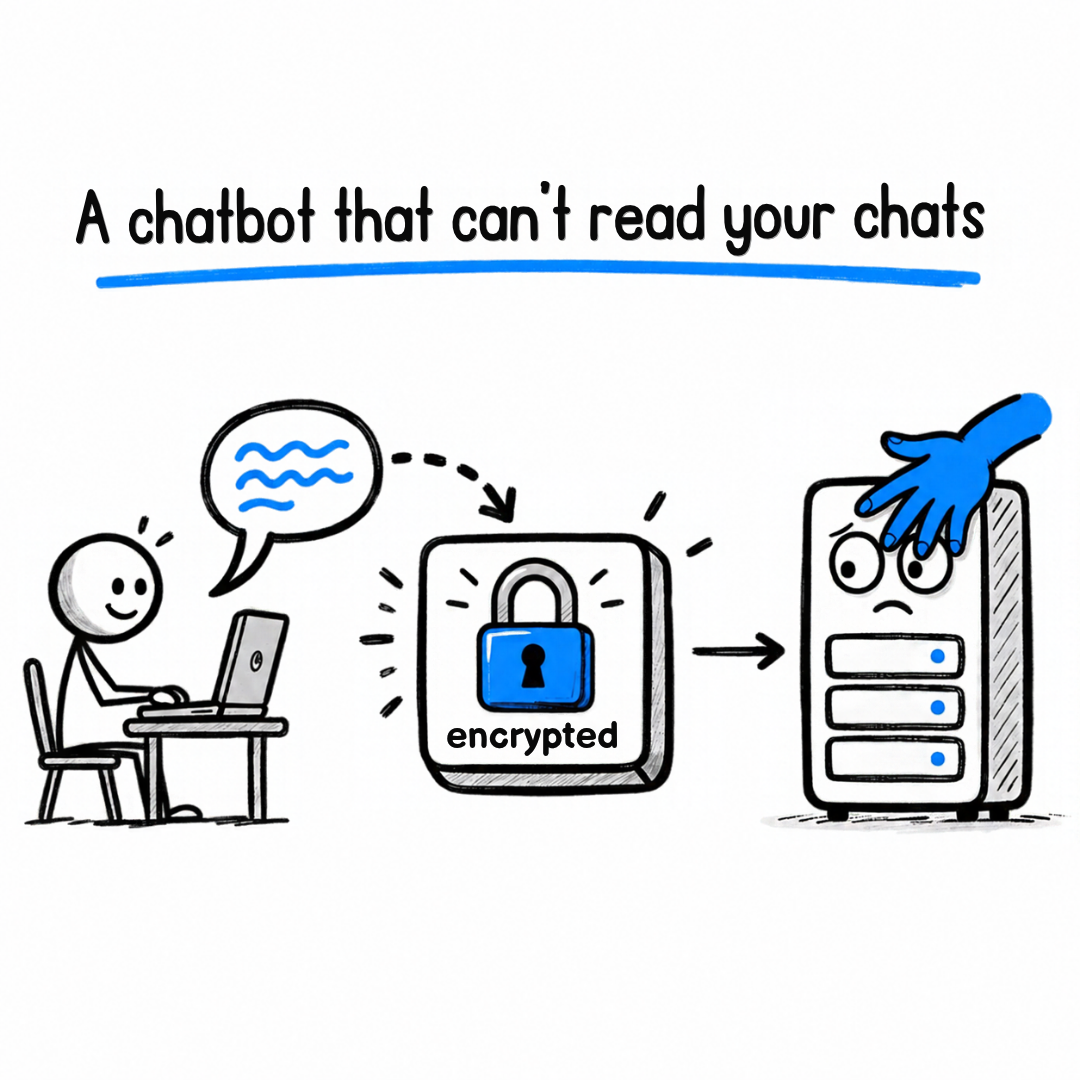
Marlinspike runs Confer, a private AI chat. In the interview he said only the user has access to their chats and that he can’t read them. Cowen asked whether the same works through Claude or GPT Pro. “No,” Marlinspike said, “they are not operating private services.” Earlier, asked whether a major lab could build a private chat, he’d said: “It’s possible to build, yes.”
Confer launched in December 2025. TechCrunch reported in January that it encrypts messages to and from the system with WebAuthn passkeys, runs all inference inside a trusted execution environment with remote attestation, and uses open-weight models. TechCrunch put the free tier at 20 messages a day and five active chats, and the paid plan at $35 a month. Confer’s own site says chats are end-to-end encrypted and the code is open source.
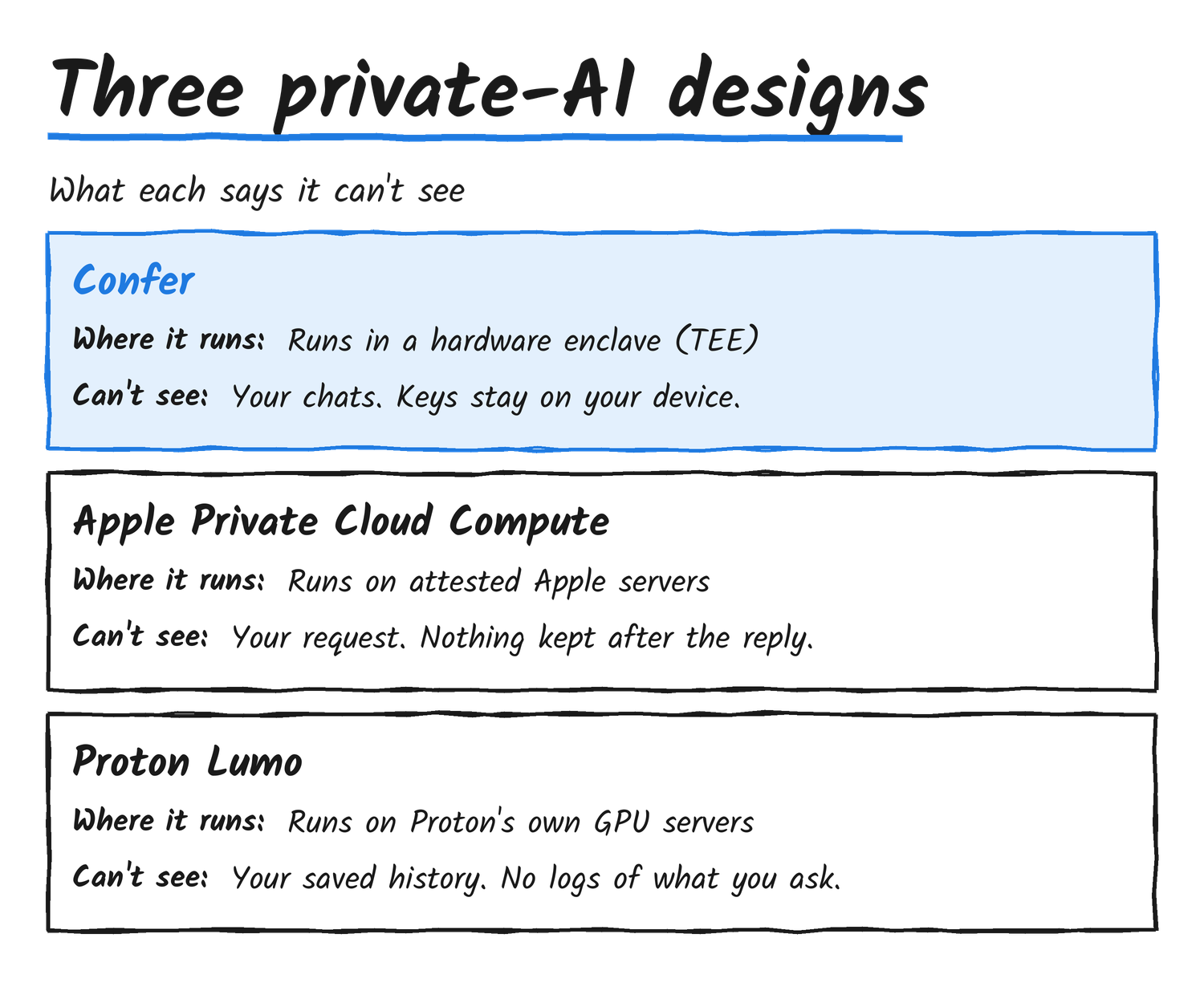
Confer isn’t the only attempt at the problem, and the designs differ in what they ask you to trust.
| Service | Where the model runs | What it says it can’t see | What you can check |
|---|---|---|---|
| Confer | Inside a trusted execution environment on its servers, open-weight models | Your chats, which it says are encrypted with keys that stay on your device | Remote attestation and open-source code, per Confer and TechCrunch |
| Apple Private Cloud Compute | Apple-built servers, and from 2026 Google Cloud systems with NVIDIA GPUs, under the same rules | Your request data. It says it keeps nothing it can decrypt once the response is returned | Attested software measured against a public transparency log; software published for researchers |
| Proton Lumo | Proton’s own GPU servers | Your saved chat history, held with zero-access encryption. It says it keeps no logs of prompts or replies | Open-source code; Proton’s own security model write-up |
Apple says on its security blog that complete end-to-end encryption isn’t an option for its cloud model, because the server has to read the request, so it relies on enforced technical limits instead. Proton says its apps send prompts that only its GPU servers can decrypt, with the history encrypted so that only the user can read it. Confer’s stated answer to the same problem is the enclave plus attestation. The design questions are the same in all three: who can read the prompt while the model works, and what can an outsider verify.
The older fight this joins
Marlinspike has been on this side of the argument for a long time. The US government announced the Clipper chip in April 1993, a plan for encryption hardware that let agencies decrypt traffic with a key the government held. The proposal was dead by 1996. In February 2016 a magistrate judge ordered Apple to help the FBI get into an iPhone from the San Bernardino attack, and Apple publicly refused. Marlinspike’s Signal became a nonprofit in 2018, when the Signal Foundation launched with US$50 million from WhatsApp co-founder Brian Acton.
Those fights were over keys: whether a government could be handed a way to read private messages. The one Marlinspike describes now is different. Nobody has to ask for a key, because the plaintext already sits with the lab. That’s my reading of his argument, not his wording, and it explains why he points at the labs’ own monitoring rather than at a law.
The rest of the interview
- On whether AI maths results could break cryptography: “I don’t know.” He said that if all of public-key cryptography stopped working, “the whole internet is in trouble,” because you couldn’t trust operating system updates or connections to any website or bank. He also described milder cases where algorithms “need to increase security bounds with larger key sizes,” and said repeating the five-year post-quantum switch “would probably take less than five years.”
- On AI finding and fixing security bugs, he hopes for an equilibrium where models get better at patching as well as finding flaws, after “a period of pain.” Cowen asked how long. “A year,” Marlinspike said.
- On surveillance in general, he said law enforcement “should be difficult; that it should not be perfect enforcement of all laws all the time.” He said total surveillance leaves everyone breaking the law all the time and enforcement “purely selective and arbitrary.” He said a consent-based version of video surveillance could be argued as more acceptable than a centralised feed, though it “still has problems,” and that he’s “not going to campaign against shoelace tying.”
- On Signal, the episode description frames the difference with WhatsApp as whether the company itself can see your contacts, group names or search history. On what’s next, Marlinspike said he’s “working more on this private AI stuff.”
- Asked what the 2025 Pentagon group chat on Signal did for the app, he said: “It made it all worth it for me.”
What the settings change today
Marlinspike’s case is that no setting fixes a monitoring pipeline. The settings still do something, and the labs’ own pages say what:
- Deleting a saved chat removes it from view at once and schedules it for deletion from backend systems within 30 days, per both OpenAI’s and Anthropic’s pages. Both make exceptions for security, legal or policy-enforcement retention.
- OpenAI’s temporary chat keeps a safety copy for up to 30 days and isn’t used to improve models while it stays temporary.
- A flagged Anthropic chat is kept for up to 2 years and its classification score for up to 7. Gemini API logs are kept for 55 days.
- If you want a service where the operator says it has nothing to hand over, Confer, Apple’s Private Cloud Compute and Proton Lumo are the three designs above, each with a different thing you have to trust.
Sources
- Conversations with Tyler, Moxie Marlinspike on Cryptography, Privacy, and Mass Surveillance (Ep. 297), audio, video and transcript, 25 November 2026
- TechCrunch, Moxie Marlinspike has a privacy-conscious alternative to ChatGPT, 18 January 2026, and Confer
- OpenAI, Transparency and content moderation; Chat and file retention in ChatGPT; Temporary chat in ChatGPT
- Anthropic, How long do you store my data?; Data retention practices for Covered Models
- Google, Gemini API abuse monitoring
- Apple, Private Cloud Compute Security Guide; Private Cloud Compute: A new frontier for AI privacy in the cloud; Expanding Private Cloud Compute
- Proton, Lumo privacy; Lumo security model
- EFF, the Clipper chip and key escrow; Apple, A Message to Our Customers, 16 February 2016; Signal, Signal Foundation, 21 February 2018
Disclosure: I’m an OpenAI, Firecrawl and Devin ambassador.
Discover more from Sulat AI & Tech News
Subscribe to get the latest posts sent to your email.