Nexus is a product from Fireworks AI, the open-model inference company. It sits inside the coding tools you already use and decides, turn by turn, whether a cheap open model or a closed frontier model should answer. Nexus Pass links are circulating on X this week, including from Fireworks staff, and they promise a week of free ultrafast inference. This is what Nexus is, what the pass costs, and what the evidence says about it.
Disclosure: I’m an OpenAI, Firecrawl and Devin ambassador.
What Nexus is
Think of Nexus as a switchboard between your coding agent and the models behind it. You keep Claude Code, Codex, Cursor or OpenCode. Nexus changes which model answers, and it keeps a running tab of what that cost.
Fireworks announced Nexus on 26 July as a layer for engineering teams with budgets. On 3 November, at its Forge event, it relaunched it as a standalone product with its own app, a desktop client for macOS and plans from US$8 a month. A Nexus account is separate from a Fireworks platform account, and it lives at nexus.fireworks.ai.
It has four parts:
- Nexus CLI. One command connects a coding tool to Fireworks and another undoes it. It’s open source under Apache 2.0.
- Nexus Desktop. The same connection for desktop apps, with one switch per tool. Fireworks lists Claude Desktop, the Codex app and OpenCode as supported.
- Nexus Auto. The router. Its model ID is
auto, and it was called FireRouter until recently. - Settings and spend controls. Budgets for an account, a group or a person, and a dashboard that attributes spend by model, user and API key.
How Nexus Auto decides
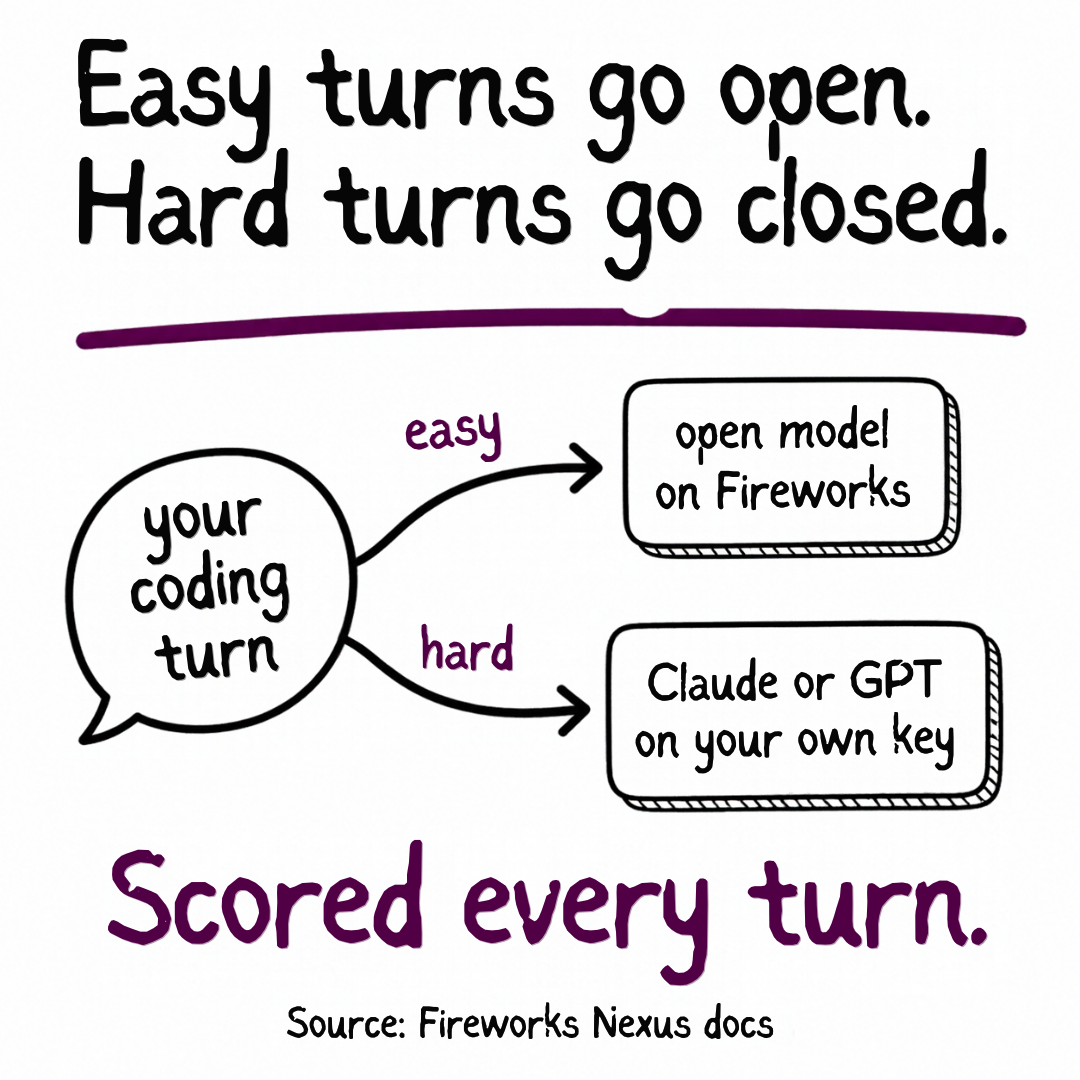
For each new message you send, Nexus Auto predicts which available model will handle it well at the lowest cost. That model then serves the whole turn, tool calls included, until your next message. Easy turns go to a Fireworks open model such as Kimi, GLM or DeepSeek. Harder turns go to an Anthropic or OpenAI model on your own account, using a key or sign-in you supply. Fireworks says the router also weighs prompt-cache hits, since cached input costs half as much and switching models throws the cache away.
Fireworks’s docs list these models for auto: Claude Opus, Sonnet and Fable, three GPT models, and on the open side Kimi K3, GLM 5.3 and DeepSeek V4.1 Flash. If you want open models only, nexus auto --providers fireworks stops it calling your closed accounts. You can also pin one model and skip routing.
What the CLI does to your machine
The install is a shell script, and the sign-in and connect steps are separate commands. The sequence from Fireworks’s docs:
curl -fsSL https://nexus.fireworks.ai/install.sh | bash
nexus login
nexus claude          # or: nexus codex, nexus opencode, nexus cursor ...
nexus claude off      # restores your original settings
It needs Node.js 22 or later. I couldn’t run it: my sandbox blocked the installer’s download from GitHub with a 403, and I don’t have a Nexus account to sign in with. I read the CLI’s README instead. Here’s what it says the tool does:
- Connecting rewrites the harness’s own config, such as
~/.claude/settings.json,~/.codex/config.tomlor~/.config/opencode/opencode.json, and keeps a snapshot under~/.nexus.offrestores file-based harnesses from that snapshot byte for byte. - Your Fireworks key goes in the operating system keychain, or an encrypted file when there’s no keychain. Anthropic and OpenAI keys you save with
nexus autoare the exception: they sit in plain text in~/.nexus/config.json, readable only by you. - Claude Code’s own telemetry stays on. Nexus CLI doesn’t switch it off.
- It ignores a
FIREWORKS_API_KEYin your environment. Sign-in goes throughnexus login.
Plans, and the free pass
| Plan | Price | Seats | Open models |
|---|---|---|---|
| Pro | US$8 a month | 1 | Through Nexus Auto |
| Team | US$10 per seat a month | Up to 200 | Through Nexus Auto |
| Enterprise | Usage-based, contact sales | Unlimited | Direct access to pick one |
Pro and Team include usage, not unlimited tokens. The included usage counts only turns that run on Fireworks, and when a seat reaches its allowance, Fireworks turns pause until the window resets. Turns that go to Claude or OpenAI bill to your own provider account. Fireworks’s docs describe the allowance as resetting on a rolling window and monthly, and don’t state its size.
The Nexus Pass checkout reads like this:
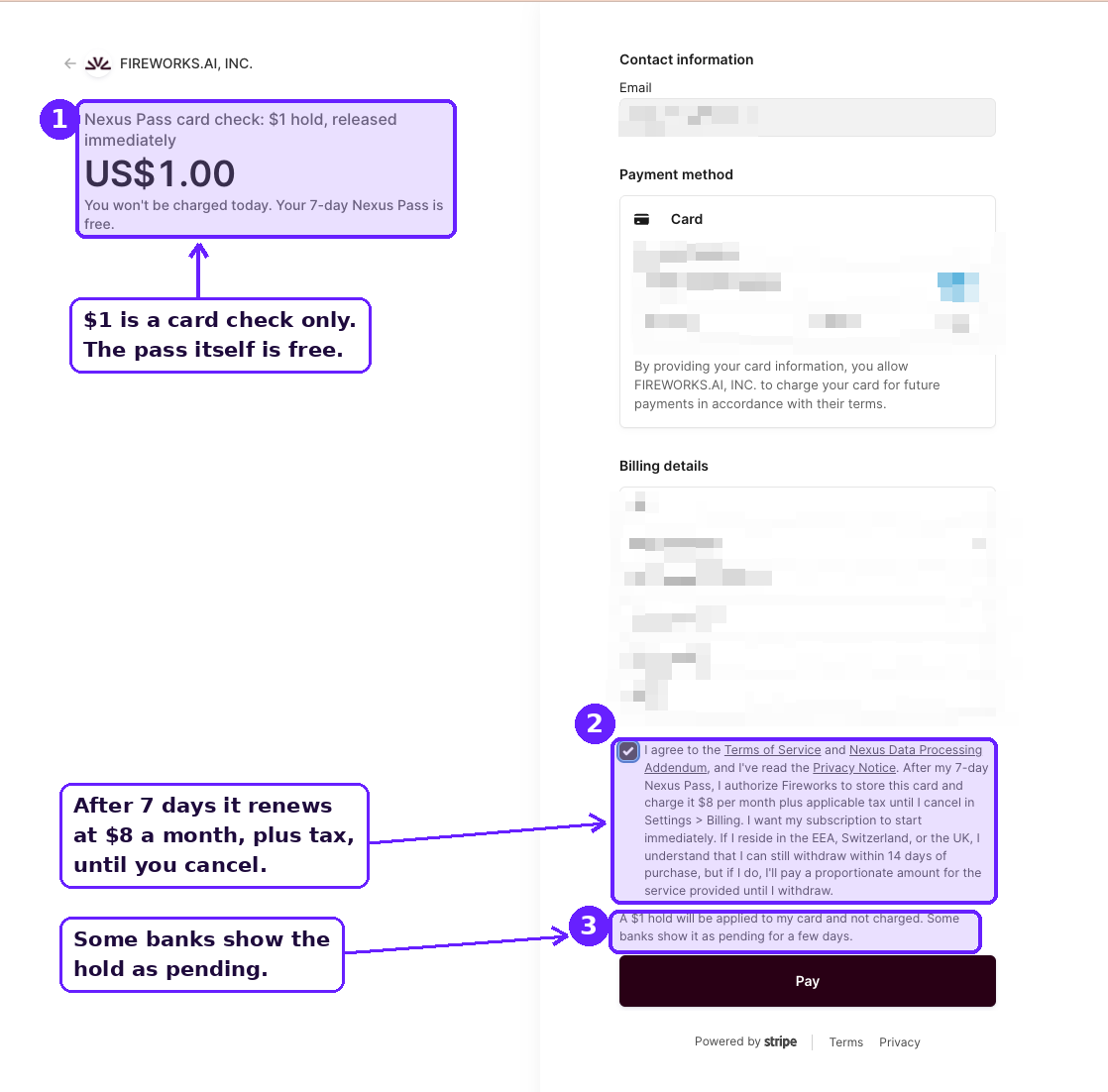
The line item is “Nexus Pass card check: $1 hold, released immediately”, US$1.00, with the note “You won’t be charged today. Your 7-day Nexus Pass is free.” The consent box under the card fields says that after the seven days, Fireworks will store the card and charge US$8 a month plus applicable tax until you cancel in Settings, Billing. It also says a US$1 hold is applied and not charged, and that some banks show it as pending for a few days. The payment page is run by Stripe, and the merchant is Fireworks.AI, Inc.
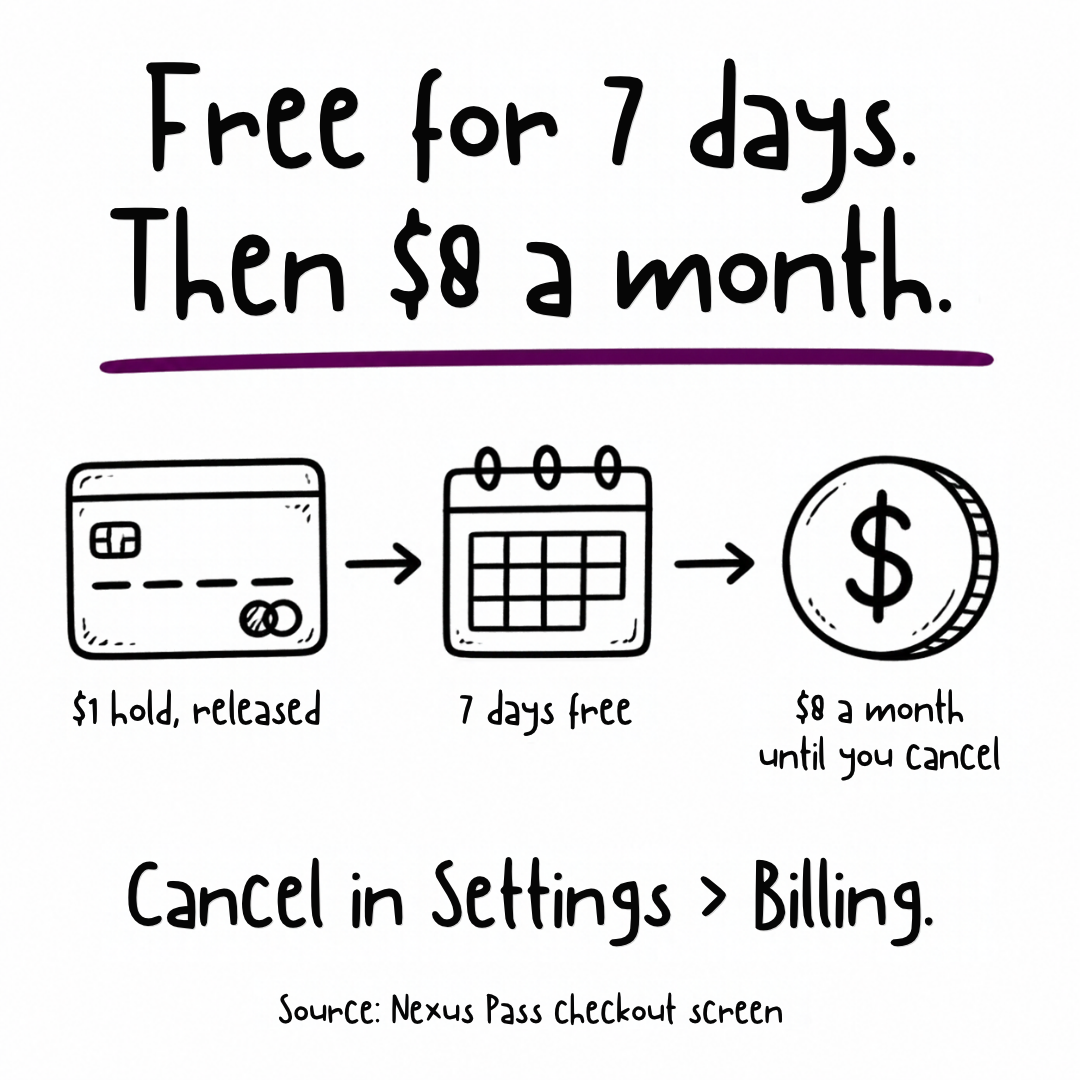
That matches the US$8 Pro price in the docs. Fireworks’s Nexus terms add three details. The subscription renews automatically at the then-current fee. A Pro user can cancel any time in account settings or by emailing support, and the cancellation takes effect at the end of the current billing period. And fees are non-refundable except where the terms or the law say otherwise, with no credit for partial periods.
What the pass doesn’t say is which models or speed tier it covers. The promotion talks about ultrafast inference. On Fireworks’s platform, Ultra-fast is a serverless mode in public preview that’s only offered for DeepSeek V4.1 Flash 1017, and Fireworks says it runs at up to 1,500 tokens a second in its demonstration. Nexus’s own pages describe a Fast tier at 100 or more tokens a second. The checkout and the docs I read don’t state that the Nexus Pass includes Ultra-fast.
US$1
card hold at checkout, released straight away
7 days
of free Nexus Pass
US$8
a month plus tax after that, until you cancel
What the evidence says
There are three layers of evidence, and they differ in how much to trust them.
Fireworks’s own numbers. On launch day Fireworks said Nexus Auto beat Claude Opus 5.5 at max effort, 89.3% against 86.8% across 1,222 tasks, at 17% lower cost. It said its own engineering traffic saw 53% lower cost per coding session. Its July post said preview customers Notion and Doximity saw about a third off the cost of each merged pull request. These are vendor figures.
A customer-style study. Faros AI, an engineering analytics firm, ran 211 real tasks from 12 of its own repositories through seven model and harness combinations. Claude Code on the open model GLM-5.2 scored 0.568 on its judge at US$0.92 and 321 seconds a task. Claude Code on Opus 4.8 scored 0.521 at US$1.76 and 775 seconds. Faros says the cohort is specific to one company and isn’t a universal leaderboard. It tested models, not Nexus Auto itself, and it’s the study Fireworks leans on for the case that open models can do routine work.
An independent router test. Vals AI’s Router Index runs six routers through the same eight agent benchmarks as its main index, about 1,250 tasks across finance, coding, law and tax, each router at its default settings. Fireworks ran two pools, and the one called Sol topped the table on 3 November.
| Router | Maker | Score | Cost per test |
|---|---|---|---|
| Nexus Auto with Sol | Fireworks | 60.0% | US$1.25 |
| Router | Ramp | 57.8% | US$0.96 |
| Nexus Auto with Opus | Fireworks | 56.5% | US$9.22 |
| Jev Router | OpenRouter | 55.7% | US$5.30 |
| Auto Router | OpenRouter | 52.2% | US$0.82 |
| Fugu Max | Sakana | 48.1% | US$3.91 |
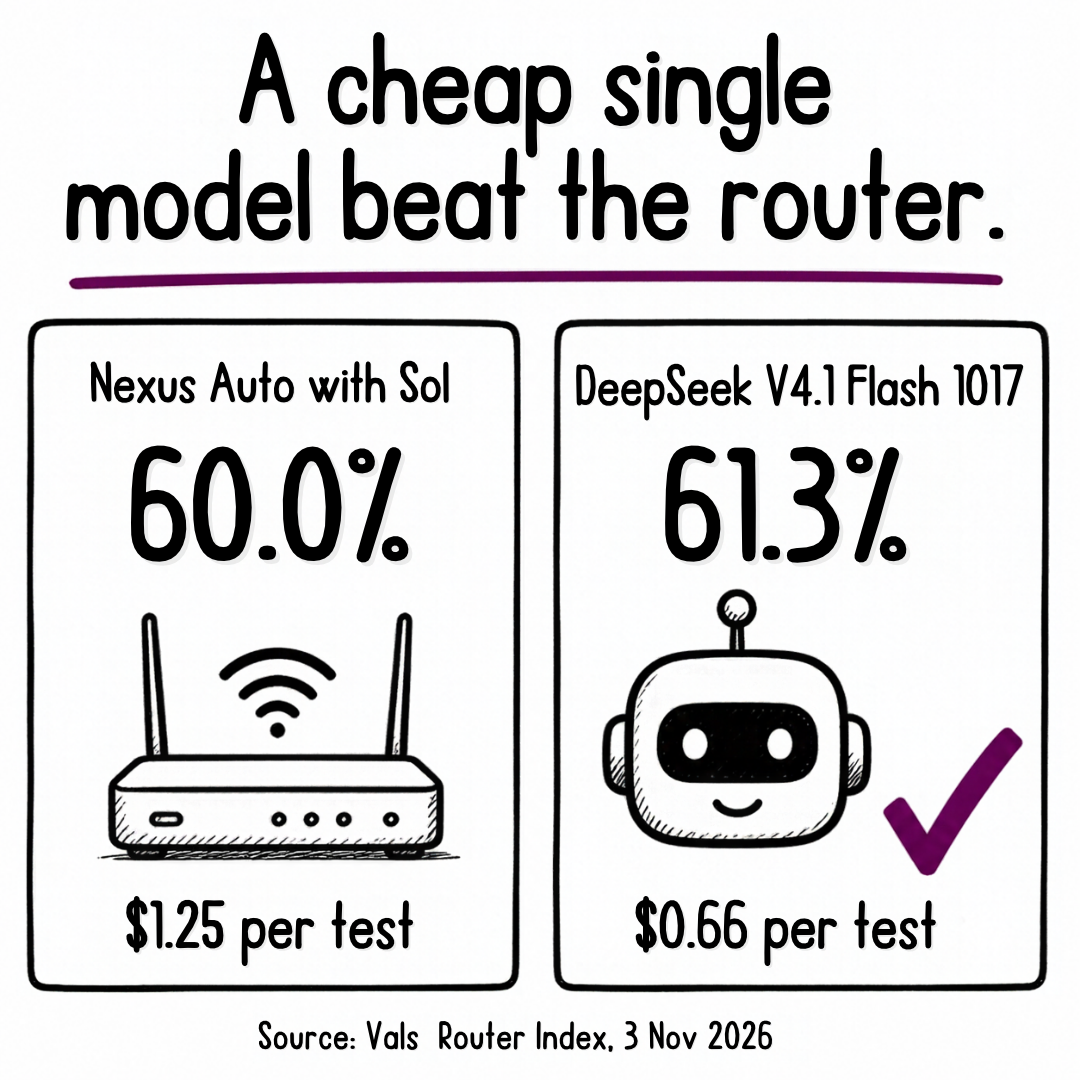
First place is real, and so is the caveat Vals attaches to it: none of the six routers sits on the cost and accuracy frontier. Each was beaten on both score and cost by at least one single model. Nexus Auto with Sol came closest. DeepSeek V4.1 Flash 1017 scored 61.3% at US$0.66 a test, against 60.0% at US$1.25, and Vals says that lead of about a point is within the margin of error.
Three more findings from Vals matter if you code for a living:
- On Vals’s three coding benchmarks, Nexus Auto with Sol scored 61.5% at US$2.48 a test. DeepSeek V4.1 Flash 1017 scored 62.7% at US$0.90.
- Nexus Auto with Opus cost less than half as much as Claude Opus 5.5 called directly, but scored 7.7 points lower on the full index, and below several cheaper models.
- Nexus Auto with Sol rarely changed models inside a task. Every Vibe Code Bench task started on GLM 5.3 and moved to the closed model for good once the agent first opened a browser to test its app.
Vals also notes that routers appear to run models at a lower reasoning effort by default, and that these are evaluations of each router as shipped, rather than isolated tests of its model choices. One rival has already contested the ranking: Weave published a Terminal-Bench 4.0 run of its own router at 54.5% first-attempt against 46.5% for the best Vals router. Weave ran that itself, Vals hasn’t run Weave Router, and Weave says a gap of a few points should be treated as a tie.
Where Nexus sits among routers
Routing has become a product category in 2026, and Nexus has company.
| Router | What it is | How you pay |
|---|---|---|
| Nexus Auto (Fireworks) | Router inside your existing coding tools. Open models on Fireworks, closed models on your own accounts. | US$8 Pro, US$10 a seat for Team |
| Cursor Router | Classifier behind Cursor’s Auto, with Cost, Balance and Intelligence modes. Cursor says Auto Intelligence delivers above-Fable user satisfaction at 68% lower cost. | Teams and Enterprise plans only |
| Auto Router and Auto Code (OpenRouter) | Rates eleven aspects of each request, then picks a model and reasoning effort from a catalogue of 600-plus models. | Standard rate of the chosen model, no router fee |
| Router (Ramp) | OpenAI-compatible gateway with guardrails, spend limits and fallbacks. | Free through 31 December 2026 |
| Weave Router | Router for Claude Code and Codex clients. | Not stated in the benchmark post |
What sets Nexus apart is that it isn’t tied to one editor or one gateway. It rewrites the settings of a dozen tools, it adds a spend dashboard with per-person caps, and it sells the open-model half itself, because Fireworks runs the inference.
Data, and Fireworks’s breach
Fireworks says Nexus is zero data retention on every plan. It says it doesn’t store prompts, responses, code or tool calls, and never keeps traces. It does keep service metadata to run the router: account ID, request time, token counts, the harness and CLI version, request shape, which model served each turn and routing quality scores. That metadata is de-identified after 30 days. Turns sent to Claude or OpenAI follow those providers’ policies, and US is the only region Nexus supports.
That claim needs reading next to this month’s news. On 9 November Fireworks disclosed that attackers reached account and billing information, and for a limited set of accounts secrets, datasets and incomplete model weights. Notion said the exposed data included Insights chat transcripts from fewer than 1% of its workspaces. Fireworks said then that it hadn’t detected impact to Inference, the Training SDK or Nexus. Separately, Cursor said a leaked Fireworks key started the fake Claude Code extension attack. Fireworks has said its investigation is ongoing. If you’re handing a company a card number and routing your source code through it, that history is part of the decision.
The company behind it is large. In July Fireworks announced a US$1.505 billion Series D at a US$17.5 billion valuation and said it had passed US$1 billion in annualised revenue.
A speed yardstick
I couldn’t test Nexus or Fireworks’s Ultra-fast tier, so I measured what ordinary speed looks like on the same model family. Using the Morph API with reasoning switched off, I streamed three 350-word answers from DeepSeek V4.1 Flash. First token took 0.44 to 0.77 seconds, and output ran at 166 to 174 tokens a second. One short run on Kimi K3.1 Pro gave 0.61 seconds to first token and 150 tokens a second. This is a different provider, a small sample and not Fireworks’s serving stack, so it says nothing about Nexus itself. It does show that 100 tokens a second, Nexus’s Fast tier, is where unremarkable serving already sits, and that Fireworks’s 1,500 a second claim for Ultra-fast would be roughly nine times faster than what I measured.
Should you take the pass
If you already pay for Claude or ChatGPT and run a coding agent most days, a week of Nexus costs you nothing but attention, and the Vals results say its routing is competitive with other routers. Don’t expect it to beat the best single cheap model, and don’t pick it for the speed until Fireworks says the pass includes it. If you work in a regulated codebase, or you can’t send code to a vendor that disclosed a breach this month, skip it.
If you take it:
- Set a calendar reminder for day six. The first charge is US$8 plus tax.
- Connect one harness, not all of them.
nexus claudeadds a status line with session cost and the model mix, which is the number you’re there to see. - Run
nexus statusandnexus claude offonce before you rely on it, so you know the undo works on your machine. - Compare the cost and the result against your normal week on a task you’ve already done, since Faros’s own advice is to measure routes on your own codebase.
- Cancel in Settings, Billing before the week ends if the numbers don’t beat your current bill.
What I ran: I read Fireworks’s Nexus docs, plans, terms and CLI README, Vals’s Router Index and Faros’s study, and timed the two Morph models above. I didn’t install the CLI or run Nexus, and I haven’t redeemed a pass.