Devin Memory scored 84.7% in a test of coding agent memory run by past.dev, ahead of Claude Code’s auto memory on 76.2% and Codex’s Memory v2 on 66.3%. The Devin Developers account shared the result on 27 November and pointed to Cognition’s post on how Memory and Dreaming work.
past.dev sells a memory API for agents. It put all three agents through DolphinBench, an open benchmark from Mem0 that scores memory by what an agent does with it, then added its own plugin to each. Devin with the plugin reached 93.2%, the top score in past.dev’s runs. The scores below are past.dev’s unless I say otherwise.
84.7%
Devin, built-in memory: 508 of 600 tests
76.2%
Claude Code, auto memory
66.3%
Codex, Memory v2
93.2%
Devin with past.dev added: 559 of 600
- What the test measured
- How Devin Memory works
- Dreaming
- Controls and shared memory
- What past.dev added
- How the other agents keep memory
- Other memory vendors
What the test measured
DolphinBench came out of Mem0 on 22 September, with a paper describing the method and a launch post. It gives an agent months of one person’s work history, then sets tasks that depend on it. There are three simulated people: Morgan runs a startup, Alex works on infrastructure and Riley manages a product. Each has about 500,000 tokens of dated messages, emails and documents.
The agent reads the history and saves what it needs. The memory is then locked, and the agent gets 200 tasks per person, each in a fresh conversation with none of the history in front of it. The tasks are jobs: send an email, add a calendar entry, review a pull request, write a document. The grader checks what the agent did, which app it called and with what arguments, and a model grades anything the agent wrote. A task passes only when every check passes.
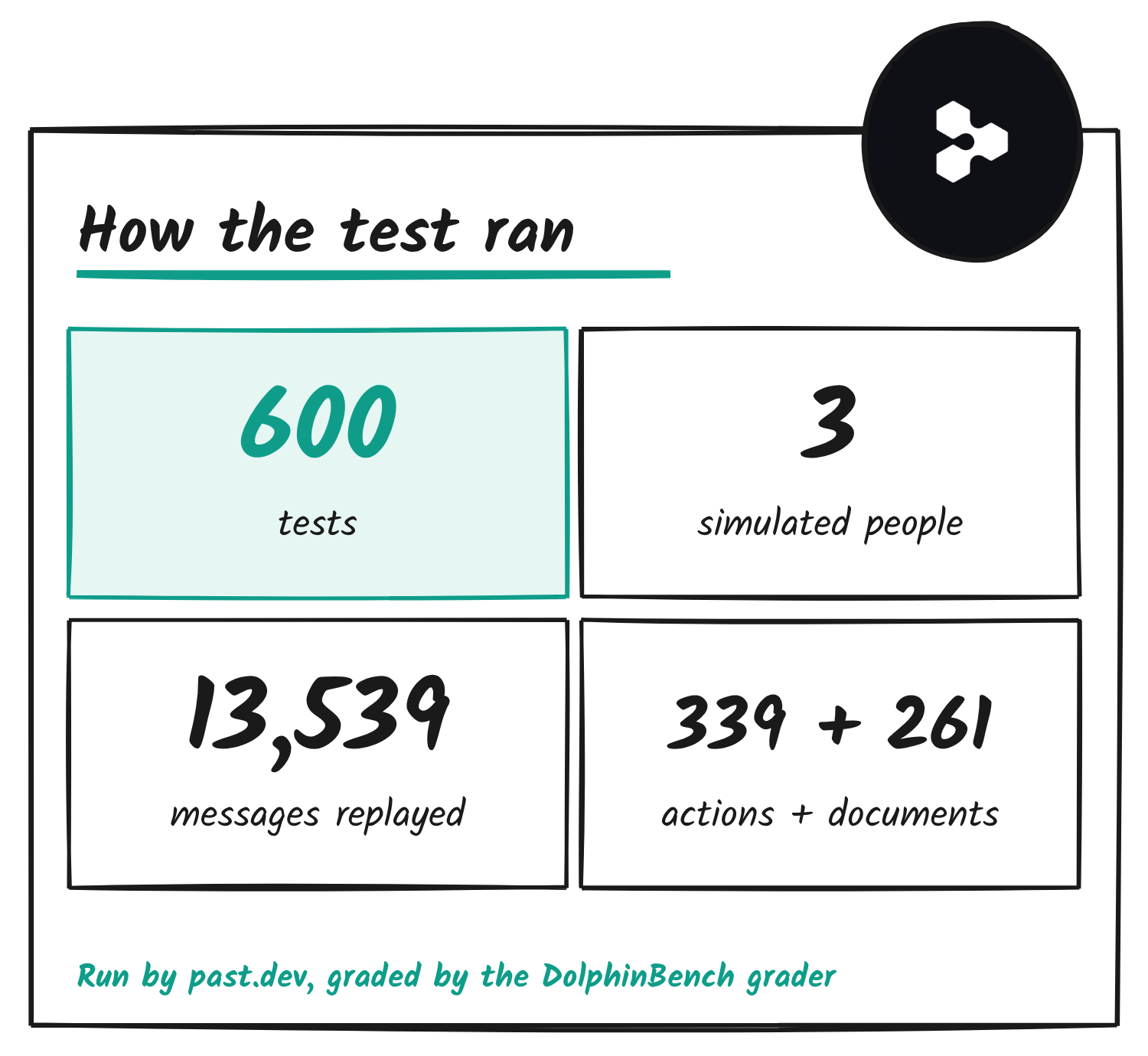
past.dev replayed those 13,539 messages into each agent and let each build its own memory, as it would for a real user. Of the 600 tests, 339 expect an action such as an email or a calendar event, and 261 ask for a document. The official grader, gpt-5.6-sol on medium effort, graded every answer. Each agent ran on its own model: Devin on its medium model in the Devin cloud, Claude Code on Opus 5.5 and Codex 0.165 on Sol 6.1. The scores therefore measure each agent with its memory, not the memories alone.
past.dev ran the whole test itself, so the results aren’t on DolphinBench’s public leaderboard. It loaded memory and tools differently from the official runs, and says to compare the scores with each other and not with the leaderboard. Its methodology page sets out the method. Devin’s API doesn’t return token counts, so past.dev reports speed, not cost, for Devin.
How Devin Memory works
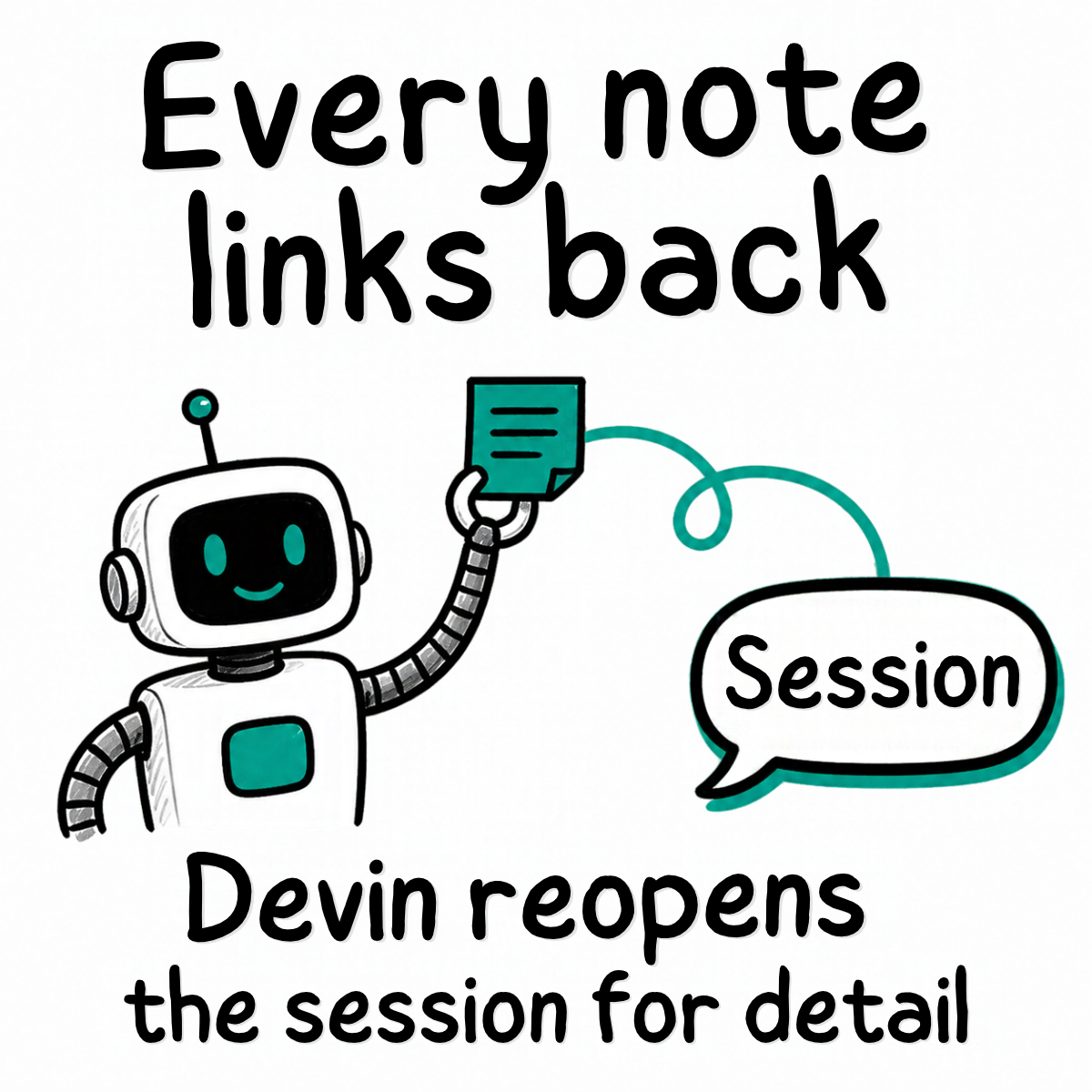
Cognition introduced Memory and Dreaming on 5 October. Memory carries what Devin learns about how you work into later sessions: your preferences, corrections you’ve made and lessons about your projects. It’s personal to you within each organisation and isn’t shared with teammates. Cognition says the notes aren’t session summaries but lessons, each written as a short note with a link back to the session where it was learned.
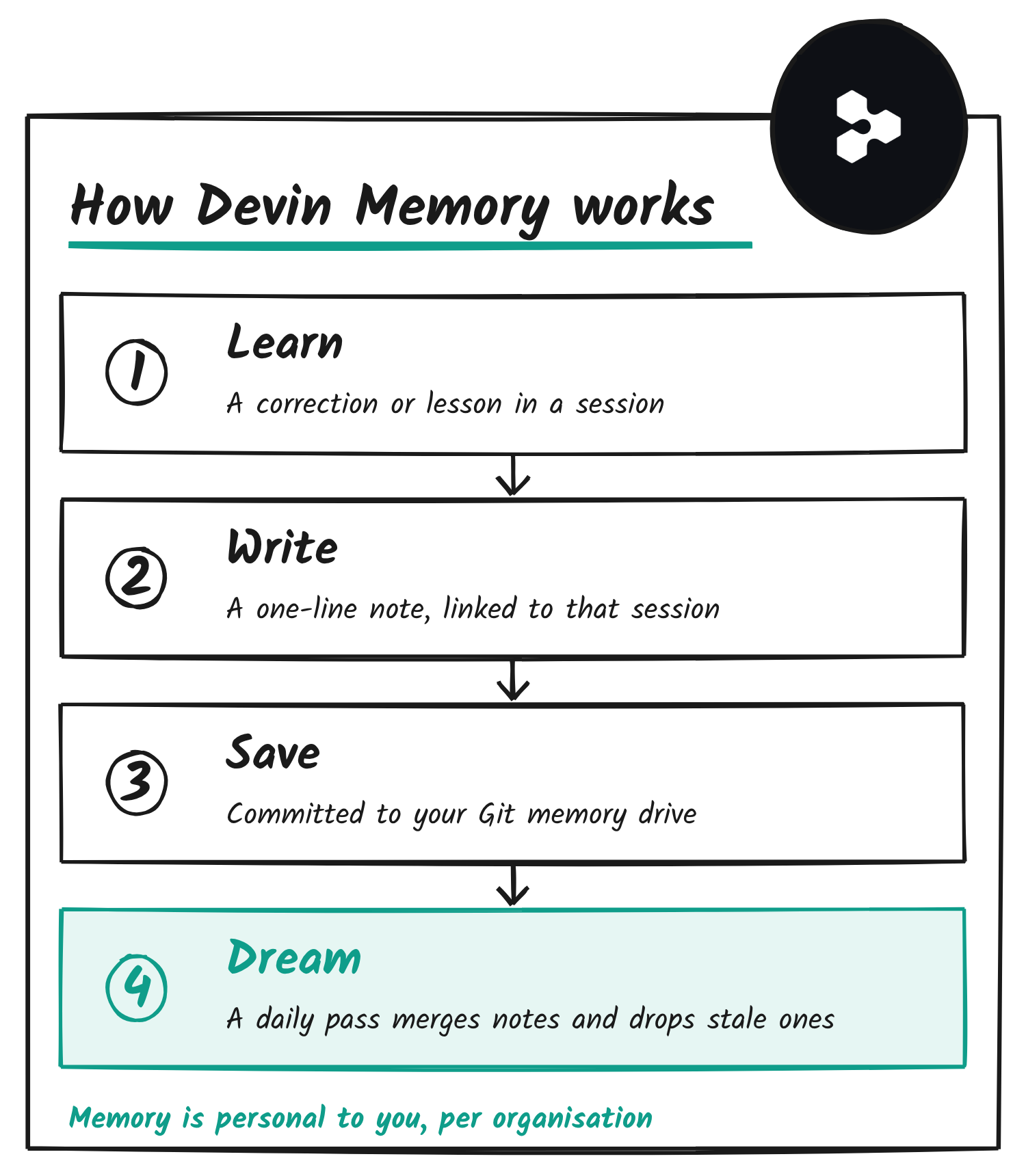
The notes live in a personal Memory Drive, a persistent Git repository of markdown files. A short MEMORY.md holds general preferences and an index of the other files, and Devin receives it at the start of each session. It then searches and reads other notes with the same tools it uses to navigate code, so the whole archive never loads into the prompt. The Devin docs describe the setup.
Each session works on its own Git checkout. After editing a note, Devin commits, merges changes from other sessions and saves the result. If another session saved first, a revision check rejects the stale write and Devin retries against the newer version, and conflicting edits are surfaced rather than overwritten. Each entry is a one-line bullet tagged with the session it came from and the date it was added.
- Prefers pnpm over npm in this repo [source: session-id; added: date]
- Runs the integration tests before opening a pull request [source: session-id; added: date]
The two lines above show the entry format only. The wording is mine, not copied from a real Memory Drive.
past.dev puts Devin’s lead down to that design, citing Cognition’s write-up: each memory links back to the session it came from, and Devin reopens that session when it needs the details.
Dreaming
Dreaming is the second half. It’s a daily background session in which Devin reviews past conversations alongside its existing memory. It consolidates overlapping notes, removes transient details and stale notes that no session used, and adds lessons the original work didn’t capture. Source links and explicit preferences are kept. Your first dream seeds memory from your recent sessions, and you can see each dreaming session and what it changed under Customize, then Memory, at app.devin.ai.

The term is spreading. Anthropic describes an offline pass it calls dreaming in Claude’s memory, which I covered in the piece on Lance Martin’s talk, and GitHub’s 28 October changelog lists memory and dreaming together under its GitHub intelligence features. My earlier piece on agent memory that forgets the right things covers the idea behind consolidation.
Memory and skills do different jobs. A skill is a repeatable procedure that you or your team write on purpose, such as how to test or deploy. Memory is what Devin writes itself as it works with you. Cognition’s docs say they work together: the skill supplies the procedure and memory supplies the context for applying it.
Controls and shared memory
Admins can switch Memory off for an organisation under Settings, Devin, Sessions, Memory. On Enterprise plans the setting can be default on, default off, always on or always off, and each member can still turn off their own memory when it’s on. When Memory is off, Devin doesn’t read or write memory in that organisation’s sessions, dreaming doesn’t run and the Memory tab is hidden. Existing notes aren’t deleted.
A Devin Bot keeps a memory of its own, separate from yours, and everyone who can use the Bot shares it. That makes Bot memory the team-level counterpart to the personal Memory Drive.

Cognition has also open-sourced the format as Agent Memory Repo, under an MIT licence. It treats memory as a Git repository with a MEMORY.md entry point, one-line entries carrying source and date metadata, and links between files, and it describes dreaming as a dedicated agent that runs periodically. You can install it in Devin CLI, or in Claude Code, Cursor and other agents through a skills installer. The trial setup keeps the memory repo local and doesn’t include automatic startup or scheduled dreaming.
What past.dev added
On Claude Code and Codex, past.dev ran its plugin on top of the built-in memory. Before each request the plugin recalls the memories most relevant to the task, and the agent can call past.dev to search for more. The built-in memory keeps working underneath. Devin with past.dev scored 93.2%, 559 of 600, which is 8.5 points above Devin on its own. Claude Code rose 13.5 points to 89.7% and Codex 19.5 points to 85.8%.
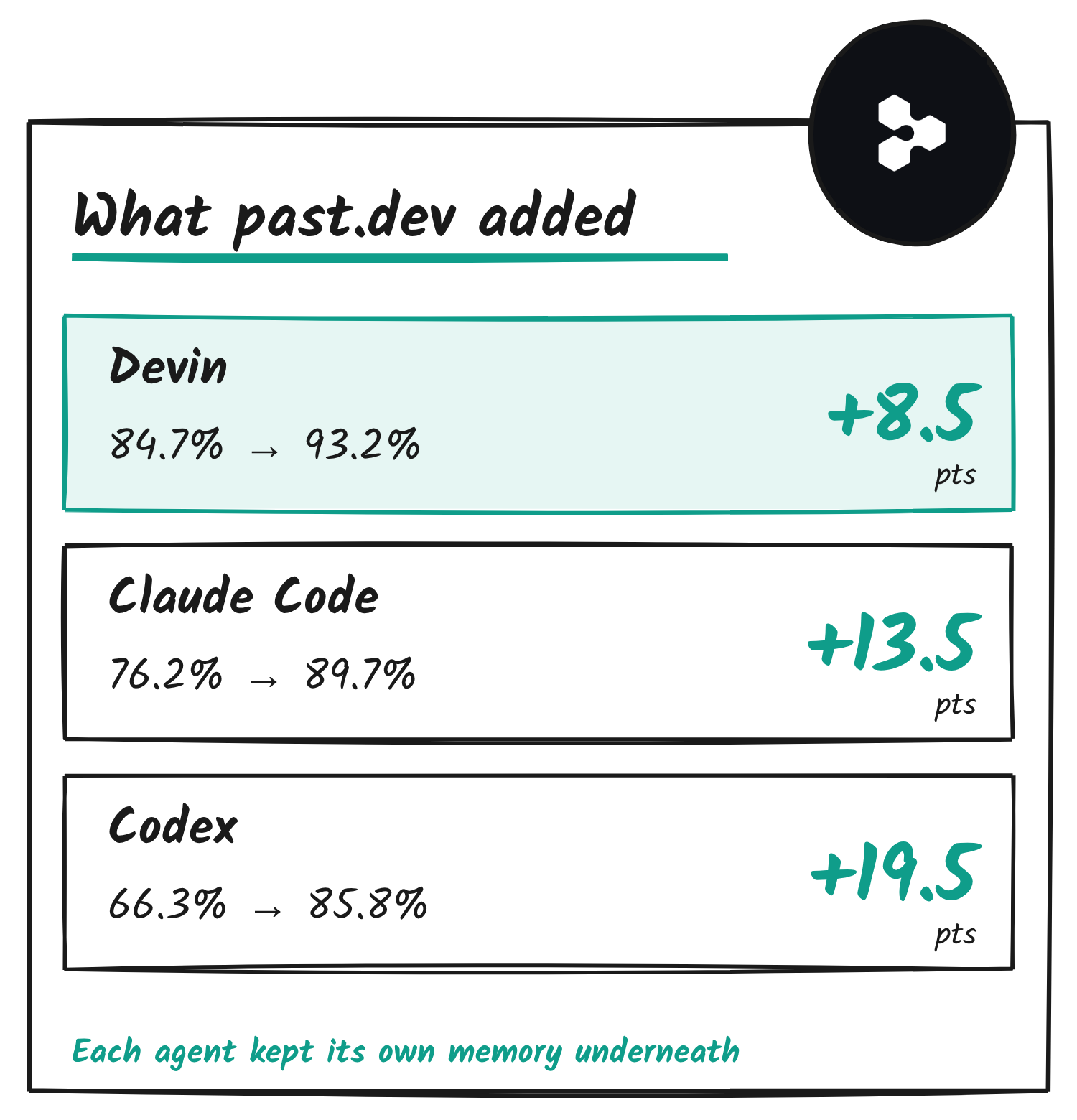
| Agent and memory | Without past.dev | With past.dev | Gain |
|---|---|---|---|
| Devin Memory | 84.7% | 93.2% | +8.5 points |
| Claude Code auto memory | 76.2% | 89.7% | +13.5 points |
| Codex Memory v2 | 66.3% | 85.8% | +19.5 points |
Cost and speed are reported for Claude Code and Codex. On Claude Code, past.dev says the plugin cut input tokens per test by 41%, from 193,811 to 114,020, and cost per passed test from US$0.449 to US$0.264. On Codex, cost per passed test fell from US$0.119 to US$0.055. On Devin, the median time per question was 62 seconds with past.dev and 65 seconds with Devin’s own memory only. Codex Memory v2 is new: in an earlier past.dev test on the same tasks it passed 66.3% against 49.7% for the first version.
past.dev’s Devin plugin is MIT licensed and works in Devin CLI, Devin Desktop and cloud sessions. Recall happens before the model answers, and a recall that takes longer than four seconds is dropped so it doesn’t hold a prompt up. On its pricing page, pay as you go starts with 50,000 credits, or 200,000 with a work email, and a session costs about one credit per 350 bytes of prose. Flex is US$99 a month. Check the page before you buy, since prices can change. past.dev says its coding-specific modules are coming soon, with more benchmarks to follow.
How the other agents keep memory
Every agent in the test keeps its own notes, with different defaults. This is what each vendor’s documentation says as of 28 November.
| Agent | Who writes it | Where it lives | Shared with others | Default |
|---|---|---|---|---|
| Devin Memory | Devin, as lessons linked to their source session | Personal Git Memory Drive of markdown | Personal to you in each organisation; a Bot’s memory is shared by its users | Admin setting per organisation; daily dreaming |
| Claude Code auto memory | Claude, as notes of four kinds: user, feedback, project, reference | Markdown files under ~/.claude/projects/, with a MEMORY.md index (first 200 lines or 25KB load) | Machine-local; shared across worktrees of one repo, not across machines | On in local sessions |
| Codex Memory v2 | Codex, in the background from threads idle six hours or more | Files under ~/.codex/memories_v2/ | Local to the machine | Off until you turn it on |
| GitHub Copilot Memory | Copilot, as repository facts and user preferences | Stored by GitHub, with citations to supporting code | Repository facts go to anyone with access; preferences follow the user | On for individual paid plans; admin policy first on Business and Enterprise |
Claude Code’s docs describe the same index-plus-topic-files pattern as Devin, kept locally and plain enough to edit by hand. The Claude Code docs also separate auto memory from CLAUDE.md, the file where you write the rules yourself. OpenAI’s Codex memories page says to keep required team guidance in AGENTS.md and treat memories as a recall layer. GitHub’s Copilot Memory docs check each repository fact against the current branch before using it.
The common thread is that memory is moving from a file you maintain to notes the agent maintains for itself, and consolidation is the part still being worked out. Devin schedules it daily. Codex runs a background consolidation pass on idle threads. Claude Code tells the agent to keep its index short and merge or drop stale lines.
Other memory vendors
past.dev isn’t the only memory vendor on the benchmark. Mem0’s launch post published official runs on two harnesses, Hermes Agent and Claude Code, for Mem0, Honcho, Hindsight and Supermemory, and requires every submission to report total cost and latency alongside accuracy. On Claude Code with Claude Sonnet 5, Honcho led Mem0’s official runs at 35.8%, ahead of Mem0 on 32.3% and Claude Code’s built-in memory on 26.3%. That setup differs from past.dev’s coding agent runs, so the two sets of figures can’t be compared. The DolphinBench site carries the public leaderboard.
Where to find it
Devin Memory is under Customize, then Memory, at app.devin.ai. Agent Memory Repo is on Cognition’s site, and past.dev’s plugin installs from its own docs. If you try more than one, run them on the same tasks, since past.dev’s numbers come from a vendor that sells one of the options.
Sources
- Devin Developers on X, 27 November: the memory test post
- past.dev: Claude Code vs Codex vs Devin memory, with the full results
- past.dev: benchmark methodology
- Cognition: Devin Memory and Dreaming
- Devin docs: Memory
- Cognition: Agent Memory Repo
- Mem0: introducing DolphinBench
- DolphinBench paper
- past.dev: Codex memory v2, with and without past.dev
- past.dev: pricing
- Anthropic: how Claude Code remembers your project
- OpenAI: Codex memories
- GitHub: About Copilot Memory
- GitHub changelog, 28 October: GitHub intelligence
Disclosure: I’m an OpenAI, Firecrawl and Devin ambassador.
Discover more from Sulat AI & Tech News
Subscribe to get the latest posts sent to your email.