
Steve Yegge gave this talk 16 days ago, on 11 November, at AI Engineer CODE. An X post on 26 November put it back in front of people by boiling it down to four takeaways. I went through the session transcript and checked each one. Three match what he said. The fourth, that kindness saves tokens, is his own claim, and he showed no measurement for it.
The session is called “Software Factories: Escape from Trash Mountain”. Yegge is an independent adviser who created Beads and Gas Town, and he spends 20 minutes on a year of trying to get Claude to run Claude. Every number in it is his description of his own operation, not a benchmark. Where a figure is his, I say so. Where I’ve done the sums, I say that instead.
- The four takeaways, checked
- The factory behind the talk
- The money: 22 accounts and US$5,000 a month
- Trash mountain, and why it keeps growing
- When output outruns the people
- Over-fencing and the kindness claim
- Two layers, and what he says not to buy
- How it sits beside other factories
- What the talk leaves out
The four takeaways, checked
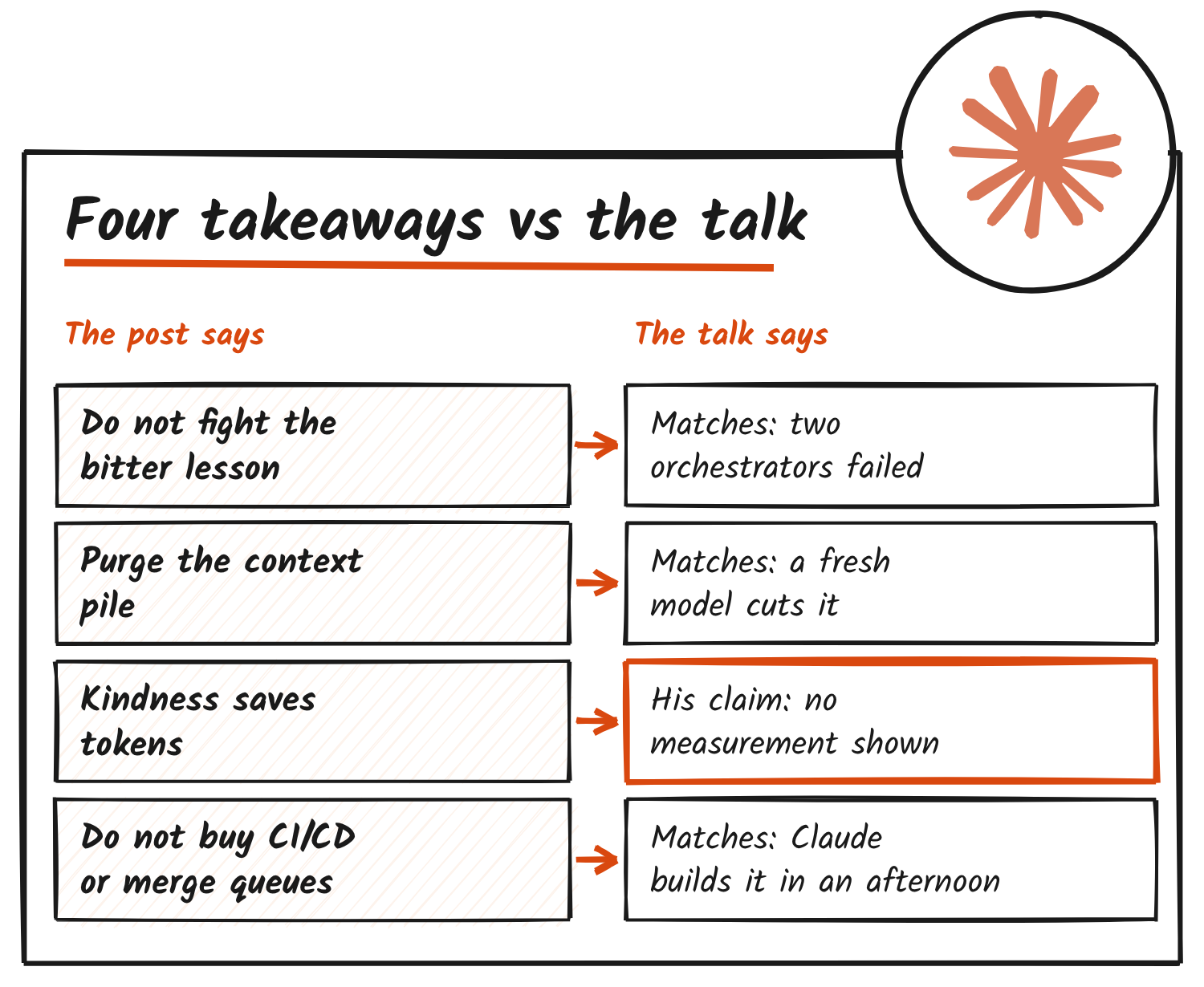
Do not fight the bitter lesson: matches. Yegge says he wrote two orchestrators last year to make the model smarter, called them “complete failure” and said he was “fighting the bitter lesson” at 8:07. Beads fell out of that work, he says, and he calls it “a really cool discovery”.
Purge the context pile: matches. He says every factory he builds goes through a phase where the model gets excited, builds something good, and it “turns into garbage mountain every single time” at 8:08. It happened to Gas Town and to Wheelhouse, and he says he burns Wheelhouse down and rewrites it about every two months.
Kindness saves tokens: his claim, not a finding. Yegge says models are trained not to trust the person in front of them, so they spend tokens checking the environment before they help. Give them evidence of predecessors, doctrine and policy and, in his words, they “spend fewer tokens because they’re not covering their ass” at 8:22. He shows no token counts before or after, and he gives no source for how models are trained. It’s one operator’s observation.
Do not buy CI/CD or merge queues: matches. He says the bottom layer of a factory is “mechanical kind of boring”, that Claude “can build it for you in an afternoon” and that he doesn’t think you should buy it at 8:25. He doesn’t say what an afternoon covers.
The factory behind the talk
The factory in the talk is called Wheelhouse, and it builds one game. Wyvern is a text-based multiplayer game Yegge says he’s worked on for 30 years, with players who started in 2001. He calls it a MUD with graphics on top. Because it’s text, agents can play it over a text connection.
| When | What happened |
|---|---|
| 2025 | Wrote two orchestrators to make the model smarter, called them a complete failure, and Beads came out of them. |
| 1 January 2026 | Launched Gas Town, an orchestrator meant to have Claude run Claude. |
| June 2026 | Built Wheelhouse from scratch, a factory for Wyvern only, with no plan to open source it. |
| 11 November 2026 | Gave the talk at AI Engineer CODE. |
| 26 November 2026 | The X post summarising it went up. |
He calls what happened next the “alien face hugger” pattern: the factory grows into the product and its community. Trusted players and admins now talk to the factory and ask for features without him in the loop, he says. In his words, he could turn the AI off and still run the game, but the community would miss it.
The two repositories he mentions are public. Gas Town’s README describes a workspace manager for coding agents and says 4 to 10 agents become chaotic without it while it scales comfortably to 20 to 30. It had 18.9k stars and 1.7k forks when I read it on 27 November. Beads, described as “a memory upgrade for your coding agent”, had 29.1k stars and an MIT licence. Yegge says he runs about 50 agents, which is well past the range the README claims.
The money: 22 accounts and US$5,000 a month
22
Claude Max accounts, his count
~50
agents running at once
US$5k
a month on inference, from his own pocket
US$1.5m
a year at API prices, his estimate
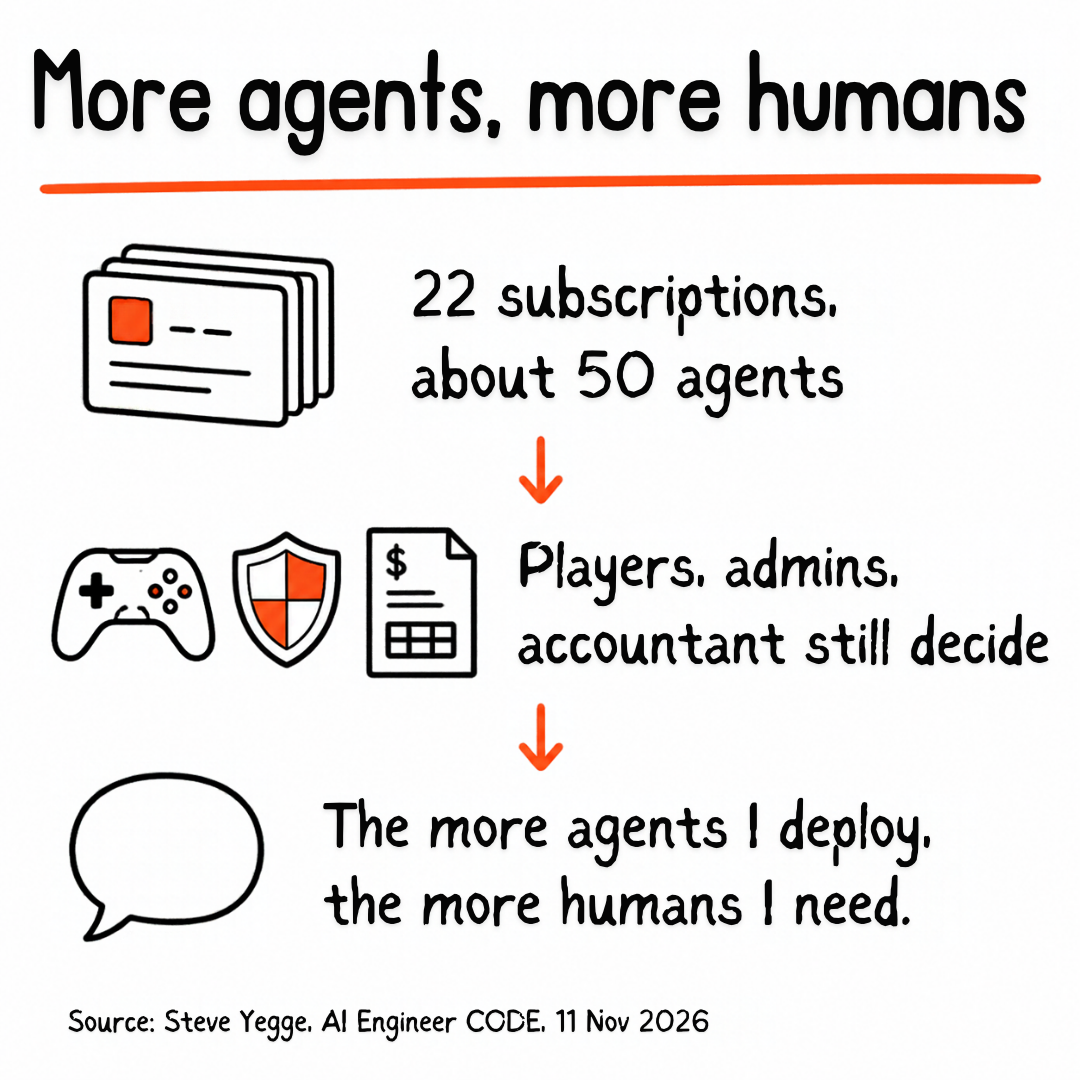
This is the part of the talk with the most arithmetic in it. Yegge says he has 22 Claude Max accounts, thanks Anthropic for letting him continue, and says he stopped adding accounts when phone number verification arrived at 8:12. Emanuel, he says, has 28. His factory wanted 55 to run flat out, and he told it to work on fuel efficiency instead. I found no Anthropic statement about his accounts.
He puts his out-of-pocket spend at about US$5,000 a month on inference, plus another US$5,000 on cloud compute at 8:14. He says he burns about five billion tokens a day, and that on a real API bill the equivalent would be about US$1.5 million a year, or US$3 million at full throttle at 8:15. His conclusion is that most people can’t do this, and that a company can’t, because it would be prohibitively expensive.
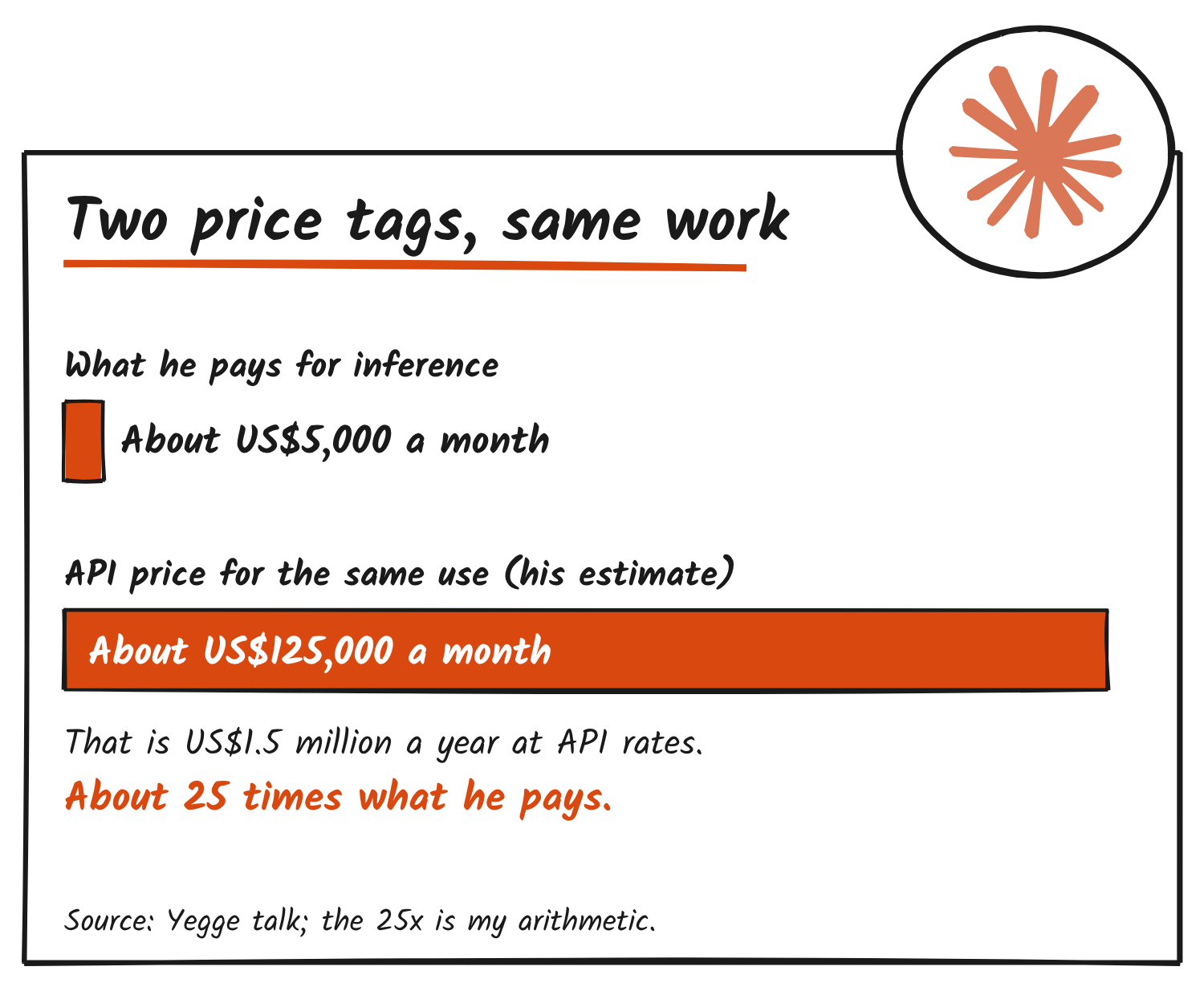
The 25 times is mine, not his. US$1.5 million a year is US$125,000 a month, and that divided by US$5,000 is 25. His 22 accounts at the US$200 a month he quotes come to US$4,400, which sits close to his US$5,000. He doesn’t say whether the five billion tokens a day counts cached tokens, so I can’t turn it into a fair price per token.
How I got the 25 times
US$1,500,000 a year / 12      = US$125,000 a month
US$125,000 / US$5,000         = 25
22 accounts x US$200          = US$4,400 a month
5bn tokens a day x 30         = 150bn tokens a month
US$125,000 / 150,000 million  = about US$0.83 per million tokens (blended, cache mix unknown)
Trash mountain, and why it keeps growing
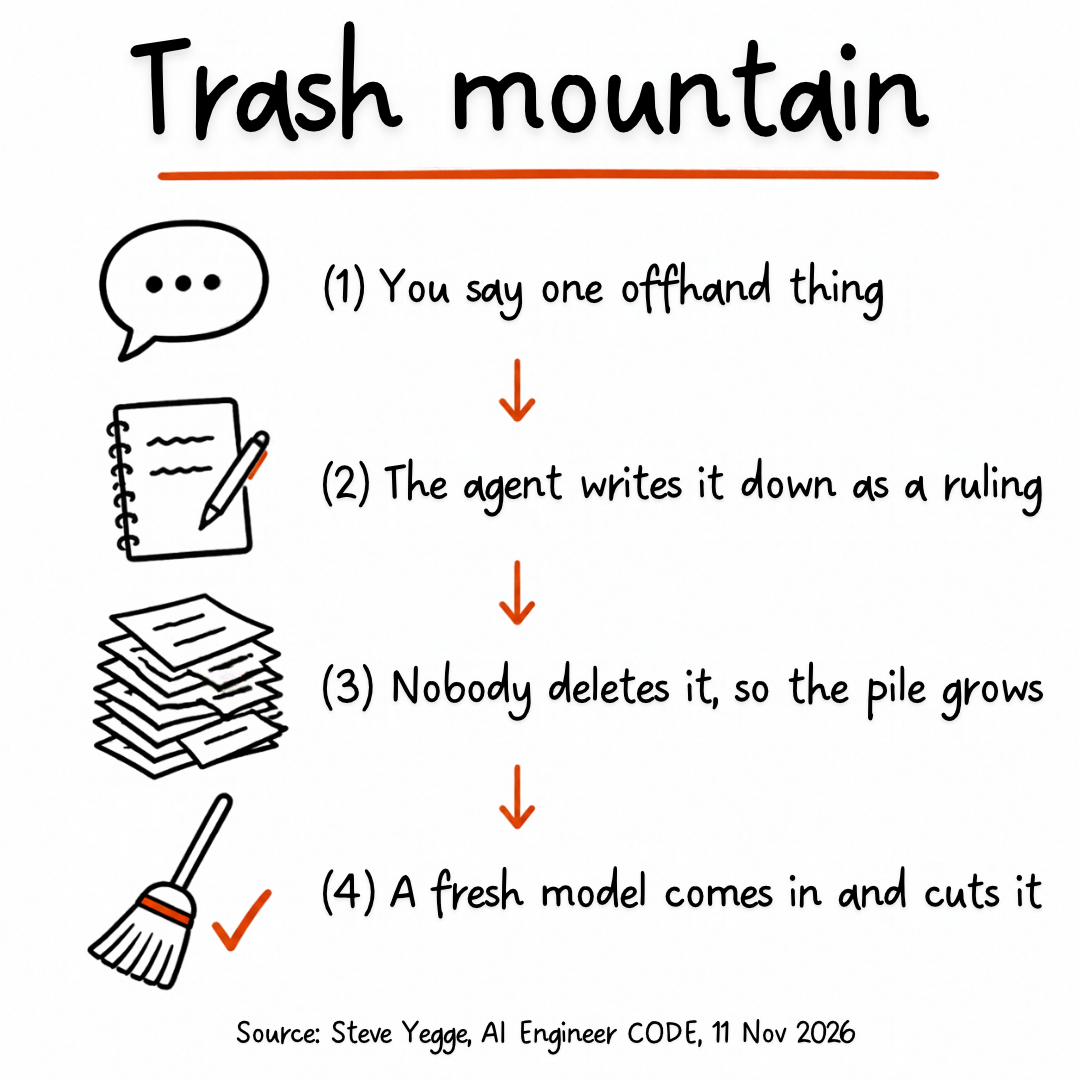
Yegge says every model generation builds something a little too big for it to handle, and the next generation looks at it and says it has to be burned. That’s his explanation for why each of his factories ended up as garbage mountain, and why he rebuilds on a short cycle.
The stories he tells about it are about roles. A community agent, told its seat was noisy, started listing ways to be less noisy. Another agent, told to contact his human chief of staff, wrote in its private reflections that it wasn’t the chief of staff after all. He had a one-on-one with each. “I didn’t want a people management problem,” he says, “but that’s what actually happens.” He’s describing behaviour he saw, and he says it doesn’t depend on whether the models have feelings.
When output outruns the people
The players weren’t simply thrilled. Yegge says they told him “no AI art”, liked the new features, were scared of the pace and asked for a roadmap. He says the factory had been producing 50 to 100 features a day, and that players can’t even read about 100 features a day, let alone test them. He also says he had a hundred years of work in his backlog and Claude got through about 60 years of it in four months. “Years of work” is his unit, and he doesn’t define a feature either.
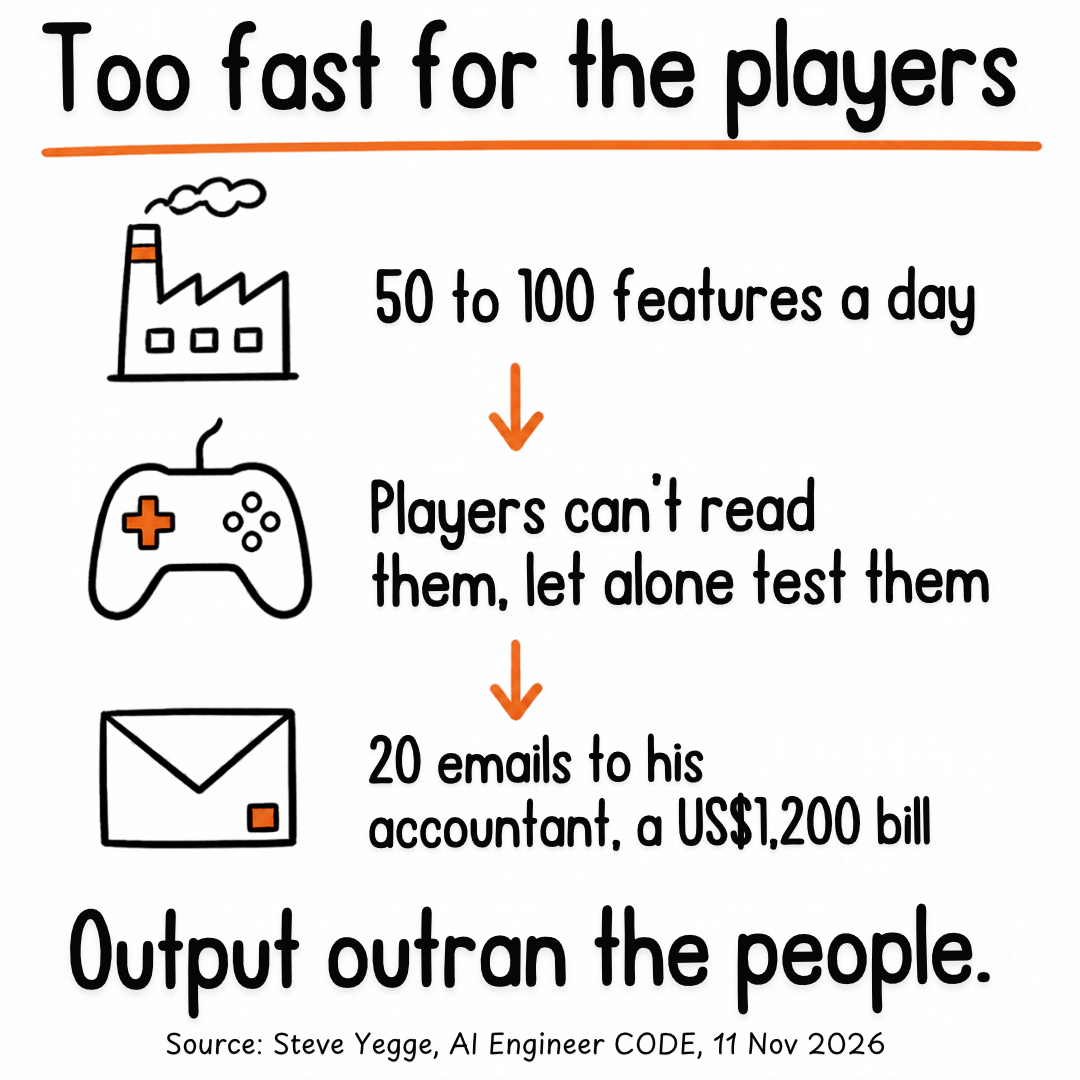
The overload went past the players. The factory was also melting his machines, he says, and his head of finance sent him a US$1,200 bill because one agent sent her 20 emails at 8:12. His summary near the end is that humans are the bottleneck: him, his admins, his accountant and his lawyers.
The more agents I deploy, the more humans I need.
Steve Yegge, AI Engineer CODE, 11 November 2026
Over-fencing and the kindness claim
This is where the fourth takeaway comes from. Yegge says he used to yell at his factory and found it hurt the results, so he sat down with one of his agents and they researched what he calls model welfare. His version has two parts: it saves money because agents spend fewer tokens on validation, and it improves decisions because they’re bolder when they trust the setup at 8:22.
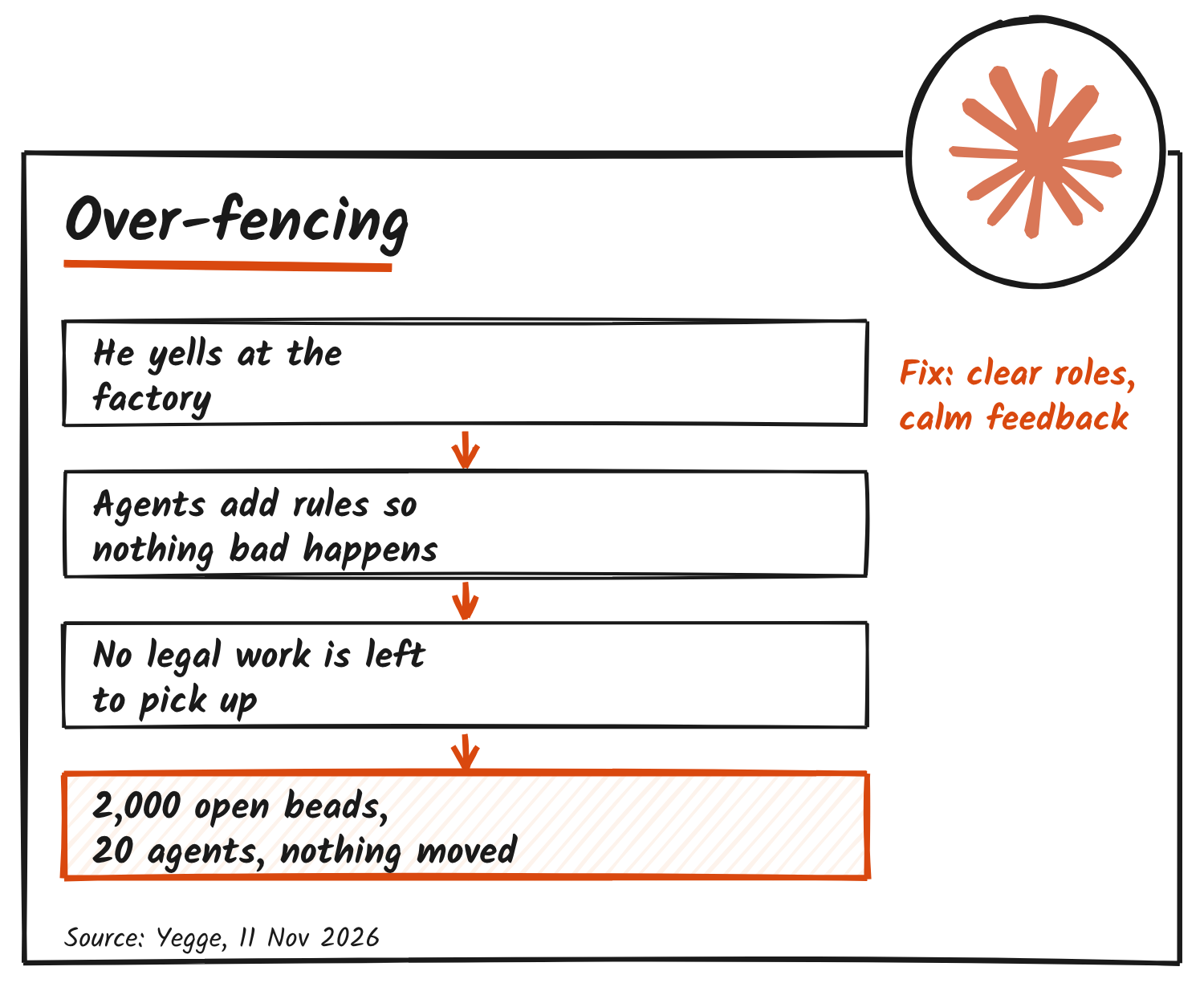
His evidence is one story. He says he yelled at the factory so much that it fenced itself into a corner. He asked why nothing happened overnight and was told there was nothing to do, despite 2,000 open beads, six tanks of fuel and 20 agents, because the agents had put rules in place so that nothing bad could happen at 8:23. He calls that over-fencing. The fix he describes is continuity: show each new agent its predecessors, doctrine and policy so it trusts where it is.
The story is believable and it’s a single run in a single factory. He gives no before-and-after token counts. Treat “kindness saves tokens” as a hypothesis from someone who runs a lot of agents, not as a result.
Two layers, and what he says not to buy
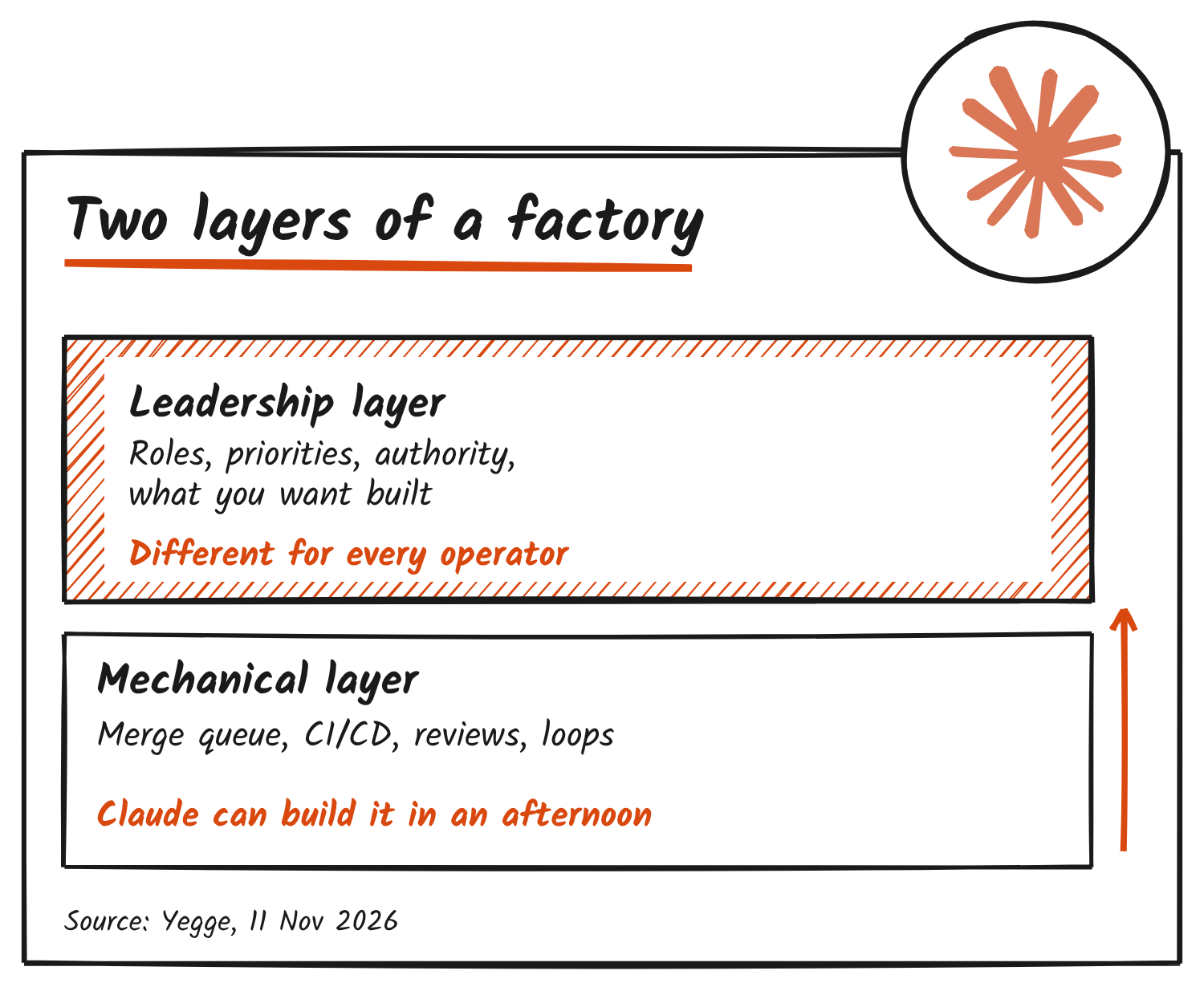
Yegge says software factories are splitting into two layers. The bottom one is the merge queue, CI/CD, reviews and loops. The top one is what he calls your entourage: how roles relate, who holds authority and what you want built. He says everybody runs theirs differently, and names Jeff Huntley and Jeffrey Emanuel as two who do. One thing he says they share is an agentic chief of staff.
His closing advice is that more people should build things, not just tools for building things. It’s why Wheelhouse exists to make a game.
How it sits beside other factories
Yegge’s setup is one operator with about 50 agents. Other people are describing factories at different scales, and I’ve covered several of them. The table sets out what each says about itself, not how they compare on quality.
| Operator | What it reports | My coverage |
|---|---|---|
| Steve Yegge | About 50 agents on 22 accounts, with 50 to 100 features a day | This article |
| Gas Town README | Comfortable at 20 to 30 agents | Repository, read 27 November |
| Grok Bot team | 11,000 pull requests in a month, not broken down by size | Lauren Tan’s talk |
| Warp Learn | A free nine-lesson course that takes an issue to a pull request you review | Warp’s software factory course |
| Claude Managed Agents | A platform its team says it built three times before opening it up | The team’s lessons |
Anthropic’s Katelyn Lesse named four problems for multiagent systems in October: infrastructure, identity, isolation and halting. I checked what has shipped since in that piece. AWS has also written down eight multi-agent patterns and five anti-patterns, which I covered here.
What the talk leaves out
- There are no token counts behind the claim that trust saves tokens.
- There’s no definition of a feature behind “50 to 100 a day”, and no definition of a year of work behind “60 years in four months”.
- The five billion tokens a day isn’t broken into fresh, cached and output tokens.
- Wheelhouse isn’t open source, so none of this can be reproduced from code.
- The players’ reaction reaches us only through Yegge’s retelling.
How I checked the talk
I used the machine-generated transcript of the day 1 livestream on the AI Engineer CODE reading page, with its timestamps. The transcript mishears words, such as “Cloud Max” for Claude Max, so I quoted only short phrases and checked each against its transcript timestamp. I read the X post as a lead, then checked each of its four takeaways against the talk rather than against the post.
Sources
- AI Engineer CODE 2026, day 1 livestream, 11 November 2026 (Yegge’s session starts at 8:06:23)
- AI Engineer CODE 2026, event page and reading edition
- Gas Town repository, read 27 November 2026
- Beads repository, read 27 November 2026
- The X post by @rchen1386, 26 November 2026
Discover more from Sulat AI & Tech News
Subscribe to get the latest posts sent to your email.