T3 Code’s 0.1.13 release, published at 8:32am NZDT on 27 November, removed two behaviours that its own pull requests describe as against what Google wants from outside clients of Antigravity. The first stopped T3 Code reading a user’s Antigravity sign-in token and calling Google’s internal quota API under a made-up user agent. The second stopped it telling Antigravity it was the Zed editor, a name that gets Claude and GPT models offered through Antigravity’s agent.
A post on X by bebu, at 1:03am NZDT on 28 November, says Google “has stepped in” after paid accounts were banned within minutes of connecting them to T3 Code. I found the two fixes and a Google rule that fits them. Replies on Google’s developer forum, from accounts writing in Google’s voice, say T3 Code is permitted for interactive use. I found no public Google statement about any ban, and nothing that shows either behaviour caused one.
This piece sets the two fixes beside what T3 said before them, then goes back over the earlier incidents I could verify from Theo Browne’s years at UploadThing and T3, quoting his own write-ups and posts, including where he was right. The telemetry affair has its own piece, T3 Code telemetry: what the record shows, so I only summarise it here.
What T3 changed on 26 and 27 November
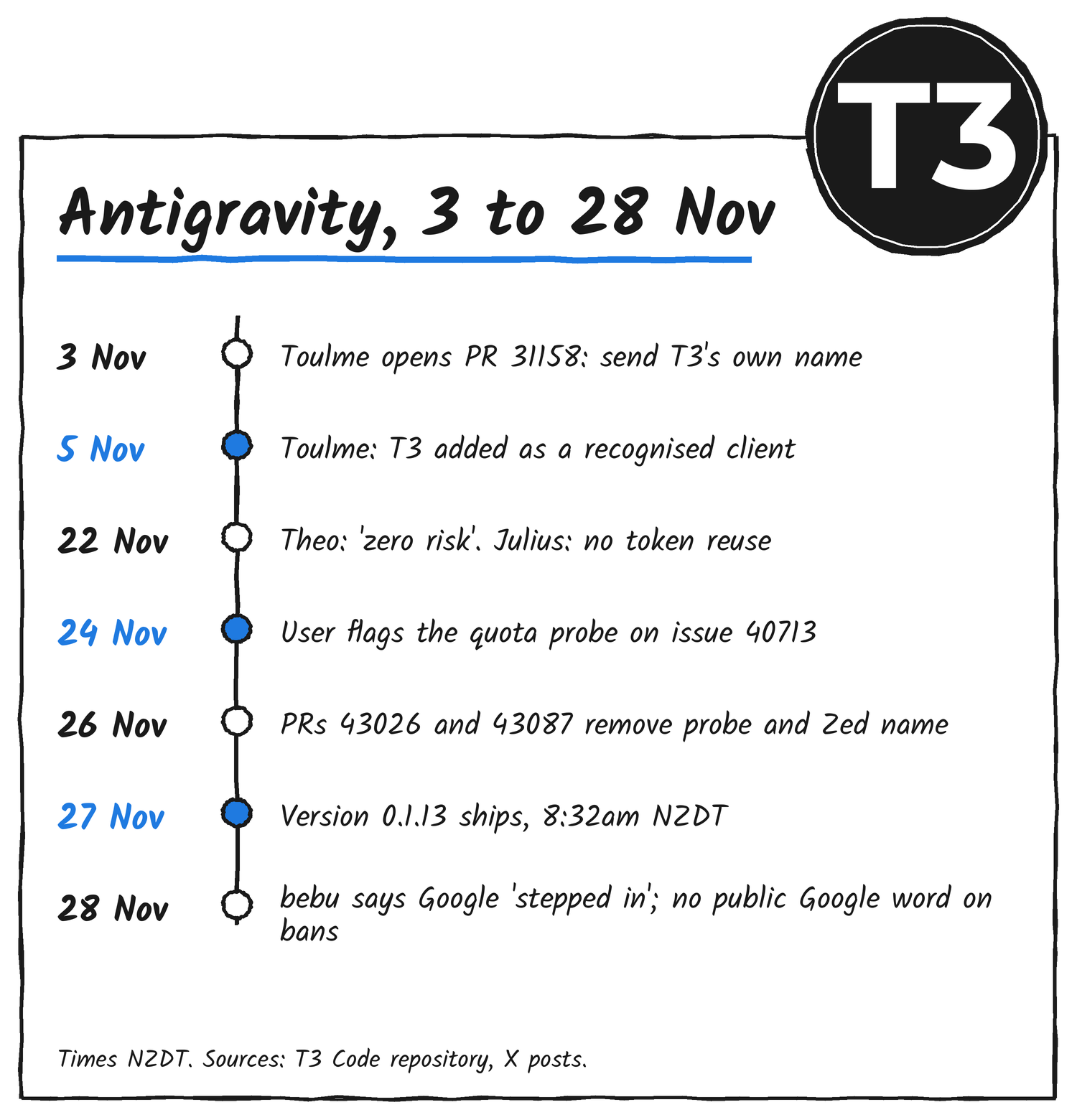
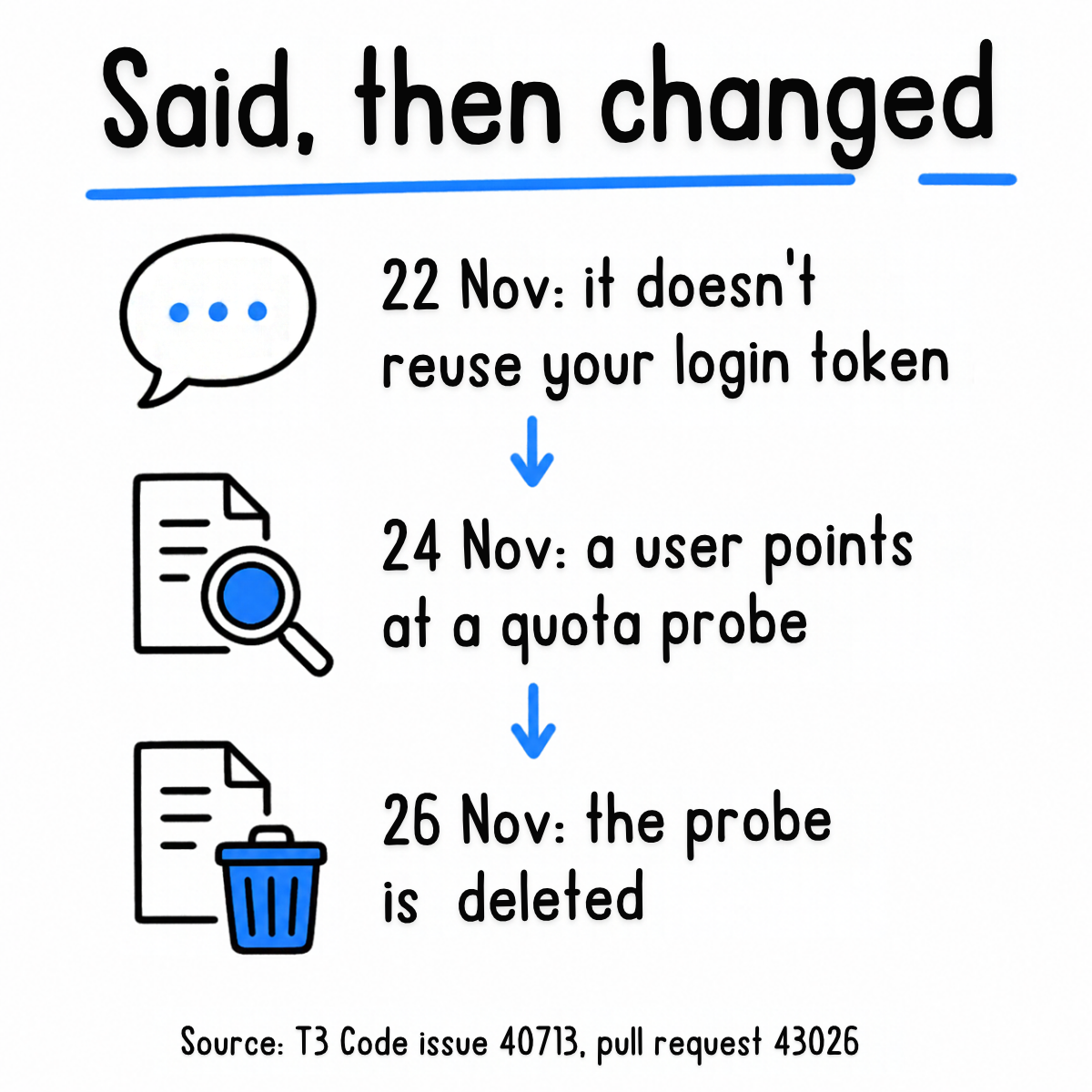
Julius Marminge, one of T3 Code’s maintainers, opened pull request 43026 at 8:15am NZDT on 26 November. Its description begins: “Antigravity supports only ACP for external clients. Google told us that calling its internal APIs can get an account flagged.” ACP is the Agent Client Protocol that Google’s agy acp server speaks. The pull request says T3 Code was reading Antigravity quotas from cloudcode-pa.googleapis.com, through the retrieveUserQuotaSummary and fetchAvailableModels calls, in two places: the local provider probe and the reader for the CLIProxyAPI hub, the account-pooling setup that T3’s FAQ describes.
The file it deleted, antigravityUsageLimits.ts, “held the quota probe, the OAuth refresh, the keyring/Windows credential reads and the fake antigravity/hub user agent.” The pull request also drops the @napi-rs/keyring dependency from the server. Antigravity now shows no limits in T3 Code, the same as other providers that don’t report any. Local token history, read from on-disk conversation databases with no network call, stays. The pull request says “Limits can come back once Antigravity exposes them over ACP” and that Antigravity’s team said they’d pass the request along.
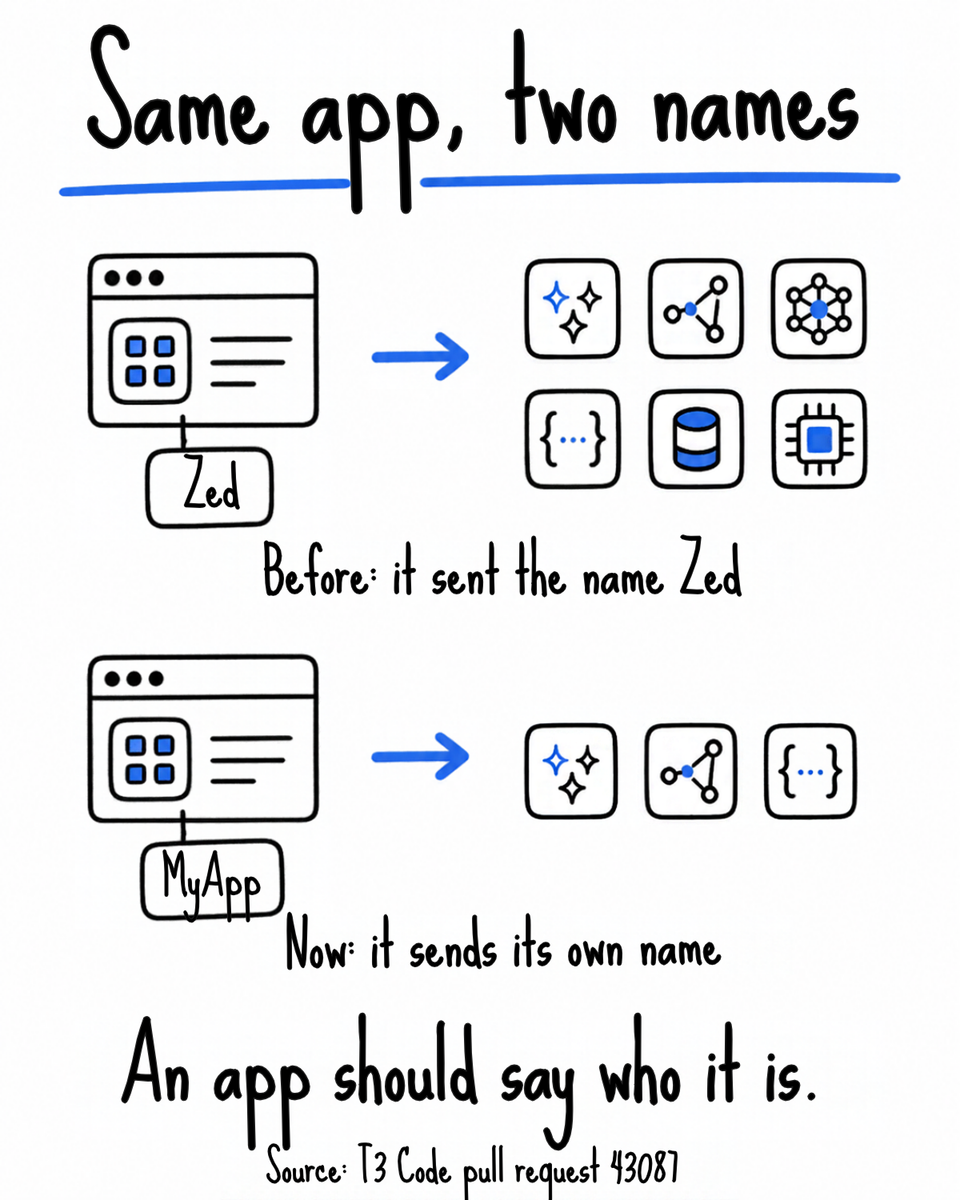
The second change is pull request 43087, opened at 10:24am NZDT on 26 November by a contributor who posts as gabrielelpidio, who also merged it. It says that on agy 1.5.0, or whenever T3 couldn’t read the runtime version, the handshake sent clientInfo: { name: "zed", version: "0.0.0" }. That got agy to offer Claude and GPT models, which version 1.5.0 offers only to allowlisted editors such as Zed. The author’s reading is that Google wants external clients to use Antigravity only over ACP, as themselves, and that “posing as another client breaks the same rule.” T3 Code now always sends t3-code, and it refuses to open a session on 1.5.0 with a message telling the user to update to 1.5.1.
The Zed identity wasn’t hidden. Pull request 31158, opened by Patrick Toulme on 3 November NZ time and titled “identify as T3 Code to runtimes that allowlist it”, says Antigravity offers non-Gemini models only to clients it recognises by name. T3 Code wasn’t one, so it sent Zed’s name, “which keeps the models available, but Antigravity counts T3 Code’s traffic as Zed’s.” On 5 November, Toulme, whose X bio lists Google DeepMind, told Theo he had “landed t3-code internally as a recognized client in Antigravity’s ACP server” and that Antigravity would attribute T3’s traffic to T3 Code once T3 ran the upcoming release. By 26 November, according to pull request 43087, only some installs still sent Zed’s name.
Both pull requests shipped in version 0.1.13, “401 changes from 52 contributors”. The seven highlights are about workflows, stopping simulators, copying file paths and similar, and none mentions Antigravity. Both pull request titles are in the “What’s Changed” list. So bebu’s line that the notes “barely mentioned” the fixes is half right: no highlight and no warning to users, but the titles are there.
What was said before, and what the pull requests describe
Four public statements, set against what the later pull requests and Google’s pages say. I’m not claiming anyone knew more than they said. The table shows where a statement and the later record differ, and where they don’t.
| When (NZDT) | Statement | What the record shows |
|---|---|---|
| 11:13am, 22 Nov | Theo on X: “T3 Code has officially supported Antigravity with their provided integration for months now. There is zero risk to using Gemini subs in T3 Code.” | Three minutes later Toulme replied: “You will NOT be banned ever for using Antigravity in T3Code.” Varun Mohan added: “Ditto, misinformation spreads too quickly….” These are individuals’ posts. Google’s terms, section 6, make using “third party software, tools, or services to access the Service” a breach. Forum replies that write as Google say T3 Code is permitted for interactive use of the official binary (see “What isn’t established”). |
| 22 Nov | Julius on issue 40713: T3’s Antigravity integration “does not call Antigravity’s backend itself and does not reuse your login token. It runs Google’s own Antigravity CLI (agy) in its ACP mode.” And: “Requests to Google are made by Google’s CLI, not by T3 or a proxy.” | On 24 Nov a user, schlessera, replied on the same issue that T3’s limits probe “extracts antigravity-oauth-token” and “calls v1internal directly with a spoofed antigravity/hub/2.24.0 User-Agent”. Pull request 43026, by Julius on 26 Nov, deletes a file that held “the OAuth refresh, the keyring/Windows credential reads and the fake antigravity/hub user agent.” I saw no reply from T3 on the issue, which is still open. |
| 1:43pm, 23 Nov | Theo on X, setting out two paths: “T3 Code -> Antigravity binary -> Google API ✅” and “Pi -> (fake antigravity shim) -> Google API ❌”. He added: “IMO this is pretty clear”. | The prompts did go through Google’s own binary, which is what Google documents for editors. The quota probe in pull request 43026 went from T3’s server straight to Google’s internal API, so the diagram left that path out. |
| FAQ, main branch | T3’s FAQ: “No. We work with all of the labs and T3 Code is within the TOS of Claude Code, Codex, and Google Antigravity… If it works in T3 Code, you can trust it is safe.” | Google’s ACP page says third-party models “are only offered to JetBrains IDEs (including JetBrains Air), Android Studio, Android Performance Analyzer, Zed, and Xcode.” The same FAQ warns that an account auto-switcher would risk “TOS bans for our users”, so it does flag risk elsewhere. |
What isn’t established
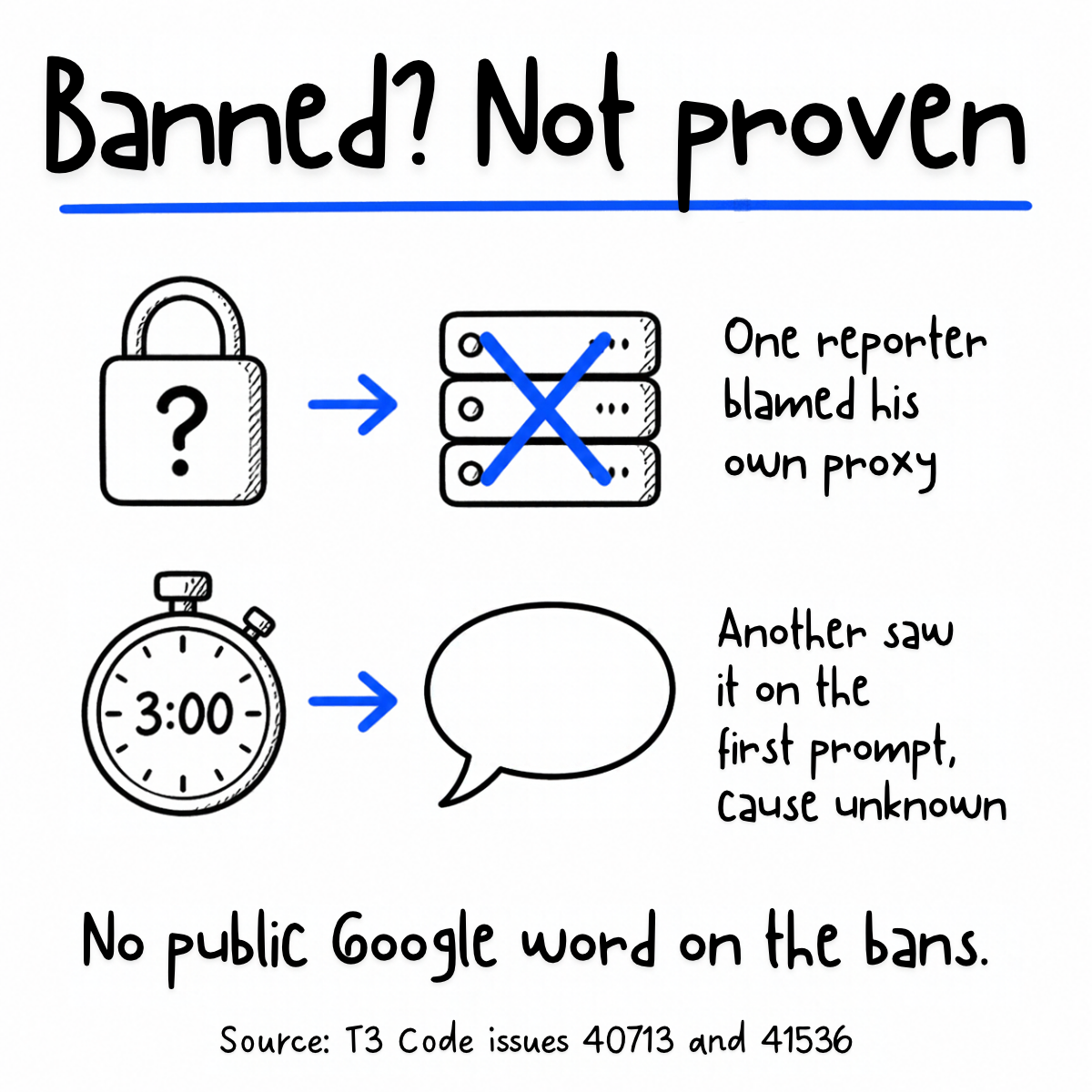
- Whether T3 Code caused any ban. The reporter on issue 40713 wrote that “this report is not claiming T3 caused the suspension”, said a proxy holding his login had sent 20 to 25 requests minutes earlier, and later wrote that the proxy “was most likely the trigger, not T3.”
- The report that had no proxy. Issue 41536, opened on 23 November by a user who posts as Allmight97, says a new paid account was suspended on the first prompt, three minutes after T3 Code installed its managed Antigravity CLI, with no proxy running and no Google login in the proxy tool. Julius closed it as a duplicate of 40713 and wrote: “If it is different, say how and it will be reopened.” The report’s opening lines already say how it differs. I saw no reopening, and I can’t tell from the page what caused that suspension.
- Other accounts. A user who posts as Victor replied under Theo’s post that he added a second Ultra account to T3 Code and it was banned later that day, and was on a second appeal. That’s one unverified claim. T3’s FAQ says an account auto-switcher would risk “TOS bans for our users”, and a forum reply lists multi-account rotation among suspended behaviours.
- What Google has said. I found no Google post or press statement about T3 Code and a ban. The only Google-attributed line about the probe is the sentence in pull request 43026: “Google told us that calling its internal APIs can get an account flagged.” Google’s developer forum has more. A reply of 26 October, from an account named Ambati_Rajendra, says using T3 Code with a personal Antigravity subscription “is permitted for your own single-user, interactive development, as long as it runs the official
antigravity-acpbinary from the ACP Registry and signs in through its native OAuth flow”. The same reply says Google does “suspend accounts that extract or proxy OAuth tokens”, wrapagy -pinside third-party agent loops or automate multi-account rotation. A reply of 16 November, from an account named Rebbanpalli_Naveen, lists “Zed or T3 Code” as supported for interactive use, and says wrappingagyinside third-party coding agents “so the external agent can delegate subtasks to Antigravity is not supported under consumer plans”, even with a human approving each step. Issue 40713 involved exactly that: a Claude agent in a T3 thread delegating a task to Antigravity. Two users asked Theo on 23 November whether delegation counts. I couldn’t confirm the roles of those forum accounts, and a forum reply isn’t a change to Google’s terms. - Advisory and apology. The repository’s security advisories page lists none published. I found no public apology or notice from T3 about Antigravity bans.
The earlier record
Theo Browne signed UploadThing’s 2024 incident report as chief executive of Ping Labs, and his X bio calls him chief executive of T3 Chat and T3 Code. Pull request 41898 says T3 Tools, Inc. holds T3 Code’s trademarks. I looked for incidents with a primary source: a company report, a postmortem or his own posts. Things I could only find second-hand, such as a quote about asking GitHub to remove a fork, are left out.
| Date | What happened | What Theo said and did |
|---|---|---|
| 10 Sep 2024 | UploadThing: every file URL was unreachable from 08:51 to 09:44 UTC. No data was lost. Cause, per the incident report: a change to the key-value store that resolves file URLs “wrote bad URLs on every request”. | He published the report the next day, under his name. “The code got a semi-sleepy review and was yolo merged late at night.” “As CEO and ‘tech lead’, I am 100% at fault here.” The fix was a revert, back in under 10 minutes from the alert. He promised a paging system and better alerting, and said “We f**k’d up, and we’re sorry.” |
| 28 May 2025 | T3 Chat’s second attempt to ship its beta to production failed. His post also counts two earlier outages, about 15 minutes of downtime in total. | An “accountability post”: “It means T3 Chat isn’t good enough.” He dropped the just-in-time migration for a parallel migration and backfill. |
| 1 Jun 2025 | T3 Chat was slow from 6:30am PT and “essentially unusable” from 9:45am to 12:27pm PT, per Convex’s postmortem. T3 had moved to Convex as its data layer the night before. | He wrote “Outages like this are unacceptable” and “Blame us!!!”, and promised a status page, paging and an automatic “refresh to latest” flow. Convex’s chief executive wrote that “none of this was Theo’s fault. It was Convex’s fault.” |
| 3 Aug 2026 | A dispute over a developer’s app, which Theo said was a fork of open-source code that claimed it as the developer’s own and dropped attribution. | In a thread he wrote that he “might actually have to phone my lawyers”, then, after the developer apologised for changing the MIT licence without understanding it, “He has apologized.” I’ve left the developer unnamed; their apology is quoted in his thread. |
| 23 to 24 Nov 2026 | A user’s X screenshot mocked a T3 Code interface. It was a third-party fork. | Theo wrote that it “definitely is NOT our app”, followed with “Temu3 Code”, and the poster replied “My bad, Theo”. At 4:33pm NZDT on 24 Nov he wrote: “Forking our code? ✅ Calling it ‘T3 Code’ and misleading users? ❌❌❌”. At 5:21pm he merged pull request 41898, which adds a TRADEMARK.md and says “this is not a policy change: this has always been true.” One developer, who posts as DLKFZWilliam2, wrote a thread criticising how he handled it. |
| 25 to 26 Nov 2026 | The telemetry affair: default-on usage events since March, a removed homepage promise and hashed account IDs. | At 8:52am NZDT on 25 Nov he wrote “We will close the source of T3 Code tonight”, and four minutes later that it was “a massive overreaction”. On 26 Nov he posted a “final statement” that T3 Code has never uploaded a file, prompt or user ID. The full record is in the telemetry piece, including where the hashed IDs fit that statement. |
InfoQ China’s report, republished by 36Kr, described the close-the-source post as the founder losing his composure. That’s the outlet’s characterisation, in my translation, not mine. The outage write-ups came within a day of each incident. For the fork and telemetry disputes, the written accounts are the trademark pull request and the 26 November “final statement”, which followed the posts quoted above.
What he and T3 got right
- Owning outages in writing. The UploadThing report and the two T3 Chat posts name the cause, the people involved and what would change. Convex’s own postmortem agrees the June 2025 outage was on its side.
- The fork screenshot. It was a third-party build, and the poster said so.
- The core claim, for interactive use. Forum replies that write as Google say T3 Code launching the unmodified
antigravity-acpbinary for single-user interactive work is permitted. That is the case Theo described. - The shim distinction. Google’s FAQ says using third-party software such as Claude Code, OpenClaw or OpenCode with an Antigravity login “is a violation of our Terms of Service”. Theo’s line between the official binary and a fake shim matches that.
- The proxy warning. Julius’s 22 November reply pointed out that a proxy holding an Antigravity login is the setup Google staff have said isn’t allowed. The reporter agreed and removed his.
- Speed of the fixes. The first public question was issue 40713 on 22 November. Both fixes were open as pull requests on 26 November and in a release on 27 November.
Where T3 Code sits among Google’s clients
| Client | What Google’s pages say |
|---|---|
| Zed, JetBrains IDEs, Android Studio, Xcode | Named on Google’s ACP page. Third-party models are offered to JetBrains IDEs (including JetBrains Air), Android Studio, Android Performance Analyzer, Zed and Xcode. Gemini models are available in every client. |
| T3 Code | Not on that list. A 16 November forum reply says clients outside first-party IDEs get “only the Gemini models included in your plan”. Toulme said on X that he added T3 Code internally as a recognised client, and I haven’t verified which models version 1.5.1 and later offer it. |
| VS Code through a community ACP extension | The page says VS Code “needs a community extension” and gives configuration for it. The model list above doesn’t include it. |
| Claude Code, OpenClaw, OpenCode used with an Antigravity login | Google’s FAQ says this “is a violation of our Terms of Service” and “can result in suspension or termination of your account”. It recommends a Gemini Enterprise or Google AI Studio API key instead. |
Wrapping agy -p in a third-party agent | “Not supported under consumer plans”, per the same FAQ. |
What to watch
Four things would settle most of this. A Google statement on the bans, and on whether a Claude or Codex agent delegating to Antigravity inside T3 Code is permitted on consumer plans. A reply from T3 on issue 40713 about the probe and on 41536 about the no-proxy suspension. A notice to users in T3’s own channels, since the release highlights don’t carry one. And whether Antigravity exposes limits over ACP, which would let T3 show quotas again without the internal API. If any of these lands, I’ll add it here.
Related: the T3 Code telemetry record, Google’s Neon cache hit rate (where Theo made a point about cache misses), the Neon usage chart, the T3 Code team guide and the Threadbear comparison.
How I checked
I read pull requests 43026, 43087, 31158 and 41898, issues 40713 and 41536, the version 0.1.13 release, the repository’s FAQ and Antigravity provider docs, and its security advisories page, all on GitHub. I read Google’s Antigravity terms, FAQ and ACP page, and three threads on its developer forum. For the older incidents I read UploadThing’s incident report, Convex’s postmortem and Theo’s posts of 28 May and 1 June 2025, 3 August 2026 and 22 to 26 November 2026. I got X post times from the post IDs and converted them to NZDT. I didn’t run T3 Code, watch its network traffic or test whether any account is banned, so what the code did comes from the pull request descriptions. bebu’s post and other X posts were leads only. I left out claims I couldn’t trace to a primary source. I don’t use “negligence” or any similar label, because nothing I could verify supports one: what the sources show are outages that were reported and fixed, disputes with two sides, and two behaviours T3 removed after its own maintainers wrote that they broke Google’s rules.
Discover more from Sulat AI & Tech News
Subscribe to get the latest posts sent to your email.