Cloudflare’s post introducing Cryptographic Attestation of Personhood is dated 13 May 2021. Its page metadata lists an edit on 15 July 2026, but the text is five and a half years old, so I’ve written this as a look at what became of it. A lot has.
The pitch was simple: touch a hardware security key such as a YubiKey and skip the fire hydrants. Cloudflare wrote that day marked “the beginning of the end for fire hydrants, cross walks, and traffic lights on the Internet.” Cloudflare now says it never issues a visual puzzle at all. What stepped in, and the new question it asks, is the rest of this piece.
- The 2021 pitch: 500 years a day, or 467
- The drinking bird, and the Arduino that replaced it
- August 2021: fingers, faces and a promise to stay tuned
- What actually replaced the pictures
- Bots got better at the pictures
- Now the test asks who you are
- Timeline, 2021 to 2026
- What the key tap didn’t show
- If you run a site or build an agent
The 2021 pitch: 500 years a day, or 467
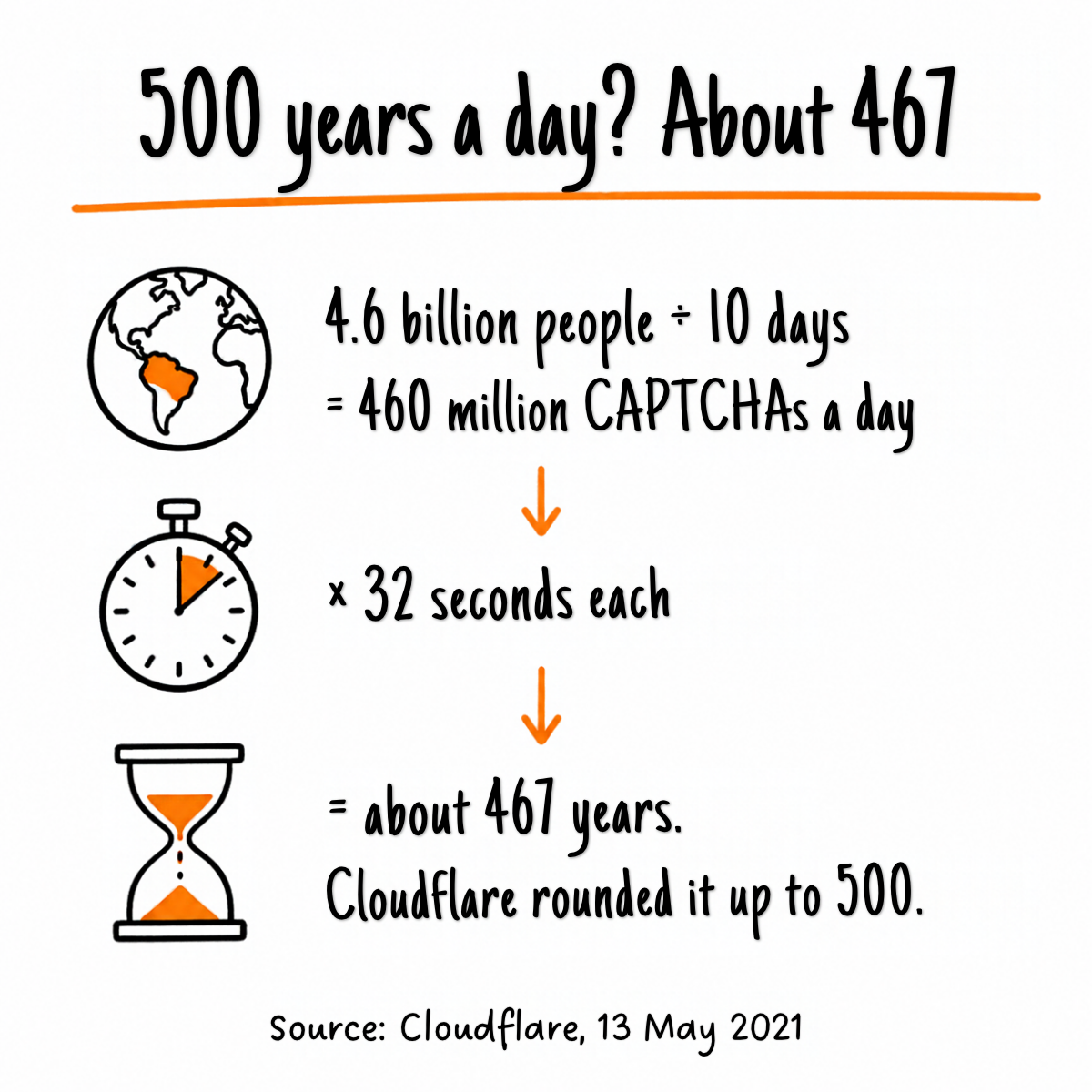
Cloudflare’s case against CAPTCHAs opened with a sum. It says a person needs 32 seconds on average to finish one, that there are 4.6 billion internet users, and that a typical user sees about one CAPTCHA every 10 days. That adds up, the post says, to “somewhere in the order of 500 human years wasted every single day.”
I ran the sum. Cloudflare’s inputs give 460 million CAPTCHAs a day, and at 32 seconds each that’s about 467 years.1 Cloudflare rounded up by 33 years. A 33-year rounding error is still a lot of buses.
The post listed four costs of the pictures: lost time, accessibility, cultural knowledge (cabs are yellow in New York and black in London) and small mobile screens. It noted that the W3C had been flagging CAPTCHA inaccessibility since 2003, and that Cloudflare had already moved from Google reCAPTCHA to hCaptcha.
How the key tap worked
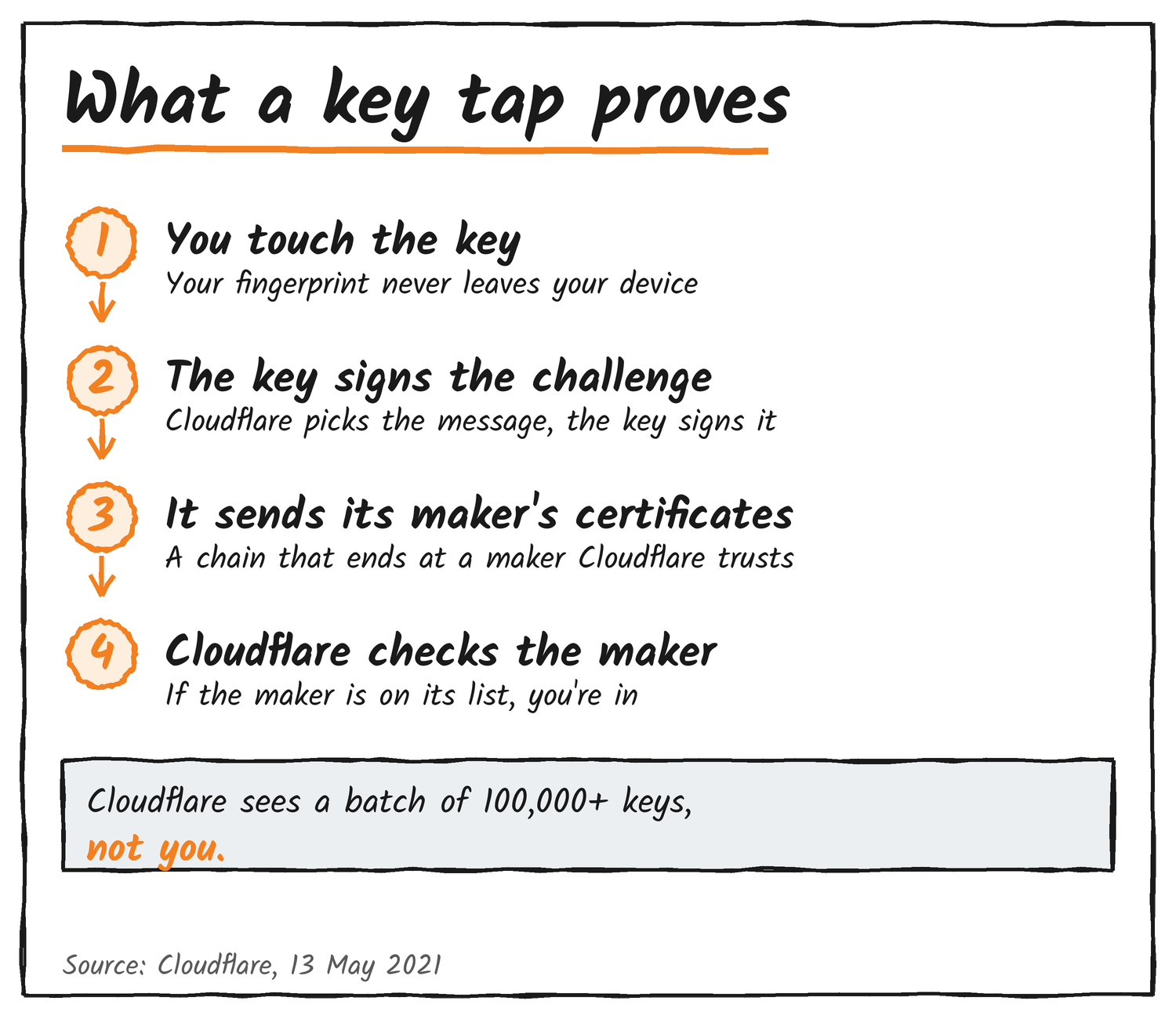
You visited a site protected by the check, clicked “I am human (beta)” and were asked for a security device. You plugged in a USB key or tapped an NFC one to your phone, and the key sent Cloudflare a cryptographic attestation. Cloudflare says that took five seconds, needed at most three clicks, and never had you “click on buses 10 times in a row.”
The trick is that Cloudflare doesn’t know your key. It checks that the key’s certificate chain ends at a manufacturer it trusts, and the FIDO specification the post cites calls for 100,000 or more keys per batch to share one attestation identity. Cloudflare sees a batch, not a person. The post adds that self-signed keys and keys from some manufacturers have been found not to meet that requirement.
32 s
average time to finish a CAPTCHA, Cloudflare’s figure
5 s
to finish the key tap, Cloudflare says
3
clicks at most
100,000+
keys per batch in the FIDO spec the post cites
Cloudflare’s privacy table says it could not get your fingerprint or face, could know your key’s maker (and does), and could tie your key to a unique ID but doesn’t. The ID would need a separate tracking cookie, which the post calls “antithetical to privacy on the Internet.” The demo supported YubiKeys, HyperFIDO keys and Thetis FIDO U2F keys, on iOS 14.5, Android 10 and later (Chrome only), Windows, macOS and Ubuntu.
By offering a CAPTCHA alternative via a single touch backed by YubiKey hardware and public key cryptography, Cloudflare’s Cryptographic Attestation of Personhood experiment could help further reduce the cognitive load placed on users as they interact with sites under strain or attack.
Christopher Harrell, Yubico’s chief technology officer, quoted in Cloudflare’s post
Finally: we’re excited to bring about the demise of the fire hydrant on the Internet. It’s no longer needed.
Cloudflare, 13 May 2021
The drinking bird, and the Arduino that replaced it
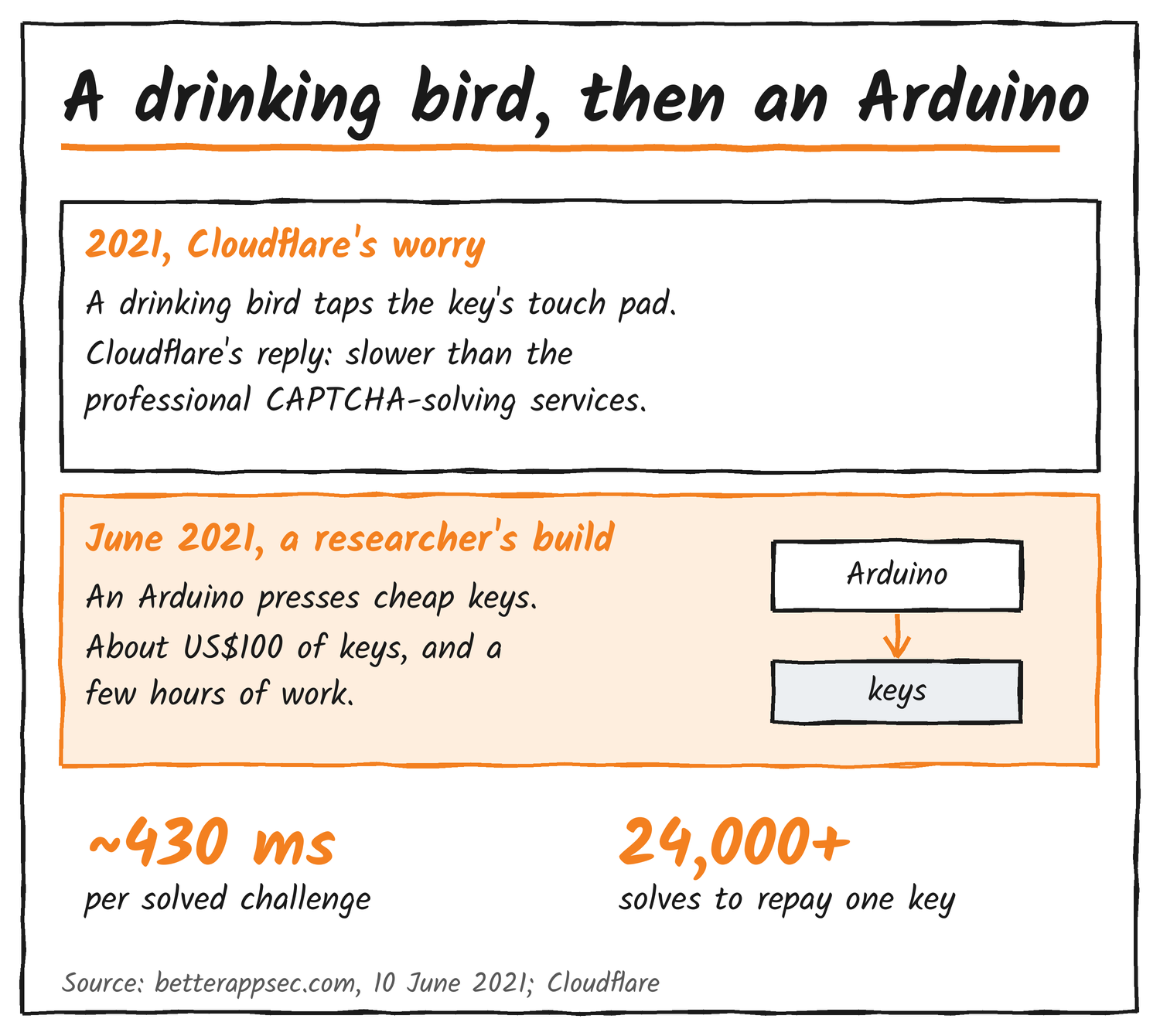
Cloudflare’s post raised its own worst case: “A drinking bird able to press the capacitive touch sensor could pass” the check. Its answer was that the bird would be slower than professional CAPTCHA-solving services. The bird stayed hypothetical. Four weeks later a security researcher swapped it for an Arduino.
On 10 June 2021 the researcher, writing on betterappsec.com, described a “click farm” built from an Arduino, some Python and about US$100 of HyperFIDO keys at US$16 each. It solved Cloudflare’s challenge at about 430 milliseconds a request. At 50 US cents per 1,000 CAPTCHA images, the author calculated each key had to answer over 24,000 challenges to pay for itself.
The author’s verdict was that the test wasn’t broken. It cost attackers far more than CAPTCHAs, and the farm could be detected “at least with the keys I tested.” Cloudflare’s current documentation links the write-up as “one thoughtfully-executed, well-documented test” and says it “raises the cost of an attack over the current CAPTCHA model.”
August 2021: fingers, faces and a promise to stay tuned
On 12 August 2021 Cloudflare widened the experiment. It added biometric authenticators, meaning Apple’s Face ID, Microsoft’s Windows Hello and Android Biometric Authentication, and said challenges took under five seconds with “just a touch of your finger or a view of your face.” It also opened the door to every USB and NFC key that’s FIDO-certified and has no known security issues in the FIDO Metadata Service. The biometric data stays on the device, the post says, and Cloudflare never sees it.
The original post had ended its privacy section with a promise: a zero-knowledge proof would hide even the manufacturer, and “stay tuned.” That sequel shipped the same day, from Watson Ladd, with a demo and a plain admission: “We’ve yet to put this proof of personhood in production.” Cloudflare’s docs add that Apple platform authenticators don’t work with the zero-knowledge version and get sent to the basic flow. Rare for a blog post: the sequel arrived before the first one cooled.
What actually replaced the pictures
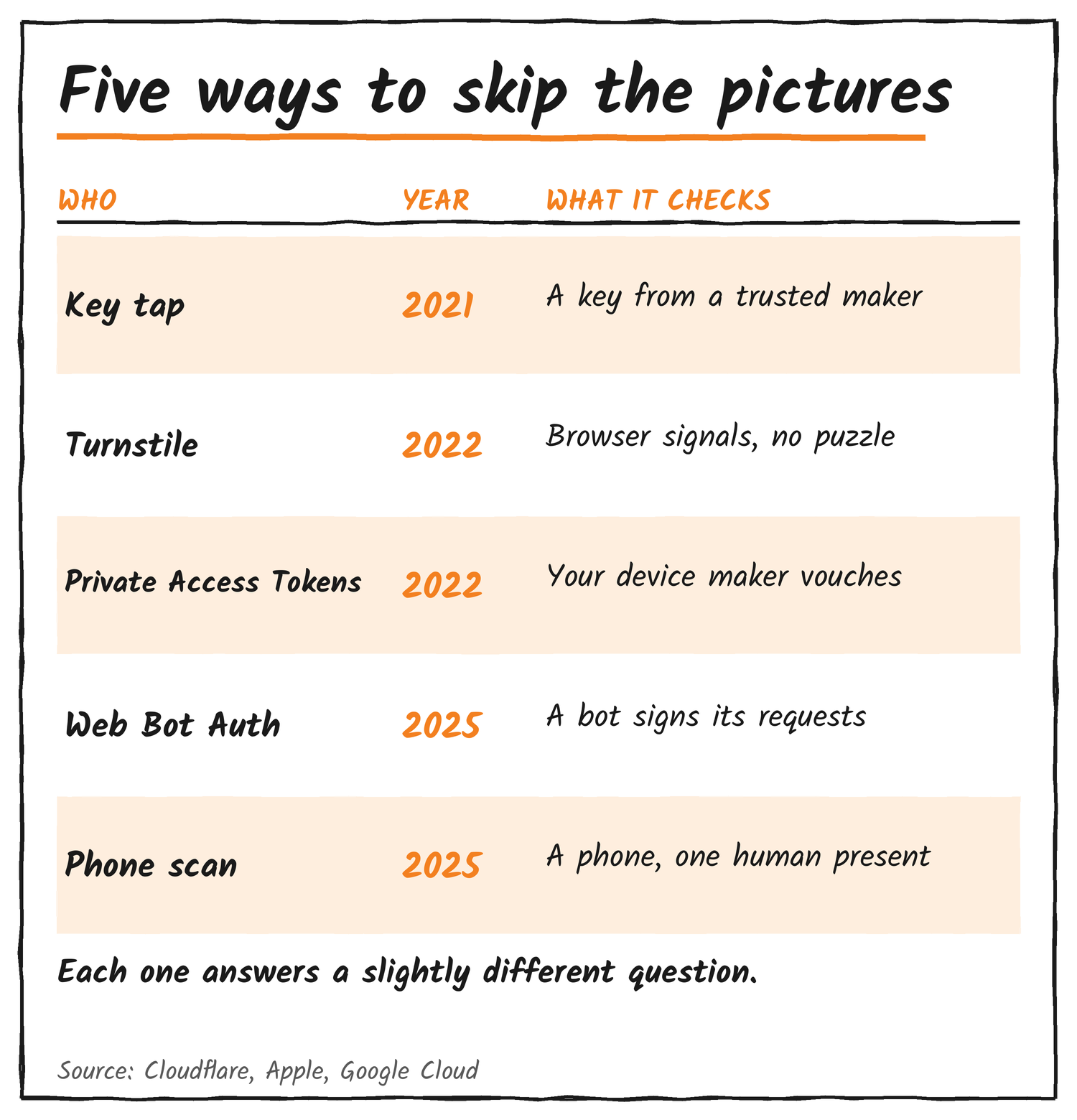
The first replacement was a handshake between device makers. On 8 June 2022 Cloudflare announced Private Access Tokens, built with Apple and other vendors and slated for iOS 16 and macOS 13. The device maker vouches for the device, so the site never inspects it. Cloudflare said this would eliminate “nearly 100% of CAPTCHAs served” to those users.
On 28 September 2022 came Turnstile, a CAPTCHA replacement anyone could add to a site, Cloudflare customer or not. Cloudflare’s press release lists the mechanisms: small non-interactive browser challenges plus Private Access Tokens. It doesn’t list the key tap. The company said it had cut its own CAPTCHA use by 91% and shrunk the average time a visitor spent in a challenge from 32 seconds to one.
Cloudflare is taking one of the most hated pieces of Internet technology, and making it easier, more secure, and more private for everyone to use.
Matthew Prince, Cloudflare co-founder and CEO, in the 28 September 2022 press release
Turnstile went generally available in September 2023. Cloudflare wrote that humans give up on CAPTCHA puzzles about 15% of the time, that it had “finished replacing every CAPTCHA issued by Cloudflare with Turnstile,” and that it “will never issue another visual puzzle to anyone, for any reason.” Turnstile’s Managed mode became free for unlimited use. The fire hydrants, on Cloudflare’s own challenges, are out of work.
Here’s a wrinkle. As I read Cloudflare’s documentation page on the key tap on 27 November, it still tells people without a key: “you can still solve a regular CAPTCHA challenge (e.g., selecting pictures).” The same company said in 2023 it would never issue one again. Both pages are live.
The tokens became a standard. Privacy Pass, which Cloudflare has supported since 2017, was published as an IETF specification in June 2024. RFC 9577, which defines how a site challenges for a token, lists authors from Apple, Google and Cloudflare.
Why a key tap needed more than most visitors had
My read, which Cloudflare hasn’t stated: the check asked every visitor for something the wider ecosystem was moving away from. Yubico’s own guidance for sites using passkeys says requiring attestation is “an invasive policy, especially when used to restrict users’ choice of authenticator,” and recommends not requiring a trusted attestation without a specific reason. The key tap is a trusted-attestation check by design. A site that wanted passkeys without gatekeeping the maker had no use for it.
Bots got better at the pictures
In September 2024 researchers at ETH Zurich published “Breaking reCAPTCHAv2,” accepted at the COMPSAC 2024 conference. They used YOLO image models and report solving 100% of reCAPTCHAv2’s image challenges, against 68 to 71% for earlier work. They found no significant difference between the number of challenges humans and bots have to solve, and add that “if anything bots are better than humans.” The sliver of pole in the corner was never going to win that argument.
Google took a hardware route too. In an October 2025 post on reCAPTCHA and the agentic web, Google Cloud describes a new mobile-device challenge where a user scans a QR code with a physical phone to give “a high-assurance attestation that a unique human is present.” It’s a close relative of the 2021 key tap, with a phone in place of the key.
Now the test asks who you are
The 2021 post’s author, Thibault Meunier, is also an author of the next chapter. On 15 May 2025 Cloudflare, with Mari Galicer, published “Forget IPs: using cryptography to verify bot and agent traffic.” The idea is that a bot signs its requests with HTTP Message Signatures (RFC 9421) and a site checks them against a published key, so the site knows which bot is knocking. On 1 July 2025 Cloudflare made message signatures part of its Verified Bots Program.
Others followed. AWS WAF announced Web Bot Auth support on 21 November 2025 for CloudFront, and Google’s crawling documentation now carries an experimental Web Bot Auth guide. Cloudflare’s docs say that as of 1 July 2026 signed agents count as Verified bots. On 16 October 2026 Cloudflare added continuous accountability checks, and recalled that it removed Perplexity’s bot from its Verified list in 2025 after the bot went after sites that had opted out of scraping and then tried to get around the blocks.
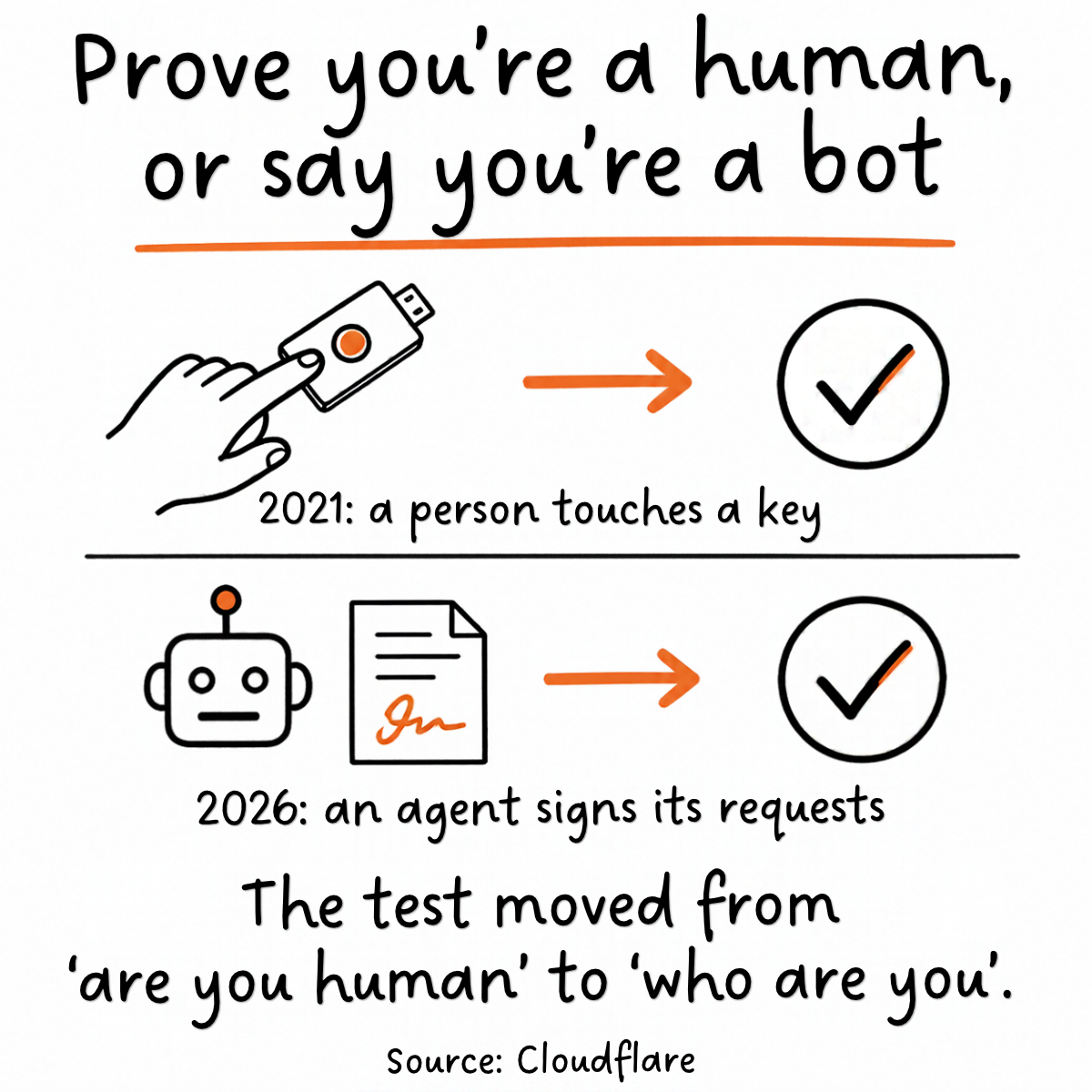
Then came the twist. On 12 November 2026 Cloudflare and World introduced Trusted Agent Delegation, a coalition to help personal AI agents reach services under conditions the services can trust. Cloudflare’s paper for it, “Agents aren’t humans (but they kinda are),” takes aim at the CAPTCHA premise. In 2021 Cloudflare wanted proof that you were a person. In 2026 it writes this:
CAPTCHAs and other human verification check whether the entity controlling the browser is a human or not. Agents are never expected to be humans. Solutions that pass this signal through to the human User add no new information and just make Agents less efficient.
Cloudflare, Trusted Agent Delegation paper, Nov 2026
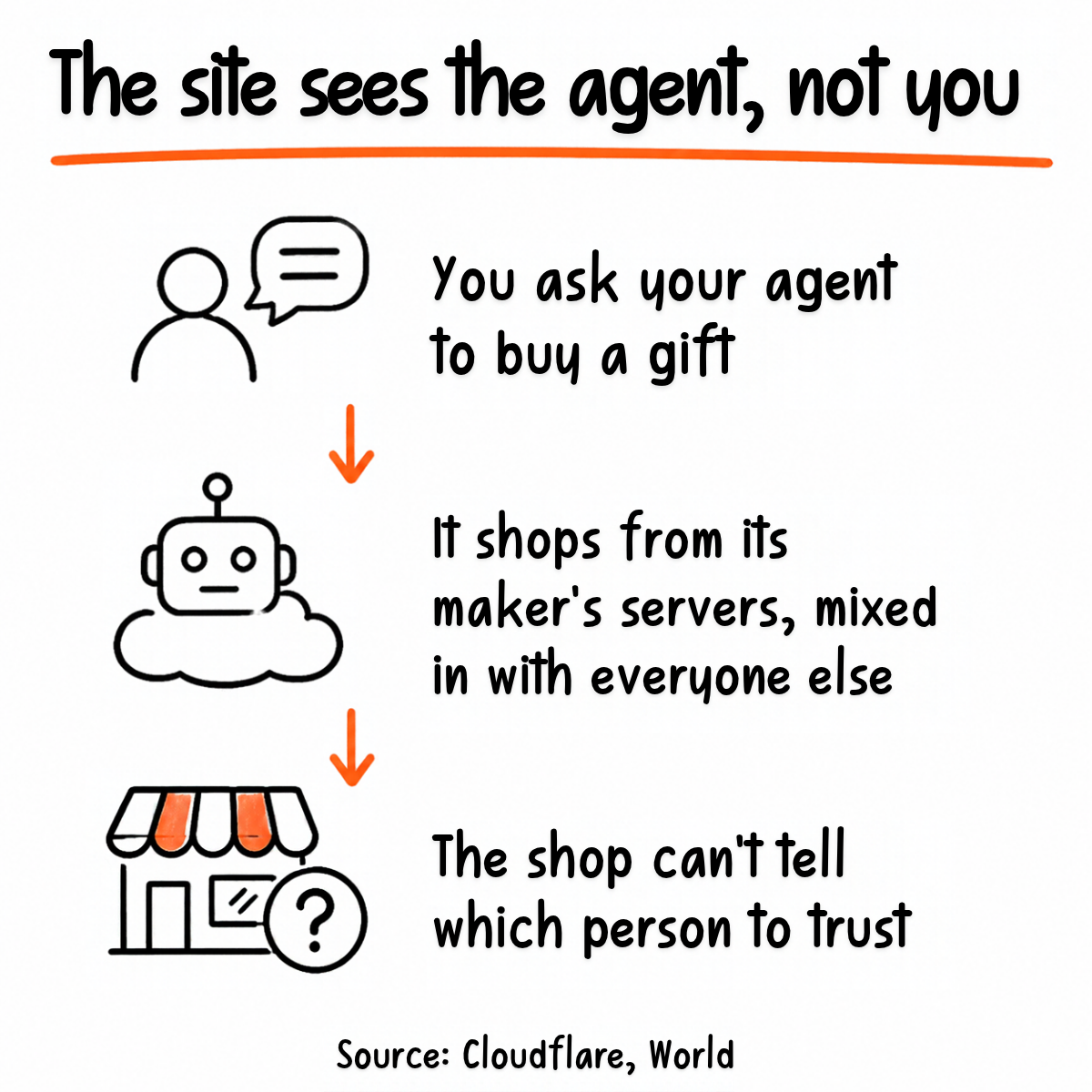
The problem, per World’s announcement, is that “websites see the agent but lose the human.” A hosted agent makes requests from its builder’s servers, mixed in with everyone else’s, so a shop can’t tell which person to trust. World’s post says bots now make up over half of all web traffic. TAD’s answer is identity, reputation and accountability: Web Bot Auth for who the agent is, a mechanism for claims such as age or cardholder status, and site policies agents can read. The group is starting with agents hosted by an operator whose reputation sites can assess. On-device and local agents are outside that first scope.
Cloudflare’s agent-facing features sit in the same stack. I covered another piece of it yesterday, the search endpoint a site can switch on for agents.

Timeline, 2021 to 2026
| Date | What happened | Source |
|---|---|---|
| 13 May 2021 | Cloudflare launches the key-tap experiment with YubiKey, HyperFIDO and Thetis keys | Cloudflare |
| 10 Jun 2021 | Researcher publishes an Arduino key farm that presses the keys | betterappsec.com |
| 12 Aug 2021 | Biometric authenticators added; zero-knowledge proof demo published | Cloudflare |
| 8 Jun 2022 | Private Access Tokens announced with Apple | Cloudflare |
| 28 Sep 2022 | Turnstile launches in beta | Cloudflare |
| 29 Sep 2023 | Turnstile generally available; Cloudflare says every CAPTCHA it issued is replaced | Cloudflare |
| Jun 2024 | Privacy Pass HTTP scheme published as RFC 9577 | RFC Editor |
| 13 Sep 2024 | ETH Zurich preprint reports 100% on reCAPTCHAv2 images | arXiv |
| 15 May 2025 | Web Bot Auth proposed for bot and agent traffic | Cloudflare |
| 1 Jul 2025 | Message signatures join the Verified Bots Program | Cloudflare |
| 28 Oct 2025 | Google Cloud describes a phone-scan reCAPTCHA challenge | Google Cloud |
| 1 Jul 2026 | Signed agents become Verified bots in BotBase | Cloudflare docs |
| 16 Oct 2026 | Continuous accountability checks for Verified bots | Cloudflare |
| 12 Nov 2026 | Cloudflare and World launch Trusted Agent Delegation | World, Cloudflare |
What the key tap didn’t show
I found no figures from Cloudflare on how many visitors passed a key tap, or how often it ran in production. The docs page still points to the demo site. The 2021 post called it an experiment available “on a limited basis in English-speaking regions,” and Cloudflare hasn’t published a results post that I could find.
Nothing in the 2021 post is wrong about the pictures. Cloudflare’s own 2023 figure, that humans give up on puzzles about 15% of the time, backs its complaint. What the post couldn’t show is that a hardware-maker check would suit the open web, or that the main visitor would stay human.
If you run a site or build an agent
- On Cloudflare’s network, Managed Challenge asks for Private Access Tokens by itself, so supported Apple devices skip the check and you don’t change anything, per Cloudflare’s 2022 post.
- Off Cloudflare, Turnstile can sit on any site, and its Managed mode is free for unlimited use, per Cloudflare’s 2023 announcement.
- If you build an agent, Cloudflare’s docs say to sign requests with an Ed25519 key, host your public keys in a directory, and apply through the BotBase form. Cloudflare publishes open-source libraries in Rust and TypeScript.
What a signed bot request looks like
This example is from Cloudflare’s 1 July 2025 post, trimmed to the identifying headers.
GET /path/to/resource HTTP/1.1
Host: example.com
Signature-Agent: "web-bot-auth-directory.radar-cfdata-org.workers.dev"
Signature-Input: sig=("@authority" "signature-agent");\
             	 created=1700000000;\
             	 expires=1700011111;\
             	 keyid="poqkLGiymh_W0uP6PZFw-dvez3QJT5SolqXBCW38r0U";\
             	 tag="web-bot-auth"
Signature:sig=jdq0SqOwHdyHr9+r5jw3iYZH6aNGKijYp/EstF4RQTQdi5N5YYKrD+mCT1HA1nZDsi6nJKuHxUi/5Syp3rLWBA==:- 4.6 billion users over 10 days is 460 million CAPTCHAs a day. At 32 seconds each that’s 14.72 billion seconds, or about 467 years at 31,557,600 seconds a year. ↩︎
Sources
- Cloudflare, Humanity wastes about 500 years per day on CAPTCHAs (13 May 2021)
- betterappsec.com, Building a WebAuthn Click Farm (10 June 2021)
- Cloudflare, More devices, fewer CAPTCHAs, happier users (12 August 2021)
- Cloudflare, Zero-knowledge proofs for private web attestation (12 August 2021)
- Cloudflare docs, Cryptographic Attestation of Personhood
- Cloudflare, Private Access Tokens (8 June 2022)
- Cloudflare press release, Turnstile (28 September 2022)
- Cloudflare, Cloudflare is free of CAPTCHAs; Turnstile is free for everyone (29 September 2023)
- RFC 9577, The Privacy Pass HTTP Authentication Scheme (June 2024)
- Breaking reCAPTCHAv2, arXiv 2409.08831 (13 September 2024)
- Cloudflare, Forget IPs: using cryptography to verify bot and agent traffic (15 May 2025)
- Cloudflare, Message Signatures are now part of our Verified Bots Program (1 July 2025)
- AWS, AWS WAF announces Web Bot Auth support (21 November 2025)
- Google Cloud, Enabling a safe agentic web with reCAPTCHA (28 October 2025)
- Google, Authenticating requests with Web Bot Auth (experimental)
- Cloudflare docs, Verified bots
- Cloudflare, Continuous accountability for Verified bots (16 October 2026)
- Cloudflare, Agents aren’t humans (but they kinda are)
- World, World and Cloudflare introduce Trusted Agent Delegation (12 November 2026)
- Yubico, Passkey relying party guidance: Attestation
Discover more from Sulat AI & Tech News
Subscribe to get the latest posts sent to your email.