Q.ANT’s chief executive says the energy saving from its light-based AI chip is about four or five times in simulation, and that the company isn’t yet demonstrating it on real hardware. Michael Förtsch told WIRED in an interview published on 27 November. That’s well short of the “30x” Q.ANT has put in its own releases since 2024. I went through the company’s announcements, the Leibniz Supercomputing Centre’s test report, the IONOS pilot terms and the rival field to see what has been measured and what hasn’t.
- What WIRED reported
- Where the 30x comes from
- What the independent test measured
- How it works, and why a GPU sits beside it
- Who can use it today
- The other light-based chip bets
- What the sceptics point to
- What’s still missing
What WIRED reported
WIRED’s Business desk ran a question-and-answer session with Förtsch, the founder and CEO of the Stuttgart company, edited for length. WIRED sets the scene this way: regular GPUs shuffle electrons around, while photonic processors use waves of light, so they “supposedly consume less energy and require minimal cooling.” The aim, it says, isn’t to replace GPUs but to run alongside them. WIRED also writes that few photonic processors are running inside data centres today, that Q.ANT has rolled its chips out to facilities run by the cloud company IONOS as a pilot, and that the company says more than 30 teams of engineers are now developing AI models optimised for photonic computing.
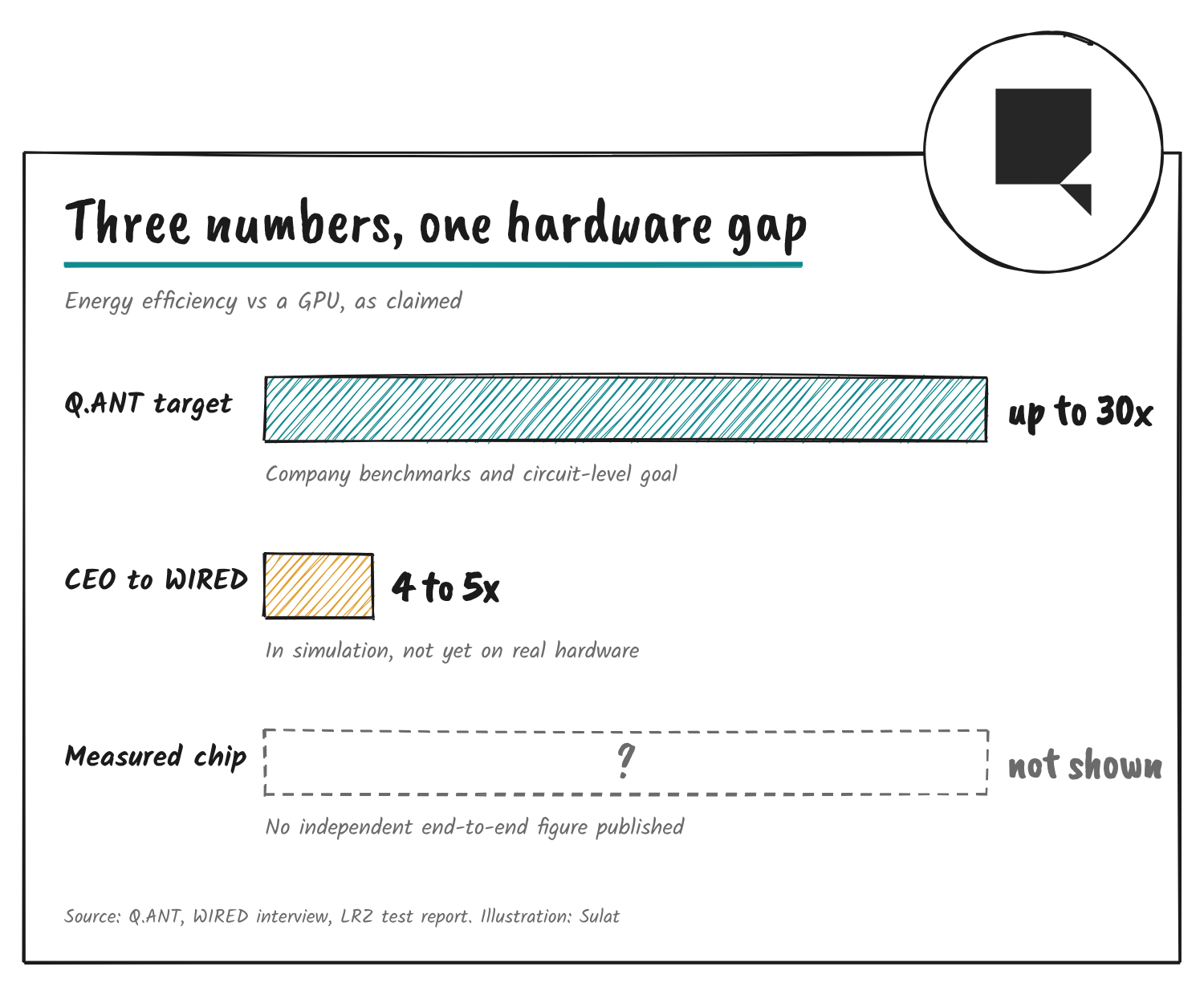
Under simulation, we are ending up at around four or five times energy reduction. But in real hardware we are not yet demonstrating it.
Michael Förtsch, Q.ANT founder and CEO, to WIRED, 27 November 2026
The rest of the interview fills in the pitch. Förtsch says linear maths should go to the GPU and “non-linear and complex stuff” to Q.ANT, and that the company expects to be strongest in image recognition, segmentation and generation, plus robotics and physical AI. Developers don’t need a new language, he says: C++ or Python works, and existing code can run on the machines. But code tuned only for a GPU shouldn’t be expected to run faster without adaptation. On supply, he said that if Q.ANT received an order for 100,000 processors it would be ready, but he wasn’t sure about its suppliers. He also said the chips need only a 90 nanometre process, “from the 2000s”, which many foundries already run. Asked whether photonics could ever replace the GPU, he said Q.ANT wouldn’t be shy about attacking it if an opening appeared in five years, and that he doesn’t know what workloads will look like by then.
Where the 30x comes from
Q.ANT’s first commercial processor release, dated 19 November 2024, said the PCIe card promised “at least 30 times greater energy efficiency” than conventional chips, and put the same factor of 30 on a GPT-4 query. The June 2026 release on its generative AI demonstrations is more careful. It says those workloads “target to operate with 30x the energy efficiency of classical processors in equivalent matrix operations at the photonic circuit level.”
So there are three numbers, and they aren’t measuring the same thing. The 30x is a circuit-level target for matrix operations. The 4 to 5x is a simulated figure for running a task with a GPU beside the chip, which is what Förtsch gave WIRED. The third, a measured energy comparison on real hardware, is the one I couldn’t find, either from Q.ANT or from anyone independent.
What the independent test measured
The best outside evidence is the Leibniz Supercomputing Centre (LRZ) report of 21 April 2026, which put Q.ANT’s cards through a real-world test. LRZ found the optical element of the first generation ran about 100 million operations per second (Mop/s). The next generation reached 500 Mop/s on each channel, with eight lasers and optical channels on the newer cards. In the best case the second-generation chips ran 50 times faster, and a convolutional neural network doing image recognition sped up by a factor of 25.
500 Mop/s
Per channel, second generation, against about 100 Mop/s for the first
8
Lasers and optical channels on the newer cards
50x
Best-case speed-up, second generation over first
25x
Faster image recognition with a convolutional network
Those are speed figures against Q.ANT’s own first generation, not energy figures against a GPU. A trade-press write-up of the pilot, Business Bearings, says LRZ found power consumption down 50 to 84 per cent for typical high-performance computing workloads. I couldn’t see that range in the LRZ text I read, so I’d treat it as second-hand until the report itself is checked. LRZ says future development would likely focus on frequency and workload management.
A slip in the LRZ page, and how to check it
The LRZ page says eight channels at 500 Mop/s add up to “four trillion operations per second or 4 Gop/s.” Those two figures disagree. Eight times 500 million is four billion, which is 4 Gop/s, so “trillion” looks like a typo. I’ve used the per-channel figures and left the total out.
How it works, and why a GPU sits beside it
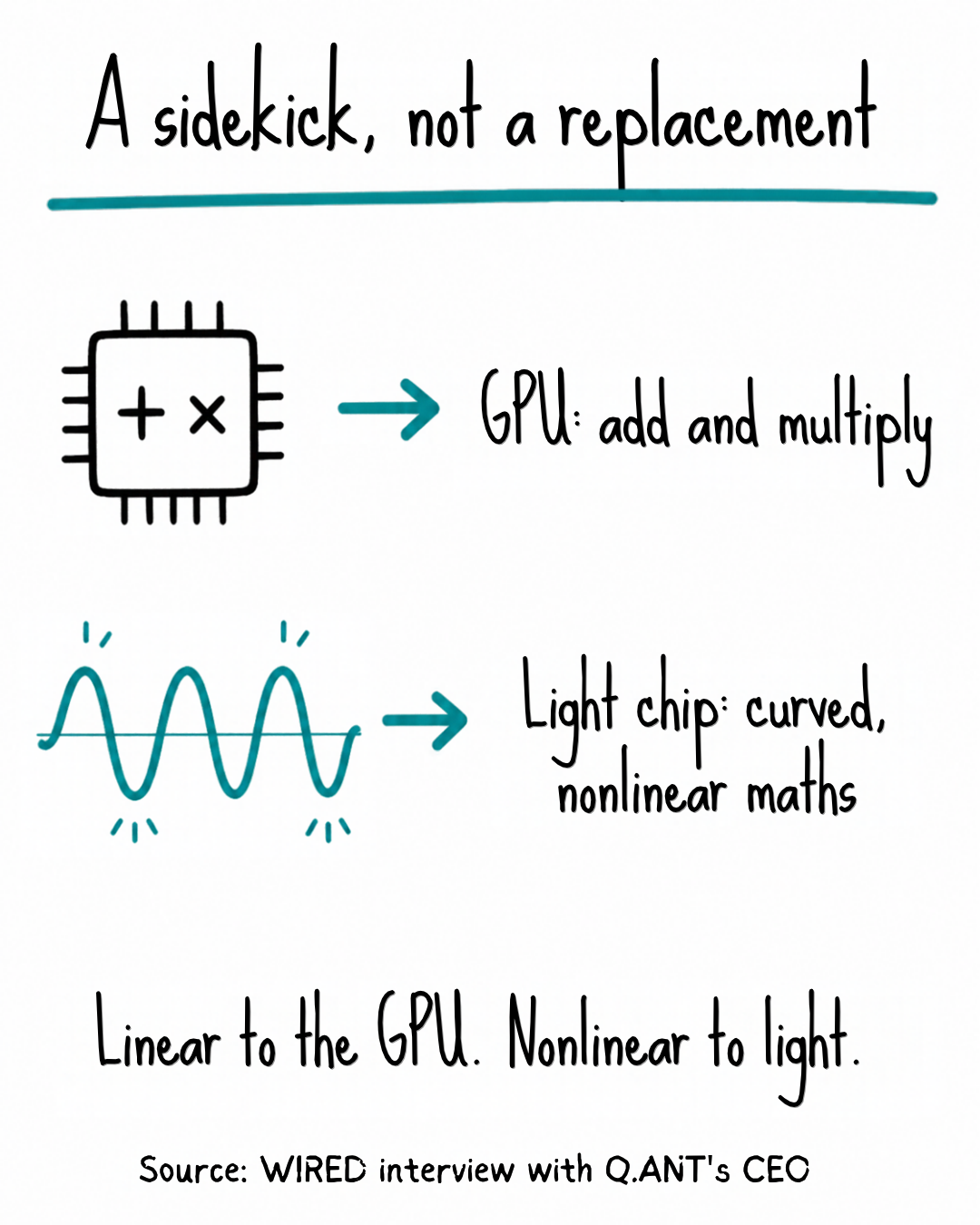
Q.ANT’s processor is a PCIe card, a Native Processing Unit (NPU), built on thin-film lithium niobate. It’s sold as a co-processor, and the company’s rack-level product is called the Native Processing Server (NPS). Förtsch’s argument to WIRED is that light is a wave, so a sine function comes for free, while a chip that only adds and multiplies needs many steps to approximate a curve. Fewer steps means less data moving to and from memory, which he calls the cost driver today.
The newest step is the NPU Gen 2+, shown at the SC26 conference and announced on 17 November. It performs discrete Fourier transforms, a standard operation in signal and image processing, in a single optical operation. Q.ANT paired it with an AMD GPU to run a large language model, which it describes as the first time with optics. In that demonstration the Fourier transform replaces an attention layer, the part of a language model that’s costly to compute. That’s a demonstration, not a benchmark: the release says only that photonic hardware could “potentially” lower energy consumption “significantly” and gives no figure.
Who can use it today
IONOS signed on 19 May 2026 as the first commercial customer for the NPS. On 9 November the two launched a pilot: applicants with approved projects get the second-generation NPU on a bare-metal server in a German IONOS data centre, running their own workloads and software. Business Bearings reports it’s a free closed beta, that IONOS provisions each system by hand with root SSH access, and that Q.ANT wants applicants with a concrete use case and the expertise to administer a bare-metal server themselves.
That’s a research pilot, not capacity you can buy. Q.ANT’s open-source SDK, released on 23 September, includes C and Python APIs, samples and a simulation backend that runs on an ordinary CPU, so developers can build and validate before touching the hardware. In June, at ISC, Q.ANT demonstrated a diffusion model and a recurrent neural network on the second-generation NPU, and said independent developers at Daisytuner had compiled an object-detection model from PyTorch onto the chip.
Förtsch accepts the chicken-and-egg problem WIRED put to him: developers won’t design for hardware they can’t get, and buyers won’t order hardware nobody designs for. “We are building a new chicken, so you can start producing eggs,” he said. The company has money for the wait. On 30 October 2025 it closed its Series A at US$80 million in total, which it calls the largest financing round for photonic computing in Europe. Investors include Cherry Ventures, UVC Partners, imec.xpand, TRUMPF and Duquesne Family Office, the investment firm of Stanley Druckenmiller.
The other light-based chip bets
Q.ANT is one of two kinds of optical start-up. Some compute with light. Others use light only to move data between chips, which is a nearer-term problem and where the larger cheques have gone.
| Company | What it does | Latest money or milestone |
|---|---|---|
| Q.ANT (Stuttgart) | Computes with light: thin-film lithium niobate co-processor card | US$80M Series A, October 2025; IONOS pilot, November 2026 |
| Neurophos (Austin) | Computes with light: optical processing unit; claims up to 100x the performance and energy efficiency of current leading chips (its claim) | US$110M Series A on 22 January 2026, led by Gates Frontier; US$118M in total |
| Lightelligence (Shanghai) | Optoelectronic hybrid accelerator with co-packaged optics | Hong Kong IPO on 28 April 2026; shares rose 383% on day one; HK$2.4bn net proceeds |
| Akhetonics (Germany) | All-optical general-purpose processor, including optical memory (its claim) | No funding figure checked |
| Lightmatter | Moves data with light: co-packaged and near-packaged optics | Joined Nvidia’s NVLink Fusion ecosystem on 3 June 2026; about US$822M raised per Cignal AI’s tracker |
| Celestial AI | Moves data with light: Photonic Fabric optical interconnect | Marvell completed the purchase on 2 February 2026, after agreeing about US$3.25bn upfront in December 2025 |
| Ayar Labs | Moves data with light: optical I/O for AI clusters | At least US$1.0bn raised; US$150M Series E extension in September 2026, per trackers |
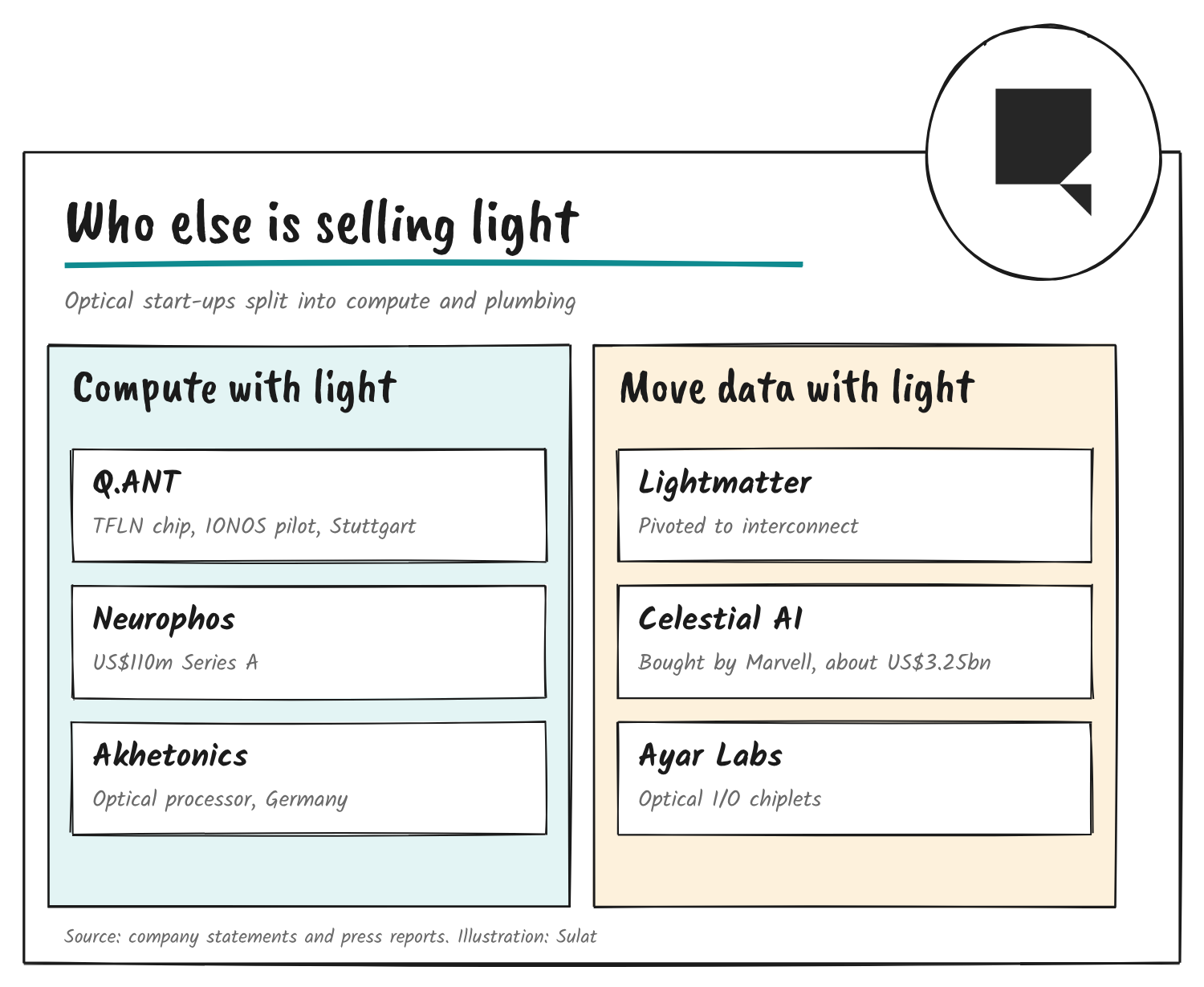
My read: the interconnect side has the exits and the customers. Marvell bought Celestial AI, and Lightmatter’s NVLink Fusion deal puts its optics inside Nvidia’s partner ecosystem. Marvell is also the subject of our report on its Lumentum offer, another optical-components bet. The compute-with-light group, Q.ANT included, is still at the stage of pilots and simulations.
What the sceptics point to
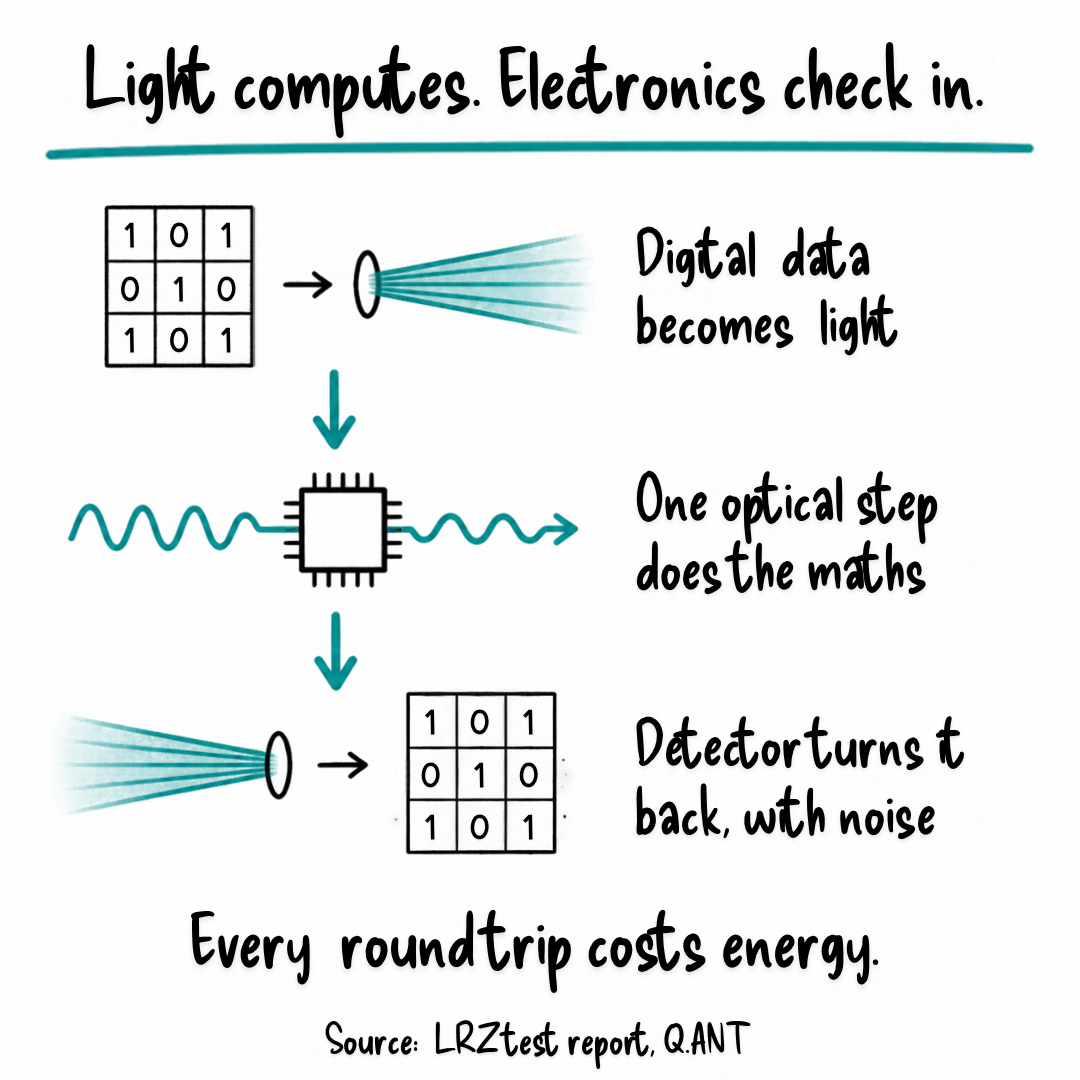
The recurring academic objection is conversion cost. Data has to become light before the optical step and become electrical again after it. A survey by researchers at the University of Texas at Austin and Arizona State University, posted to arXiv in April 2026, models this and finds electro-optic conversion, dominated by digital-to-analogue converters and optical modulation, is the main contributor to total energy, outweighing laser power and data movement. They call the cost of high-resolution analogue-to-digital conversion a “precision wall.” A June 2026 SPIE paper makes a similar point: the efficiency of photonic accelerators is often limited by the conversion interfaces, not the photonic core.
Q.ANT’s design answers this by doing more work per conversion: one optical step for a whole Fourier transform or a nonlinear function, where a digital chip needs thousands. That’s my inference from its releases. Q.ANT hasn’t published a conversion-inclusive energy figure to confirm it. The energy squeeze behind all this is real, though. I covered the IEA’s warning on data-centre power use last week.
What’s still missing
Four things aren’t public as far as I can find. There’s no measured energy per task for a Q.ANT system against a GPU on the same workload, and no figure that includes the conversion steps. There’s no price for the NPU or NPS, and no stated capacity beyond Förtsch’s “we are ready” for an order of 100,000. WIRED’s edited transcript doesn’t mention the 30x, so the interview doesn’t reconcile it with the 4 to 5x.
Until Q.ANT or an independent lab publishes measured energy per task on the same workload as a GPU, the 4 to 5x is a simulation and the 30x is a target.
Sources
- Q.ANT, first commercial photonic processor release, 19 November 2024
- Q.ANT, IONOS signs as first NPS customer, 19 May 2026
- Leibniz Supercomputing Centre, LRZ puts photonic computers to a real-world test, 21 April 2026
- Q.ANT, generative AI on photonic hardware, 23 June 2026
- Q.ANT, open-source SDK, 23 September 2026
- Q.ANT and IONOS, photonic computing pilot, 9 November 2026
- Q.ANT, NPU Gen 2+ at SC26, 17 November 2026
- Q.ANT, Series A second closing, 30 October 2025
- Neurophos, US$110 million Series A, 22 January 2026
- Marvell, completes acquisition of Celestial AI, 2 February 2026
- Lightmatter, joins NVIDIA NVLink Fusion, 3 June 2026
- Caixin, Lightelligence Hong Kong debut, 28 April 2026
- Zhu and others, Harnessing Photonics for Machine Intelligence, arXiv, April 2026
- WIRED, A New Breed of Chip Runs AI Models Using Waves of Light, 27 November 2026
Discover more from Sulat AI & Tech News
Subscribe to get the latest posts sent to your email.