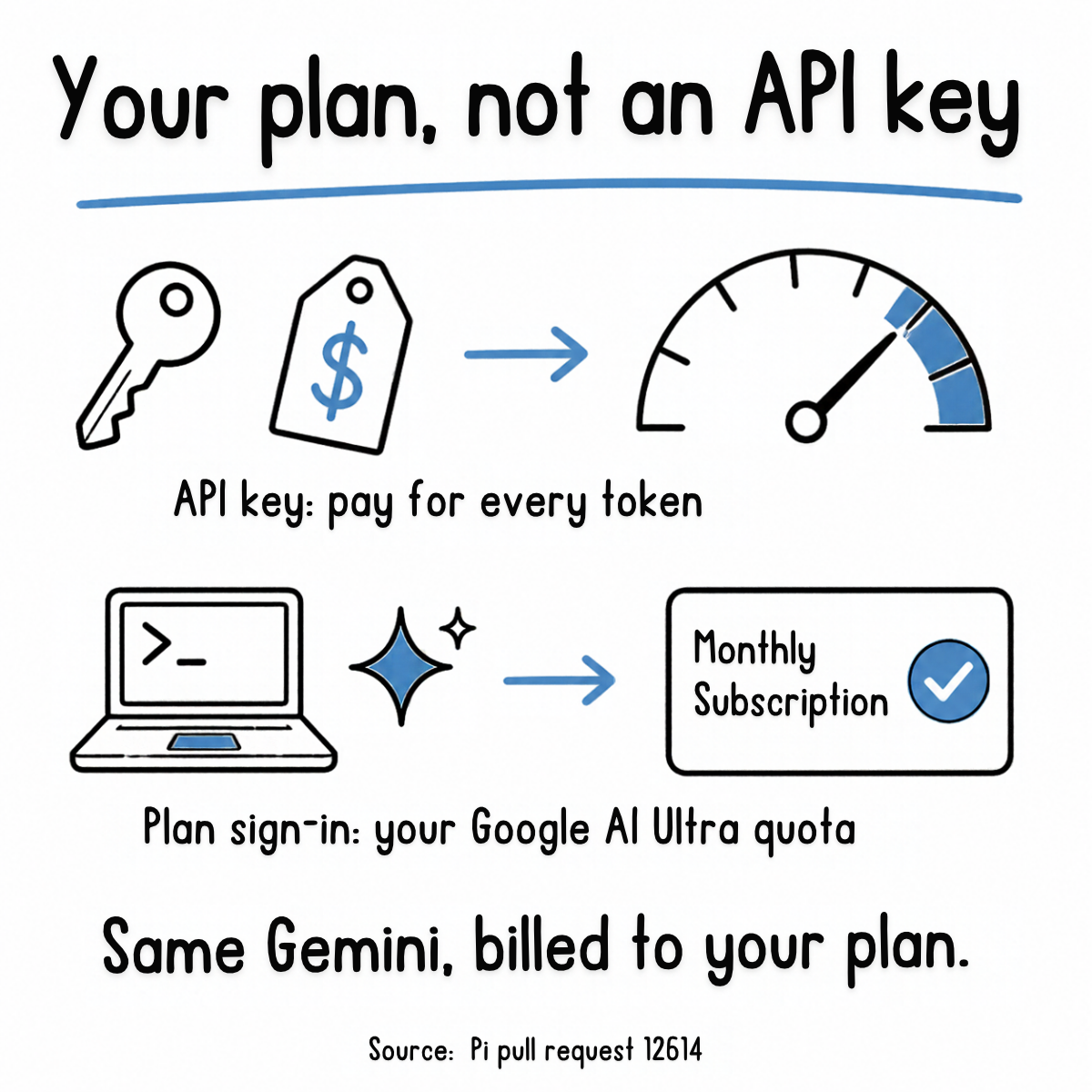
Pi, the open-source coding agent from Earendil, has a draft pull request that lets people sign in with a Google AI Ultra plan and use its Gemini quota instead of an API key. A widely shared X thread on 27 November says Google approved Pi for this; Pi’s own README says the same, and Google hasn’t published anything I could find that confirms it.
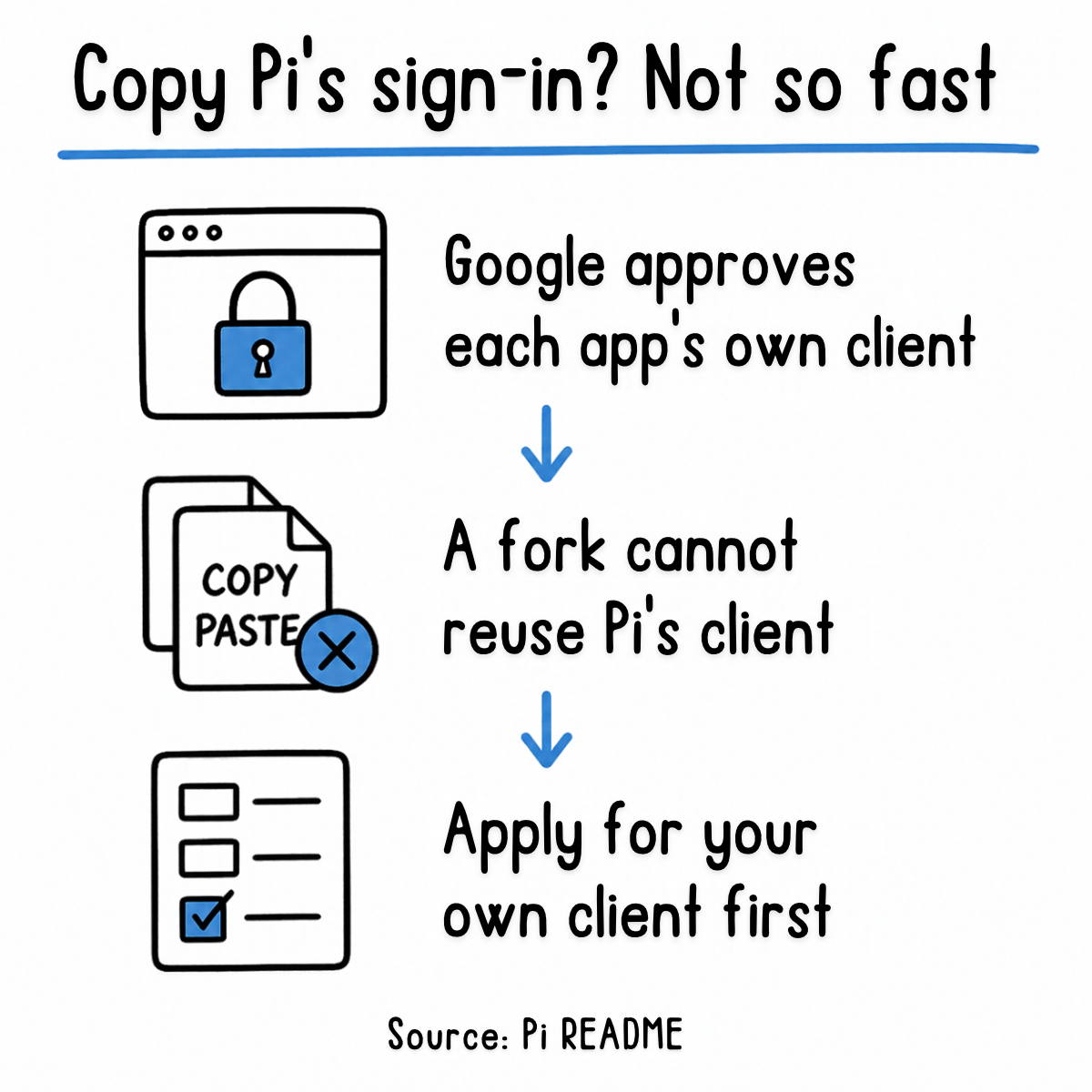
The sign-in runs through a Google OAuth client that Pi says Google approved for Pi alone, so a fork can’t copy it. I read the pull request’s code, checked each claim in the thread against it, and went through the replies and the other agents that touch the same Google endpoint. I didn’t run the sign-in, because it needs an Ultra account and Pi’s approved client. How to try it is below.
What the thread says, and what holds
The thread’s author says they read pull request 12614, which Pi’s repository listed that day as a draft not yet merged into its main branch. They say Pi applied to Google for its own approved OAuth client, that Google makes each tool register a separate desktop app and submit it for review, and that the refresh token is bound to a key made on the user’s machine. They add that requests go to a new personal-quota endpoint open only to AI Ultra, and that Google can switch off a single app at any time.
| Claim in the thread | What the code and docs show | Verdict |
|---|---|---|
| Google approved Pi’s OAuth client | Pi’s README says the client is one “Google approved for pi only”. I found no Google statement. | Pi’s claim, not confirmed by Google |
| Pull request 12614 is a draft, not merged | The thread said so on 27 November. I read the branch that day and haven’t rechecked its state since. | Held when the thread was posted |
| Each tool needs its own approved desktop client | Pi’s README and its AI package README both say apps must register their own client, and the package ships none. | Holds, per Pi |
| The refresh token is tied to a key made on your machine | The sign-in code generates a P-256 key, stores it beside the refresh token, and signs each refresh request with it (a scheme called DPoP). | Holds |
| Requests go to a new per-user quota endpoint | The code posts to /v1beta/interactions:createPerUserQuota on Google’s Generative Language API. | Holds |
| Only AI Ultra works, not Pro | Pi’s code and messages name only the Ultra plan. One reply says a Pro account worked and a free one didn’t; I couldn’t test either. | Ultra is Pi’s target; Pro is unverified |
| Google can disable one app at a time | Pi’s error handling has a message for a blocked client: “The Google AI Ultra plan is currently unavailable in pi.” | Holds, per Pi’s code |
| Reverse-engineered and shared-credential plugins will stop working | This is the author’s prediction. Nothing I read measures it. | Opinion |
How the sign-in works
The flow is a standard Google desktop sign-in with an extra lock on top. Pi opens a browser page where the user approves access. It listens for the reply on a loopback address (a port on the user’s own machine), and it uses PKCE, a code check that stops a stolen reply from being reused. The scope it asks for is generative-language.peruserquota, which is Google’s name for quota that belongs to the person rather than to a cloud project.
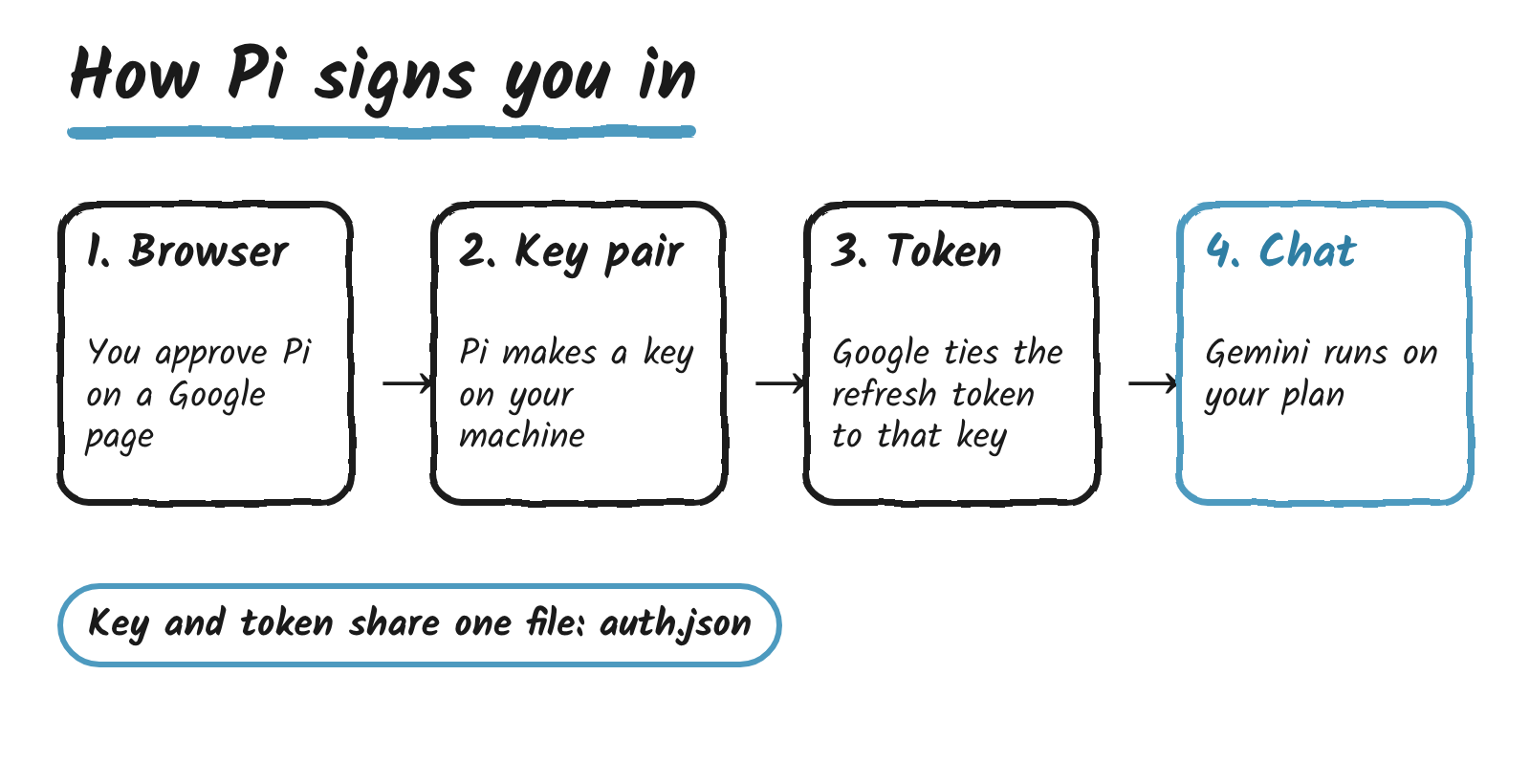
The lock is DPoP, a standard (RFC 9449) that ties a token to a key the client holds. Pi generates a P-256 key on the user’s machine, keeps it in auth.json next to the refresh token, and signs every refresh request with it. A copied refresh token without the key is useless. The flip side is that auth.json now holds both halves, so it needs the same care as a password file.
Chat requests then go to Google’s Interactions API at the per-user quota address, with the access token as a bearer credential and streaming over server-sent events. Pi sends store: false and the whole conversation each time, so Google isn’t asked to store the conversation between turns.
Which models, and what happens at a limit
Google’s plan has no endpoint that lists models, so Pi hard-codes four. A code comment says Google’s partner docs require a fixed list. Cost is set to zero because the plan covers usage.
| Model | Pi model ID | Thinking levels |
|---|---|---|
| Gemini 4 Hydrogen (default) | gemini-4-hydrogen | low to xhigh |
| Gemini 4 Neon | gemini-4-neon | low to xhigh |
| Gemini 4 Carbon | gemini-4-carbon | low to high |
| Gemini 3.5 Flash-Lite | gemini-3.5-flash-lite | minimal to high |
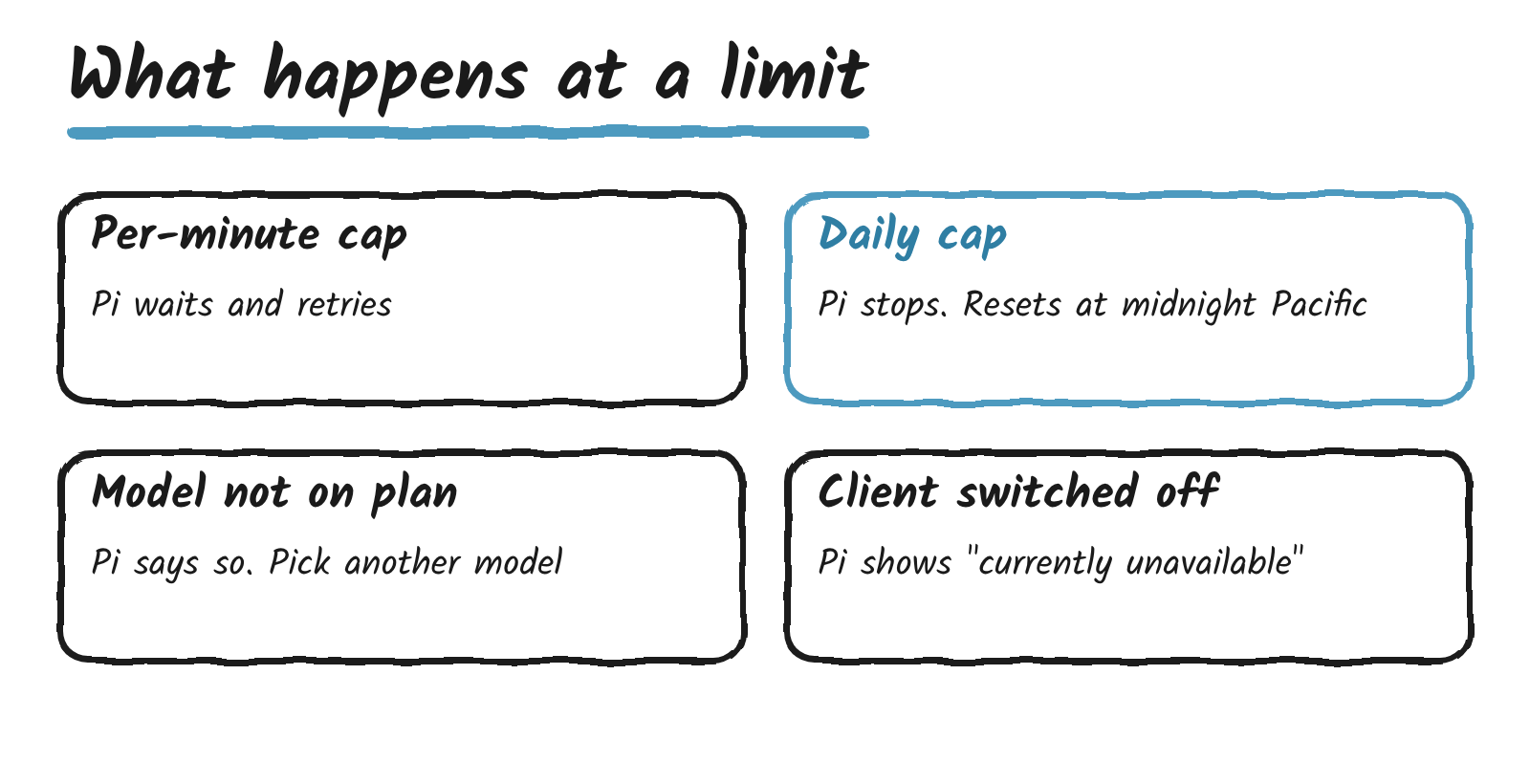
The error handling is the most careful part of the change. A per-minute 429 is retried. A daily limit isn’t: Pi stops and tells the user to switch model or use a Gemini API key, and a code comment says the daily limit resets at midnight Pacific time, which is about 9pm in New Zealand while Pacific time is on standard time. A model the plan doesn’t include fails at once with “Choose another model”. A 401 asks the user to run /login again, and a 402 or 403 points to the plans page at one.google.com/ai.
One comment in the refresh code matters for daily use. It says Google’s docs treat an expired grant, listed as 7 days, or a revoked one as final, and Pi then asks the user to sign in again. A sign-in that lapses after a week is Pi’s reading of Google’s documentation; I haven’t seen it happen.
What it means for other harnesses
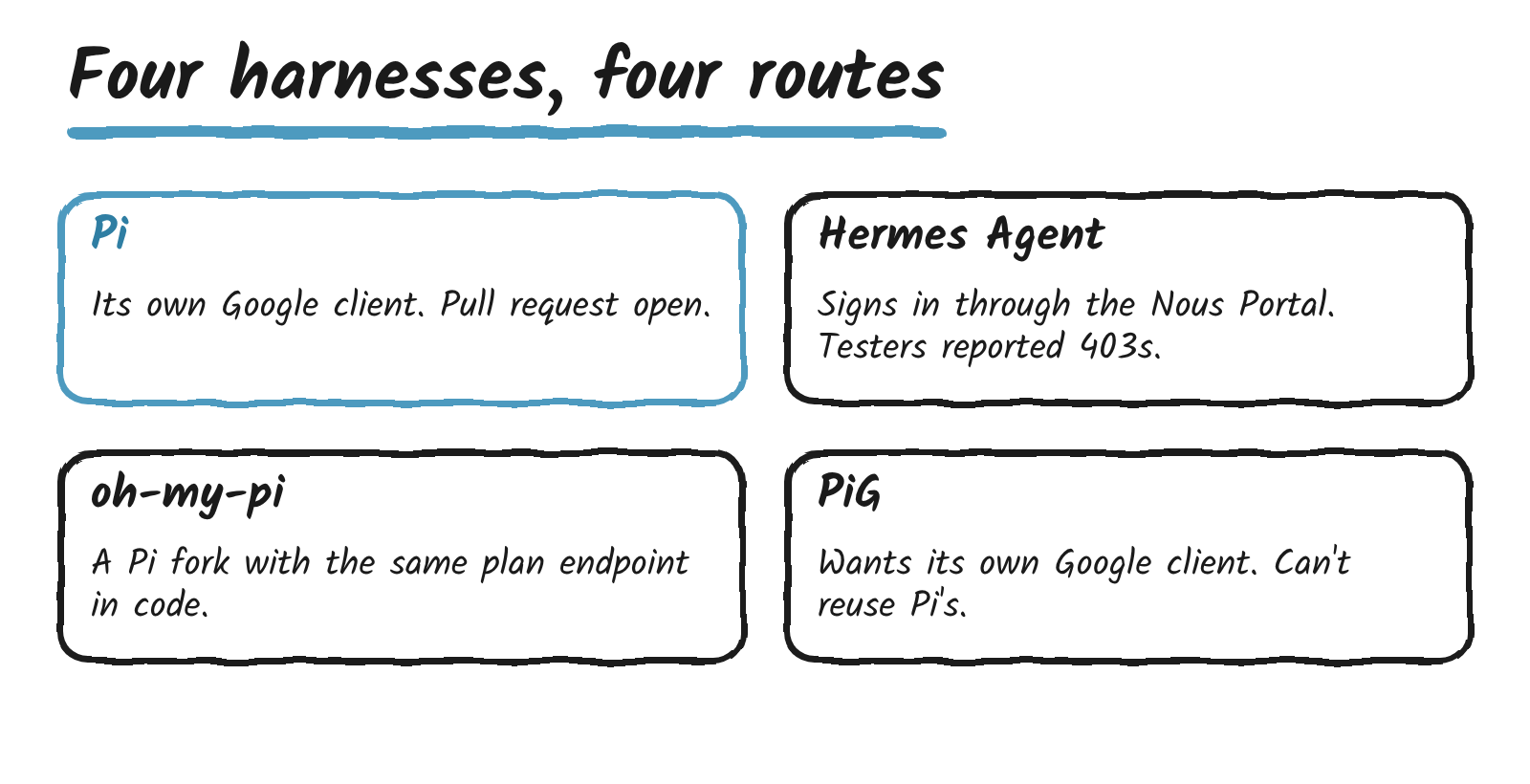
The rule that matters is in Pi’s own README: the approved client belongs to Pi, and “forks and other apps built on pi’s packages must register their own Google OAuth client and replace pi’s”. The AI package ships no client, and its README shows the one-line change for an app that has its own: googleAiPlanProvider({ clientId, clientSecret }). The hard part is getting Google to approve the client, and I found no public guide from Pi on how.
| Harness | Where it stands | Source |
|---|---|---|
| Pi | Own Google client, approved for Pi per its README. Code is in a draft pull request, not a release. | Pull request 12614 |
| Hermes Agent | The Solstice plugin signs in through a Nous Portal broker that holds the Google client secret. In late October, users reported a Google 403 saying the app was in testing mode. The agent’s own Google provider code now calls the same per-user quota endpoint. | Solstice issue 3, account_client.py |
| oh-my-pi | A Pi fork whose code already contains a Google Interactions provider for the same endpoint. I couldn’t tell which client it signs in with. | google-interactions.ts |
| PiG | A Pi-based project with an open issue asking its maintainer to get its own OAuth client approved. | Issue 585 |
Google’s stance toward third-party agents until now was an API key. I covered that for Hermes on 20 November in Hermes Agent has no Gemini plan sign-in, where Google’s Gemini CLI FAQ says piggybacking on its OAuth sign-in violates its terms. A per-app approval is a different arrangement: Google decides which tools get plan quota, and each tool carries its own client that Google can turn off.
The cautionary case is on the other side of that line. T3 Code removed an Antigravity quota probe that read Google sign-in tokens in version 0.1.13; I set that out in the T3 record. A tool that reuses someone else’s tokens is exposed to bans; a tool with its own approved client is exposed to a kill switch. For any harness, the first step is the same: ask whether Google will approve your client, because copying Pi’s won’t work.
How to get started
Pi’s sign-in isn’t in a release yet, so there are two paths. I couldn’t run either end to end, so treat the steps as what Pi’s docs and the pull request describe, not as something I reproduced.
If you use Pi and have an AI Ultra plan. Wait for the pull request to merge and ship, then update and sign in. The installer and npm commands below are from Pi’s quickstart; it needs Node.js 22.19 or newer for the npm route.
curl -fsSL https://pi.dev/install.sh | sh
# or
npm install -g --ignore-scripts @earendil-works/pi-coding-agent
If you want to try it before it ships. Run Pi from the pull request’s branch. Pi’s README gives the development commands; the first two lines fetch the branch, and the build step refreshes model data over the network.
git clone https://github.com/earendil-works/pi.git
cd pi
git fetch origin pull/12614/head:pr-12614
git checkout pr-12614
npm install --ignore-scripts
npm run build
./pi-test.sh
Then, inside Pi:
- Run
/loginand pick the Google AI Ultra plan provider, labelled “Sign in with Google (AI Ultra)” in the code. - Approve access on the Google page that opens. Pi catches the reply on a local port; a manual-code prompt is the fallback.
- Run
/modeland choose Gemini 4 Hydrogen, the provider’s default, or another of the four models. - Check that
auth.jsonin your agent directory now holds the sign-in, keep it out of backups and repositories, and expect to sign in again if Google expires the grant.
If you build on Pi’s packages, register a Desktop app client in your own Google Cloud project, get Google to approve it for the plan, and pass it to googleAiPlanProvider. Set your app’s name and version as its identity as well, because the AI package README says Google identifies apps by User-Agent.
| If you see | It means | Do this |
|---|---|---|
| “Run /login to sign in again” | A 401, or a scope problem | Sign in again |
| “does not have an eligible Google AI Ultra plan” | A 402 or 403 for your account | Check the plan at one.google.com/ai, or use a Gemini API key |
| “Daily limit reached for” a model | The model’s daily quota is spent | Switch model; the limit resets at midnight Pacific |
| “currently unavailable in pi” | Google has blocked the client | Nothing on your side; use an API key meanwhile |
What I didn’t check
I didn’t sign in, so I can’t say how the Google consent page reads, whether a Pro account works, or how long a session lasts. I didn’t compare quota on the plan with API pricing, and Pi’s code sets cost to zero without stating Google’s limits. Google hasn’t commented in anything I found. The pull request was a draft when the thread was posted, so any of the details above can change before it merges.
Sources
- Pi pull request 12614, Google AI Ultra plan provider, including the README note on forks and the AI package README
- Unicorn (@ohayou792) on X, 27 November
- Hermes Solstice plugin and issue 3
- Hermes Agent Google account client
- oh-my-pi Google Interactions provider and PiG issue 585
- RFC 9449, OAuth 2.0 Demonstrating Proof of Possession (DPoP)
Discover more from Sulat AI & Tech News
Subscribe to get the latest posts sent to your email.