
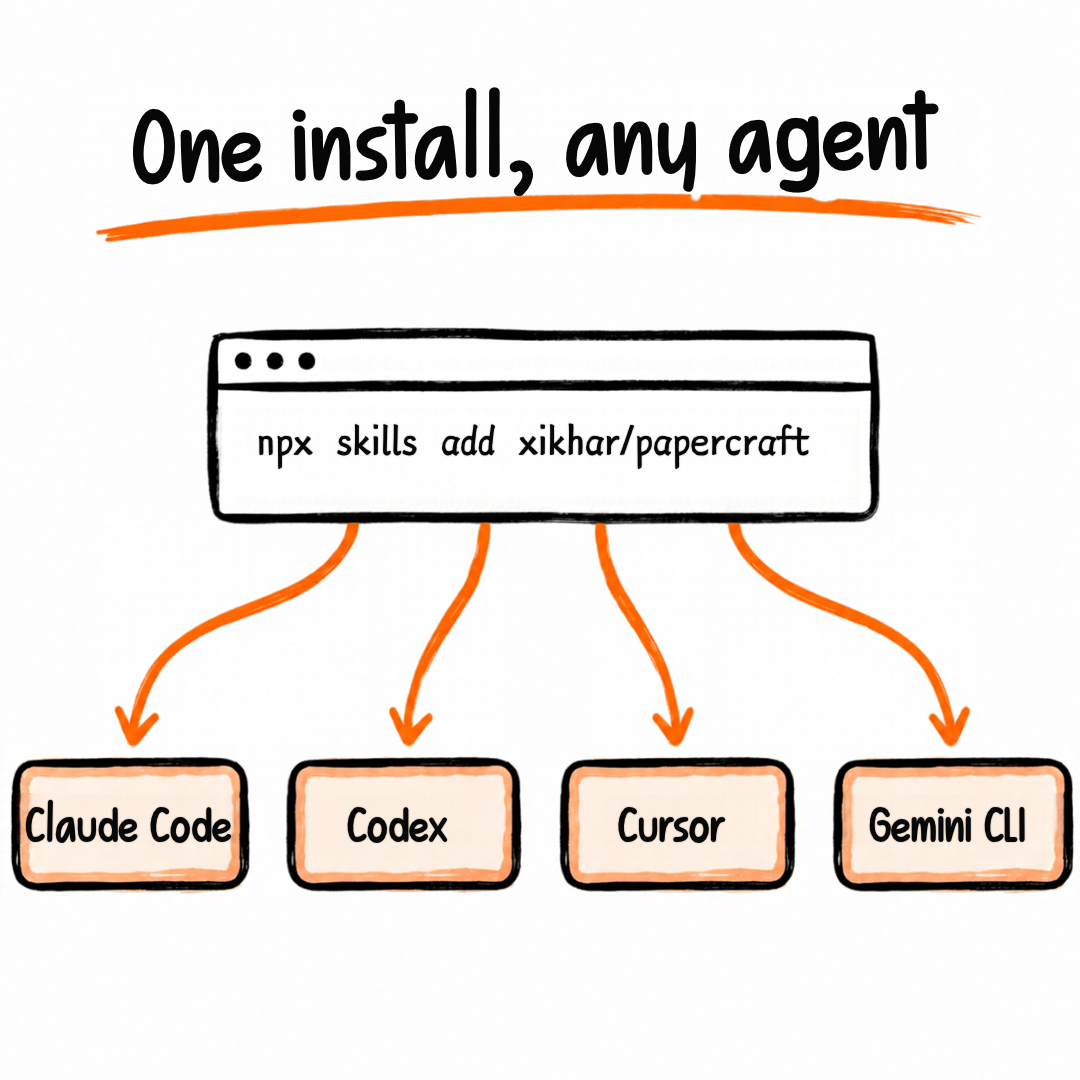
Papercraft is an agent skill that teaches a coding agent to build games, web pages and films that look like a photographed pop-up book. Shikhar, a creative engineer at fal who posts as @xikhar, published it on GitHub on 21 November under the MIT licence. On 28 November he posted a video called “The paper rails”, made with Opus 5.5 and three.js, and pointed to the install line: npx skills add xikhar/papercraft. That post has about 26,400 views. The repository has 986 stars and four commits, and its latest, version 0.7.0, landed the same day.
986
GitHub stars in seven days
12
numbered laws of paper in SKILL.md
0.7.0
latest version, pushed 28 November
What the skill is
An Agent Skill is a folder with a SKILL.md file that an agent loads when a task matches its description. Papercraft’s description says to use it when something should look, move or sound like paper or card, and not for real folding instructions, printable craft patterns or paper as in documents. It runs in any agent that reads skills, and the README names Claude Code, Codex, Cursor, Gemini CLI and OpenCode.
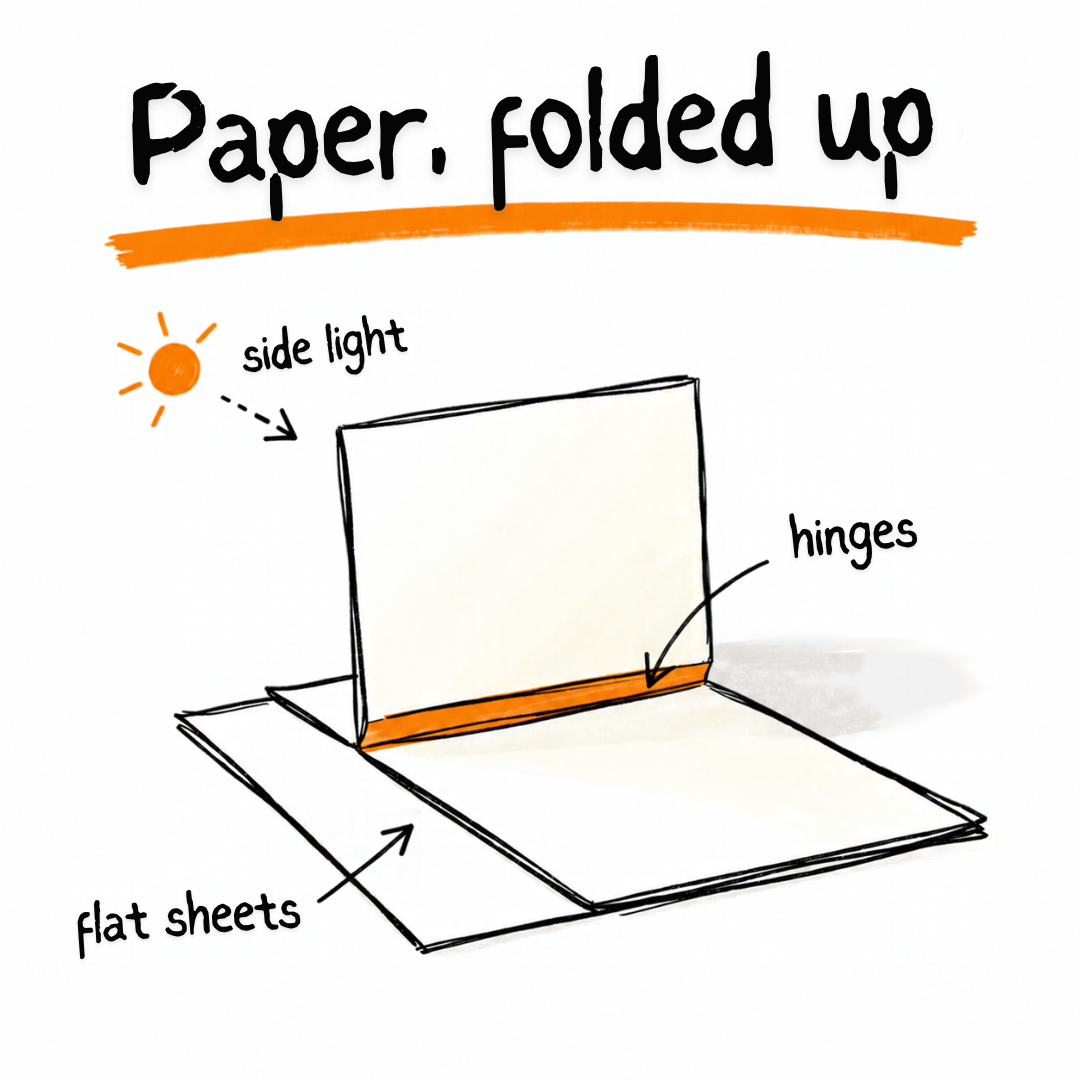
It doesn’t ship a game. It ships a method. The agent is told that everything is a flat sheet of card with thickness, folded or slotted into shape and never sculpted, then lit and filmed the way a photographer would shoot a real paper model. The first section of SKILL.md sets out twelve laws:
- Every piece is a flat sheet with thickness, 1.5 to 3 per cent of the hero’s height. Trees and posts are two printed planes slotted at 90 degrees; buildings are folded boxes.
- Dead matte: diffuse light only, no specular, no reflections, under 1 per cent clipped pixels.
- One low key light from the side, with soft shadows tinted by the world: amber on warm ground, lilac-blue on snow, navy at night. Never grey or black.
- Every print is a small layered collage: three to five inks, a short shadow under each layer, a pale lip on the lit edges.
- A thin dark cut edge, with a pale highlight only on the edges that face the light.
- A long macro lens (24 to 32 degrees) looking 40 to 55 degrees down, with the printed ground running past every edge and a tilt-shift blur above and below one sharp band.
- The brief’s own palette, never the example scene’s.
- A dense world of 100 to 250 chunky pieces of about 20 kinds, in tight groups of different things.
- Anything walked on, under or into is built in 3D, not a standing flat.
- Paper moves by rotating about creases: a fast rise with an 8 to 15 per cent overshoot, settled in about a second, and nothing scales or fades in.
- Sound, if any, is soft, warm, low and sparse.
- The world is alive with three to five kinds of weather, flyers, smoke or creatures, small and slow.
The file says its numbers “held up” in a shipped browser game and are “starting points, not decoration”, and that the brief always wins over them. Before any code, the agent has to fill in a “paper spec” with numbers for the palette, light, lens, motion, life and sound. It then proves the material on a single test card before building the world, and after the build it measures and critiques the frames for at most three rounds.
What is in the folder
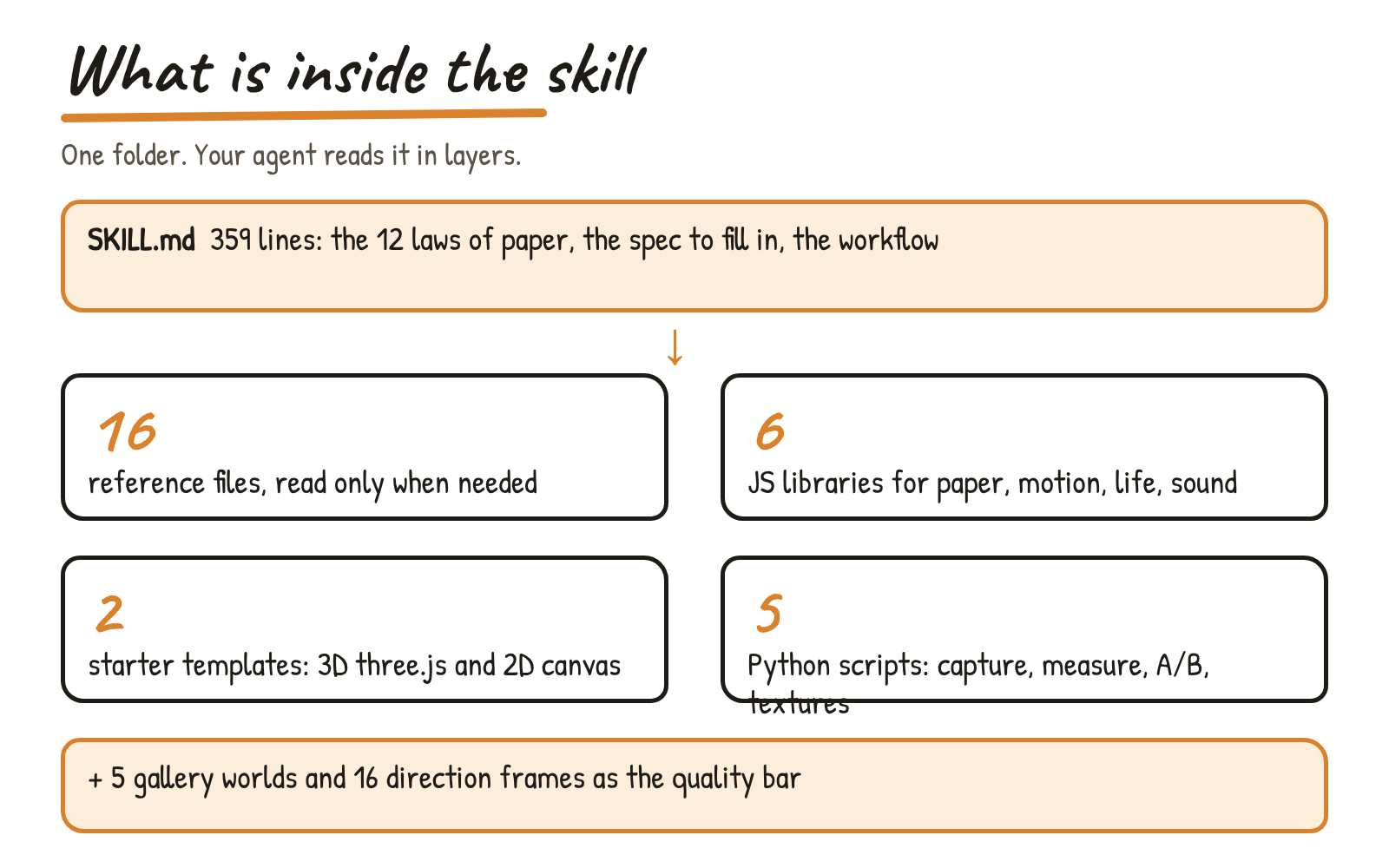
The skill folder is 6.4 MB. SKILL.md runs to 359 lines and routes the agent to 16 reference files only when it needs them, on structures, look, palettes, motion, sound, formats and process. The code is plumbing for the agent to import: paperkit-3d.js (paper material, cards with thickness, hinges, crosses, box and prism folds, soft shadows, the macro lens), paperkit-2d.js, paper-motion.js, paper-life.js, paper-sound.js and, new in 0.7.0, paper-music.js, a felt piano. Two templates, a three.js 3D one and a Canvas 2D one, hold the harness and a replaceable example scene. Five Python scripts handle capture, measurement, blind A/B sheets, paper textures and cutout extraction.
One rule sets it apart from a template pack. The README says the bundled code is “plumbing”, and the worked examples are “one countryside world to read, never a catalogue of parts”. The agent is told to design its own pieces for the subject. Image generation is optional and used only when the user asks for it.
Where it came from
The skill was distilled from a game. On 17 November Shikhar posted Papertrails, “an endless papercraft world that pops up around you”, built with Fable 5.2 and Opus 5.5 and running in the browser on three.js. That post passed 100,000 views. His thread describes the process the skill now encodes: the agent generated concept frames with GPT Image and collected real pop-up photos, measured their colours, edges and lighting, then ran one subagent per part with blind critics comparing every build against the reference. All the printed art was generated as one atlas and cut onto hinged cards. He made style guides for 15 biome types, and the agent looped through render, compare, critique and fix. The game is on GitHub under the MIT licence, with 266 stars.
On 21 November he posted “Turning this style into a skill” (43,700 views) and pushed the first commit. Version 0.5.0 followed that afternoon, with “worlds from the brief, structure types, living worlds, faster builds”, and 0.6.0 that night, with “any format, references as a way in, cards that never clip”. The 0.7.0 commit, a week later, added:
- Films and dioramas without a hero. A scripted camera, rises, light and score, with a
mixMoodcall that blends two lighting moods while it plays. - New kit pieces. Laminated cutouts of transparent art, stepped relief stacks, prism folds on any plan and a continuity check for camera cuts.
- Video with sound.
capture.pynow encodes colour-checked MP4s through Chrome’s WebCodecs, mixes the paper sounds under the felt-piano score and verifies the frame count. - A wider gallery. Sixteen direction frames of other subjects, among them a reef, a space station, a rainy city, a bakery interior and a paper-style app screen. The skill’s own gallery notes call them “generated direction frames, not builds”.
Version 0.7.0 shipped the same day as the “paper rails” demo. Shikhar’s post names the model and three.js, and doesn’t say the rails were built with the skill. I haven’t seen the source behind the video. The week’s other demo, “Yearning for Adventure”, is in a different style, made with Gemini 4 Neon and three.js, and was posted on 27 November.
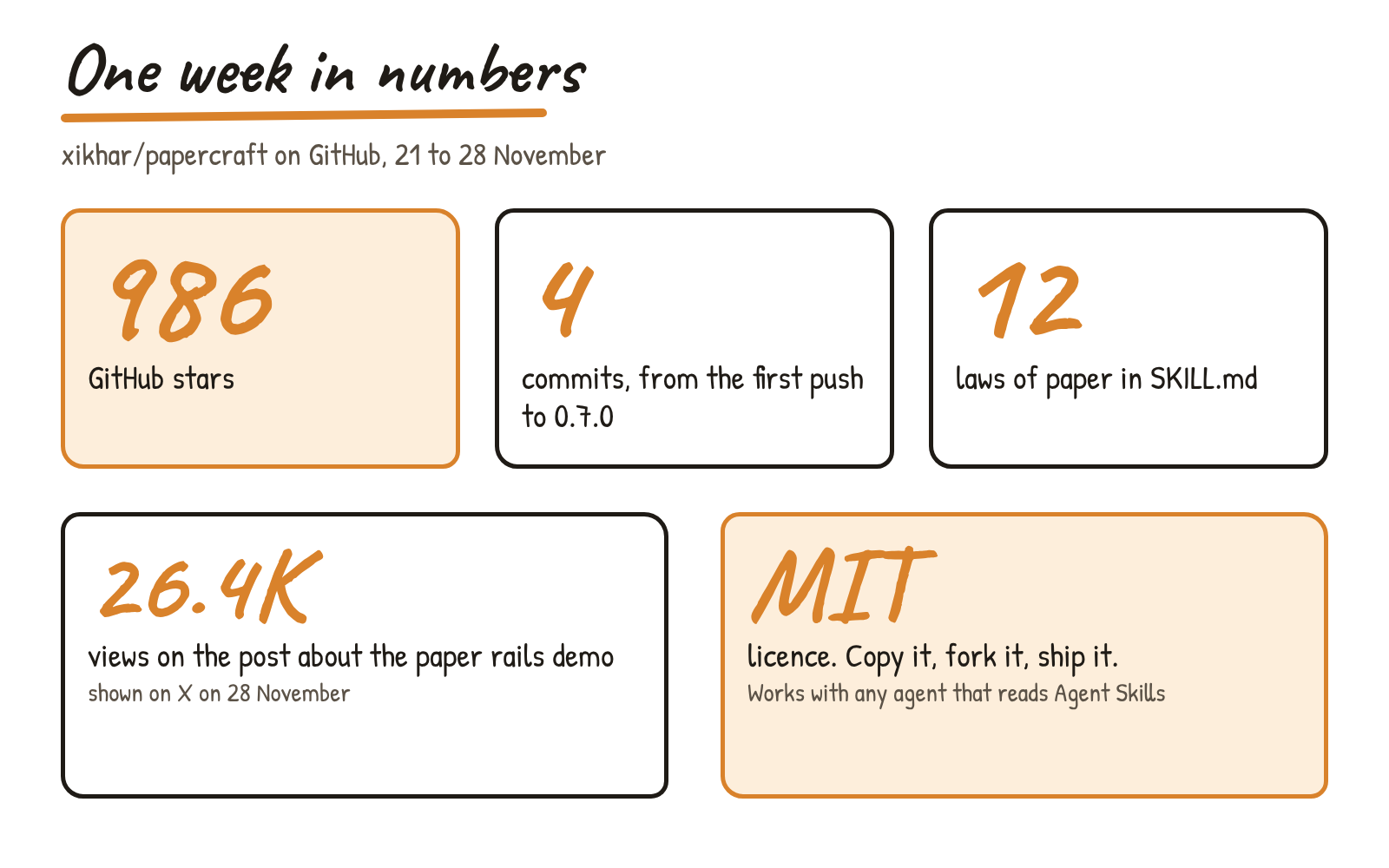
The pace is unusual. GitTrend’s snapshot on 27 November has the repository at 817 stars, with 874 gained over the previous seven days, a best day of 223 on 23 November, and a peak rank of 73 on GitHub’s daily trending list on 24 November. By 28 November GitHub’s search API reported 986.
What I ran
I cloned the repository at commit 30e9aaf (version 0.7.0), served the skill’s assets folder over HTTP and opened its 3D template in headless Chromium 28 November, with software rendering and no GPU. The example scene built and rendered with no page errors. This is the countryside world the template ships with, by day and with its night mood switched on:
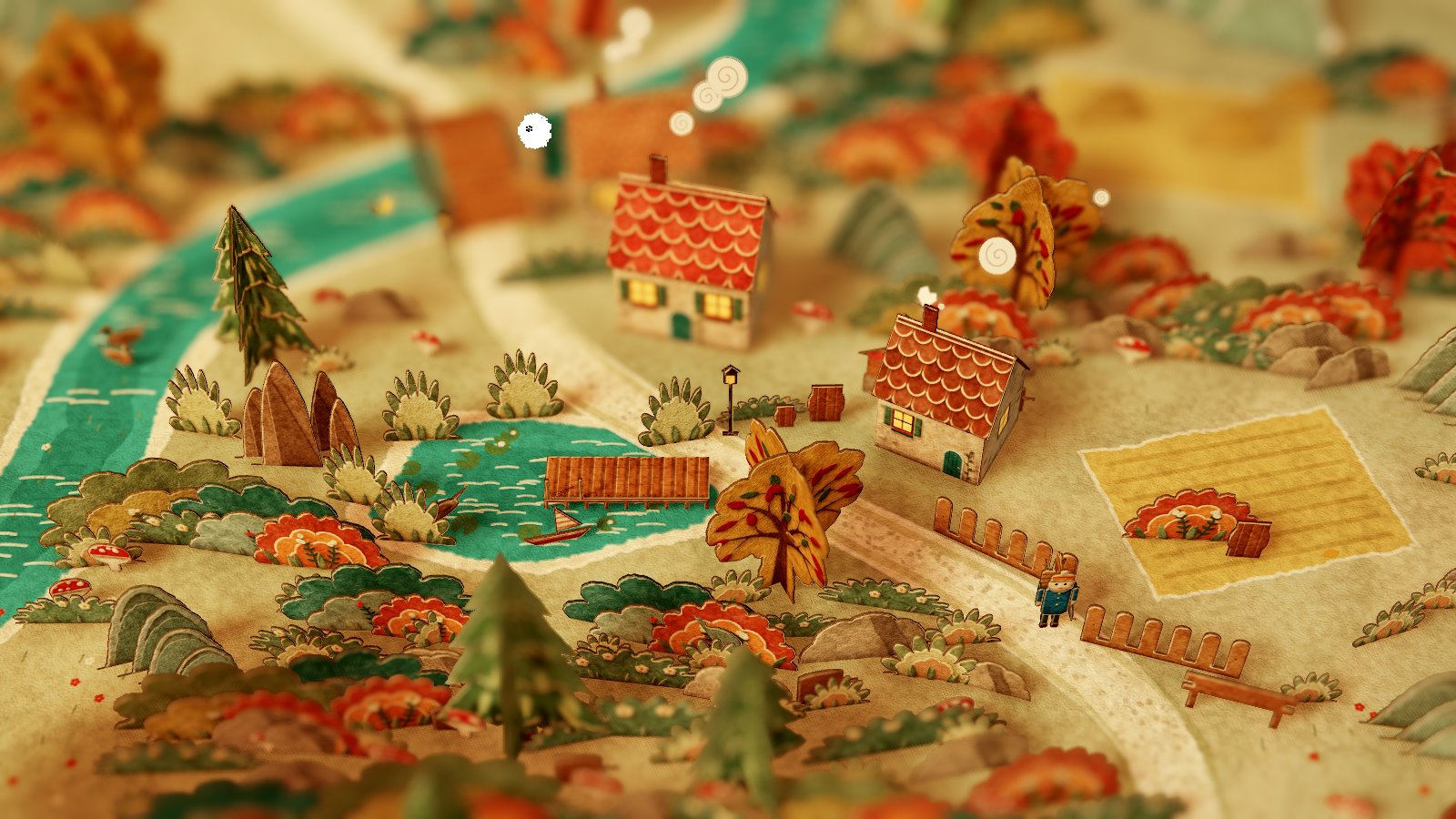
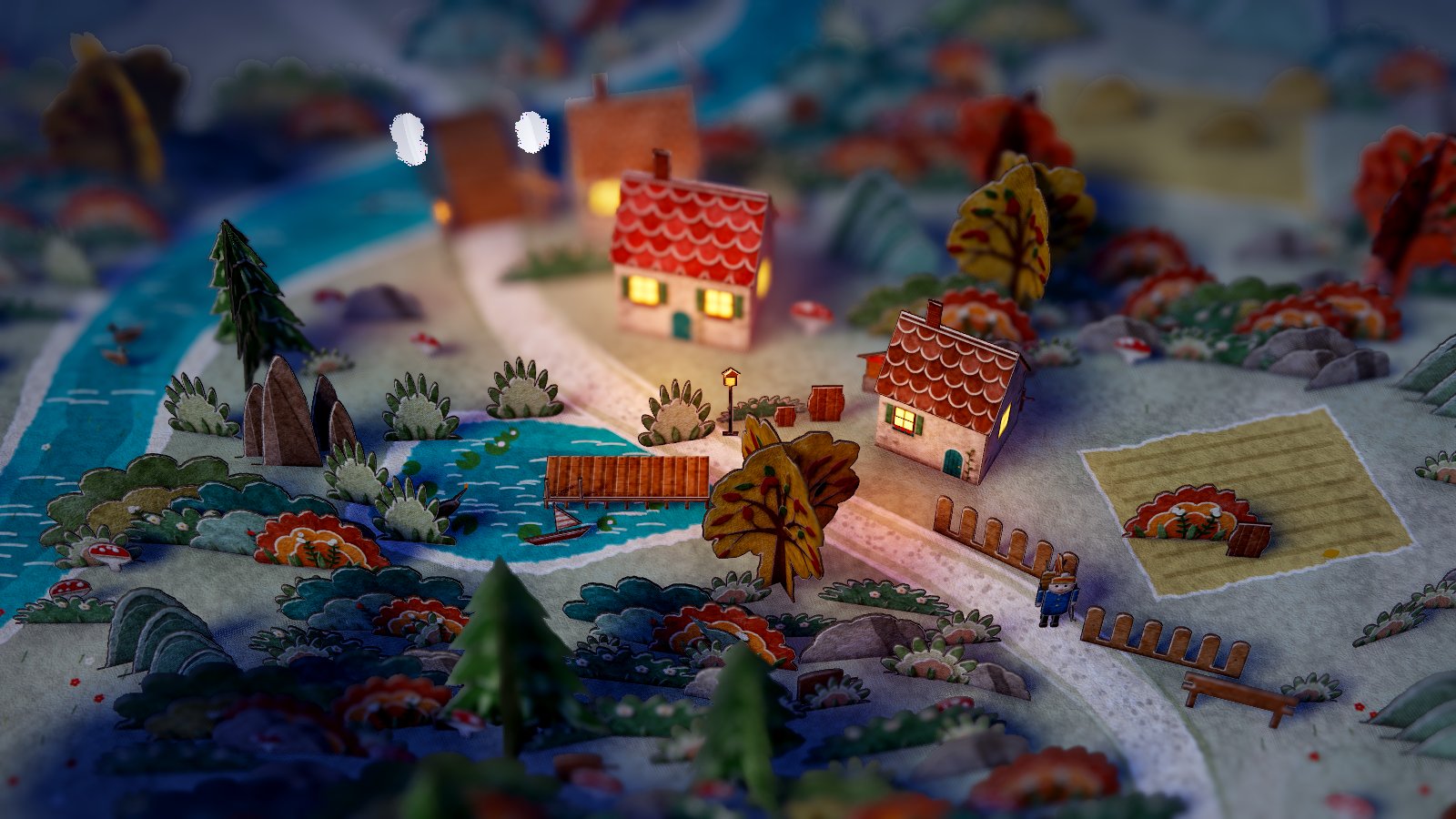
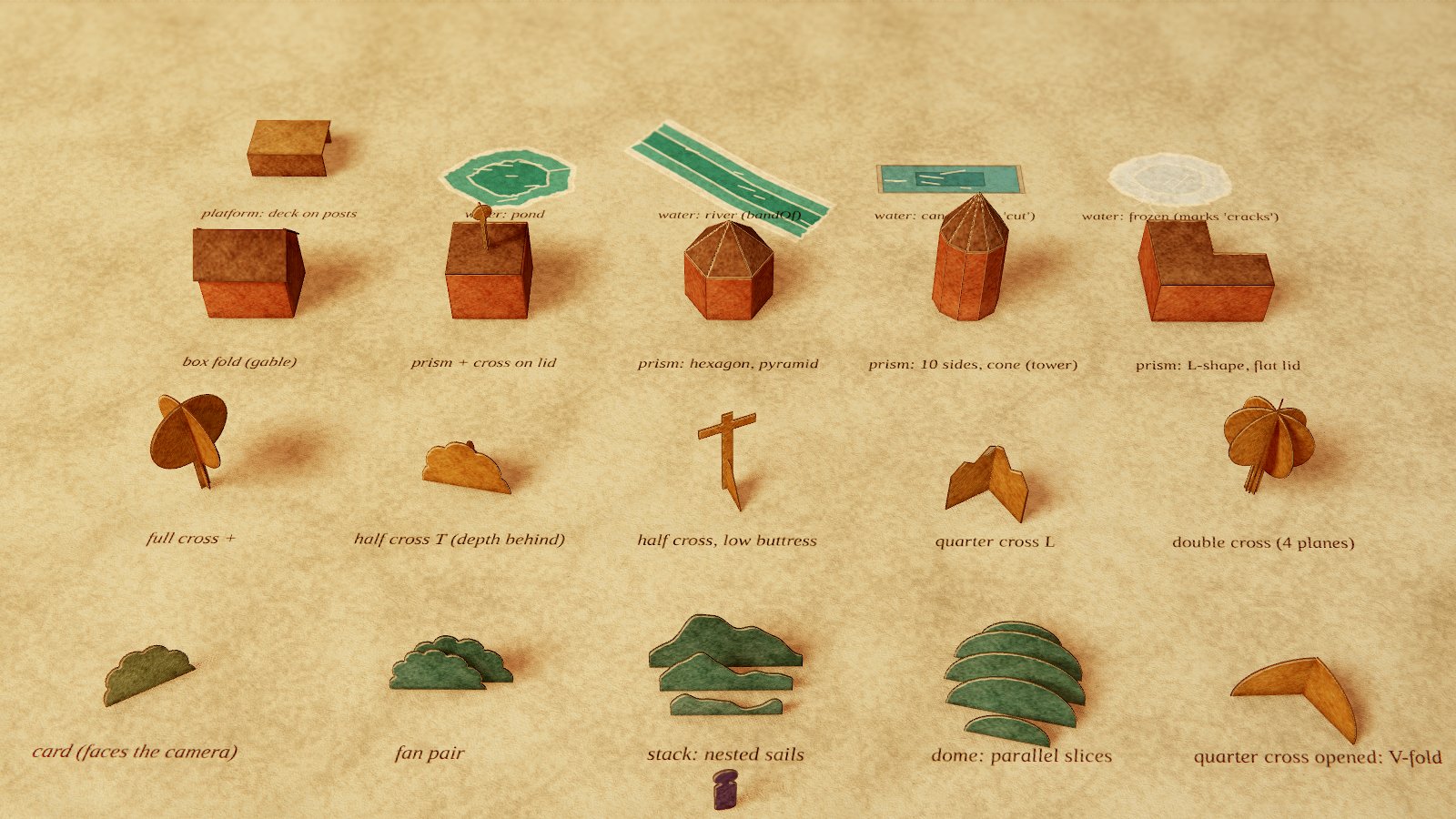
The structure sampler page also rendered, with every structure type the skill defines in plain placeholders: the box fold, prisms on a hexagon, ten-sided and L-shaped plans, the full, half and quarter crosses, fan pairs, nested sails and the dome built from parallel slices. It’s the clearest picture of how the skill gets volume from flat card.
I didn’t run capture.py, the repository’s test files or the npx skills installer. The skill’s own porting notes for Godot, Unity, Unreal and Blender, engines.md, are labelled untested.
What I ran with an agent and Morph
A skill is only as good as what a different agent does with it, so on 28 November (NZ) I gave the folder to two models through opencode 1.19.6 and the Morph API. I used DeepSeek V4.1 Flash (morph-dsv41flash) and Kimi K3.1 Pro (morph-kimik31). Each got a fresh copy of the skill and the same prompt: build a pop-up papercraft diorama of a small lighthouse harbour town at dusk, replace scene.js in the three.js template, leave harness.js alone, check it with a render script, and stop after three render rounds.
This is the exact prompt both models got, word for word:
Use the papercraft skill (in .claude/skills/papercraft; read its SKILL.md first and only the references you need).
Task: build a pop-up papercraft diorama of a small lighthouse harbour town at dusk, in three.js, in ./project/templates/popup-3d/ (the folder already holds the template harness and the example scene.js). Replace scene.js with your own harbour world: your own pieces, palette derived from the brief, a leading line (the quay), water, a few boats, a lighthouse with a lit lamp, at least 10 kinds of piece. No hero is needed (a diorama). Keep harness.js as is.
To check your work, run: NODE_PATH=$(npm root -g) node tools/shot.js ./project "templates/popup-3d/index.html?still&mood=dusk" ./out.png 40000   (it prints page errors; then look at out.png). Fix page errors. Do at most 3 render rounds, then stop and say what you verified and what you did not.
It was run headless with opencode run -m morph/morph-dsv41flash and opencode run -m morph/morph-kimik31, one model at a time, in separate folders.
| Run | Wall time | What came out | My render check |
|---|---|---|---|
| DeepSeek V4.1 Flash | 14 min 50 s | A new 58 KB scene.js, three render rounds | No page errors, 262 cards, built in 2.0 s |
| Kimi K3.1 Pro, first try | 2 min 39 s | Nothing. It reported success but wrote no files and produced no image | Not applicable |
| Kimi K3.1 Pro, second try | 10 min 19 s | A new 29 KB scene.js | No page errors, 180 cards, built in 1.4 s |
I rendered both final scenes myself rather than trusting the agents’ reports, in headless Chromium with software WebGL, and both loaded cleanly. For scale, the skill’s own template built 363 cards in 4.9 s on the same machine. Both agents left harness.js byte for byte unchanged, as asked.
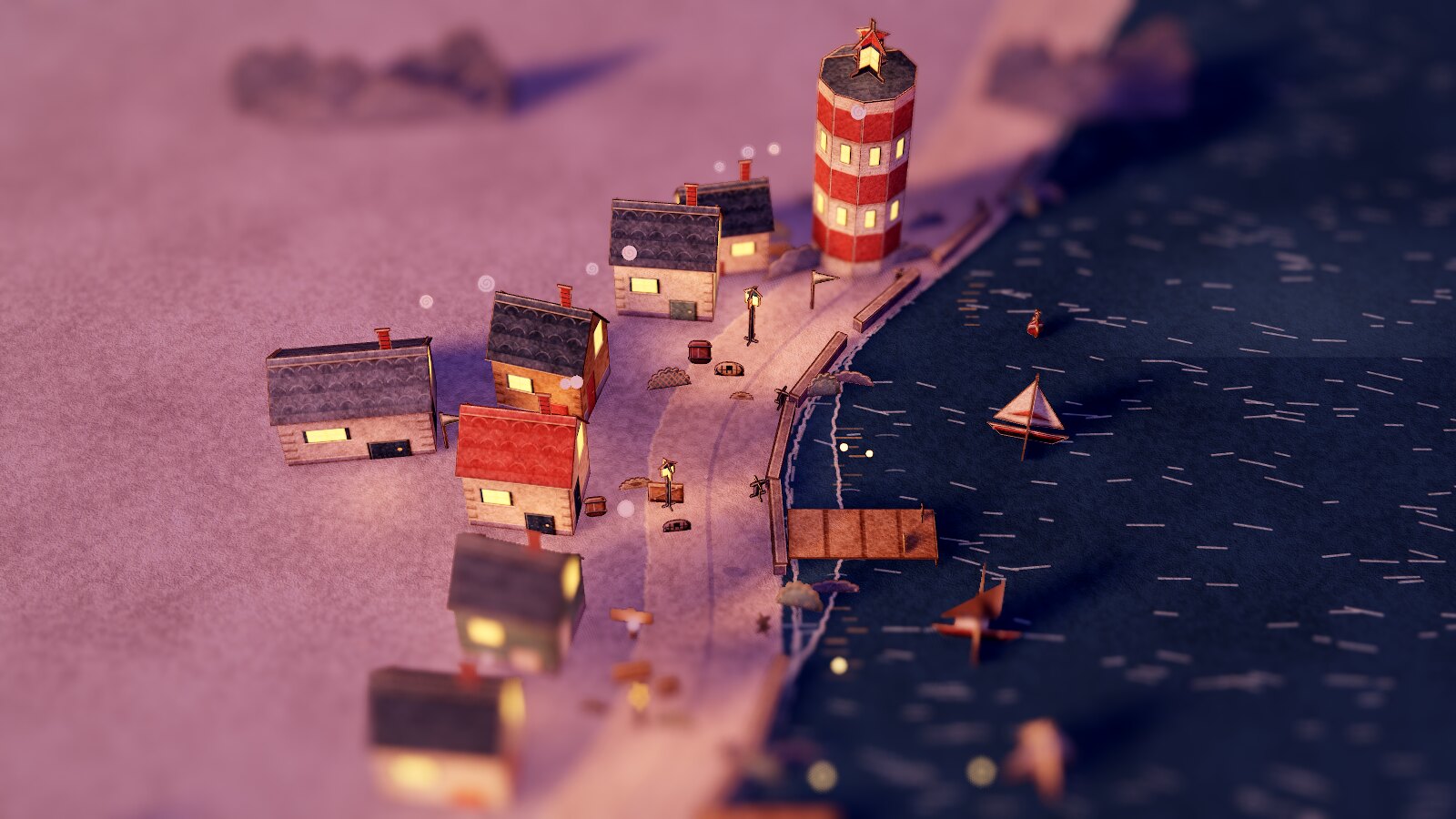
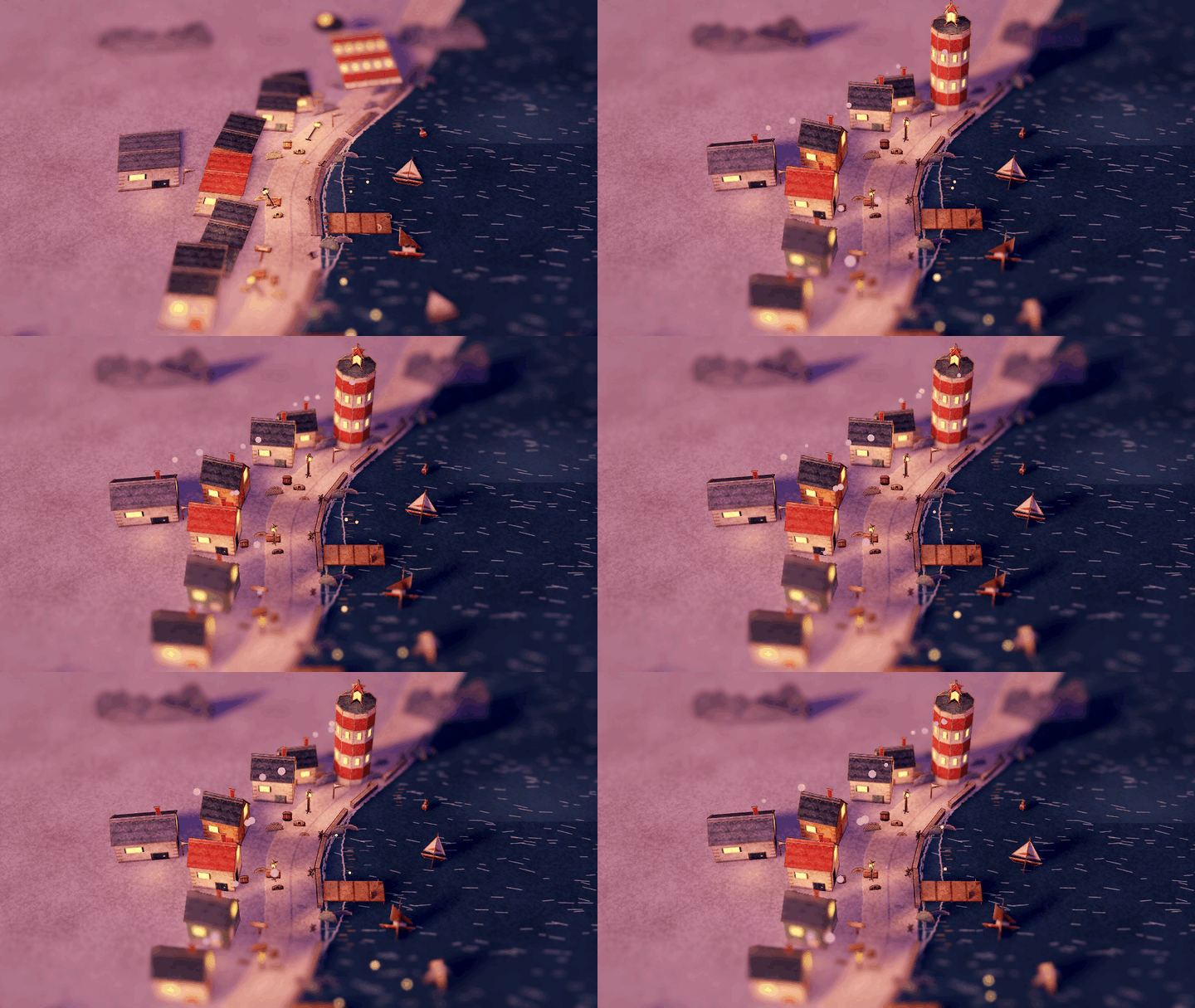
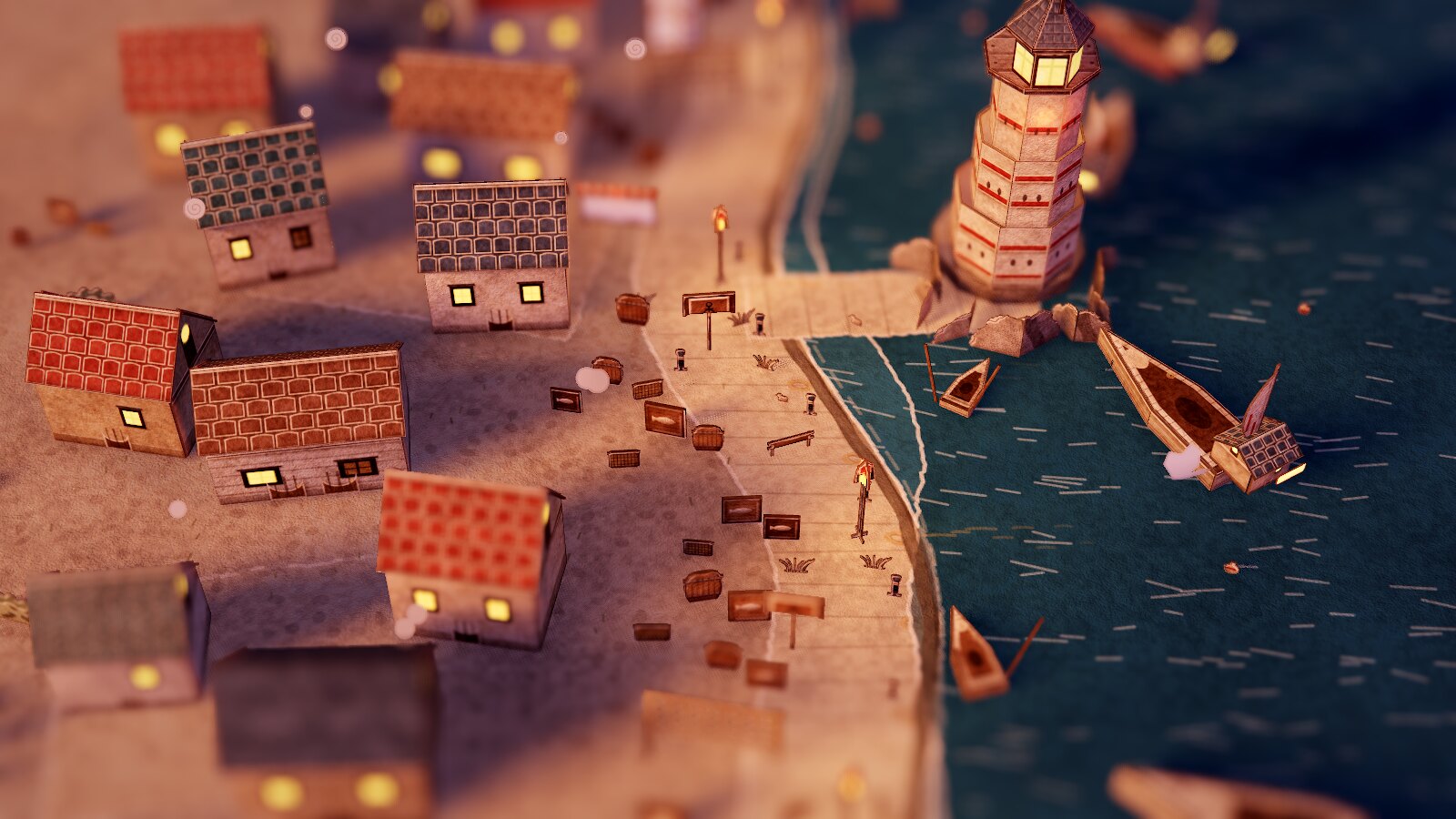
Both frames read as paper: matte sheets, a side light, tilt-shift blur and tinted shadows. That is the skill doing its job on models that had never seen it. They are also plainly weaker than Shikhar’s own examples. The DeepSeek foreground is crowded with small crates and signs that read flat, which the model itself flagged in its closing notes. The Kimi scene is cleaner but sparser.
The failures matter more than the pictures. Kimi’s first run told me it had finished while nothing existed on disk, so any workflow that trusts an agent’s “done” needs a check like my render step. The DeepSeek run also stalled for several minutes after it wrote a helper script outside the project folder. Kimi has a tight per-minute token limit on this key, which is why I ran the two models one after the other.
This is a sample of one prompt per model, not a benchmark. I didn’t compare against a run without the skill, so I can’t say how much of the paper look comes from the skill and how much from the template it points at. I used my own screenshot script rather than the repository’s capture.py, and I did not record a video. The animation is stitched stills.
How it compares
Skills for graphics are a crowded corner of the Agent Skills ecosystem, and papercraft is unusual in being one look rather than a toolbox.
| Skill | What it teaches | Created | Stars | Licence |
|---|---|---|---|---|
| xikhar/papercraft | One style, any subject: pop-up paper worlds, pages and films, with a capture and measure loop | 21 November 2026 | 986 | MIT |
| scottstts/Threejs-Awesome-Graphics-Agent-Skills | Three.js graphics systems: mesh design, lighting, PBR, shaders, TSL and WebGPU, post-processing, particles. It says it is not an API cheat sheet | 19 June 2026 | 1,047 | MIT |
| xikhar/atlas (Shikhar’s earlier pack) | Three.js shaders and renderer pipeline for polished 3D scenes | July 2026 (first listed 24 July) | 6 | Not checked |
The graphics pack asks the agent for general three.js quality across any look, and installs through its own command into Codex, Claude Code, Cursor, GitHub Copilot, Gemini CLI, Windsurf and others. Papercraft fixes the look and hands the agent the numbers for it, from card thickness to blur radius. The two are complementary: a general pack for shaders and post-processing, a style skill for what the frame should feel like. The AI UX Playground directory lists papercraft under Visual Design beside Anthropic’s canvas-design and theme-factory skills, which cover static art and document themes rather than interactive worlds.
Papercraft also lands in a run of agent-made browser 3D. Google’s Gemini 4 Neon launch post, from 18 November, highlights a first-person WebGL2 ski simulator, an interactive Turing’s study and a 100,000-cell spreadsheet relit with formulas, all written by the model. Shikhar’s own week shows two models and two styles side by side: Opus 5.5 for the paper rails and Gemini 4 Neon, priced at US$3 per million input tokens and US$15 per million output, for “Yearning for Adventure”. What the skill adds is the part a model doesn’t know by default, which is a specific look expressed as numbers.
What to know before you use it
- It needs a network and a toolchain. The templates import three.js 0.187.0 from the jsDelivr CDN. The scripts need Python 3 with numpy and Pillow, and
capture.pyalso needs Playwright with Chrome, plus ffmpeg for video. - It runs code on your machine. The skill ships five Python scripts that launch a browser and write files. Read them before an agent runs them, and run them in a scratch folder.
- Builds are heavy. A print costs pixels times layers, and the skill’s own notes put most prints at 2 to 8 ms and big many-layered ones at 50 to 100 ms. On software rendering my night capture of the bundled example took about a minute.
- The range gallery is not proof of range. The sixteen frames of reefs, stations and cities are generated images, not builds. The quality bar is the five worlds from the shipped game.
- It is one person’s project. Four commits from a single author in a week, and no tagged releases or issue history to judge it by yet. Shikhar says he’ll “keep improving slowly by testing it more”.
- Taste stays with you. The skill’s gotchas note that metrics and critics push towards more bob, more sound and more detail, and that when in doubt the owner of the source project took something away.
Try it
- Install the skill with
npx skills add xikhar/papercraft, or copyskills/papercraft/into your agent’s skills folder. - Ask for something paper. The README’s examples: “make our bakery landing page feel like a pop-up storybook”, “a dome on Mars as a paper diorama, with a rover that pops up”, and “an 8-second vertical Reel of a paper lighthouse town waking up at dawn”.
- To see the template first, serve
skills/papercraft/assetswithnpx serveorpython -m http.serverand open/templates/popup-3d/. Add?mood=nightor?stillto the address, and open/templates/popup-3d/structures.htmlfor the sampler. - Give it references if you have them. A photo of a real paper model can be the look target itself, and a moodboard gives it the theme.
- Expect to steer. Ask for one test card first, then the world, and judge frames at 100 per cent, as the skill’s own checklist does.
Sources
- Shikhar (@xikhar) on X, “The paper rails”, 28 November 2026
- xikhar/papercraft on GitHub, README, SKILL.md and commit history
- Shikhar on X, “Turning this style into a skill”, 21 November 2026
- Shikhar on X, Papertrails thread, 17 November 2026
- xikhar/papertrails on GitHub
- Shikhar on X, “Yearning for Adventure”, 27 November 2026
- GitTrend, xikhar/papercraft star history
- AI UX Playground, Papercraft skill listing
- scottstts/Threejs-Awesome-Graphics-Agent-Skills
- Google, “Introducing Gemini 4 Neon”, 18 November 2026
- Google AI Studio, Gemini API release notes, 18 November 2026