
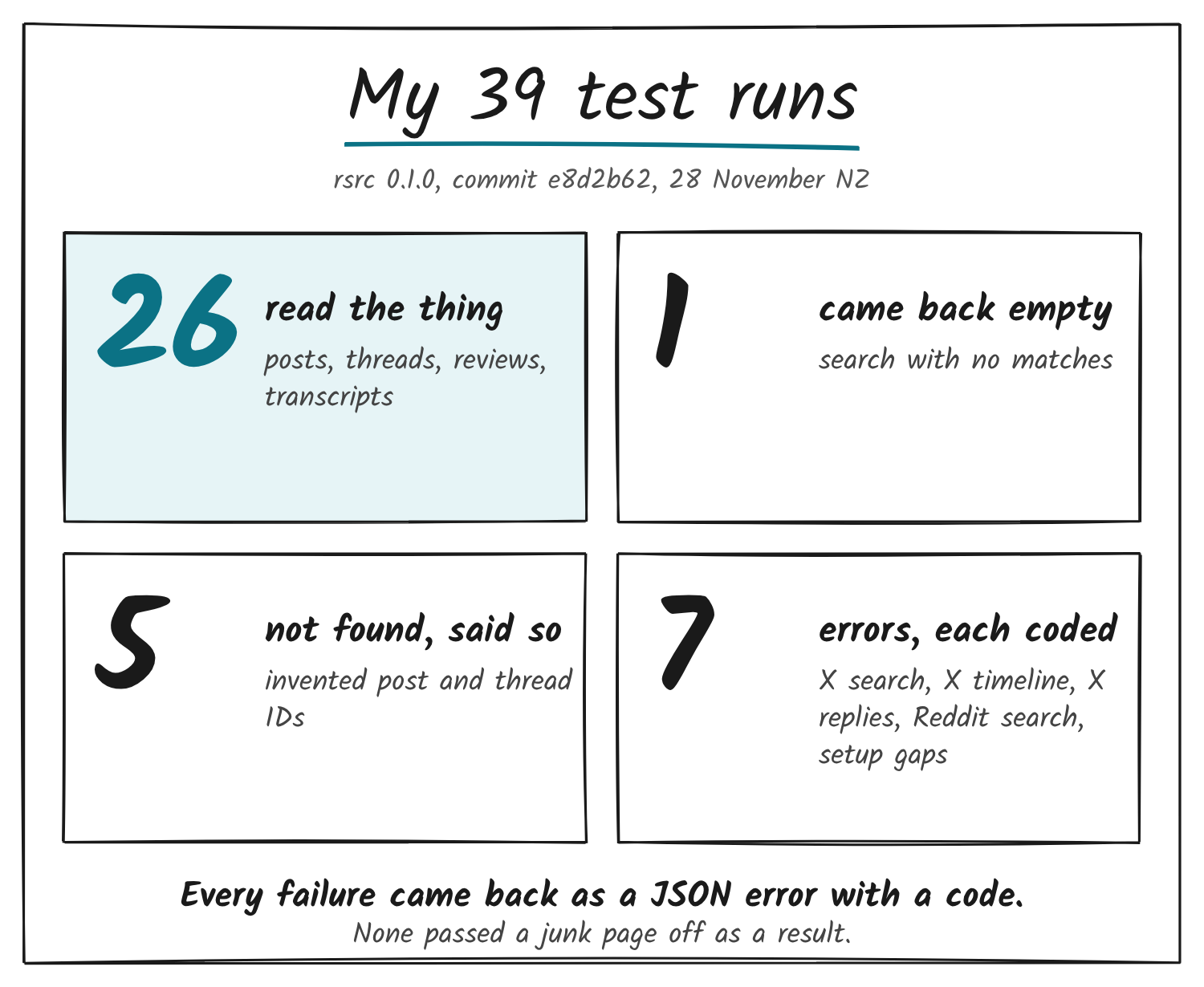
Samuel Zhang has released rsrc, a free, open-source command-line tool and agent skill that lets an AI agent read X, Reddit, Hacker News, YouTube, LinkedIn and the App Store. I installed it and ran 39 commands: 26 returned the content, and every failure came back as a coded error, not a junk page.
Zhang announced it on X at 4:49am NZ time on 28 November, writing “let your agents read x, reddit, and 5 other sites web search misses”. When I checked, the post had 946 likes and 49,532 views.
What rsrc does
rsrc runs from a terminal. Each command, such as rsrc x read with a post address or rsrc hn search "vibe coding", prints one JSON object with the text, author, date and engagement of each item, in the same shape on every site. According to the README, exit code 0 means at least one item came back, 66 means none, 2 means bad arguments or setup, and 1 means a runtime failure with a code such as rate_limited, blocked or not_found.
It needs Python 3.11 or newer and uv, has no other Python dependencies and is MIT licensed. The agent gets a separate skill file, SKILL.md, which says which command answers which question.
uv tool install git+https://github.com/SamuelZ12/research-sources
rsrc check hn appstore
npx skills add SamuelZ12/research-sources
The skill’s rules are short. The agent cites only URLs the tool returned, stops using a site for the rest of the session after a rate_limited error, and passes a config error to the user instead of trying to fix it.
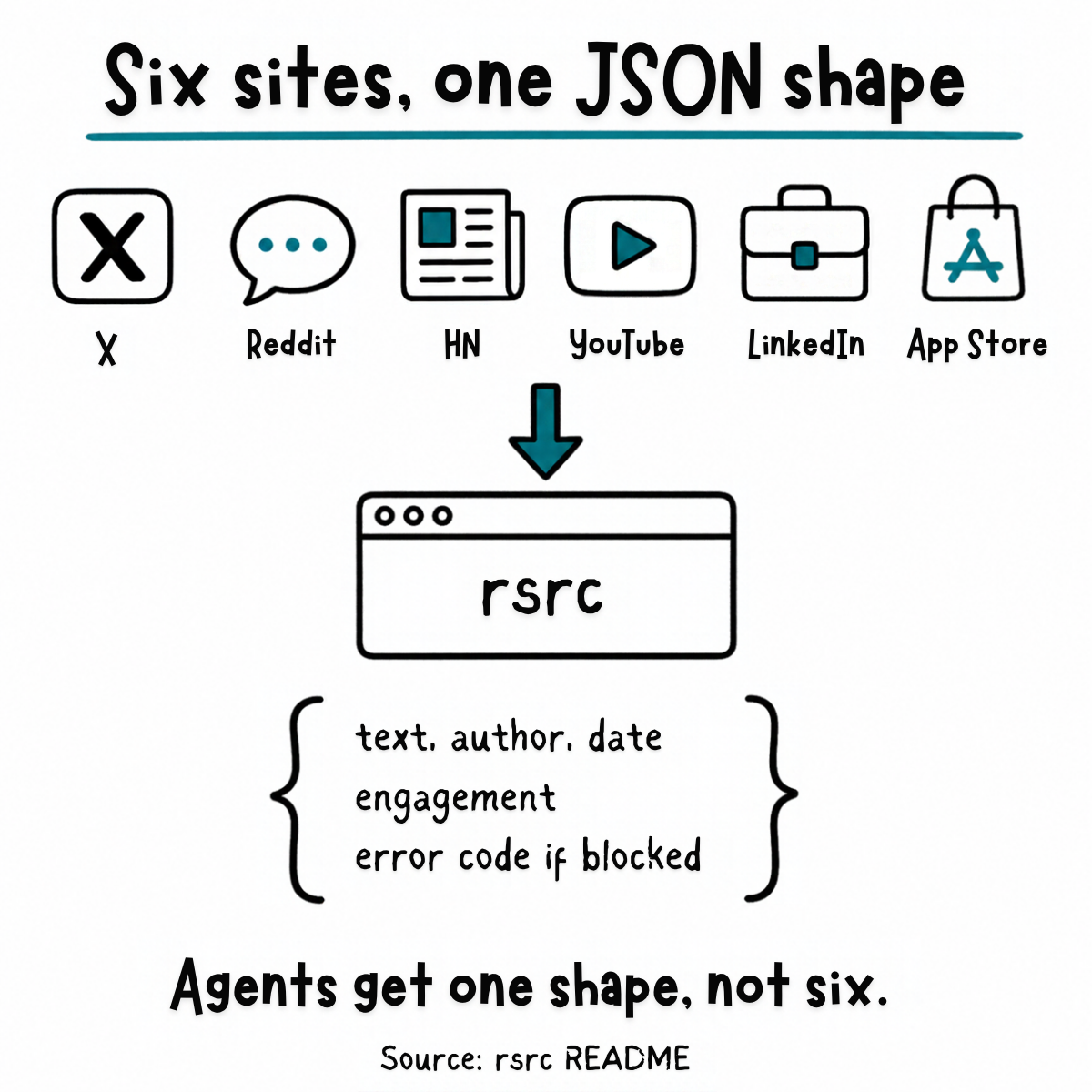
Each site has its own route. X posts, threads, replies and timelines come from the FxTwitter public API. Reddit reads come from the Arctic Shift archive, Hacker News from Algolia’s API and the App Store from Apple’s iTunes endpoints. YouTube goes through yt-dlp, with deno for transcripts, and LinkedIn is one public HTTPS request. Only two things need a login of your own: X search takes a cookie pair or a Chrome connection, and Reddit search and live threads take Ego Lite.
I read the source, about 6,491 lines of Python. The only HTTP POST is X’s SearchTimeline request, which is a read and needs those cookies. The cookie file has to be mode 600, and the cookies never appear in the output.
What I ran
I ran 39 commands in a Linux sandbox on 28 November NZ time, on rsrc 0.1.0 at commit e8d2b62, with no X session and no Ego Lite. The README says the live sources have been tested on macOS only, so this is a different setup from the author’s.
| Command | Outcome | Time |
|---|---|---|
| X read, the launch post | 1 post, with engagement counts | 0.24 s |
| Hacker News search, “Claude Code”, limit 10 | 10 items | 0.30 s |
| App Store search, “notes”, limit 5 | 5 items | 0.67 s |
| X read, a post ID that doesn’t exist | not_found error | 0.81 s |
| X search, “rsrc”, limit 5 | upstream_error | 2.30 s |
The fast reads match what the author reports. His measurements doc gives a 558-word transcript for the YouTube video in its timing table, and rsrc youtube read on that video returned 558 words for me.
Where it failed
Seven runs ended in an error. X search returned upstream_error, and the measurements doc says the public X search route has returned HTTP 503 since 19 November, so the author already knows about that one. Reddit search needs Ego Lite, which the sandbox didn’t have.
Two failures were odd. rsrc x replies returned url_mismatch with ok set to false, although four replies arrived in the output. And the X timeline for Zhang’s own account failed twice with a 404 from FxTwitter, while Andrej Karpathy’s timeline loaded.
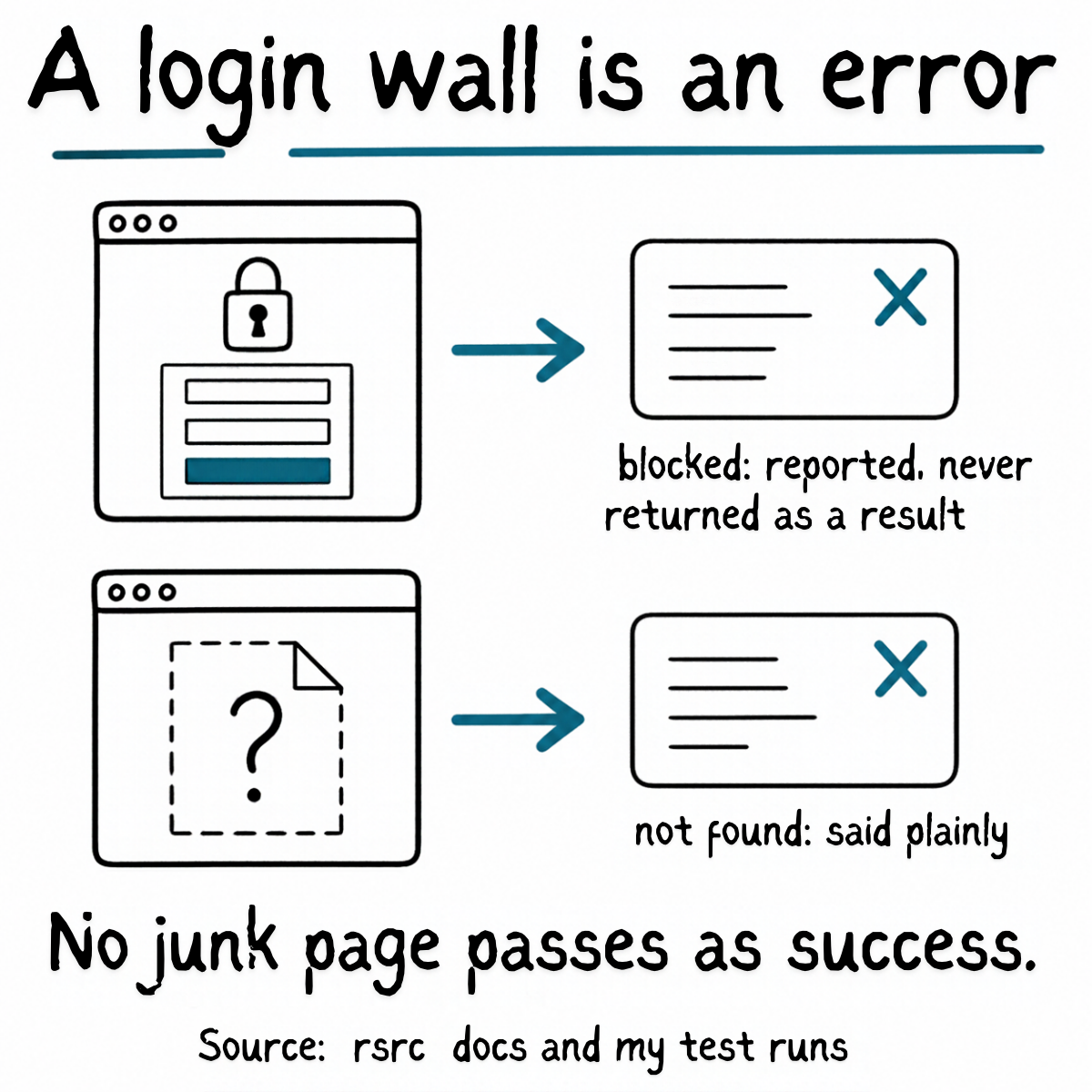
The five invented post and thread IDs each came back as a not_found error that said so. That is the behaviour the README promises: “A login wall, a CAPTCHA page or the wrong post is an error, never a result.”
Seven sites or six
The tweet says X, Reddit and five other sites, which makes seven. The README’s source table lists six: X, Reddit, Hacker News, YouTube, LinkedIn and the App Store. The measurements doc says five other channels, GitHub, Polymarket, Bluesky, Product Hunt and Ashby, were removed on 27 November, the day of the post.
What the author measured
The README makes three claims about performance, and the measurements doc lists the limits of each. I haven’t reproduced any of them.
- Finds what web search misses. In a five-topic test on 6 November, an agent with an early rsrc cited at least four URLs per topic that web search alone didn’t. The doc says the findings were pre-screened by subagents and confirmed by the author, who built the tool, and that no cited URL was fetched to check it.
- Fast. On the X and Reddit tasks that another tool also passed, rsrc’s median time was 2.2 to 16 times shorter, according to the doc. Against Agent-Reach the ratio was 2.2 to 12.
- Honest. Signed in, rsrc passed all 34 lookups in all 204 runs on 25 November. The doc says Agent-Reach reported success on 12 LinkedIn runs that returned a not-found or sign-up page. A new install without logins fails four of the 34.
The doc’s own limits section says the author chose the tasks, wrote the judge and ran the test, on one machine in Ontario with one X account and one Reddit account. The task list follows rsrc’s command list, so 8 of the 34 tasks have a command in rsrc only.
How it compares
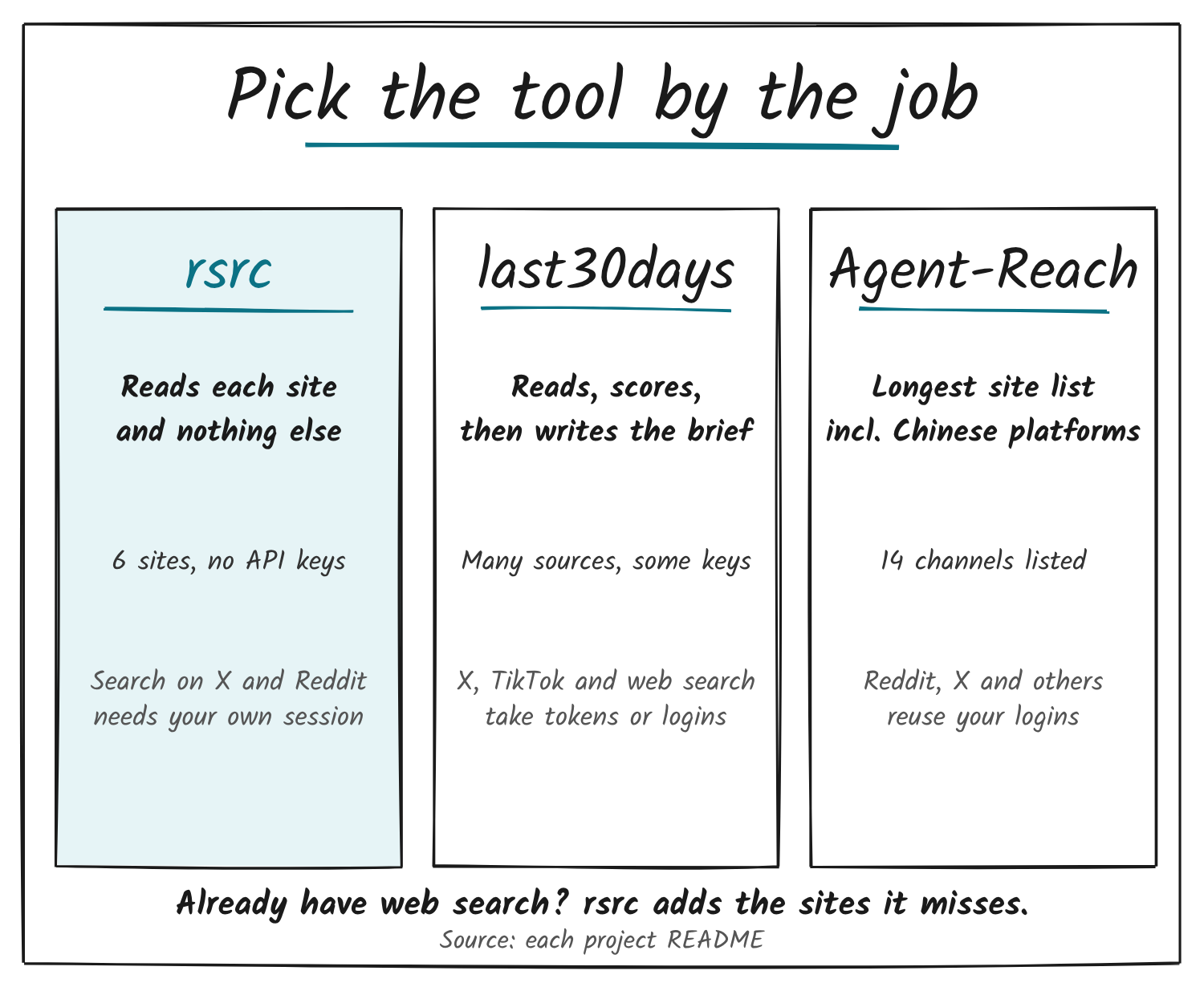
The README points to two other tools and says when to use them instead.
| Tool | What the README says it’s for |
|---|---|
| rsrc | Each site’s own results in one shape, and nothing else. Pair it with web search. |
| last30days | A finished brief: it searches many sites, scores the results and writes the report. |
| Agent-Reach | Chinese platforms such as Bilibili and Xiaohongshu, with a longer site list. |
Limits
The README says rsrc is read-only: it never posts, likes or follows. It also says rsrc reads X, Reddit, YouTube, LinkedIn and the App Store without their official APIs, that X, Reddit and LinkedIn restrict automated access in their terms, and that X or Reddit can limit an account rsrc uses. The user is responsible for following each site’s terms. It’s early software with one maintainer.
I didn’t test signed-in X search, Reddit search with Ego Lite, or any run against plain web search. The claim that rsrc finds what web search misses rests on the author’s five-topic test.