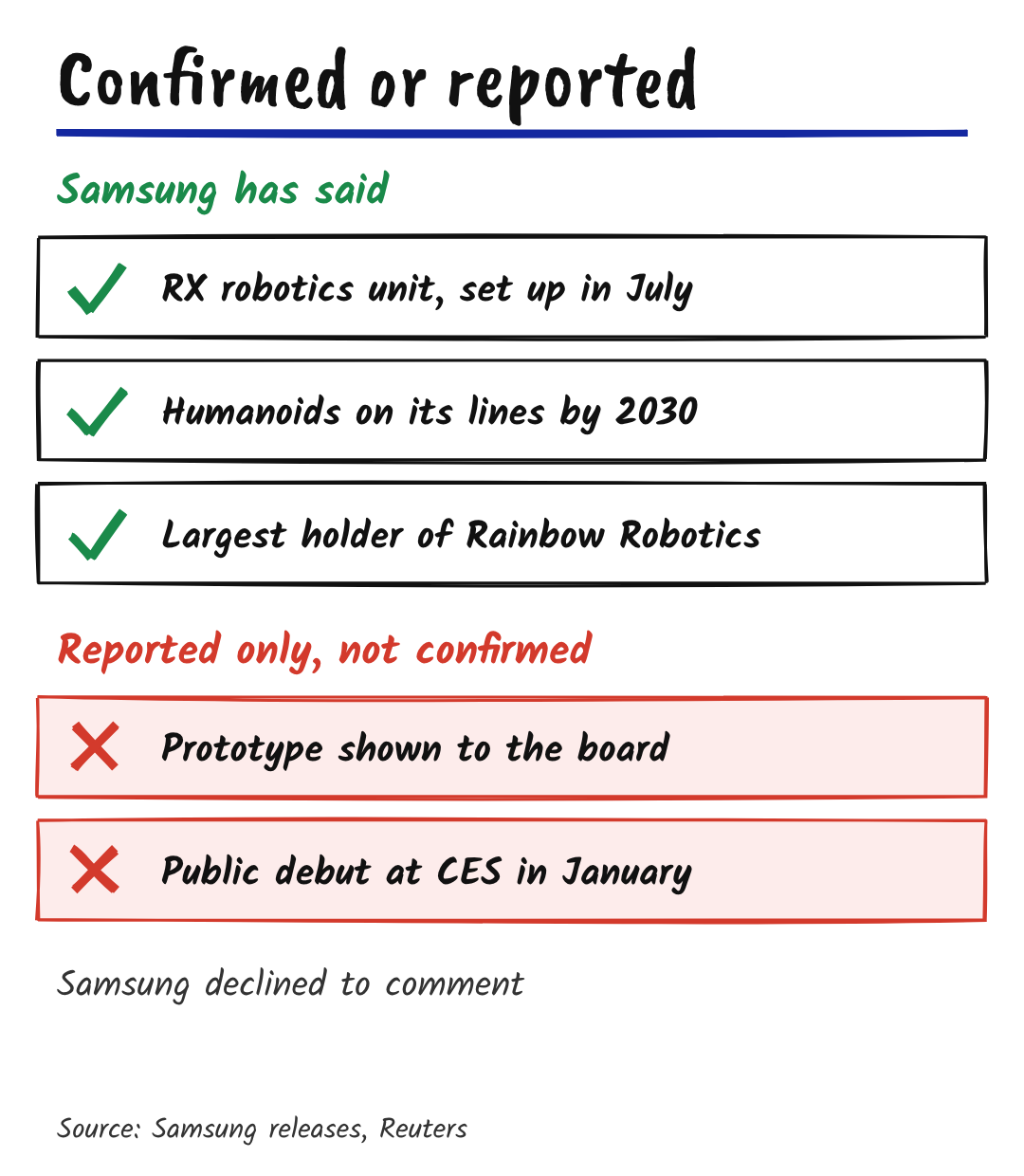
Samsung Electronics showed its first humanoid robot prototype to its board last week and plans to unveil it to the public at CES in Las Vegas in January, Reuters reports, citing a person familiar with the matter. Samsung declined to comment.
The robot comes out of a robotics push Samsung has built up over two years, and it lands in a market where Hyundai’s Boston Dynamics, Tesla, LG and the Chinese makers are already ahead on production or shipments.
What Reuters reports
The demonstration took place on Thursday at Samsung’s robotics research hub in Seoul, and Roh Tae-moon, who runs the company’s device business and its robotics unit, attended. It focused on full-body control and on the robot picking up and manipulating objects with its arms and hands, the source told Reuters. The source asked not to be named because Samsung hasn’t shown the prototype publicly.
Yonhap, citing industry officials, puts the public debut at CES 2027, which runs from 6 to 9 January. It also says industry officials believe Samsung applied the precision machining and assembly know-how from its Galaxy foldable phones to the robot’s hands. Samsung hasn’t confirmed that either.
How Samsung got here
Samsung’s own releases show how it got here. In 2023 it bought 14.7% of Rainbow Robotics, the Korean company founded by researchers from KAIST’s humanoid robot centre, for KRW 86.8 billion. On 31 December 2024 it said it would use a call option to lift that to 35%, become the largest shareholder and consolidate Rainbow as a subsidiary. The same release set up a Future Robotics Office under the CEO, headed by Rainbow co-founder Oh Jun-ho, to work on humanoids.
On 1 March this year Samsung said it would turn all its manufacturing into “AI-driven factories” by 2030, with humanoid and task-specific robots phased in across production lines for line operations, logistics and precision assembly. Reuters adds that Samsung plans a humanoid production line in Gumi, the city that houses its smartphone factories.
In July it created the Robotics eXperience (RX) division, which reports straight to Roh and covers research, long-term strategy and commercialisation. The Korea Herald reported that the division is based at Samsung’s Seoul R&D campus, with a data factory planned at Gumi and further research bases in the US, China and Japan. Lee Dong-gun, hired in May from Hyundai Motor Group, where he led robotics strategy including the direction of Boston Dynamics, runs the strategy team. On its July earnings call Samsung said it would start with business customers in manufacturing and logistics and move step by step into consumer products.
Reuters notes that Samsung said earlier this year it would consider investments and acquisitions where needed to speed up its robotics work.
Why the hands are the story
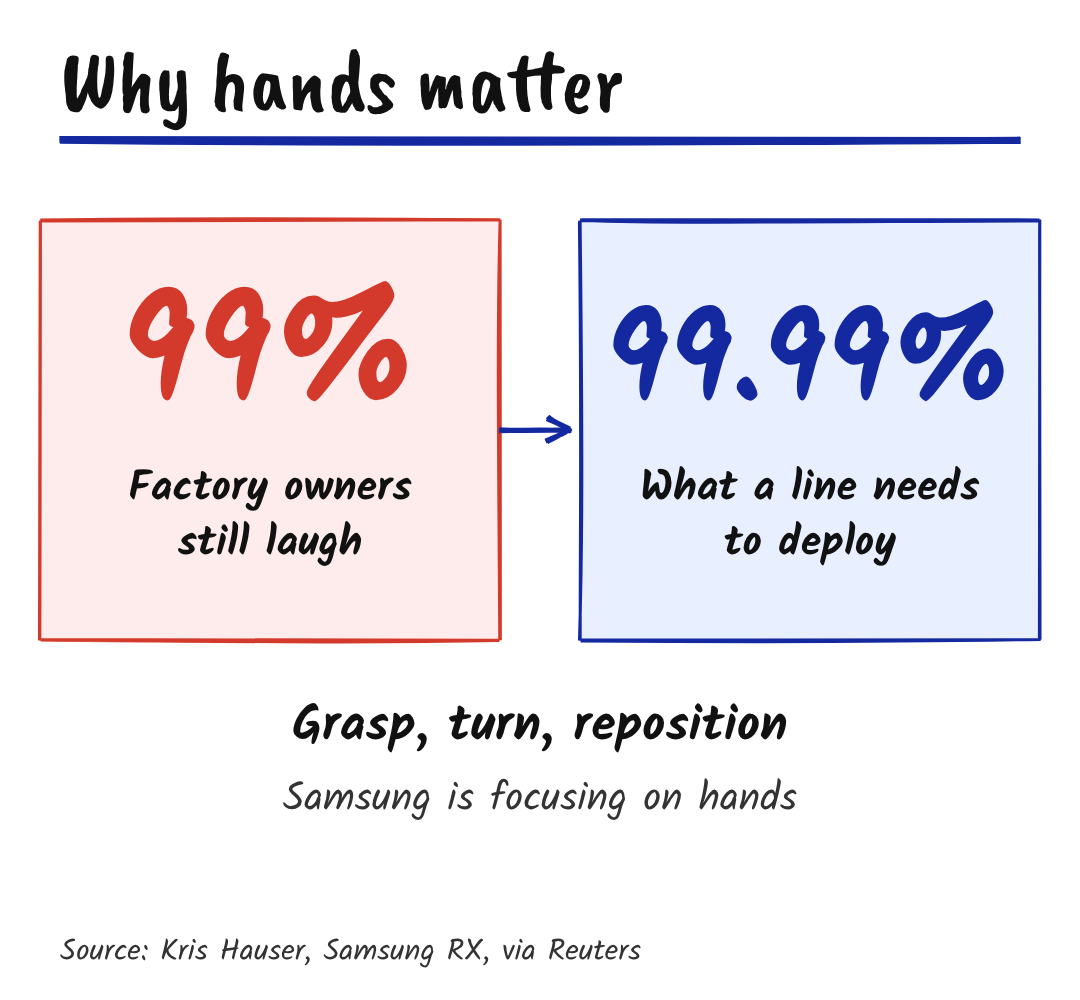
Reuters says Samsung is concentrating on hand manipulation, which it describes as a key challenge for humanoids that have to grasp, turn and reposition objects reliably on a factory line. Kris Hauser, who heads the robotics lab inside RX, put the bar plainly in September: “You go to the factory owner and you say that your robot acts with a 99% success rate, they’re still going to laugh because it has to be at a 99.99% success rate for them to actually deploy it on their factory line.”
Hauser also said Samsung’s longer-term aim includes household robots that do chores and help older people. Yonhap frames the CES showing the same way: the global race is moving from walking and full-body movement to dexterity and finishing tasks. In an Aju Press report on that contest, an analyst says tendon-driven hands are a long-established idea, so Samsung will have to show what makes its version different.
Who else is in the race
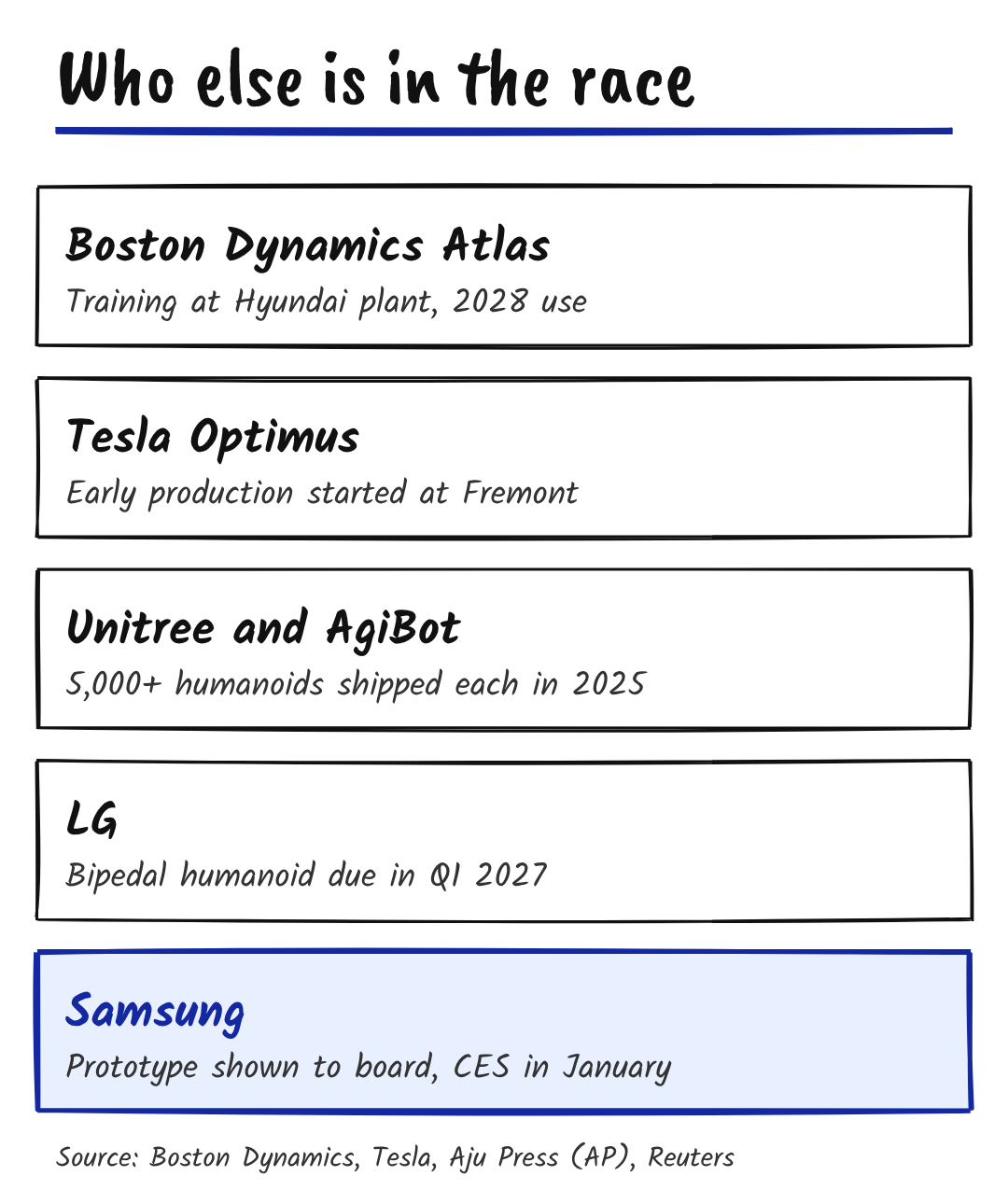
Boston Dynamics showed the production version of Atlas at CES 2026 and said its 2026 units were committed to Hyundai and Google DeepMind. Atlas is now training at Hyundai’s Metaplant in Georgia. Hyundai plans 25,000 Atlas units across its plants over the next few years and a US factory that can build 30,000 robots a year, and GlobalFoundries will test Atlas in semiconductor manufacturing from early 2027.
Tesla said in October that early Optimus production has begun at its Fremont factory. LG has said it will unveil a bipedal humanoid in the first quarter of 2027 on Nvidia’s Isaac GR00T model and Jetson Thor platform; it didn’t name CES. Chinese makers lead on volume: Unitree and AgiBot each shipped more than 5,000 humanoids in 2025, out of about 15,000 worldwide, according to figures The Associated Press reported.
The US adds a regulatory hurdle. Aju Press reports that since 28 July the Federal Communications Commission has restricted new equipment authorisations for foreign-made advanced robotic devices, including covered humanoids built in South Korea, unless they get conditional approval. Samsung wants to show the robot to a Las Vegas crowd, so the rule applies to it directly.
What to watch
- Whether Samsung confirms the CES plan and shows the robot working, not only standing on a stage.
- What its hands can do, and whether the foldable-phone engineering shows up in how they’re built.
- Whether Rainbow Robotics, which isn’t taking its own CES booth and will sit in a government-organised pavilion, features in the reveal.
- Any move on the acquisitions and investments Samsung said it would consider.
Sources: Reuters, Yonhap, Samsung on Rainbow Robotics, Samsung on AI-driven factories, The Korea Herald, Aju Press, Boston Dynamics, The Robot Report.