

OpenAI has a published US patent application for an earbud that works out which words you’re mouthing without a sound. It senses how your ear canal moves, or changes shape, as your jaw forms each word, then turns that into text, a command or speech. The application, US 2026/0369273 A1, is titled “In-Ear Silent-Speech Detection System”, and the US Patent and Trademark Office published it on 19 November.
Here’s what the filing covers, how the sensing would work, where the words could go, and how it sits beside Apple’s filing of the same day and a tooth-mounted sensor from ETH Zurich.
What OpenAI filed
OpenAI OpCo, LLC is the applicant. The named inventors are Douglas Stuart Brodie and Daniel Boothe. A provisional application went in during May 2025 and the full one a year later. There are 20 claims, with independent claims 1 and 10.
The idea rests on anatomy. The joint that hinges your jaw to your skull sits right beside the ear canal, so when you mouth a word the canal moves and flexes. The earbud picks up those small movements and works out which sounds and words you meant, with no audio at all. The words needn’t be perfectly silent either. The description covers speech quieter than about 30, 20 or 10 decibels.
Two ways to read the ear
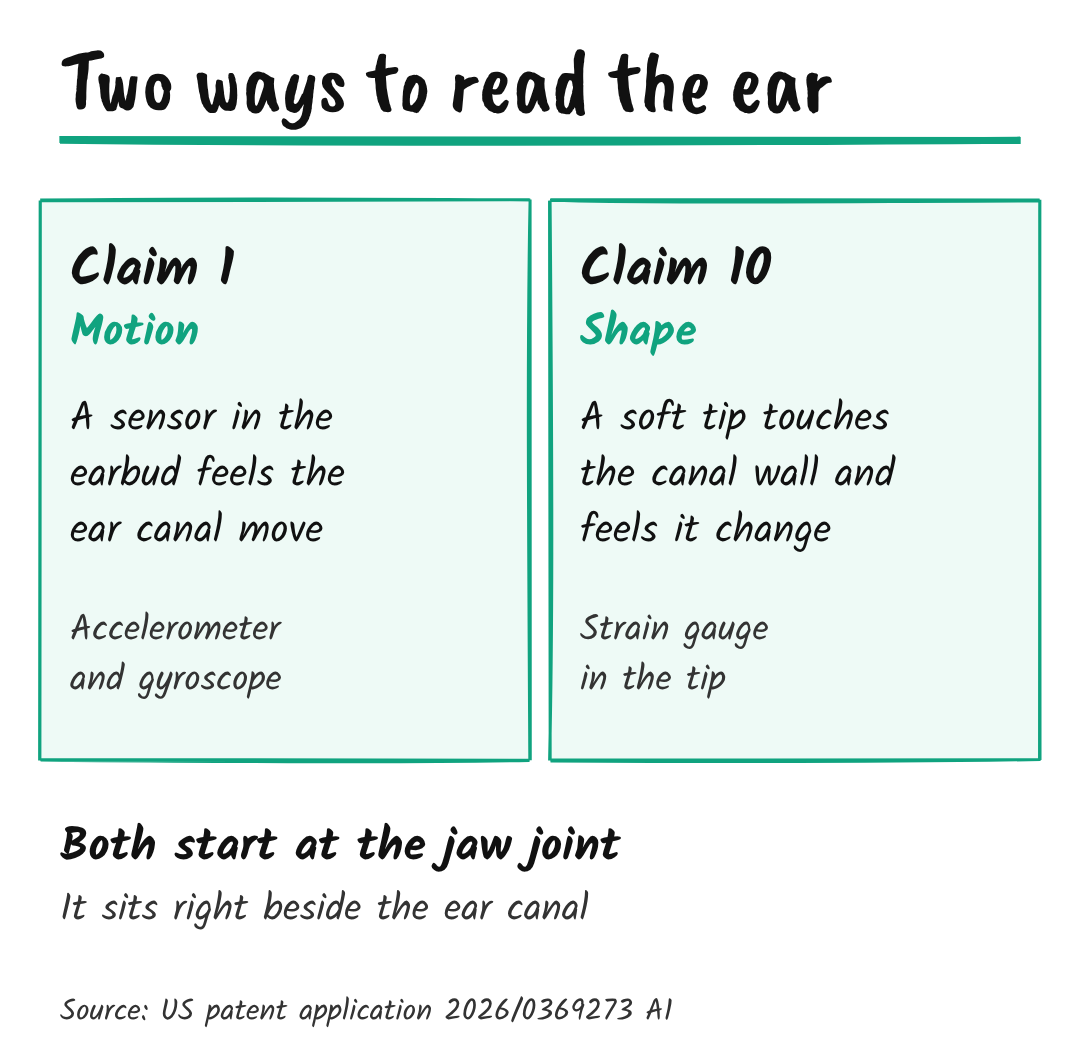
Claim 1 covers motion. A body sits at least partly in the ear canal, and a sensor inside it detects the canal moving while the wearer mouths words. The description names accelerometers, gyroscopes and magnetometers. One example pairs a 3-axis accelerometer with a 3-axis gyroscope, sampling between about 100 and 1,000 times a second.
Claim 10 covers shape. A soft tip, made from something like silicone or foam, presses against the canal wall, and a sensing element attached to it detects the surface changing shape. The claims single out the strain gauge as the example. That same soft tip can seal the canal, which lets a pressure sensor watch the air as the mouth and tongue move.
The description also lists more sensors that could sit in or near the ear, including bone conduction microphones, pressure sensors, electrodes for muscle activity, and sensors for temperature and blood flow.
From mouthed words to an action
The description walks through four stages. Sensors read the movement, and a processing stage cleans up the signal. A machine learning model then matches it to phonemes, the building blocks of speech, or to whole words. Last, an application layer decides what to do with the result. For English, the example model outputs a vector of 44 entries, one for each phoneme.
Training can be personal. Claims 9 and 16 cover a model trained on the wearer’s own mouthed training words, and the description says the pipeline can be tuned to a particular user.
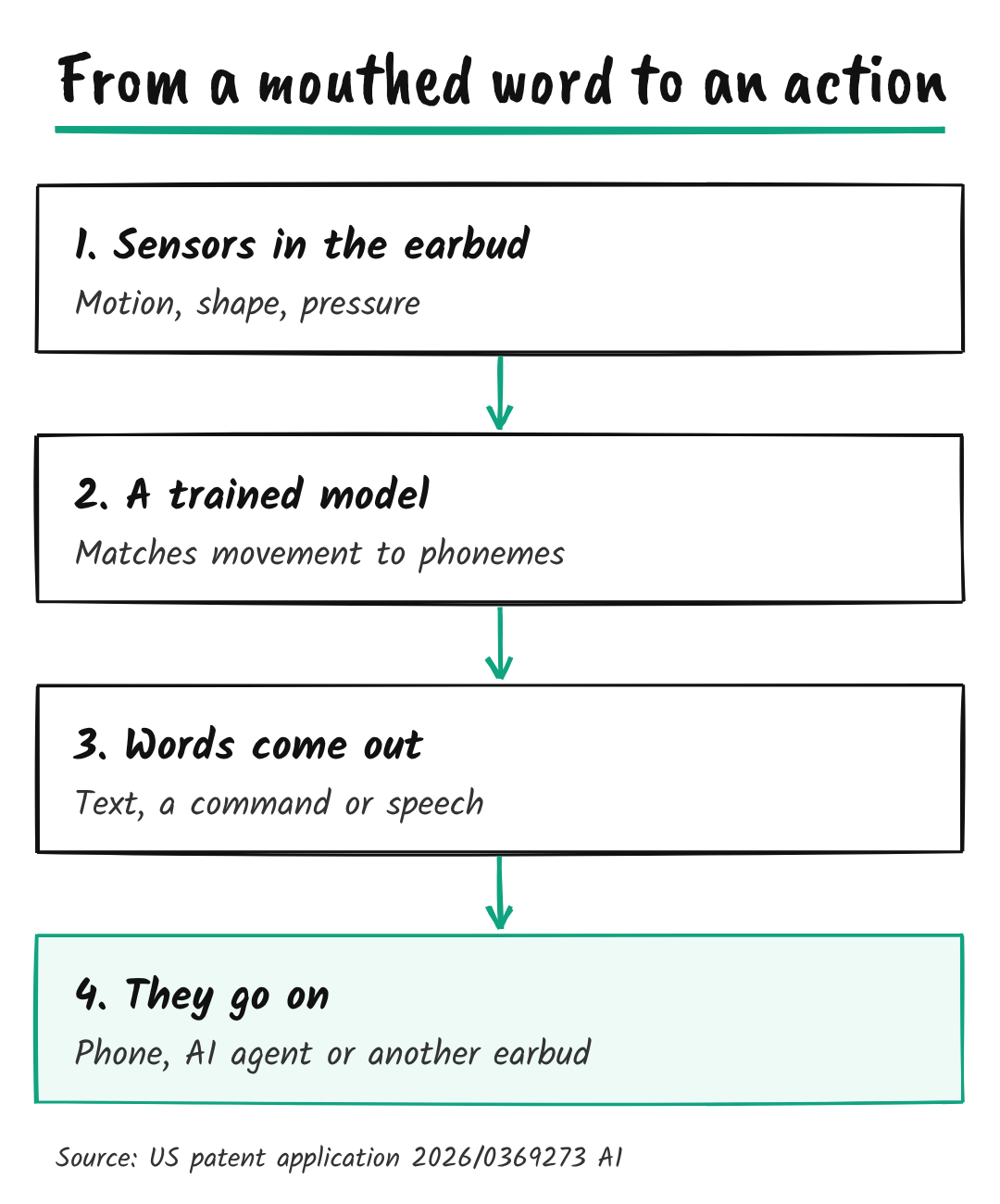
The last stage is where the filing reaches past earbuds. A phrase such as “call XYZ” becomes an instruction to place a call. Large language models can pull intent out of the text, and agents can compose messages, update schedules, query databases, generate documents or navigate interfaces. Those uses sit in the description rather than the claims.
Two wearers could also talk without a sound. Because earbuds are largely silent to bystanders, the filing says a communication system built on them could keep conversations private and work where speaking aloud isn’t practical. Claims 18 to 20 add a microphone, which can be a bone conduction one, for quiet spoken speech below about 30 decibels.
How others are doing it
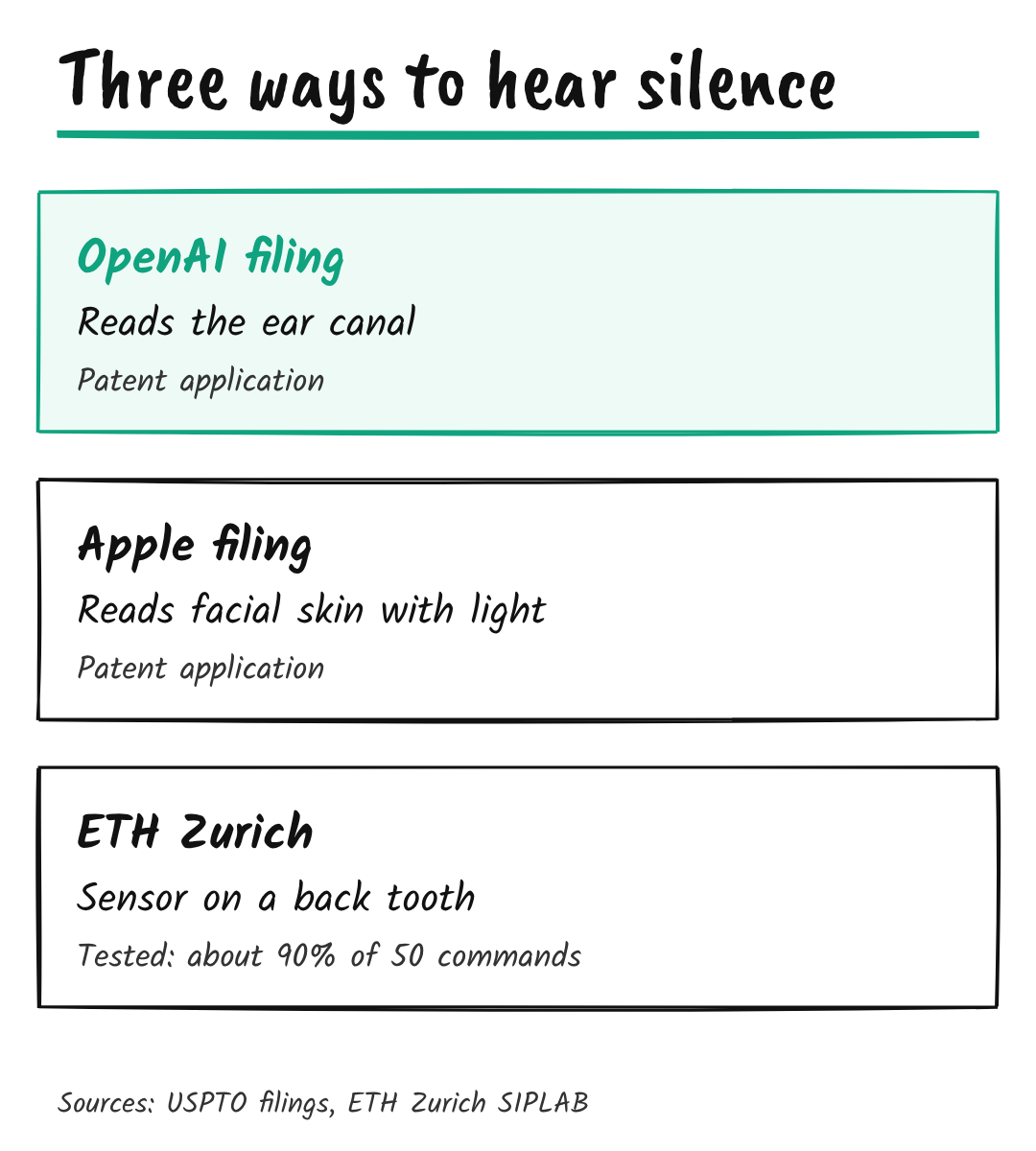
Apple’s application, US 2026/0369274 A1, came out the same day. It describes a head-worn system for silent conversations that reads facial skin micromovements from reflected coherent light, and it names a large language model as one possible participant in a conversation.
ETH Zurich researchers have built InvisiSpeech, a sensor that sits between a back molar and the cheek and picks up vibrations from the tongue. Robotics & Automation News reports that in tests with 15 participants it recognised about 90 per cent of 50 preset English commands after a short calibration.
The field is older than any of these. EchoSpeech, presented at CHI 2023, uses inaudible sound waves from glasses frames to read skin movement. In a study with 12 participants it recognised 31 commands with a 4.5 per cent word error rate. MIT’s AlterEgo is a head-worn system with electrodes on the face. Putting the sensor in the ear is the filing’s angle, and it sits where people already wear audio hardware.
What to watch
- Whether the USPTO grants the application, and with which claims.
- Whether the claims, which name only motion and shape sensing, widen to cover the language model and agent uses in the description.
- ETH Zurich’s push from preset commands to open conversations with AI.
Sources: US 2026/0369273 A1, US 2026/0369274 A1, Robotics & Automation News, EchoSpeech, CHI 2023.
Disclosure: I’m an OpenAI, Firecrawl and Devin ambassador.