
OpenRouter’s model pages now open Tencent’s HY-World Panorama output in an interactive viewer, so you can drag around a full 360° by 180° scene instead of squinting at a stretched strip. The model itself has been on OpenRouter since 13 November. It takes a text prompt and returns one panorama, at about US$0.77 an image.
I went through OpenRouter’s model page, Tencent Cloud’s pricing and API docs, and the HY-World 2.0 paper and code to see what the model is, what it costs and what else is on the market.
What the viewer adds
A panorama is awkward to judge as a flat image. OpenRouter’s post says the viewer lets you look around the scene, and a follow-up in the same thread lists two tools beside it. Inspect zooms into the full-resolution image. Seam check shows where the left and right edges wrap round and meet.
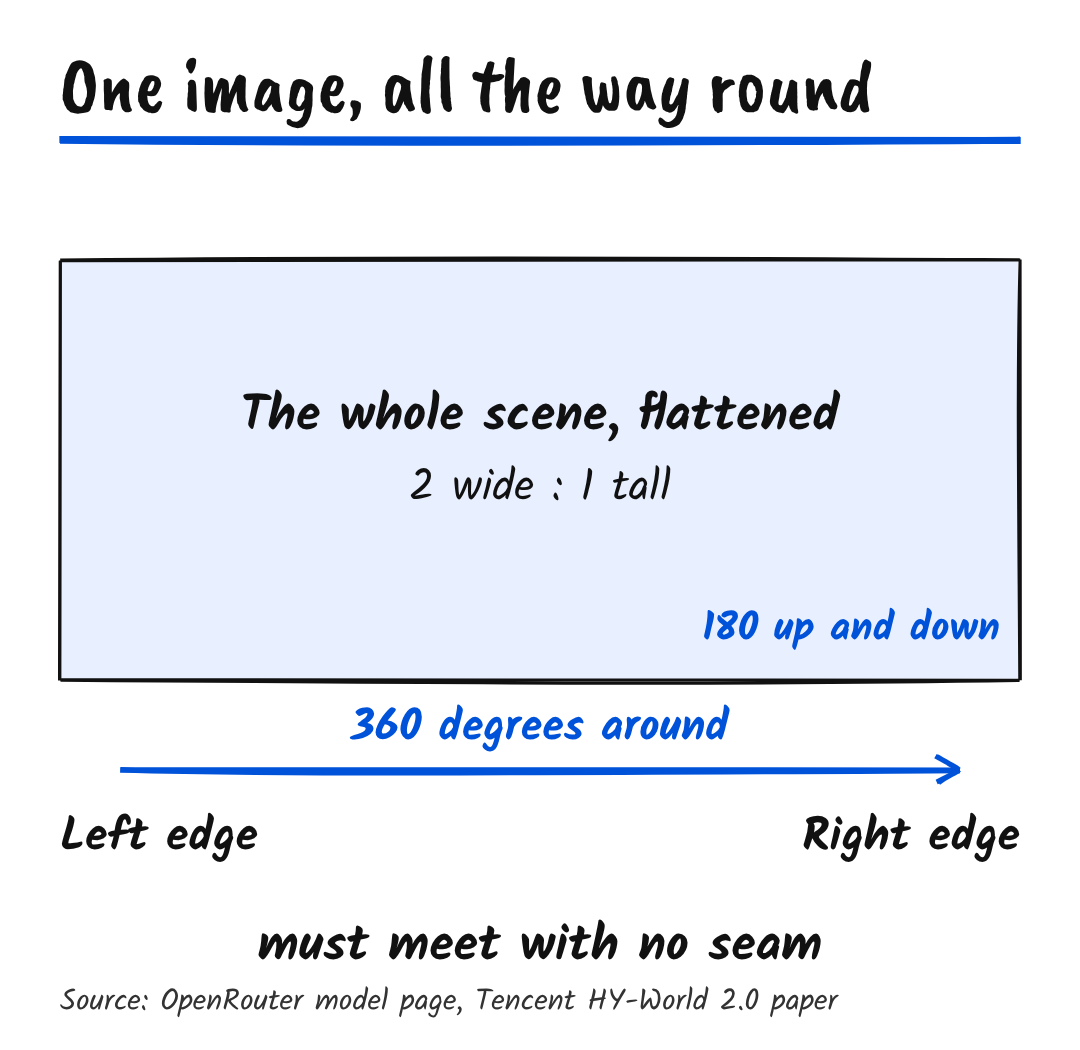
The seam is the useful one. A panorama that looks fine in a flat preview can still show a visible join once it’s wrapped into a skybox or a headset. The demo on the page, a snowy storefront at blue hour, took 97 seconds and US$0.77 to generate, according to OpenRouter.
What I ran and what I didn’t
I didn’t generate a panorama myself. Generating needs an OpenRouter account and credits, and I don’t have either, so the price and timings in this piece are OpenRouter’s and Tencent’s, not mine. I did open the model page, where the example loads with a “Drag to look around” prompt, plus Download and Full size buttons, and a Sign in to generate button in place of the run button. I haven’t judged output quality, and nothing here rates how good the panoramas look.
What the model does
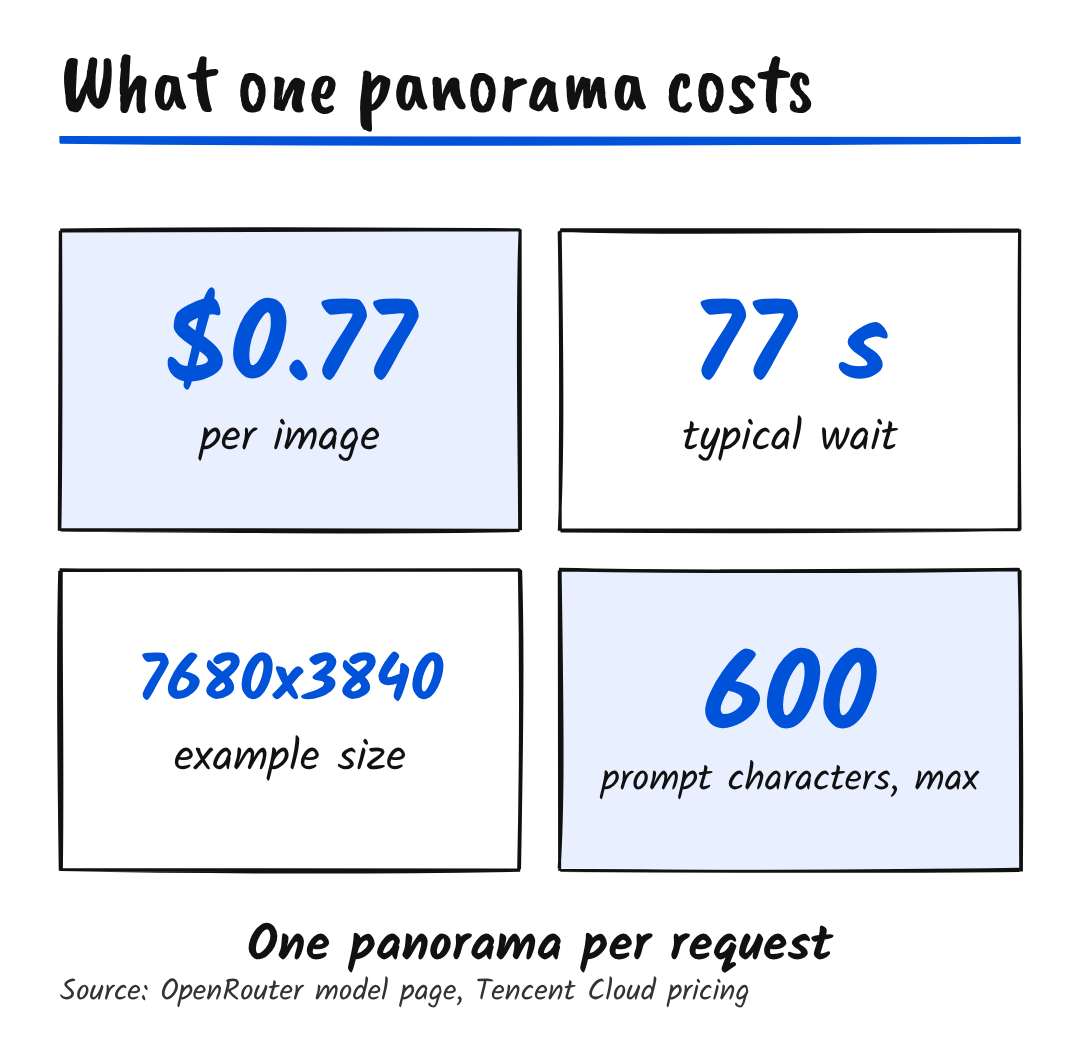
OpenRouter lists it as tencent/hy-world-2.1-panorama, served by Tencent Cloud as the only provider. You send a prompt of up to 600 characters and get back one equirectangular panorama, which is the flat 2:1 layout used for 360° images. The example on the page is 7680 by 3840 pixels. OpenRouter’s request takes a prompt only. Tencent’s own API also accepts reference images, but OpenRouter’s page doesn’t list that field.
Price, speed and size
OpenRouter shows US$1.60 per million tokens with no markup on Tencent’s price. Tencent’s pricing page turns that into a flat charge: one panorama uses 481,250 tokens, which comes to US$0.77. OpenRouter’s median end-to-end time is about 77 seconds, and the call is synchronous, so the image comes back in the same request. You can ask for a signed URL that lasts 24 hours or for the bytes inline.
Where it sits in Tencent’s world model
The panorama is the first stage of HY-World 2.0, Tencent Hunyuan’s text-to-3D-world system, described in a paper from April. The stages run in order: generate a panorama, plan a camera path through it, fill in views along that path, then reconstruct a navigable 3D scene as Gaussian splats or a mesh. Tencent’s repository frames this against video world models, which produce clips that vanish when playback ends. Our Genie 4 piece covers the video side.
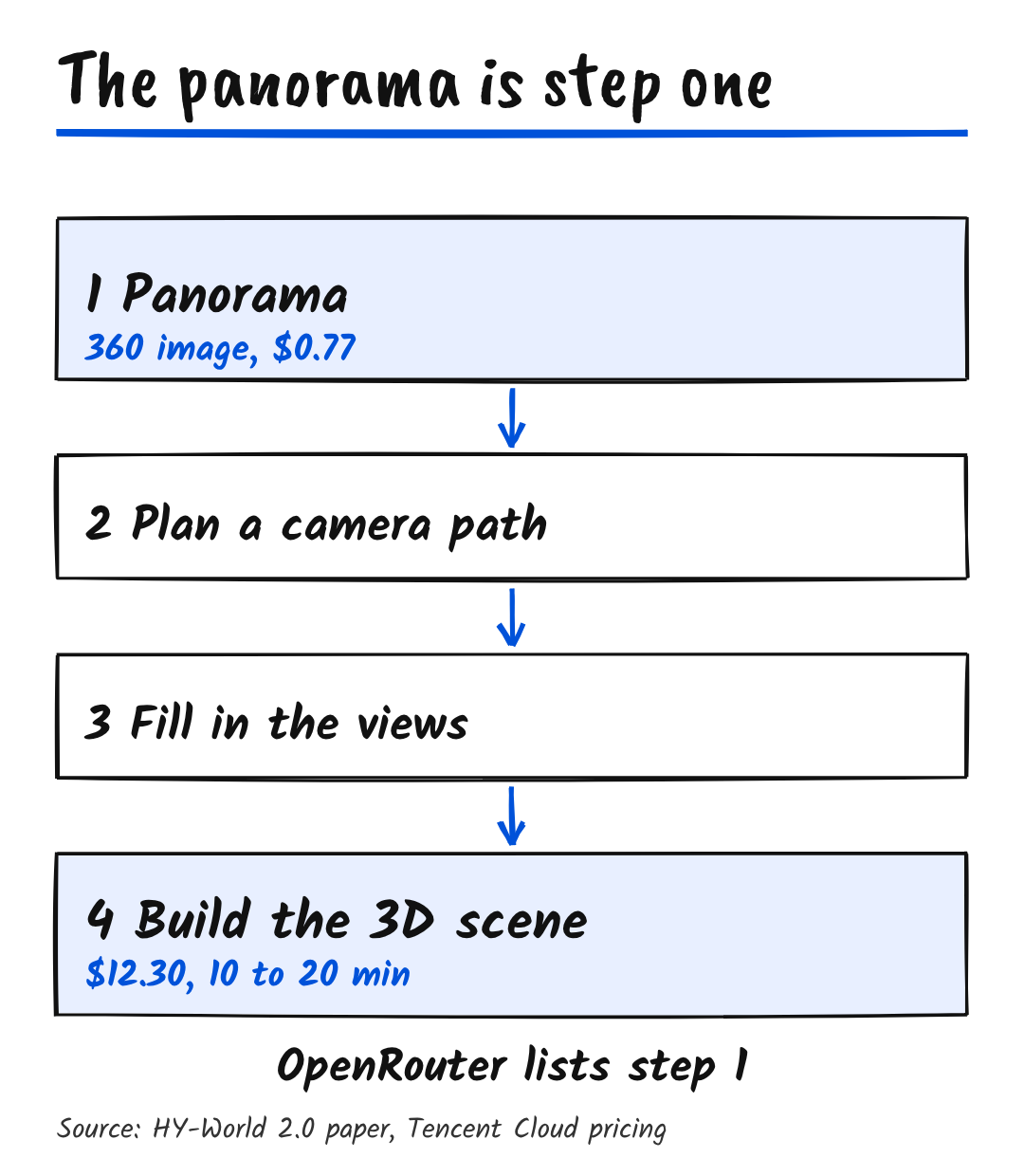
Tencent sells the last stage too. Its HY-World 2.1 scene model costs US$12.30 a scene on Tencent Cloud, and Tencent says a scene takes 10 to 20 minutes through an asynchronous API. OpenRouter’s Tencent list carries the panorama model, not the scene one.
The paper says the panorama stage handles the seam in two places. It pads the latent image circularly so the model sees the wrap-around while it generates, then blends pixels along the equirectangular edges when it decodes. That’s the join the new Seam check lets you inspect.
What’s open
Tencent open-sourced HY-Pano 2.0 on 11 May. The Hugging Face release has two versions: a model of about 80 billion parameters built on HunyuanImage-3, and a roughly 425 million parameter LoRA that runs on Qwen-Image-Edit. The model zoo lists HY-Pano 2.0 only. The 2.1 model that OpenRouter serves isn’t in it, so its weights aren’t published there. Tencent’s July README note says only that HY World 2.1 is updated and points to its product page.
How the paper rates it
These are Tencent’s own tests of HY-Pano 2.0, not of the OpenRouter model. For text-to-panorama it compared against DiT360, Matrix3D and its own HY-World 1.0. HY-Pano 2.0 scored highest on CLIP-T, which measures how well the image matches the prompt, at 0.258 against 0.250 for HY-World 1.0. It led most of the Q-Align quality and aesthetics columns but not all of them: HY-World 1.0 scored higher on equirectangular quality (4.493 against 4.403) and on perspective aesthetics (3.404 against 3.376). For image-to-panorama it ranked first on all five measures.
How it compares
Two products already sit close to this. Blockade Labs’ Skybox AI generates 360° skyboxes and HDRI lighting from a prompt, and World Labs’ Marble builds whole 3D worlds from text, images, video or an existing panorama. They bill differently, so a per-image price comparison doesn’t hold up.
| Product | What you get | How you pay |
|---|---|---|
| HY-World 2.1 Panorama (OpenRouter) | One text-to-360° image, 7680 by 3840 in the example | About US$0.77 per image, pay as you go |
| Skybox AI (Blockade Labs) | Skyboxes up to 16K on Model 3 and 4K on Model 4, plus HDRI and edit tools | From US$24 a month per seat, credit-based; Model 3 takes about 15 seconds |
| Marble (World Labs) | A persistent 3D world, with splat and mesh export; text input makes a panorama first | From US$20 a month; a text-to-world run costs 1,580 credits of 20,000 |
The difference is the unit you buy. HY-World Panorama sells a single image by the call, with no subscription. Skybox AI and Marble sell workflows, with editing, export formats and, for Marble, a 3D world.
What to watch
- Whether OpenRouter adds the reference-image input that Tencent’s own API already takes.
- Whether the scene model follows the panorama model onto OpenRouter.
- Whether Tencent publishes the 2.1 weights or panorama scores for 2.1, since the published results are for 2.0.
Sources: OpenRouter on X; OpenRouter model page; Tencent Cloud model pricing; Tencent Cloud Hy World API guide; HY-World 2.0 paper; HY-World 2.0 on GitHub; Blockade Labs docs; Marble pricing; World Labs API pricing.