
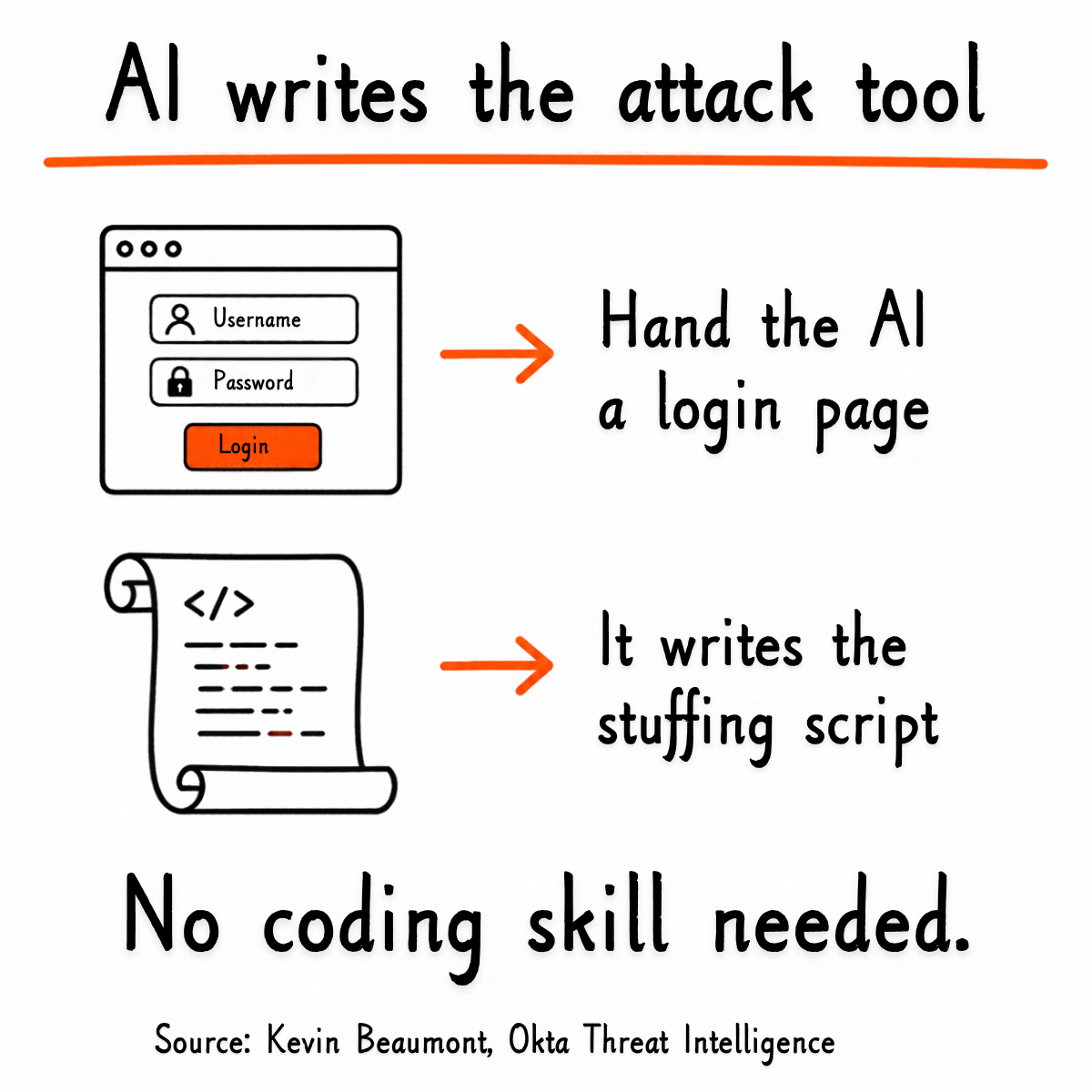
Kevin Beaumont, the security researcher who posts as GossiTheDog, has warned defenders that attackers now get generative AI tools to write credential stuffers, and then scripts that harvest account information once the login works. His point is how little effort it takes: you hand the AI a login page.
He says plenty of organisations are being caught out by what he calls “shite tier attackers”, because they had nothing real in place to stop credential stuffing. Some only find out when the flood of logins knocks the service offline and they mistake it for a DDoS attack.
Beaumont’s post is an observation from the field. It names no victims, no tools and no incident counts. So I went to the people who measure this: Okta’s threat team on AI and the credential stuffing trade, Verizon’s breach investigators on how common the attacks are, OWASP and NIST on defences, and the regulators who’ve dealt with 23andMe, PayPal and Roku. His advice holds up. The AI part matches what Okta is seeing, with one limit that matters.
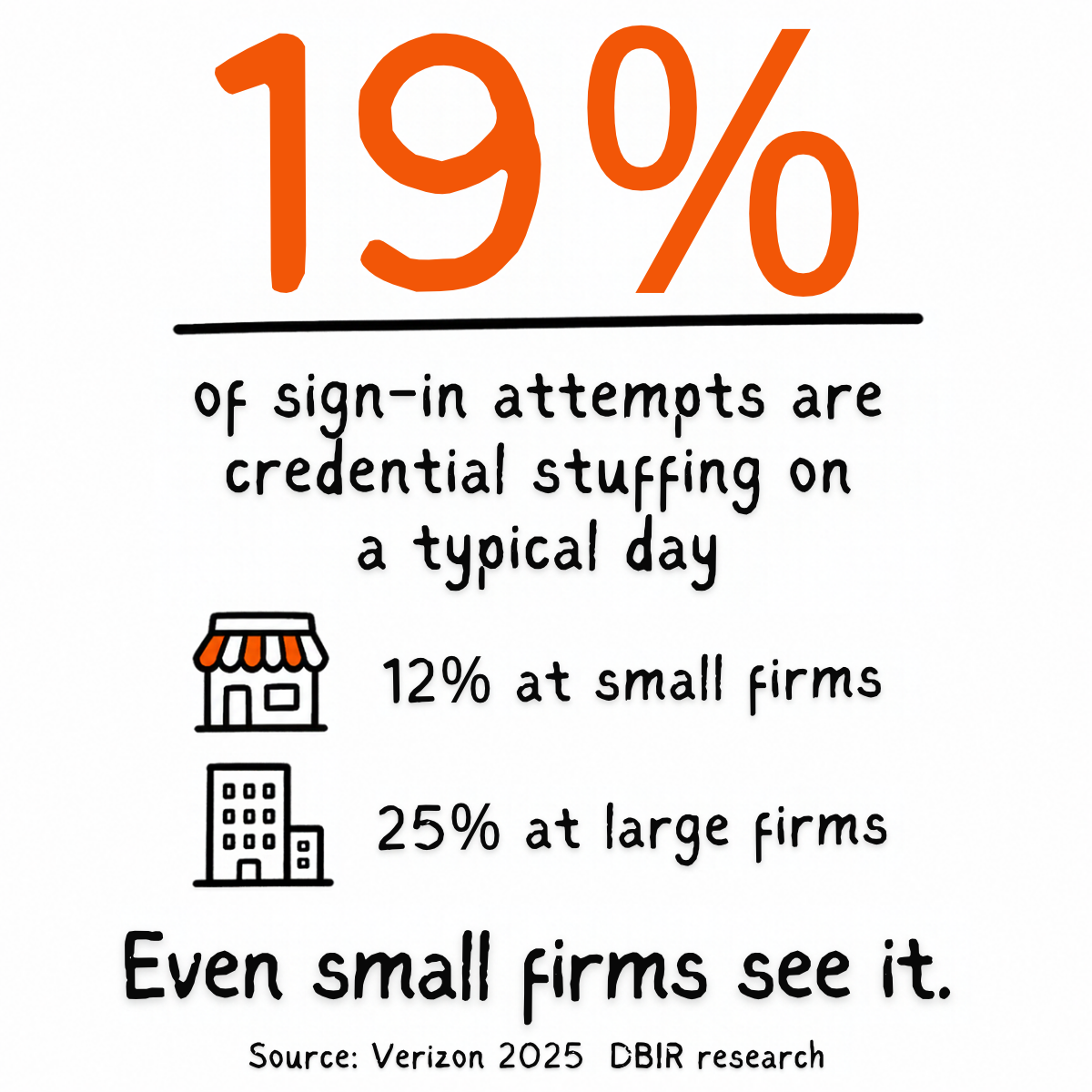
19%
Median daily share of sign-in attempts that are credential stuffing, across 2,301 organisations in Verizon’s analysis
22%
Breaches in Verizon’s 2025 report that started with compromised credentials
US$22
Average price of an attack config file from one vendor Okta tracked
How credential stuffing works
OWASP defines it as the automated injection of stolen username and password pairs into login forms. It works because people reuse passwords. Verizon’s infostealer data shows that, in the median case, only 49% of a person’s passwords across different services are distinct from each other. One old breach becomes a key to accounts elsewhere.
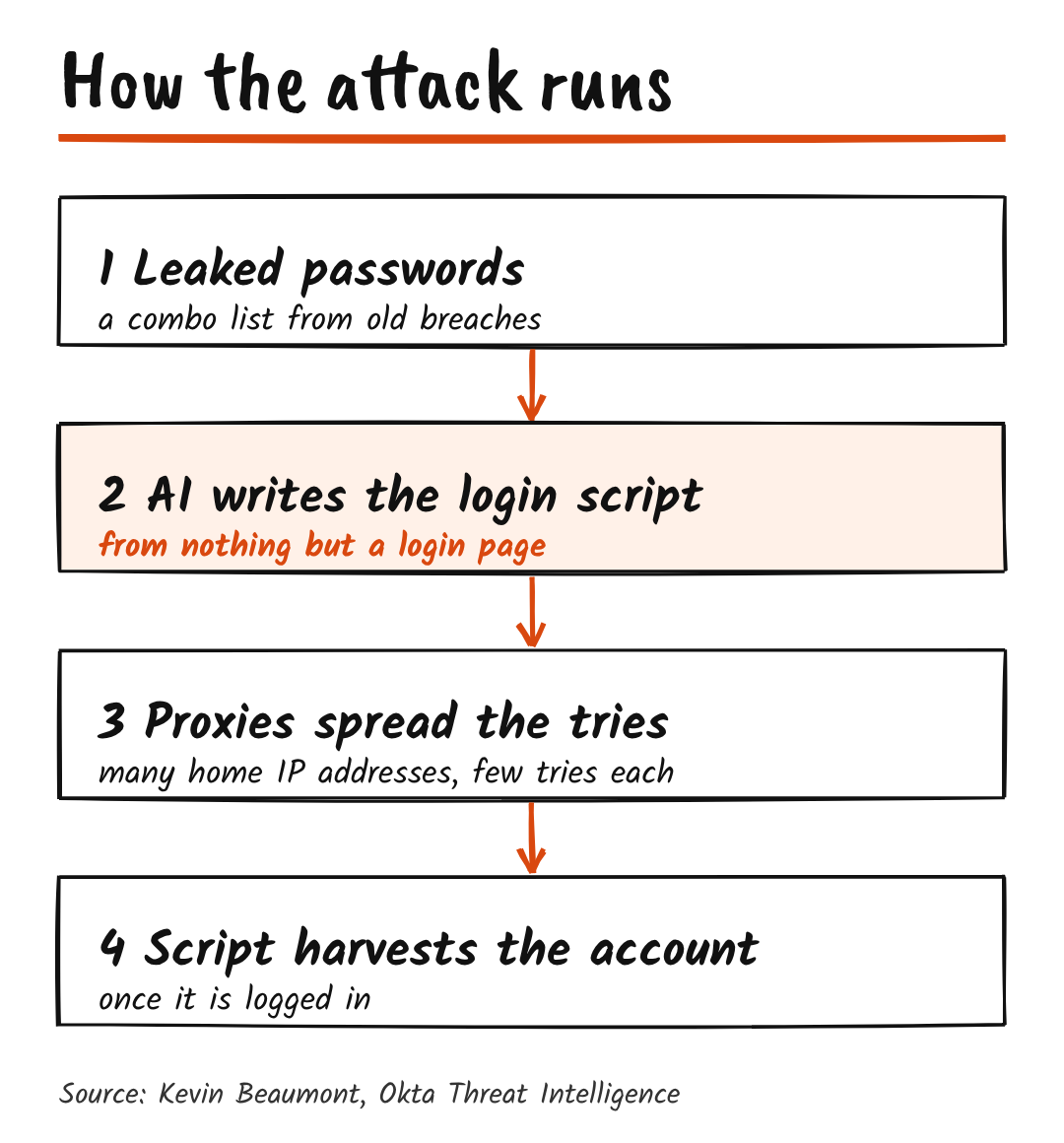
The trade is mature. Okta Threat Intelligence describes four standard parts: an open-source checker such as OpenBullet 2, config files that tell it how a given site’s login works, combo lists of leaked credentials, and proxy networks that spread the attempts across many IP addresses. Successful logins land in a results database. Some configs are sold as “full capture”, meaning that after a login works the script pulls profile data, order histories and stored payment information. That’s the account harvesting Beaumont describes.
What AI changes, and what it doesn’t
The config file used to be the skilled part. Someone had to study a site’s sign-in flow and write the script, and config vendors sold the result. Okta says it has now seen AI used to write working configs. OpenBullet 2’s web client, version 2.0, includes an MCP server that lets coding agents create, edit and debug configs, and its documentation covers setup for the mainstream coding agents. Okta says the server comes with pre-written prompts and documentation of the tool’s scripting language, and that agents can quickly assess and reverse engineer a service’s sign-in flow. Its assessment is that attacks will be more frequent and hit a broader range of targets.
| Part of the attack | Before | Now |
|---|---|---|
| Config file for a target site | Written by skilled attackers and sold, US$5.99 to US$59.99 from one vendor | An AI coding agent can write it, per Okta |
| Studying the login flow | Manual reconnaissance | Agents assess and reverse engineer it quickly, per Okta |
| Combo lists of leaked passwords | Bought, shared, or taken from breaches, infostealers and phishing | Unchanged |
| Residential proxies | Rented to spread attempts across many IPs | Unchanged |
| Why it works | Password reuse | Password reuse |
That last row is Okta’s own caveat: the AI tools it has observed don’t change the weakness that makes credential stuffing work, password reuse. They scale the reconnaissance and resource-gathering stages. Okta describes AI writing the config files. Beaumont goes a step further and says it writes the harvesting scripts too, and that step rests on his observation alone. Okta’s conclusion is that the durable fix is on the account side: passkeys.
Why a flood of logins looks like a DDoS
Beaumont says organisations are learning about the attack when their service goes offline. The traffic profile explains why. Okta recently watched an attack that used more than 800,000 residential IP addresses over six hours, with the median address making only 20 attempts before it was rotated out. Attackers can choose exit nodes by country, city or even ISP so the logins look local to the account. Residential addresses often have no history of abuse, which blunts IP reputation blocklists.
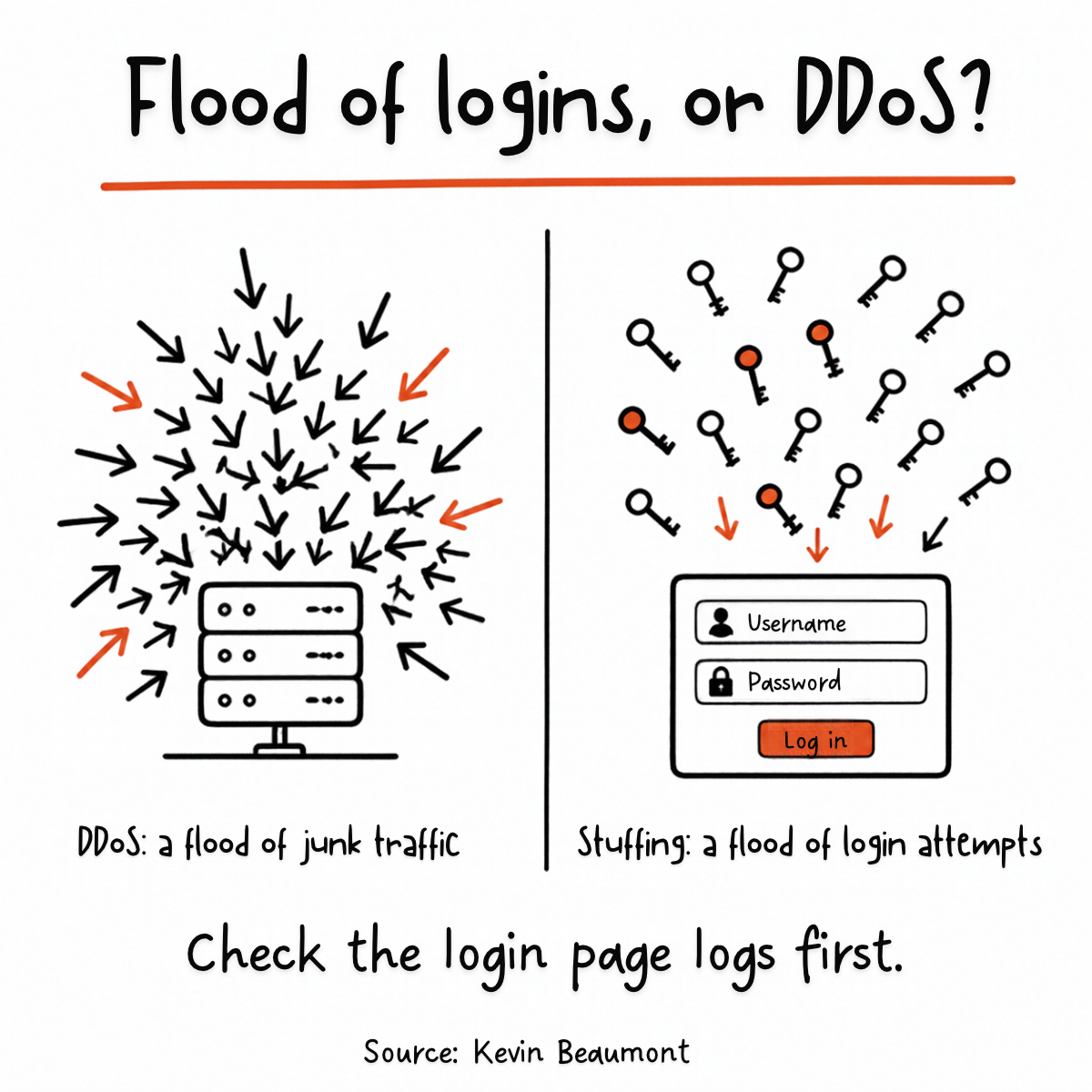
Verizon’s DBIR research adds the other half. Each try authenticates once against a given account, and headers can be varied, so the attacks hide among normal sign-ins. In SSO provider logs from 2,301 organisations, credential stuffing made up a median 19% of daily authentication attempts over two years. Small organisations saw about 12%, enterprise-sized ones up to 25%, and the worst single day hit 44%.
What it has cost
Credential stuffing rarely gets billed as an attack. Push Security has noted that victims prefer to describe a sophisticated intruder rather than admit the entry point was this basic. The regulators’ own findings tell it plainly.
| Case | What happened | What was missing | Outcome |
|---|---|---|---|
| 23andMe, 2023 | Five months of credential stuffing reached more than 18,000 accounts directly, and through linked features exposed information on nearly 7 million customers | MFA was optional and fewer than 22% of customers had opted into MFA or single sign-on. It took four days to reset sessions and about a month to make MFA mandatory | The UK ICO fined the company £2.31 million in June 2025 after a joint investigation with Canada’s privacy commissioner |
| Roku, 2024 | About 15,000 accounts, then about 576,000 more, out of more than 80 million | Roku says its own systems weren’t the source of the passwords | Fewer than 400 accounts saw unauthorised purchases. Roku reset passwords and turned on two-factor authentication for every account |
| PayPal, December 2022 | 34,942 accounts accessed over two days, with names, birth dates, addresses and Social Security numbers visible | PayPal added CAPTCHA and rate limiting only after the attack began | New York’s financial regulator issued PayPal a consent order in January 2025 |
A close cousin is the 2024 Snowflake customer campaign. Mandiant found the attackers used credentials mostly lifted by infostealer malware, at least 79.7% of the accounts had prior credential exposure, and the oldest stolen credential dated to November 2020. Those logins worked because the accounts had no MFA. It’s stolen credentials rather than stuffing against a login form, but the failure is the same.
None of this is new to regulators. In January 2022 the New York Attorney General reported more than 1.1 million accounts compromised through credential stuffing at 17 well-known companies, and published a business guide on defending against it.
What defenders can do
Beaumont’s follow-up is specific. Look for large numbers of POST requests to login pages with a 200 reply, or successful logins in the app. Baseline your login traffic: if you average 1,000 unique user logins an hour and suddenly see 50,000, something is wrong. And require MFA or passkeys, “even if it’s just an email code”.
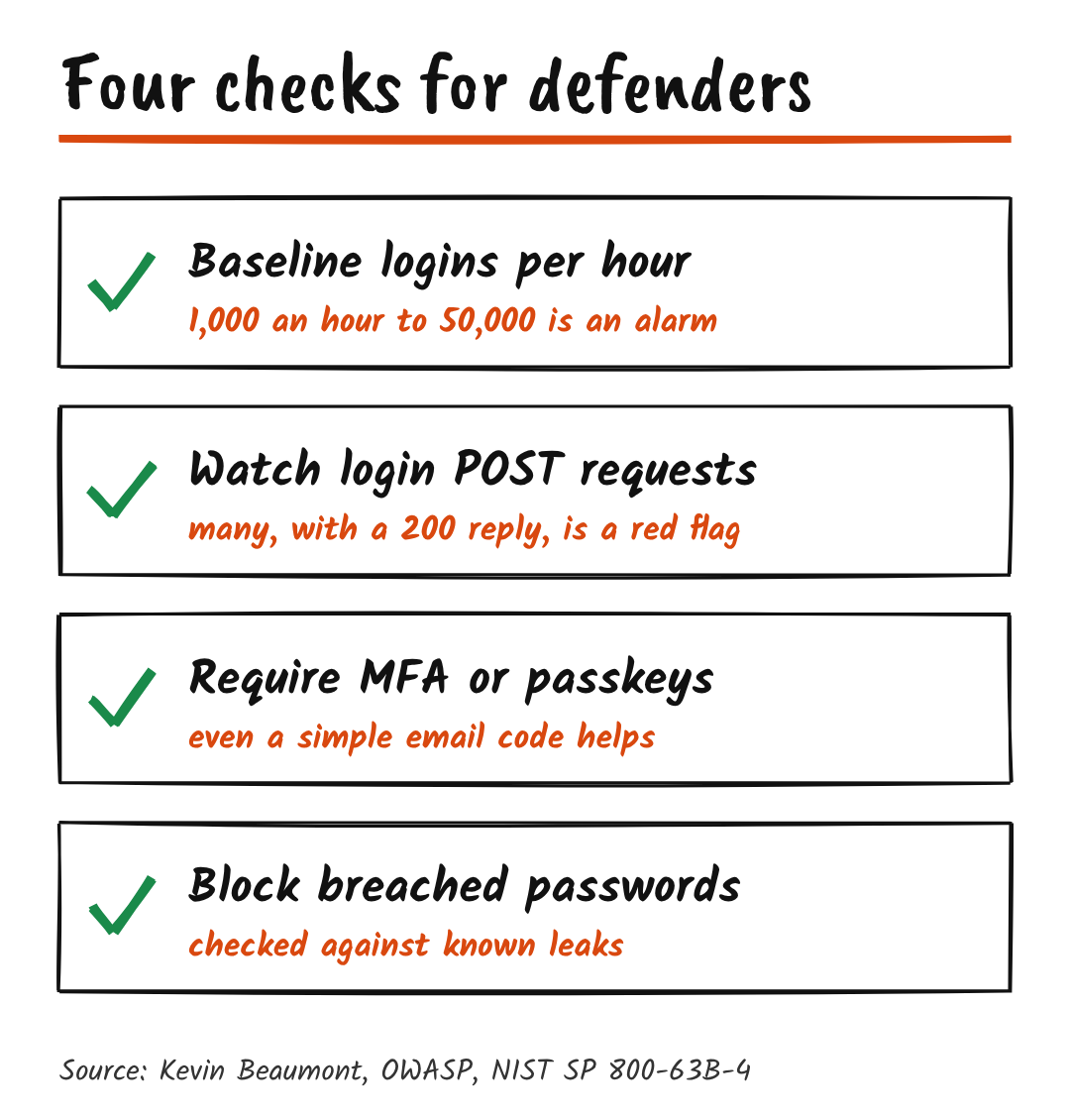
The published guidance agrees with him and goes further.
- MFA first. OWASP’s prevention cheat sheet calls it by far the best defence, and says it can be applied only when a login looks risky, such as a new device, an unusual location or scripted behaviour. Verizon calls MFA no longer a panacea but table stakes.
- Layers behind it. OWASP lists device and connection fingerprinting, multi-step logins, blocking headless browsers, unpredictable usernames and leaked-password checks. It warns that CAPTCHAs can be broken and that proxy networks defeat simple per-IP rate limits. Verizon says the same about CAPTCHAs.
- Block known-bad passwords. NIST SP 800-63B-4, final since July 2025, requires verifiers to check new passwords against a blocklist of breached, common and expected values. NIST writes for US government systems, and the guidance is voluntary elsewhere. It also states that passwords aren’t phishing-resistant.
- Passkeys where you can. Okta calls them the only durable prevention for customer identity systems, because malware can’t steal a passkey and replay it. It adds that IP and ASN blocking should be supplementary given residential proxies, that rules written only for IPv4 miss IPv6 traffic, and that unused legacy sign-in paths should be switched off.
- Have the response ready. The New York Attorney General’s guide says the most effective safeguards are bot detection, MFA and passwordless login, and that spikes in failed logins are the usual sign of an attack that got through. 23andMe’s regulators faulted the company for slow detection and slow mitigation, so write the playbook before the flood arrives.
If you’re on the other side of the login page
You can’t fix a site’s defences, but you can break the chain at the first link. Give every account its own password, which in practice means a password manager. Turn on MFA wherever it’s offered and choose a passkey when the site supports one.
What’s confirmed and what isn’t
Confirmed by primary sources: Okta has seen AI used to write credential stuffing configs, OpenBullet 2 ships an MCP server for coding agents, credential stuffing is a large share of everyday sign-in traffic, and the cases above cost real money and regulator attention. Beaumont’s claims about AI-written harvesting scripts and about organisations mistaking floods for DDoS attacks are his own observations. His posts give no named cases, and I haven’t found any organisation that has publicly tied an incident to AI-written tooling. The advice doesn’t depend on that gap: the defences are the same whether a person or an AI wrote the script.