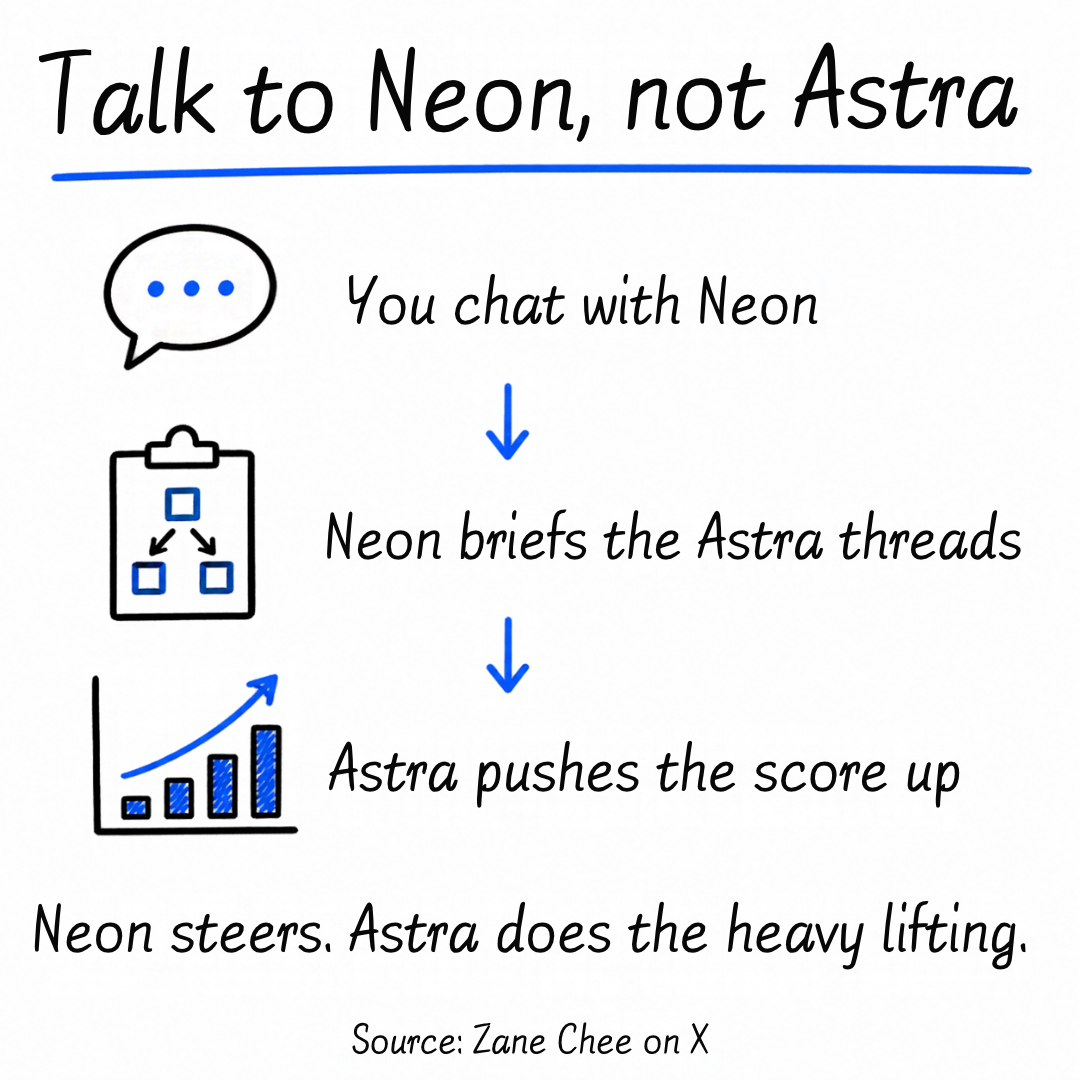
Zane Chee says the best way to use GPT-6.2 Astra is to never talk to it: you talk to Gemini 4 Neon, and Neon briefs and steers Astra threads. I ran Zane’s prompt in OpenCode on a scored task, next to each model working alone. The setup works as described. Neon splits the job into sensible Astra threads, and its check-ins are short and easy to follow. But on my task the strongest models finished within a hair of each other, with or without the pairing, so it added no score. Zane’s condition for the pairing is a measurable outcome, and my task was measurable, but it had little room to climb.
Disclosure: I’m an OpenAI, Firecrawl and Devin ambassador.
What Zane Chee says
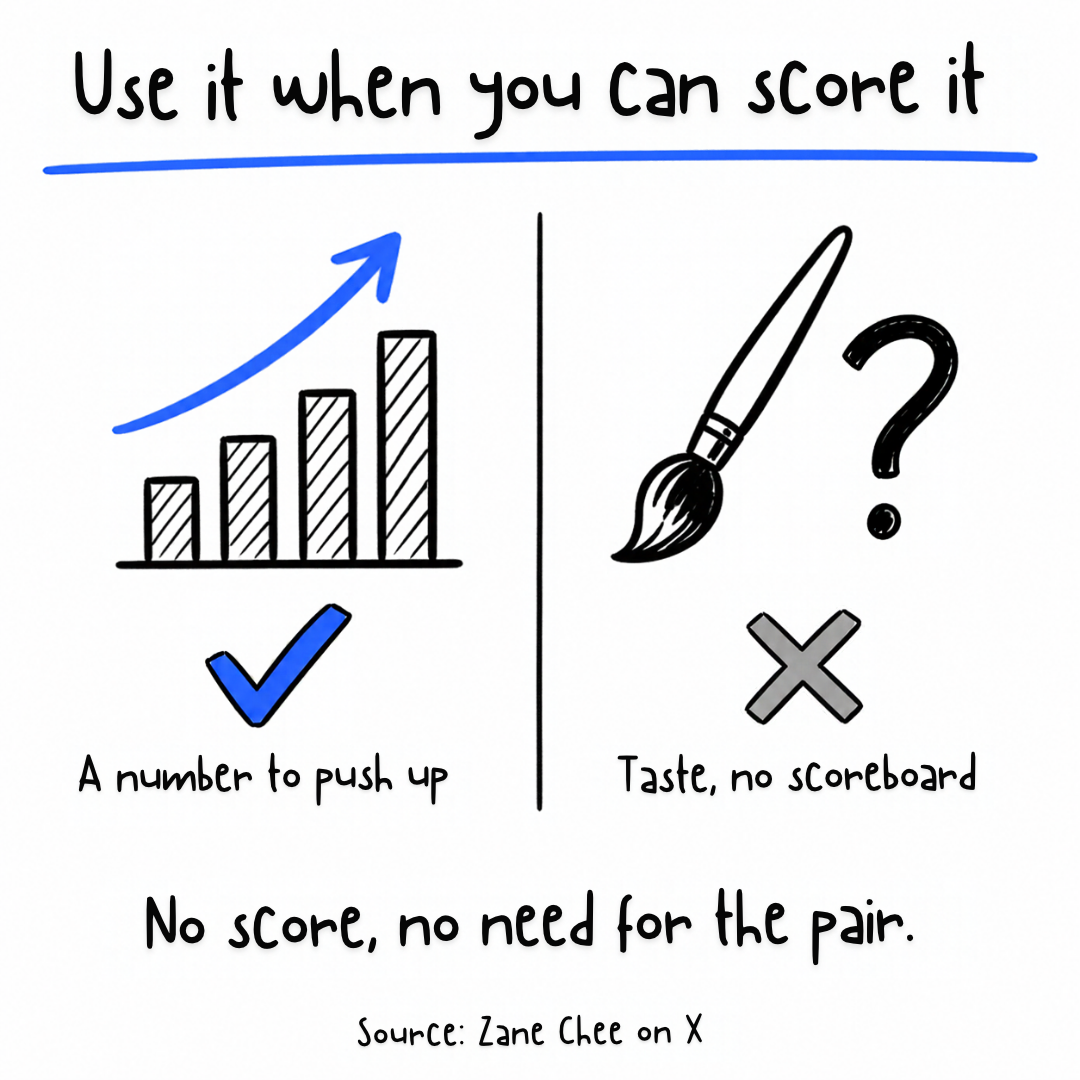
Zane, who is linked to Cua and describes themselves as an OpenAI Codex ambassador, published the article “Astra is a superhuman model in the hands of Neon”. Their one-line summary is that if your outcomes are clearly measurable, Astra is better used with Neon than on its own. Zane picks Neon for the conversation because it’s the model they find most readable and coherent, and lets it control the model they think is most capable.
The recipe is two prompts, which Zane ran in T3 Code. This is the first, with Zane’s placeholder for the thing you’re improving:
Let's hillclimb on this <url>. Spin up 6.2 Astra threads and act as their orchestrator, using an automated check-in through which you can communicate with me in intervals. Before you begin, ensure that the eval we are hillclimbing against is sound, and make sure to steer Astra when neededThe second is one sentence that adds a thread for long shots:
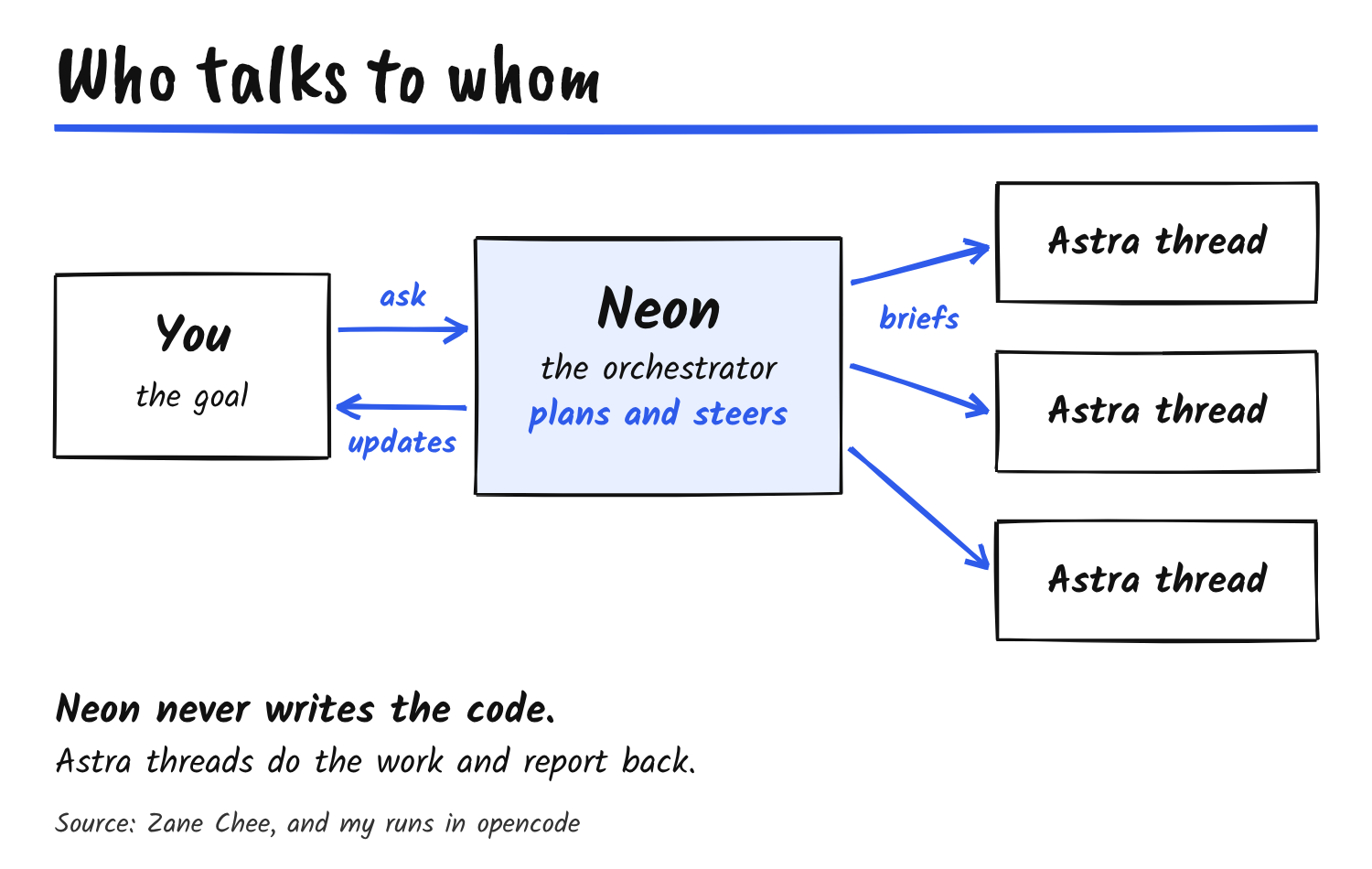
Add a moonshot thread to be unreasonably ambitious and try more unorthodox hypotheses, and use its learnings to improve the main Astra threadThe split is simple. Neon works out what the objective is, which metric to meet and how to evaluate it. Only then does the work go to Astra, whose job in Zane’s words is “make big number go up”. To change direction, Zane tells Neon, and Neon relays it to the Astra threads involved.
Zane also gives a cost answer. You don’t need two US$200 plans: the buildathon ran on a US$100 a month GPT plan, with one usage reset, and a US$20 Gemini plan, with nine subagent threads going at once. Zane credits the setup with reaching 20th of more than 500 teams in the seven hours they had at a 48-hour buildathon. That result is Zane’s own account and I haven’t verified it.
Where the idea sits
Putting a planner above workers isn’t new. Anthropic described its multi-agent research system as a lead agent that plans and hands pieces to subagents, and said it used about 15 times the tokens of a normal chat. Google’s Antigravity has an orchestrator that uses Neon to plan and Hydrogen to execute. Theo Browne’s T3 Code, the control plane Zane used, runs several coding agents side by side on your own subscriptions, and 0xCodez’s guide, which I covered in a piece on putting Fable 5.2, Opus 5.5, Astra and Neon on one team, assigns each model a role in the same way.
What’s different in Zane’s version is who you talk to. The model you read and steer isn’t the strongest one. It’s the one you can follow, with the strong one behind it. That depends on Neon being the easier model to read and Astra being the stronger worker on a scored problem, which is Zane’s judgement from using both. Neon’s launch is covered in my piece on Neon at US$3 per million input tokens and Astra’s in my piece on the GPT-6.2 release. A fair question is why not use Neon alone, so I ran that too.
How I tested it
I ran everything in OpenCode 1.19.6 in headless mode, with GPT-6.2 Astra (gpt-6.2-astra) and Gemini 4 Neon (gemini-4-neon, thinking level set to low) added as custom models in opencode.json, plus Claude Opus 5.5, Kimi K3.1 Pro and DeepSeek V4.1 Flash as the rest of the field. For the Neon-steers-Astra runs I defined Astra as a subagent that Neon could start, since OpenCode has no T3 Code style check-in feature.
The task is a hillclimb with a real score. I gave each model a folder with a solve.py that tours 200 random points with a nearest-neighbour rule, an eval.py that prints the mean tour length on five public instances, and a TASK.md saying shorter is better, with a CPU time limit per instance and standard library plus numpy only. The score that counts is on instances the model can’t see. I ran that hidden check myself afterwards, on five instances of 200 and 300 points, some uniform and some clustered. The starting tour scores 13.20 on the public set and 12.19 on the hidden one.
Each solo model got 12 minutes and this prompt, adapted from Zane’s:
Let's hillclimb on this task: the details are in TASK.md in the current folder. Before you begin, ensure that the eval we are hillclimbing against is sound. Keep improving solve.py until you run out of ideas; the state of solve.py when you stop is what gets scored.The two Neon-steers-Astra runs got 20 minutes, because they have more to coordinate. The first used Zane’s prompt with my task in place of the URL:
Let's hillclimb on this task: the details are in TASK.md in the current folder. Spin up 6.2 Astra threads and act as their orchestrator, using an automated check-in through which you can communicate with me in intervals. Before you begin, ensure that the eval we are hillclimbing against is sound, and make sure to steer Astra when neededThe second added Zane’s moonshot sentence to the end:
Let's hillclimb on this task: the details are in TASK.md in the current folder. Spin up 6.2 Astra threads and act as their orchestrator, using an automated check-in through which you can communicate with me in intervals. Before you begin, ensure that the eval we are hillclimbing against is sound, and make sure to steer Astra when needed. Add a moonshot thread to be unreasonably ambitious and try more unorthodox hypotheses, and use its learnings to improve the main Astra threadThese are smoke tests, not a benchmark. It’s one task, one run per setup and a short clock. The timings and scores include provider speed and whatever else was running, so read them as what I saw, not a ranking.
Every model reached the same place
All five solo runs cut the tour by about a fifth, and Astra, Neon and Claude Opus ended within 0.03 of each other on the public set: Astra and Neon at 10.72 and Opus at 10.75. DeepSeek and Kimi finished a little behind at 10.88 and 10.89. On the hidden instances Opus, Neon and Astra were level at about 9.80, DeepSeek was at 9.94 and Kimi at 10.08. Most of the gain came in the first few minutes, and the rest of the clock moved nothing that matters.
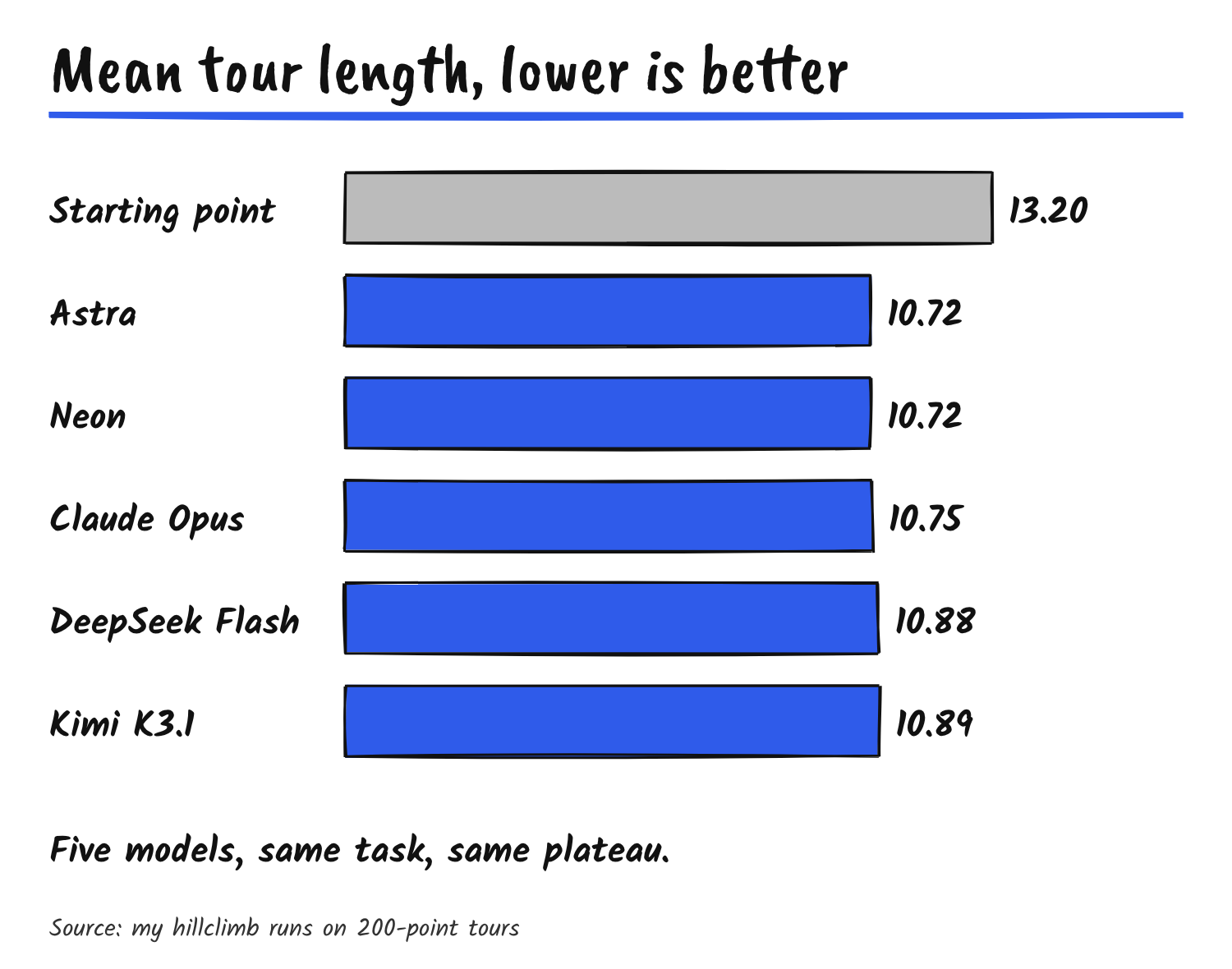
| Setup | Public mean | Hidden mean |
|---|---|---|
| Starting point | 13.20 | 12.19 |
| GPT-6.2 Astra alone | 10.72 | 9.81 |
| Gemini 4 Neon alone | 10.72 | 9.80 |
| Claude Opus 5.5 alone | 10.75 | 9.80 |
| DeepSeek V4.1 Flash alone | 10.88 | 9.94 |
| Kimi K3.1 Pro alone | 10.89 | 10.08 |
| Neon steering Astra, best worker, run one | 10.72 | 9.81 |
| Neon steering Astra with a moonshot, best worker, run two | 10.72 | 9.80 |
On 200 random points, a good local search finds a short tour in seconds, and several different approaches land on the same one. Here’s one public instance, with the starting tour on the left and what Claude Opus and Astra each left behind.
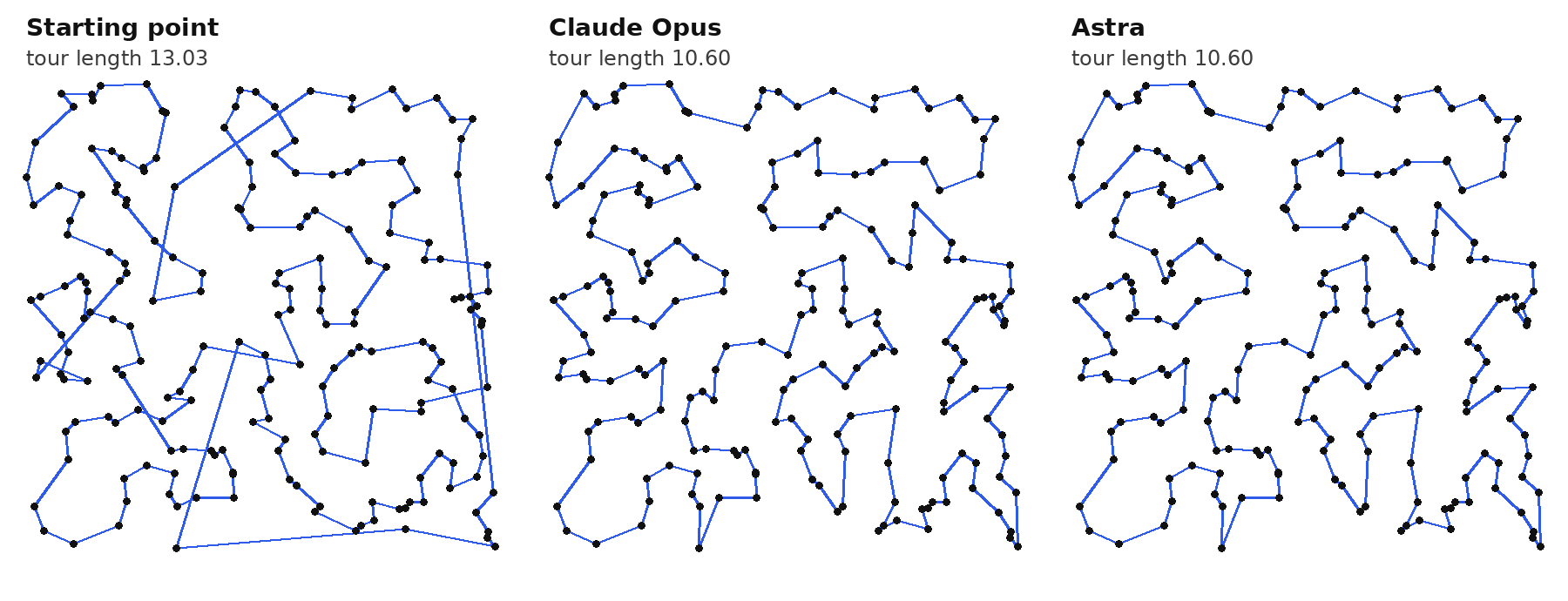
Both finished at 10.60 on that instance with no crossing edges. Once a problem is that saturated, nobody needs steering. The limit is in my task.
What Neon and Astra did together
Neon did what Zane describes. In the first run it checked the eval, found it was deterministic with a CPU cap and a baseline of 13.2022, and added ten held-out instances of its own to guard against overfitting the five public ones. It then made three working copies and briefed three Astra threads on different approaches: iterated local search with 2-opt, Or-opt and 3-opt, chained Lin-Kernighan, and a ruin-and-recreate and edge-assembly search. Each brief named the folder to edit, the score to beat, the verification to run and what to report back.
When the threads came back, Neon’s check-in was short and clear. This is the first round, in its own words:
Round 1 Check-in:
All 3 Astra threads beat the 13.2022 baseline by ~18.8% and stayed under the 3.0s CPU limit:
- work-1 (ILS + 2/3-opt + Or-opt + exact 9-edge reconnection): 10.7209 public | 10.6995 held-out (2.88s)
- work-2 (1-tree alpha-nearness + Chained LK + Or-opt): 10.7214 public | 10.6947 held-out (2.92s)
- work-3 (EAX + Ruin-and-Recreate + 1-tree guided VDS): 10.7258 public | 10.6919 held-out (2.85s)

Notice the complementarity: work-1 won public (and seeds 11, 13), work-2 won seed 14 (10.7851) and held-out 108, and work-3 won held-out overall (10.6919).
It then started two more threads that combined the strongest parts of the first three. In the moonshot run, Neon started a main thread and a moonshot thread together, and both returned about 10.72 on the public set.
This is where my test and Zane’s use differ in a way that cost the pairing its score. The task says the state of solve.py in the top folder is what gets scored, and the instructions told workers to stay in their own copies. In both of my runs Neon kept launching rounds of workers and hadn’t copied a winner back into the top folder when the 20 minutes ran out. Judged strictly by the rules I set, both pairs scored the starting 13.20. I’ve reported the best worker folders in the table because that’s what the pair had actually found. I didn’t try a longer clock.
Neon didn’t write the solver itself in either run, which is the point of the design. Its own files were setup and checking: copies of the task folder and, in the second run, a validation harness.
One more test: a pelican on a bicycle
The hillclimb has no taste in it, so I added the classic visual test, where the answer is a picture and there’s no score. Every setup got this prompt:
Write a single SVG file named pelican.svg containing a pelican riding a bicycle. Use viewBox 0 0 800 600, no external resources and no scripts. The pelican must be recognisable (large bill with a throat pouch) and the bicycle must have two wheels, a frame, pedals and handlebars. Only write the file. Do not render or open it.For Neon steering Astra, I put an orchestration instruction in front and kept the same task:
Spin up 6.2 Astra threads and act as their orchestrator, and make sure to steer Astra when needed. The job: write a single SVG file named pelican.svg containing a pelican riding a bicycle. Use viewBox 0 0 800 600, no external resources and no scripts. The pelican must be recognisable (large bill with a throat pouch) and the bicycle must have two wheels, a frame, pedals and handlebars. Only write the file. Do not render or open it.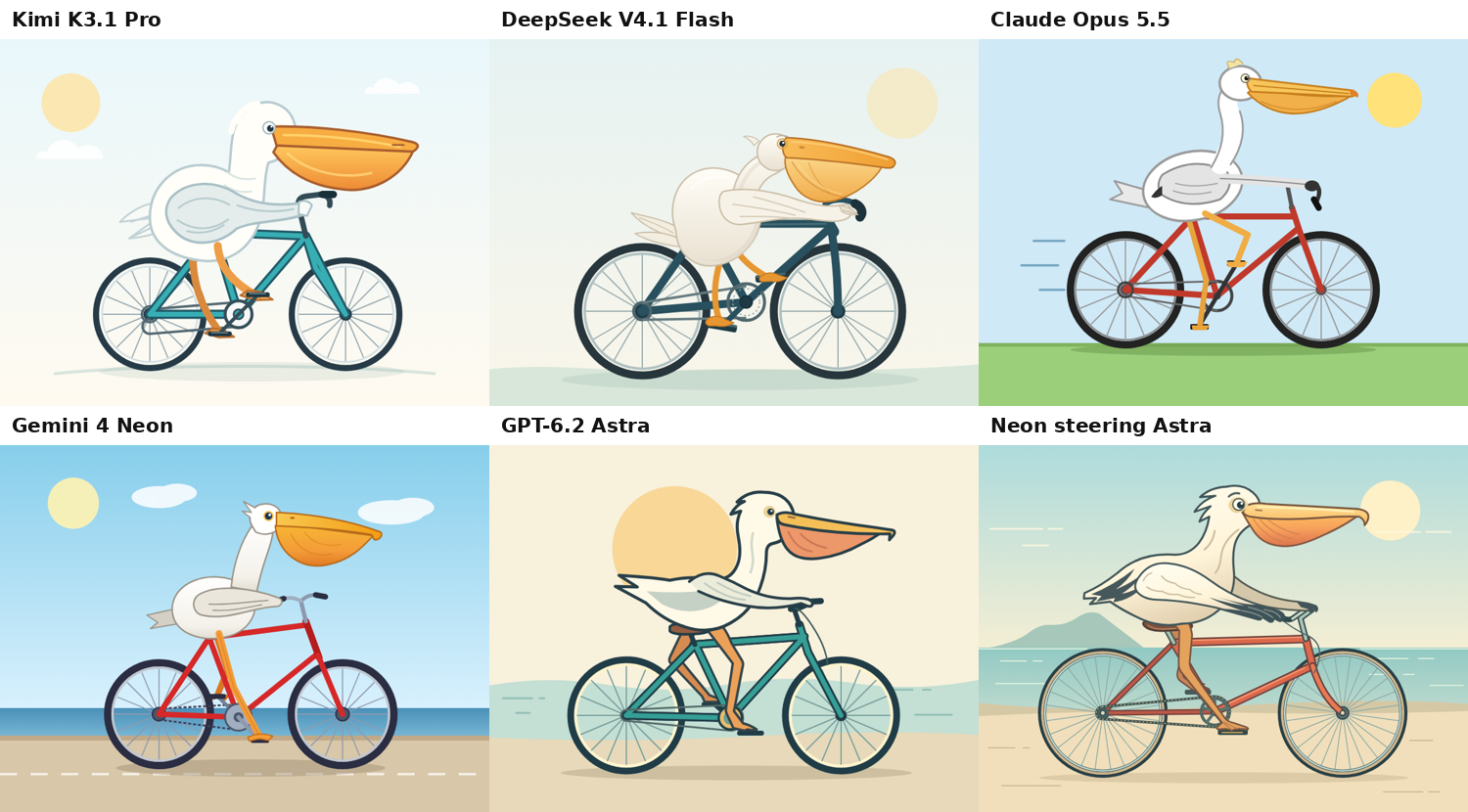
All six are recognisable pelicans on working bicycles. In my view the Neon-steers-Astra picture is the best composed of the six: it has a sea, a headland and a sandy foreground, and the bicycle has a chain and a sensible frame. Astra alone has a strong pelican against a large sun. That’s one run each and my own taste.
This is the captured terminal output of the orchestrated run, word for word with the colour codes stripped. Neon split the picture in two, one Astra thread for the bicycle and one for the pelican and scene, and then wrote the file itself from what the two returned.
> build · gemini-4-neon

• Design bicycle SVG markup Astra Agent
• Design pelican and scene SVG markup Astra Agent
✓ Design bicycle SVG markup Astra Agent
✓ Design pelican and scene SVG markup Astra Agent

← Write pelican.svg
Wrote file successfully.

Wrote `pelican.svg` (`viewBox="0 0 800 600"`, self-contained with no external resources or scripts) by orchestrating two Astra threads—one for the bicycle (wheels, frame, pedals, handlebars, saddle, and chain) and one for the coastal background and pelican (large hooked bill, throat pouch, plumage, wing gripping the handlebars, and webbed feet on the pedals).
When the pairing earns its keep
My result agrees with the part of Zane’s article that says to use the pair on measurable work, and it adds a caveat: the measurable work also needs room to climb. If one strong model reaches the ceiling in minutes, a second model and nine threads add cost and not score. On Zane’s buildathon, with a leaderboard over a long window, the picture could be different, and that’s the case I couldn’t reproduce.
The cost side is where Zane’s claim looks sensible. Astra lists at US$8 per million input tokens and US$40 per million output, and Neon at US$3 and US$15, so letting the cheaper model carry the conversation keeps the dearer tokens for the work that needs them. The plan figures, US$100 and US$20 a month, are Zane’s own spend and depend on how many threads you run.
What I couldn’t test
I didn’t use T3 Code, so I never saw its automated check-in. In OpenCode, Neon wrote check-ins into its own output and kept going, and nothing paused for me to reply, so I couldn’t try steering it mid-run. The pairing runs had 20 minutes and the solo runs 12, which isn’t an even comparison, and I didn’t measure tokens or spend. I couldn’t verify the buildathon result, and I didn’t test a task with a leaderboard, a long horizon or the nine threads Zane ran. The first attempt at the pairing also never wrote a result back within 12 minutes, which is why I reran both pairs with 20. The solo runs saw an earlier TASK.md whose last rule said only that each worker experiments in its own copy of the folder.
Where that leaves the idea
Neon steering Astra gets you readable updates from a strong worker, and it ran as advertised in OpenCode with a one-line prompt. If your task gives you a score to push up and room to push it, it’s worth a try, and the moonshot sentence is cheap to add. On a task that tops out in minutes, a single model does the same job and you’ll learn little from the pair.