

Revolut says it cut its AI coding bill by about 90% by moving around 2,000 engineers onto an open-weight GLM model that it runs on its own GPUs. David Abitbol laid out the setup, the tuning and the numbers in a talk called “Shipping like a startup, regulated like a bank” at AI Engineer NYC.
Linas Beliunas flagged the talk and put it down to incentives. I went to the talk itself to check what Revolut said, what the 90% does and doesn’t show, and how other companies running open-weight models compare.
What Revolut said
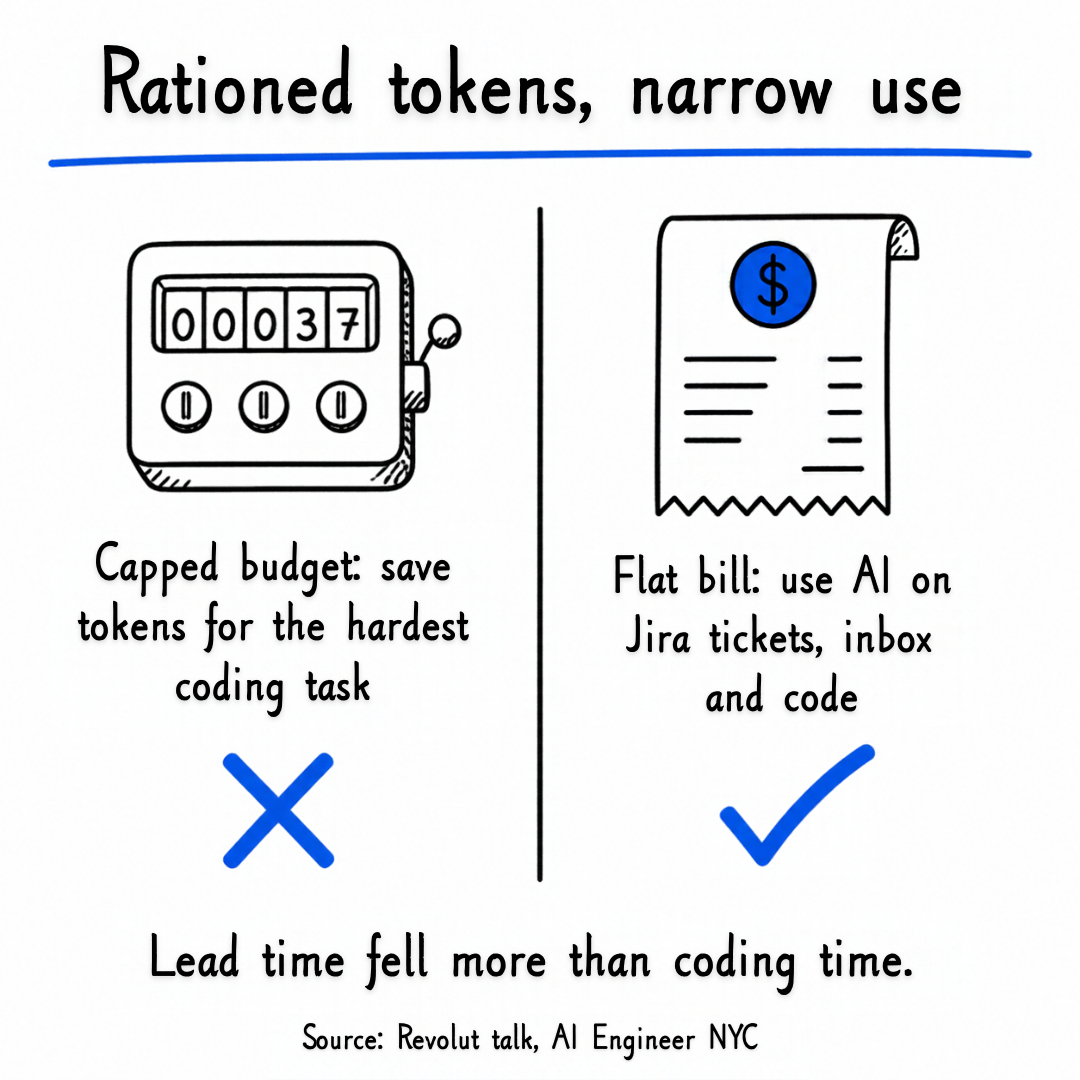
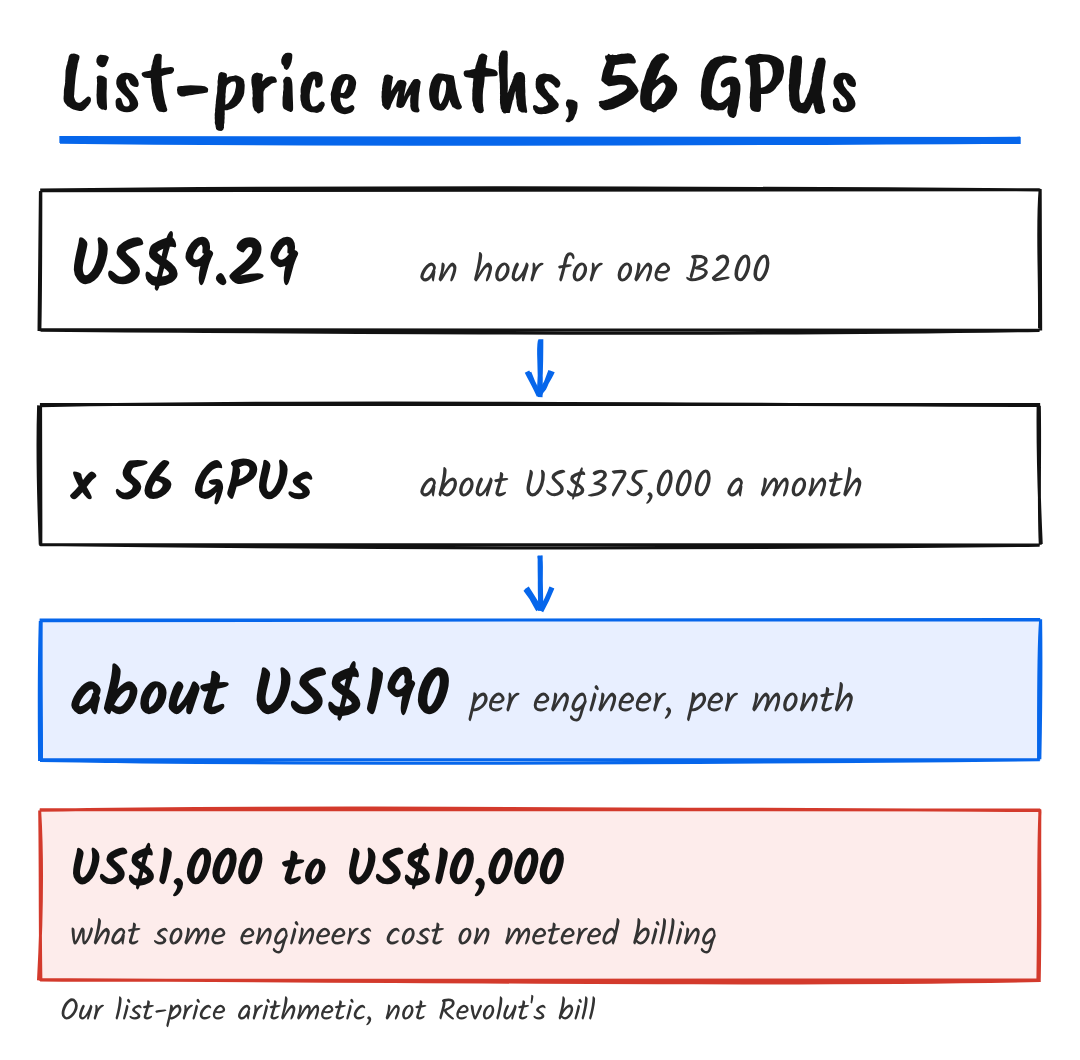
Revolut started with commercial tools. Engineers used Claude Code and Codex, and the bills got large enough that the company capped them. “We were seeing engineers spend $1,000 a month, $10,000 a month with not so much ROI, and so when we launched it we launched it with strict budget limits,” Abitbol said. The caps worked against the tools: engineers saved their tokens for the hardest coding task and didn’t reach for AI on routine work.
The replacement is GLM, the open-weight model family from Z.ai. Revolut began on GLM-5.1 in April and moved to GLM-5.3. It serves the model on 56 Nvidia B200 GPUs, working with Together AI, for about 2,000 engineers. The endpoints speak the OpenAI-compatible Responses API, so OpenCode, Codex and Claude Code can all point at them.
The headline numbers, all Revolut’s own: a blended cost of about US$0.30 per million tokens for input and output, with cache hits free, and an invoice about a tenth of what it paid Anthropic and OpenAI before. Abitbol also reported coding time down 60% and lead time down about 70%. His slide says 60% for lead time, so I’d treat the speech and the slide as one claim in the 60 to 70% range. These are observational figures from inside the company, not a controlled comparison.
Making it fast enough to use
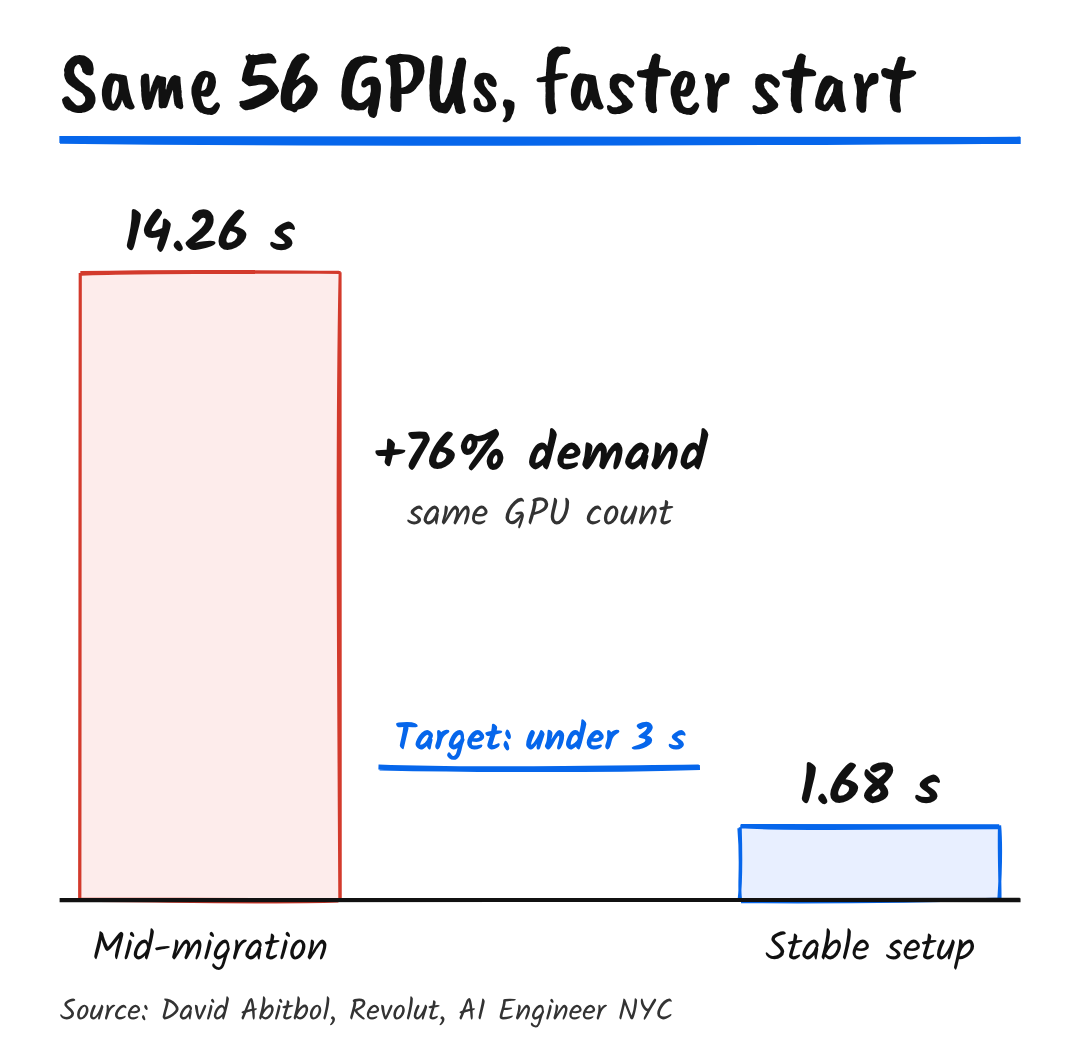
Cost wasn’t the hard part. Engineers complain when the first token takes longer than about five seconds, so Revolut set a target of under three seconds to first token and roughly 200 tokens a second. Partway through the migration, time to first token sat at 14.26 seconds. After tuning it fell to 1.68 seconds, and requests per second rose 76% on the same GPUs.
Abitbol walked through the levers: a 256k context window instead of 1M, FP4 quantisation (NVFP4 on Blackwell), tensor parallelism of 8 versus 4 to leave more room for the KV cache, keeping cache hits above 90%, speculative decoding, and splitting prefill from decode. Each one trades something, so the list reads as a map of what to try when a self-hosted coding model feels slow.
Routing, sandboxes and compliance
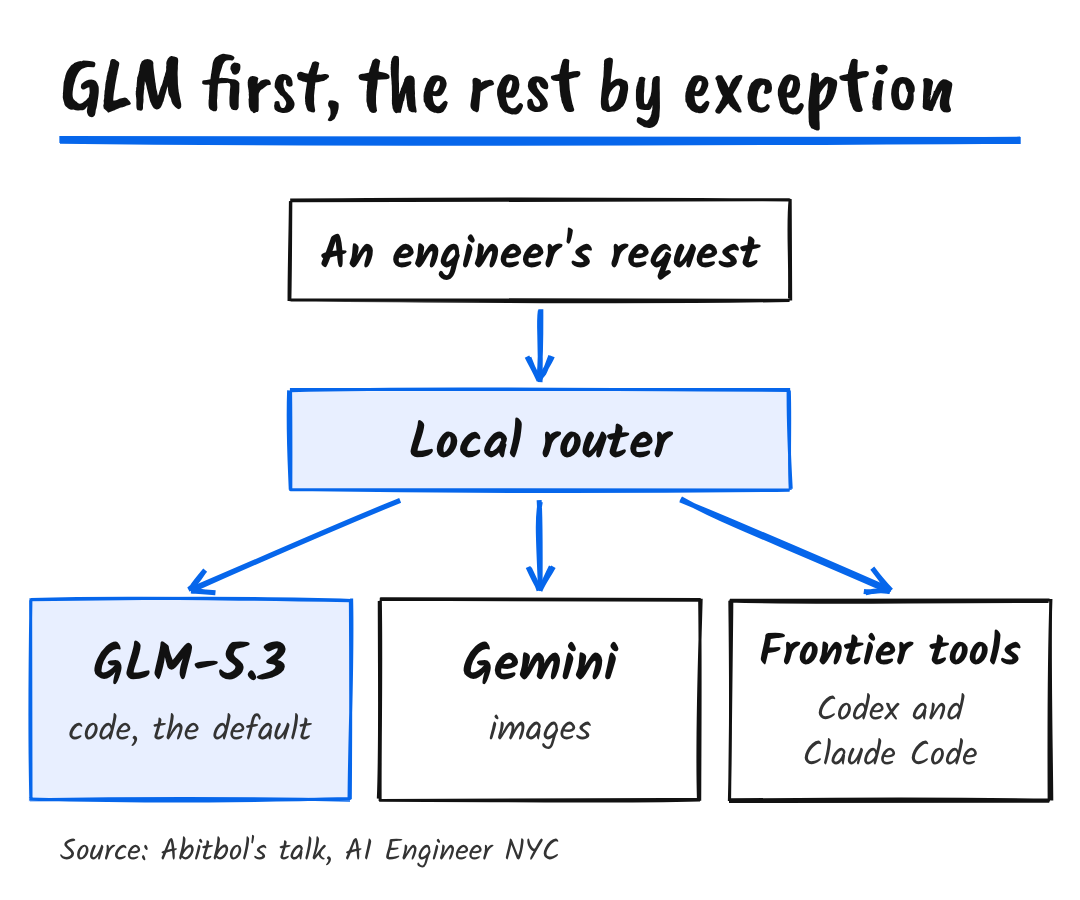
GLM-5.3 is text-only, so Revolut routes anything with an image to Gemini. Frontier tools stay available for the cases where GLM falls short, but GLM is the default path.
For a bank, the compliance answers matter as much as the speed. Revolut downloads the weights and runs them on US infrastructure rather than calling a China-hosted endpoint, applies zero data retention, and tracks usage with OpenTelemetry. The agents run under sandbox rules that are specific rather than blanket: grep is fine, Gradle isn’t. Abitbol’s view that running Chinese weights locally carries little risk is one company’s judgement, and regulators or customers may see it differently.
The model and its licence
Z.ai released GLM-5.3 in August, with the weights following two weeks later. It’s a mixture-of-experts model of about 753 billion parameters with about 40 billion active, a 1M-token context and no image input. The licence is a custom one that reads close to MIT, with a condition aimed at companies that sell the model as a hosted service above US$10 billion in revenue. Revolut uses it internally, so that gate doesn’t touch the setup.
Revolut’s US$0.30 is also well under Z.ai’s own API price of US$1.40 per million input tokens and US$4.40 per million output. That gap is what owning the GPUs buys: the price per token falls the busier the hardware stays. Our earlier coverage of the family is in the GLM-5.3 open-weights piece and the GLM-5.4 release.
What 56 GPUs cost at list price
Revolut hasn’t said what it pays, so here’s our own arithmetic, not Revolut’s bill. Together lists a dedicated B200 at US$9.29 per GPU-hour on demand. Fifty-six of them for a month comes to about US$375,000, or about US$190 per engineer across 2,000. A negotiated contract will differ from list, but the shape holds: a fixed cost spread across everyone, instead of a metered bill that spiked for the heaviest users.
How other companies compare
Red Hat runs the closest comparison. Its internal pilot, described in a Red Hat blog post, serves open-weight models including GLM through one gateway and reports token costs down 40 to 70%. TechTarget reports that as many as 1,400 Red Hat engineers use it, with about 70% of inference traffic going to open-weight models and a US$300 monthly allowance for frontier ones. Red Hat’s Stephen Watt told TechTarget that after a while on a frontier model, “you’d be crazy to stay on it because it just eats all your margin.”
Smaller teams get smaller results. Parity ran DeepSeek V4 Flash for 25 engineers and about 12.9 billion tokens at around US$1,200 of GPU compute, roughly US$0.10 per million tokens for GPU time alone, with the GPUs idle about 55% of the time. Parity’s own caveat is that engineering time is the bigger cost, and most engineers who answered its survey thought the model was only just good enough.
Coder’s write-up is a counterpoint. One automation, a documentation check, went from about US$1,750 a month on Opus to under US$11 a month on a local box. But adoption for interactive work stayed low and spiky, because asking people to pick a weaker model for everyday coding is a hard sell. Coder’s lesson is to own the layer every request passes through, so models and budgets can change without touching developer tools.
The imec aistack team put numbers on the utilisation question in their own test: an eight-GPU B200 rack serving GLM needs only around 15% utilisation to beat frontier API pricing on their coding tasks, while a four-GPU H200 box needs to stay close to 90% busy to beat DeepSeek’s API price.
What the 90% doesn’t show
The saving compares GLM against a capped, metered bill for some of the most expensive usage in the company. The talk doesn’t say what the engineers who run the cluster cost, and I found no comparison in the talk or slides of GLM’s output quality against the models it replaced. The productivity figures are Revolut’s own observations. The result shows self-hosting working at Revolut’s scale, with a team able to tune inference. A smaller team shouldn’t expect the same ratio.
Beliunas’s point that it’s all about incentives holds for one part of the story. Per-token billing pushes engineers to ration, and rationing is what Revolut said it was fighting. A flat GPU bill removes that. His post also quoted Gokul Rajaram on the jump from Anthropic’s Team plan to Enterprise, which charges US$20 a seat plus all usage at API rates. We covered that cliff in our earlier piece on Anthropic’s seat pricing.
What to watch
Three things decide whether this spreads.
- Whether Revolut or Together publishes a quality comparison between GLM and the frontier models it replaced.
- Whether the GLM-5.3 licence or US policy on Chinese weights changes what a regulated company can run. Our earlier coverage of the House report on Chinese open-weight models covers the political side.
- Whether frontier providers change their pricing for heavy coding use now that Revolut and Red Hat have made the alternative visible.
Disclosure: I’m an OpenAI, Firecrawl and Devin ambassador.
Sources: AI Engineer NYC, Revolut talk; talk video; Linas Beliunas on X; Red Hat EnMaaS; TechTarget; Parity; Coder; imec aistack.