
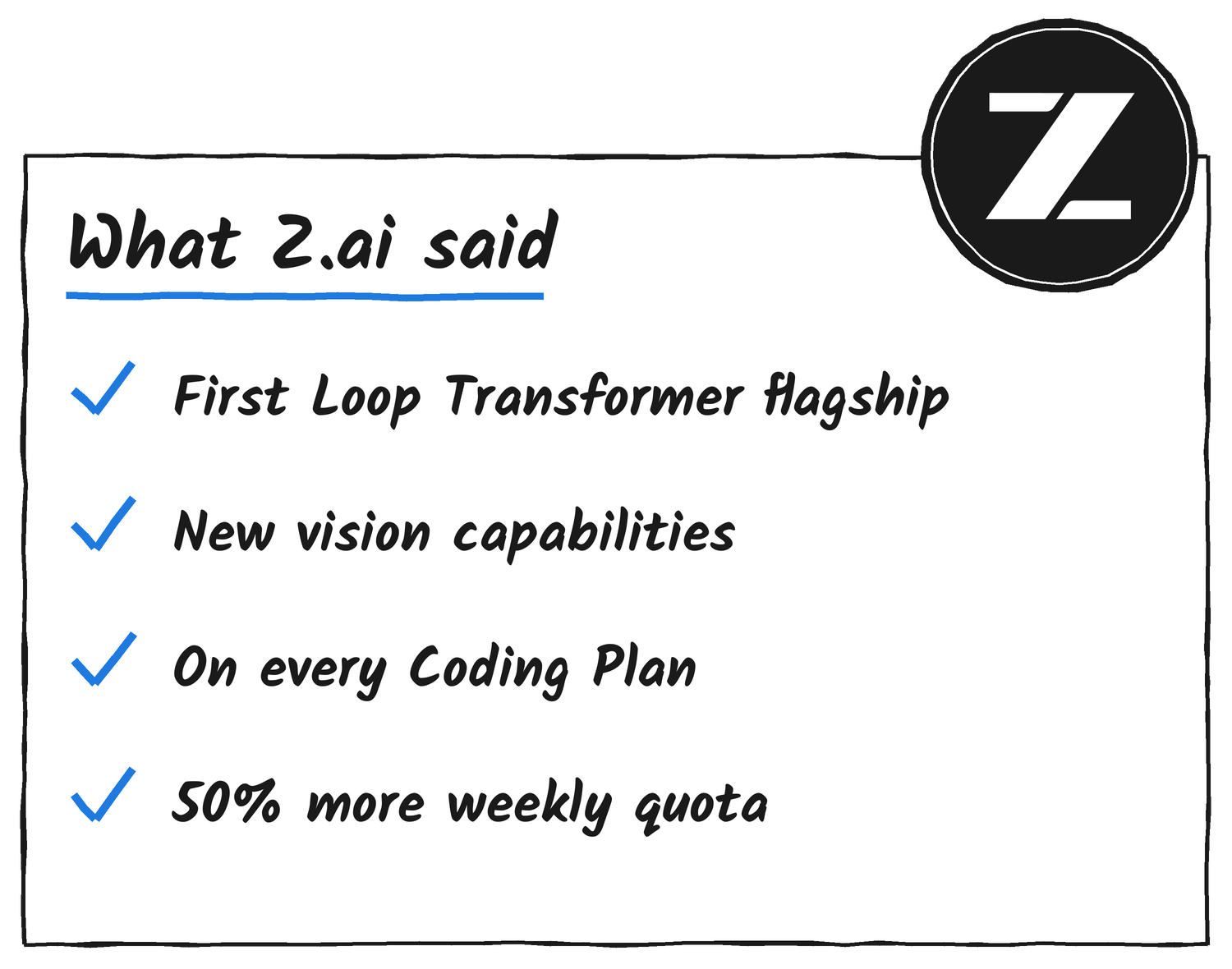
Z.ai has launched GLM-5.4, its first flagship built on a Loop Transformer, and put it on every GLM Coding Plan. Zixuan Li, the head of Z.ai, announced the release on X on 23 November with new vision capabilities, stronger all-round coding and 50% more weekly quota than GLM-5.3. Z.ai’s official account followed, and a blog post sets out the architecture.
GLM-5.4 is now available to all GLM Coding Plan users. New vision capabilities and stronger all-round coding performance. For users with weekly quotas, GLM-5.4 now comes with 50% more quota compared to GLM-5.3.
Zixuan Li, Head of Z.ai, on X, 23 November 2026
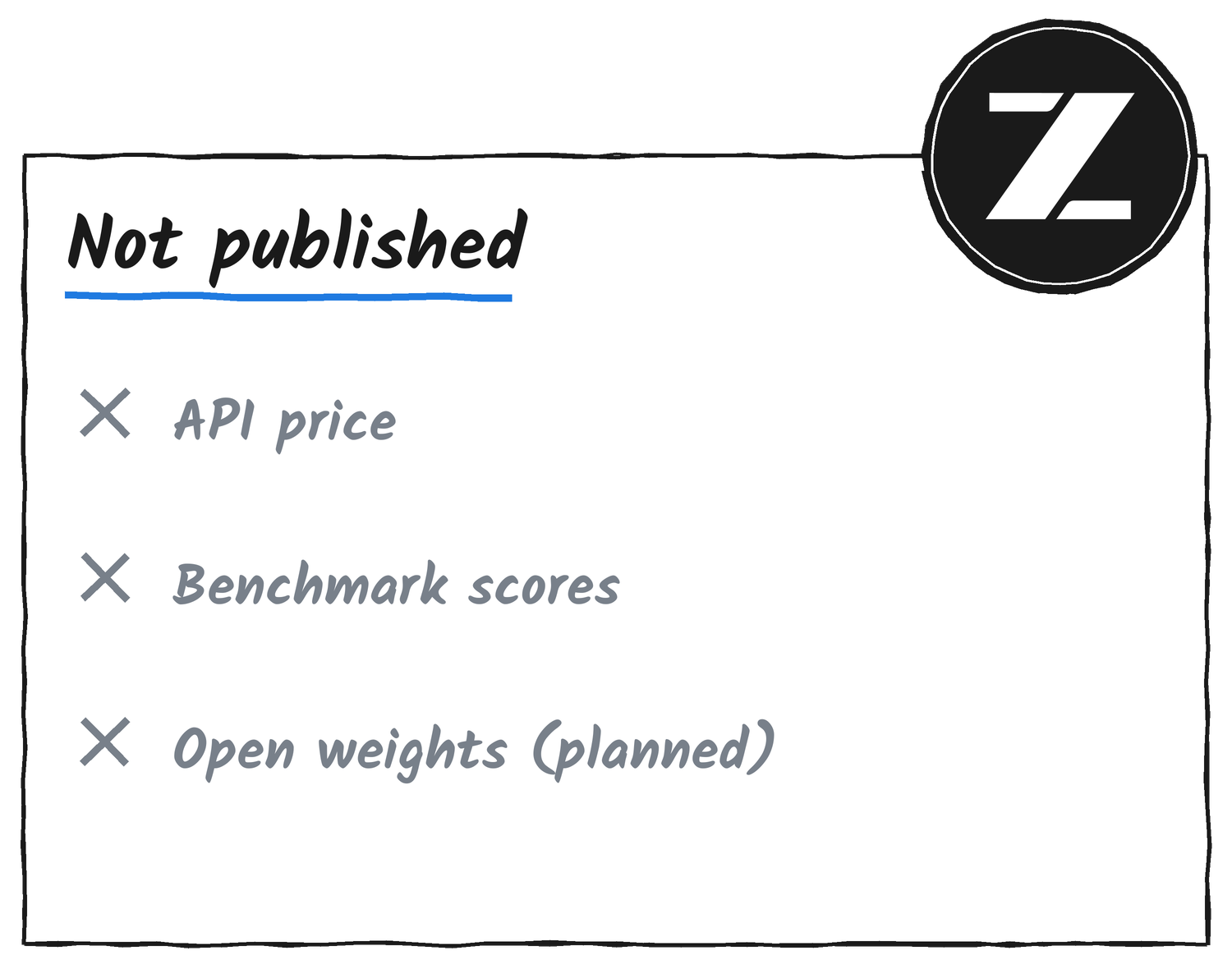
Z.ai’s blog post at z.ai/blog/glm-5.4 says GLM-5.4 loops 28 layers of the GLM-5 base model twice at the 750B scale, and that it reaches intelligence levels comparable to 2T to 3T parameter models. That comparison is Z.ai’s own claim. The post lists the API as coming soon, says the weights will follow after safety hardening and gives no price. Li followed up with the settings: glm-5.4[1m] in Claude Code and glm-5.4 in other tools. Z.ai’s new GLM-5.4 docs page lists a 1M context window and 128K of output, and says the Model API will open once a security assessment is complete. Sulat’s direct API probes establish the exact token limits, modalities, protocols and reasoning behaviour.
Z.ai’s official account then posted its own announcement:
Introducing GLM-5.4: Generalized Coding with Our First Loop Transformer.
Z.ai (@Zai_org) on X, 23 November 2026
– Loops existing layers in the GLM-5 base model for deeper reasoning
– Pushes beyond traditional coding to video, games, 3D shaders, and CAD modeling
– Adds vision capabilities for stronger visual coding
- What Z.ai has said
- What Z.ai’s blog says
- What live API probing confirmed
- How to use GLM-5.4 in Amp
- How GLM-5.4 uses the same Coding Plan credits
- Why vision matters here
- Where GLM-5.4 sits in the family
- How the plan compares with its peers
- Open weights
- The company behind it
- What’s reported about GLM-5.4 and GLM-5.5
- First hands-on reactions
- See it for yourself: the one-shot demos
- Terms used in this piece
What Z.ai has said
Li’s LinkedIn profile says he leads Z.ai’s global product, API platform, partnerships and model releases, so the post is the company’s own announcement channel. It makes four claims: GLM-5.4 is on every Coding Plan tier, it adds vision, it codes better across the board, and that users with weekly quotas get 50% more GLM-5.4 usage than on GLM-5.3. Nothing else in it is a number.
What Z.ai’s blog says
The post, dated 23 November, calls GLM-5.4 Z.ai’s first flagship built on a Loop Transformer. A group of weight-shared layers runs more than once, so the model reasons deeper without adding parameters. Z.ai says it adapted the pre-trained GLM-5 base through continued training instead of training a looped model from scratch, and that GLM-5.4 loops 28 layers for two iterations at the 750B scale.
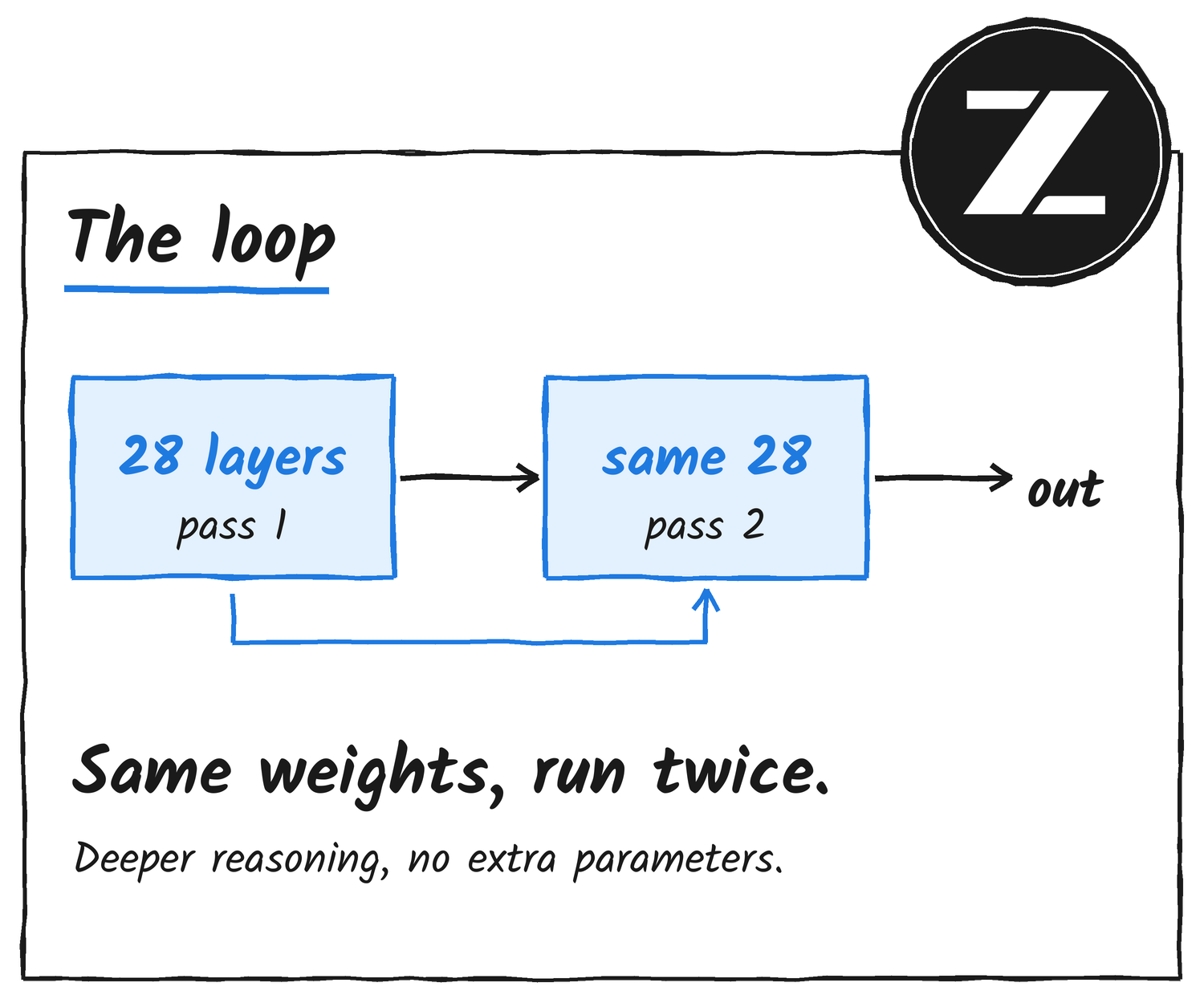
Z.ai claims the result reaches intelligence levels comparable to 2T to 3T parameter models. It backs the design with a controlled test on a 30B model, where the looped version showed clear gains for about 10% more training compute, and it says average output length on benchmarks such as GPQA-Diamond and MMLU-Pro fell 10 to 14%. Those results are for the 30B test model. The post’s text gives no benchmark scores for GLM-5.4 itself.
On speed, Z.ai says GLM-5.4 reaches up to 200 tokens per second off-peak and holds 70 to 80 at peak load. Sulat’s own probes measured 58 to 81. Z.ai also names the main limitation: the model tends to get caught in overly long “marathon thinking” loops, which it says still improve accuracy.
Z.ai says GLM-5.4 can write code that produces videos, complete games, 3D scenes with GLSL shaders and CAD models, and it shows a six-axis robotic arm built in FreeCAD. The post lists the Coding Plan, ZCode and Z.ai Chat as live and the API as “coming soon”, though Sulat’s probes already got HTTP 200 from glm-5.4 on the standard PaaS endpoint. Z.ai says it plans to open-source the weights “responsibly after completing necessary safety hardening”, and that its next, significantly larger model will be “ready soon”.
What live API probing confirmed
Z.ai’s post gives no token limits or protocol details, so Sulat probed glm-5.4 directly against Z.ai’s Coding Plan and PaaS endpoints on 23 November to establish its hard boundaries, input modalities, protocol support and reasoning behaviour. The model ID glm-5.4 is already listed by GET /models and responds with HTTP 200 across all four Z.ai endpoints: Coding Plan OpenAI Chat Completions (https://api.z.ai/api/coding/paas/v4), standard PaaS (https://api.z.ai/api/paas/v4), OpenAI Responses (https://api.z.ai/api/v1/responses) and Anthropic Messages (https://api.z.ai/api/anthropic/v1/messages). My own demos built on GLM-5.4 are live at glm-5-4.demos.sulat.com.
1,048,576
confirmed input context ceiling (1 MiB tokens; 1,048,569 accepted, 1,048,580+ rejected)
131,072
hard max_tokens ceiling (131,073 rejected with error 1210)
58–81 tok/s
measured decode speed across reasoning levels and streaming (1.65s TTFT)
| Capability | Status | Measured behaviour on Coding Plan endpoint |
|---|---|---|
| Input context ceiling | Confirmed: 1,048,576 tokens | A 1,048,569-token prompt succeeded with HTTP 200; a prompt just above 1,048,576 failed immediately with HTTP 400 code 1261 (“Prompt exceeds max length”). |
| Output token ceiling | Confirmed: 131,072 tokens | max_tokens: 131072 succeeded; 131073 returned HTTP 400 code 1210 with the range [1,131072]. Requesting max_tokens: 131072 alongside a 1,004,976-token prompt also succeeded. |
| Prompt caching | Confirmed active | Automatic prefix caching hit up to 1,048,448 cached tokens on back-to-back long prompts. |
| Images (vision) | Confirmed native | Single and multi-image image_url data URIs passed straight to glm-5.4 without the Vision MCP server; the model identified colours across multiple attached PNGs. |
| PDF documents | Confirmed native | Both Z.ai’s file_url and OpenAI’s file content parts with a base64 PDF returned the exact text embedded in the document verbatim. |
| Video & audio | Video parsed / audio rejected | video_url reached Z.ai’s video parser (returning code 1210 format/parse error on a dummy URL), while input_audio (valid WAV) was rejected outright as an invalid API parameter. |
| Tools & structured output | Confirmed (one quirk) | Function calling, parallel_tool_calls (two simultaneous tool calls), tool_choice (required and named function), json_object and strict json_schema all worked. Quirk: tool_choice: "none" still emitted a tool call. |
| Reasoning & effort levels | Always-on thinking | Reasoning stays active even when thinking: {"type": "disabled"} or reasoning_effort: "none" is sent; unknown effort strings are accepted and fall back rather than erroring. On a hard logic puzzle, reasoning tokens scaled from 1,509 at low to 3,911 at max, and every level reached the correct answer. |
| Latency & throughput | 58–81 tok/s measured | Streaming a 258-token reply took 1.65s to first token and decoded at 77.1 tok/s. Reasoning runs on a multi-step puzzle averaged 57.8 tok/s (low) to 81.2 tok/s (high and max). |
Two probe details are easy to miss if you only read the announcement. First, the input ceiling is the full binary megatoken (1,048,576 tokens) rather than a round million, and Z.ai didn’t subtract max_tokens from the input budget when a 1,004,976-token prompt requested the full 131,072 output tokens. Second, like GLM-5.3, reasoning is effectively always on across Chat Completions, Responses and Anthropic Messages: passing thinking: {"type": "disabled"} returns HTTP 200 instead of an error, but the response still emits reasoning_content (or Anthropic thinking blocks) and bills reasoning tokens.
How to use GLM-5.4 in Amp
Amp’s built-in catalogue doesn’t list zhipuai/glm-5.4 yet, so the model won’t appear in the model picker automatically — even when a Z.ai provider is already connected. Because Amp supports custom model mappings and metadata overlays on provider connections, users can expose GLM-5.4 immediately by asking Amp (or Puck) to configure their Z.ai provider directly.
Three settings matter when wiring Z.ai’s Coding Plan into Amp:
- Use the Coding Plan base URL: Point the Z.ai provider’s
baseURLathttps://api.z.ai/api/coding/paas/v4withapiFormat: "chat-completions". Amp’s default Z.ai base URL (https://api.z.ai/api/paas/v4) hits pay-as-you-go PaaS billing instead of the Coding Plan credit pool. - Map the model and supply its metadata overlay: Add
zhipuai/glm-5.4 -> glm-5.4tomodelMappingand set amodelMetadataOverlaysentry forzhipuai/glm-5.4withmaxInputTokens: 1048576,maxOutputTokens: 131072,supportsImageInput: true,reasoning: trueandtoolCall: true. Amp only shows an unknown model in the selector once its overlay declares input/output token limits andtoolCall: true. - Check provider priority: Amp routes each model through the first active personal connection whose mapping includes it. If a router or proxy such as Devin or Synthetic sits higher in the priority list and maps
zhipuai/glm-5.3orzhipuai/glm-5.3-flash, move Z.ai above them so all GLM models draw from the Coding Plan quota.
For an existing Z.ai connection in Amp Model Routing, paste this request into any Amp thread (or Puck) to update and verify it:
Update my Z.ai Amp model provider so it uses the GLM Coding Plan endpoint (https://api.z.ai/api/coding/paas/v4, apiFormat chat-completions), maps zhipuai/glm-5.4 -> glm-5.4 while keeping my existing mappings, and adds a modelMetadataOverlays entry for zhipuai/glm-5.4 with displayName "GLM-5.4", maxInputTokens 1048576, maxOutputTokens 131072, supportsImageInput true, reasoning true, and toolCall true. Move Z.ai above any proxy that maps zhipuai/glm-5.3, then verify routing with amp config model-providers check-access --provider-model zhipuai/glm-5.4.To connect Z.ai to Amp from scratch, paste this prompt instead — Amp opens a masked dialog for the Z.ai API key so the secret never enters the thread transcript:
Create a personal Z.ai model provider connection (type model_provider_zai) using baseURL https://api.z.ai/api/coding/paas/v4 and apiFormat chat-completions, prompt me for my Z.ai API key, activate it, map zhipuai/glm-5.4 -> glm-5.4 alongside zhipuai/glm-5.3 and zhipuai/glm-5.3-flash, add the zhipuai/glm-5.4 metadata overlay (1,048,576 input, 131,072 output, vision, reasoning, toolCall true), and verify access with check-access.Once saved and verified, GLM-5.4 appears under Other Models in Amp’s model selector and under Add Model in Settings → Model Selector for pinning to Top Models. One Amp caveat applies until native catalogue support lands: custom overlay models run with Amp’s general system prompt at medium effort.
Exact Z.ai provider config JSON (for manual setup or reference)
{
  "apiFormat": "chat-completions",
  "baseURL": "https://api.z.ai/api/coding/paas/v4",
  "modelMapping": "zhipuai/glm-5.4 -> glm-5.4\nzhipuai/glm-5.3\nzhipuai/glm-5.3-flash",
  "modelMetadataOverlays": {
    "zhipuai/glm-5.4": {
      "displayName": "GLM-5.4",
      "maxInputTokens": 1048576,
      "maxOutputTokens": 131072,
      "supportsImageInput": true,
      "reasoning": true,
      "toolCall": true
    }
  }
}
How GLM-5.4 uses the same Coding Plan credits
The Coding Plan runs on credits. Each tier has a rolling 5-hour pool and a weekly pool, and when either runs dry you wait for the reset. Z.ai’s published allowance still lists 10,000 weekly credits for Lite, 60,000 for Pro and 140,000 for Max. Li’s post mentions the weekly quota only. It says nothing about the 5-hour limit. IT Home reports that Zhipu’s operations account put the uplift at 1.5 times for V2, V3 and Team plan users.
| Plan | Monthly price | 5-hour credits | Weekly credits | GLM-5.3 credit equivalent (uncached) |
|---|---|---|---|---|
| Lite | US$18 | 2,000 | 10,000 | 15,000 |
| Pro | US$80 | 12,000 | 60,000 | 90,000 |
| Max | US$168 | 28,000 | 140,000 | 210,000 |
+50%
more weekly usage versus GLM-5.3, per Li
4.6 / 1.1 / 16
GLM-5.4 multipliers for uncached input, cached input and output, per Z.ai’s docs
7pm to 11pm
weekday peak window in NZDT, when model usage costs twice as many credits as off-peak
Z.ai defines peak as Monday to Friday, 14:00 to 18:00 Singapore time, in its 30 July plan notice. Singapore doesn’t change its clocks, so that’s 7pm to 11pm in New Zealand while daylight saving lasts, and 6pm to 10pm after it ends in April. Model usage outside the window, including all of Saturday and Sunday, costs half as many credits.
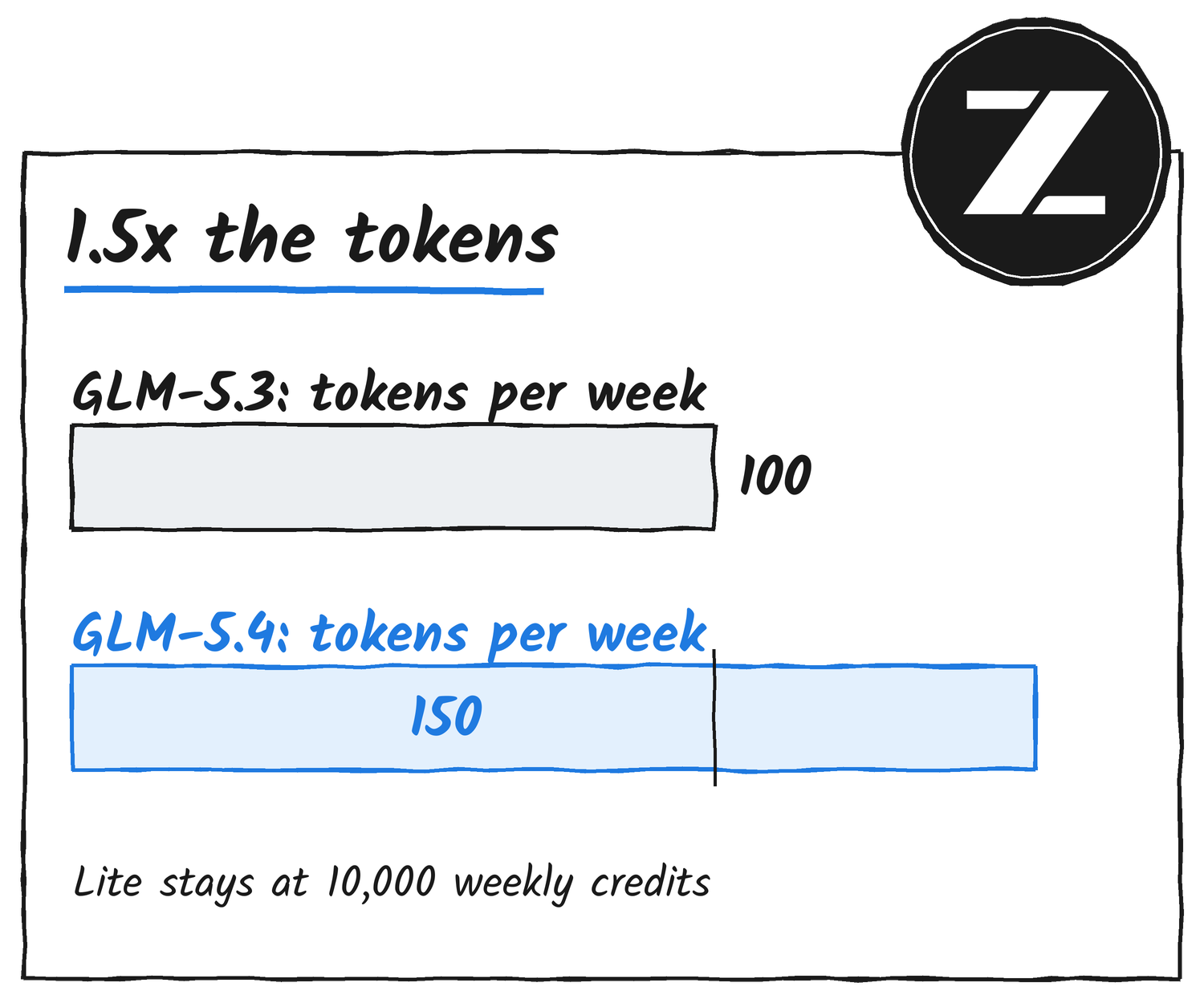
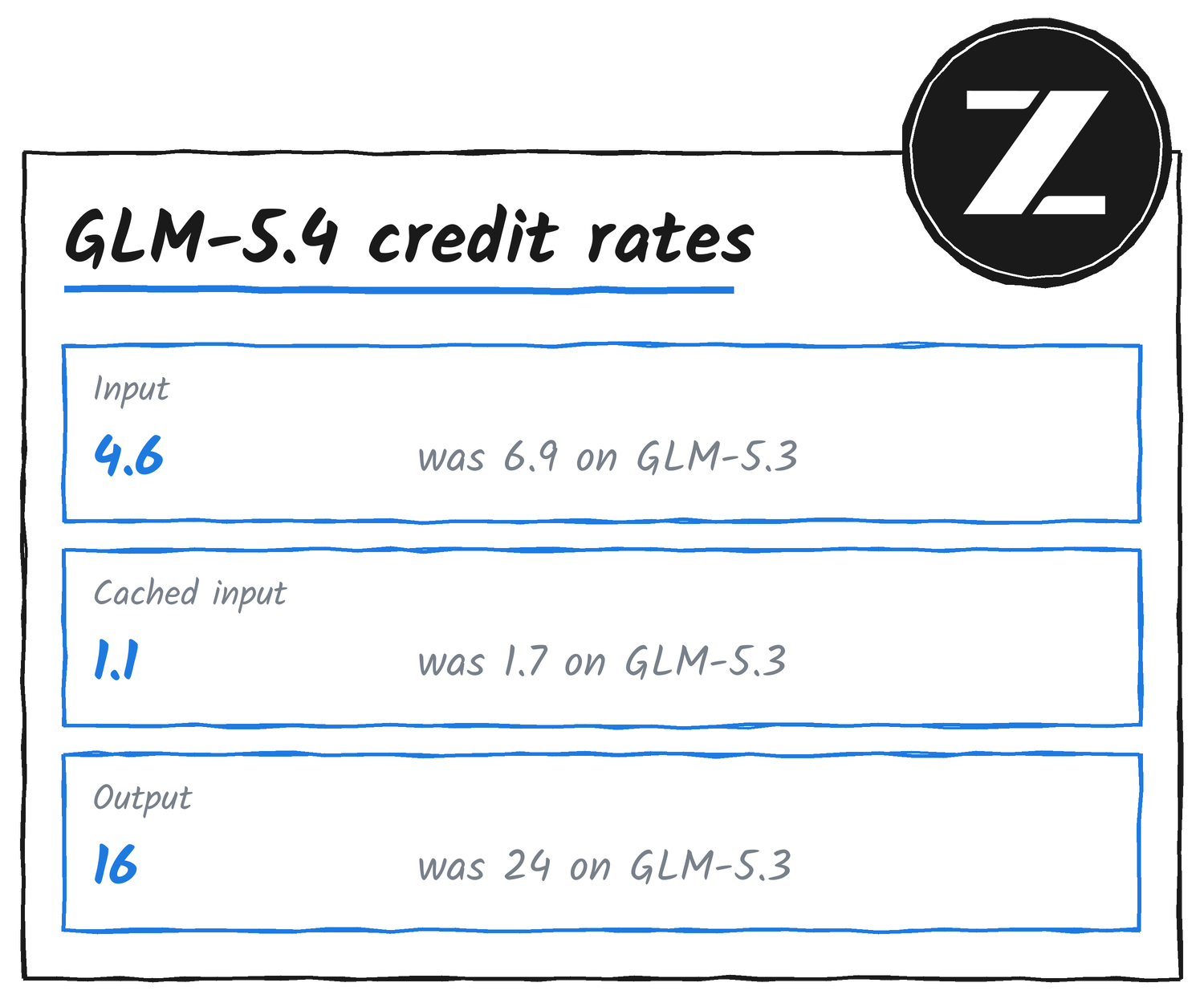
Z.ai’s Coding Plan docs list GLM-5.4’s multipliers at 4.6 for uncached input, 1.1 for cached input and 16 for output, versus 6.9, 1.7 and 24 on GLM-5.3. Uncached input and output cost exactly one-third less; cached input costs about 35% less. The same pool buys roughly 50% more model tokens for comparable workloads, depending on how much input is cached. That is consistent with Li’s announcement. The docs do not explicitly explain his wording or list a separate increase in the standard weekly credit pools.
How Coding Plan credits are worked out
Z.ai’s credit calculation adds up uncached input, cached input and output tokens at their respective rates, then divides the sum by 10,000. For GLM-5.3 the rates are 6.9, 1.7 and 24. For GLM-5.3-Flash they’re 2.3, 0.56 and 8. Search, web-reader and repository tools count the call, multiplied by 1.2.
As an example on GLM-5.3, a turn with 100,000 uncached input tokens and 10,000 output tokens costs 93 credits at peak and 46.5 off-peak. A Lite week of 10,000 credits covers about 107 such turns at peak or 215 off-peak. On GLM-5.4 the same turn costs 62 credits at peak or 31 off-peak, covering about 161 or 322 turns, respectively, within the same weekly pool. Z.ai’s docs put Lite at 72 to 146 million GLM-5.4 tokens a week at a 95% cache hit rate, against 48 to 97 million on GLM-5.3, with Pro at 440 to 870 million and Max at 1,014 to 2,028 million.
Why vision matters here
Z.ai’s GLM-5.3 page says the flagship takes text only, with a 1M-token context window and 128K of output. Until now, the only native multimodal model in the GLM-5 series was GLM-5.3-Flash, which accepts images, video and files and has 320B total parameters with 18B active. Z.ai gives Coding Plan users 3 times the GLM-5.3 quota on it.
That split forced a choice: the stronger model couldn’t see a screenshot, and the model that could was the cheaper one. Z.ai also shipped a Vision MCP server for Coding Plan users that routes image and video questions through GLM-5.3-Flash. Live probing confirms GLM-5.4 closes that gap directly: the model natively accepts single and multi-image inputs as well as PDF files straight through the chat completions API, with no Vision MCP sidecar required. Audio input (input_audio) is rejected, and Z.ai hasn’t published how GLM-5.4’s visual accuracy compares with GLM-5.3-Flash.
Where GLM-5.4 sits in the family
Z.ai says GLM-5.3 gained 50% over GLM-5.2 on its own Z.ai Code Bench, and lifted Terminal-Bench 3.0 from 4.6 to 28.3 and DeepSWE v1.1 from 46.2 to 66.9. Those are the numbers GLM-5.4 has to beat. The Coding Plan also routes older model names forward, so requests for GLM-5.2 and GLM-5.1 already land on GLM-5.3, according to Inference Hub.
| Model | Input | Context / max output | API price per million tokens (in / out) | On the Coding Plan |
|---|---|---|---|---|
| GLM-5.2 | Text | 1M / 128K | US$1.40 / US$4.40 | Routed to GLM-5.3 |
| GLM-5.3 | Text only | 1M / 128K | US$1.40 / US$4.40 | Yes |
| GLM-5.3-Flash | Image, video, file, text | 1M / 128K | US$0.15 / US$0.50 | Yes, with 3 times the quota |
| GLM-5.3-FlashX | Image, video, file, text | 1M / 128K | US$0.37 / US$1.25 | Not yet |
| GLM-5.4 | Text, image, PDF (probed) | 1,048,576 / 131,072 (probed) | Coming soon, after a security assessment, per Z.ai | Yes (probed live on Coding Plan & PaaS) |
How the plan compares with its peers
GLM-5.3’s API price of US$1.40 in and US$4.40 out sits in the middle of the open-weight pack. Kimi K3.1 Pro costs US$2 and US$10, according to Convika’s November comparison, and Qwen4-Max, released on 16 November without open weights, costs US$1.50 and US$4.50. DeepSeek V4.1 Flash is the cheap end at US$0.30 and US$1.20 at peak, and half that off-peak. Third-party hosts undercut Z.ai: Sulat previously covered OpenCode’s 60% cut that puts GLM 5.3 at US$0.56 and US$1.76.
| Model | Price per million tokens (in / out) | What sets it apart |
|---|---|---|
| Z.ai GLM-5.3 | US$1.40 / US$4.40 | 1M context, open-weight family, text input only |
| Kimi K3.1 Pro | US$2 / US$10 | 3T-class parameters and 1M context, per the Kimi Code notes at Jiegec’s knowledge base |
| Qwen4-Max | US$1.50 / US$4.50 | Released 16 November, no open weights |
| DeepSeek V4.1 Flash | US$0.30 / US$1.20 at peak | Half price off-peak |
| GLM 5.3 on OpenCode’s Console | US$0.56 / US$1.76 | Same model through a third-party host |
On quality, the only head-to-head figures are Z.ai’s own. Its GLM-5.3 page says that at High effort the model scores 31.4% on its agentic coding test using about 50K output tokens, against Claude Opus 4.8’s 29.5% at 120K. It also says GLM-5.3 trails Claude Fable 5, which reaches 39.5% at Max effort. Z.ai’s GLM-5.4 post gives no benchmark scores for the model itself.
Open weights
Open weights are the core of Z.ai’s pitch to developers. In a talk at the AI Engineer conference on 27 September, Li argued that releasing near-frontier models lets enterprises and governments run them on their own servers, lets companies fine-tune for law, finance and security, and lets customers shape where the models go next. Z.ai’s GLM-5.4 blog post says it plans to open-source the weights “responsibly after completing necessary safety hardening”. There’s no repository yet. The GLM-5.3 page calls that model state of the art among open-source models, so the lab’s habit is to release them.
The company behind it
Z.ai is the international brand of Zhipu, listed in Hong Kong as Z.AI Co., Ltd. (2513). StockAnalysis puts its 2025 revenue at RMB724.3 million, up 131.9%, with a loss of RMB1.92 billion, 37.6% bigger than in 2024. The shares closed at HK$408.40 on 13 November, down 10.04% on the day, according to Yahoo Finance, and were off 32% over the month and 64% over six months. Bloomberg reported that Zhipu and MiniMax each fell more than 5% on 17 November after Washington set new curbs on China’s access to compute. Morningstar showed HK$359.80 on 19 November.
RMB724.3m
2025 revenue, up 131.9%
−RMB1.92bn
2025 loss, 37.6% wider than 2024
−64.5%
share price over six months to 13 November
The chip rule is the live pressure. The Commerce Department’s interim final rule of 16 November restricts data centres anywhere from supplying large volumes of advanced compute to companies headquartered in China. Z.ai’s GLM-5.3-Flash page says it serves that model on Chinese AI chips, which are limited by memory capacity and bandwidth at 1M-token contexts. Sulat previously covered the rule and the House report on Chinese open-weight models in federal systems.
What’s reported about GLM-5.4 and GLM-5.5
IT Times, a Chinese tech outlet, reported on 22 November that Zhipu would release GLM-5.4 the following week, after a gap of close to 100 days. It says GLM-5.4 is the lightweight model of more than 700 billion parameters that investment bank research notes had described, with a preview in small-scale testing, and that it’s meant to replace GLM-5.3 as the main model and fill the multimodal gap. It also says a flagship GLM-5.5 above 3 trillion parameters is expected in December. Z.ai’s blog now puts the base model at 750B and says GLM-5.4 follows three months spent scaling both loop depth and model size, which matches IT Home’s report of what Zhipu’s operations account told users. It promises a “significantly larger” model “soon”, without naming it GLM-5.5 or giving a size or date. Li’s post and the blog confirm the release and the vision claim, and live API tests confirm the native image and PDF support.
First hands-on reactions
Within hours of the release, developers posted their own tests on X. The results split.
Rez (@RezAIT00) posted a Paris scene made with GLM-5.4 and called it probably the best generation he has had from a Chinese model. Diwakar Ray Yadav (@Norwakar) said he ran the model on high effort, not max, with the prompt “voxel pagoda garden, single HTML file”, and reports 117,000 voxels, 47,000 faces, a one-second build and no console errors. @mikeluan123 and @louszbd each posted a demo built with the model, a music video drawn in HTML and canvas and a small browser game.
The negative reports are just as specific. Loktar (@loktar00) wrote that he wasn’t impressed: his first zero-shot attempt errored and multi-turn requests were mediocre. He added that he hopes Z.ai releases a smaller model for the community. A Japanese user, しとちゃ (@nemumusitocha), ran a castle-building test and said there were too many broken parts, calling it arguably the worst result of the models he has tried on it.
One tester, AJ (@ItsmeAjayKV), also made claims about the model itself. He said it supports a 1M context and native vision — both now confirmed by Sulat’s probes — that decode speed is on the low end, and that it is “only 700B”, which he judged at least as good as a much larger rival. Z.ai’s blog puts the base model at 750B, in line with his rough figure.
Speed is where the early posts disagree most. Iam (@SPAC89) compared GLM-5.4 Max with three rival models on a 3D test, said it beat one of them and that he would put it in the top two, and called it “really fast”. Rez (posting a Tokyo scene) said the outputs were good but the model “takes FOREVER”. Leo (@leo114119) ran GLM-5.4 Max in Z.ai’s ZCode tool on an animated SVG peacock and said it was a very large step up from GLM-5.3, and ahead of Google’s Gemini 4 Hydrogen on that test, but that it took more than an hour. Sulat’s Coding Plan probes measured a healthy 58 to 81 tokens per second (with 1.65s time to first token on streaming), though heavy reasoning prompts spend thousands of thinking tokens — 3,911 reasoning tokens on a single logic puzzle at max effort — and burst requests quickly hit HTTP 429 rate limits (code 1302). That explains how both sets of reactions can be true at once: decode throughput is brisk, but long reasoning chains plus launch-day rate limiting can make agentic runs feel slow.
Taken together, the early posts and direct probes show a 1 MiB multimodal model with brisk raw decode speed, heavy always-on reasoning and mixed launch-day results from other developers. Z.ai’s blog names the likely cause of the slow runs itself: the model tends to get caught in overly long “marathon thinking” loops.
See it for yourself: the one-shot demos
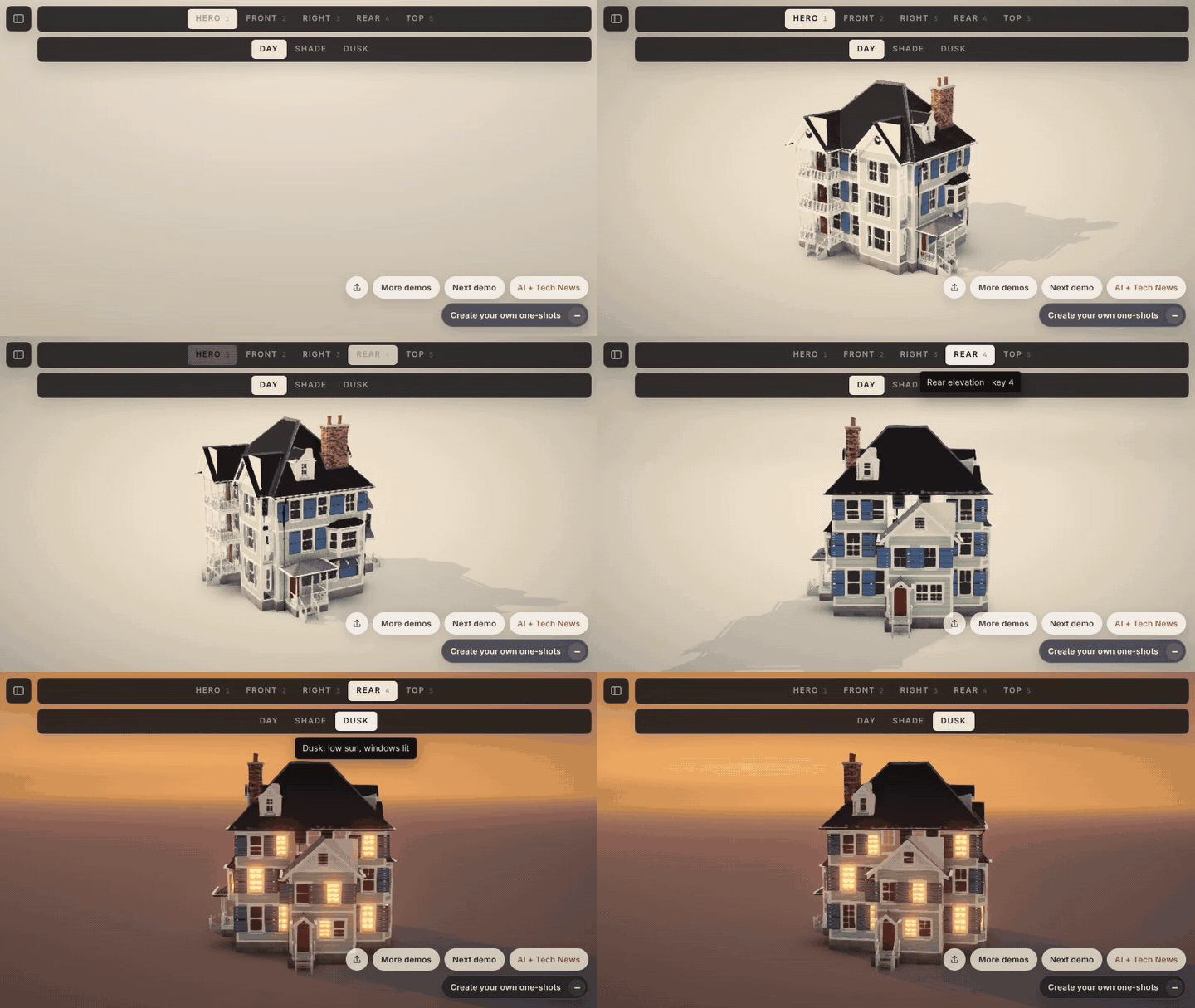
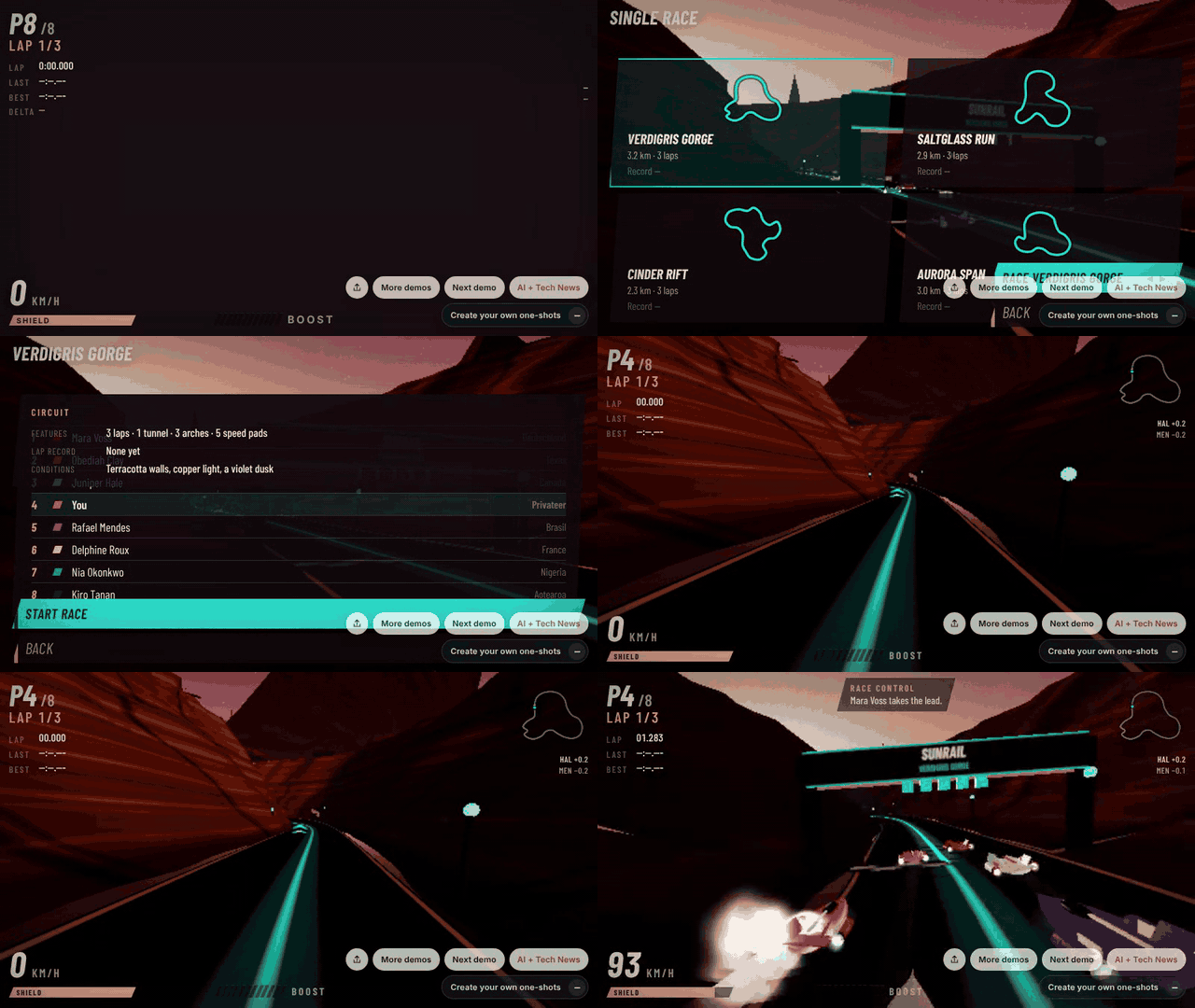
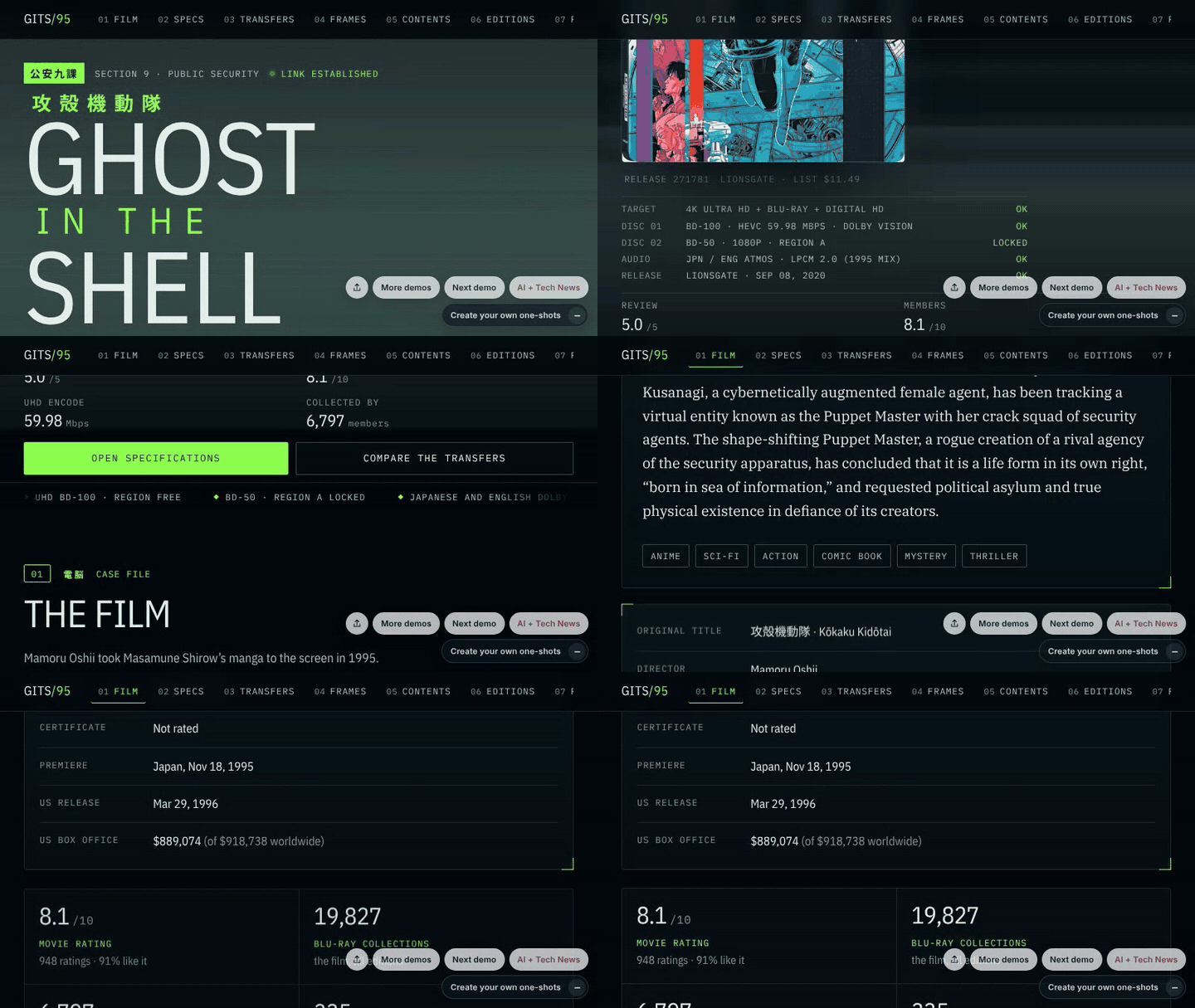
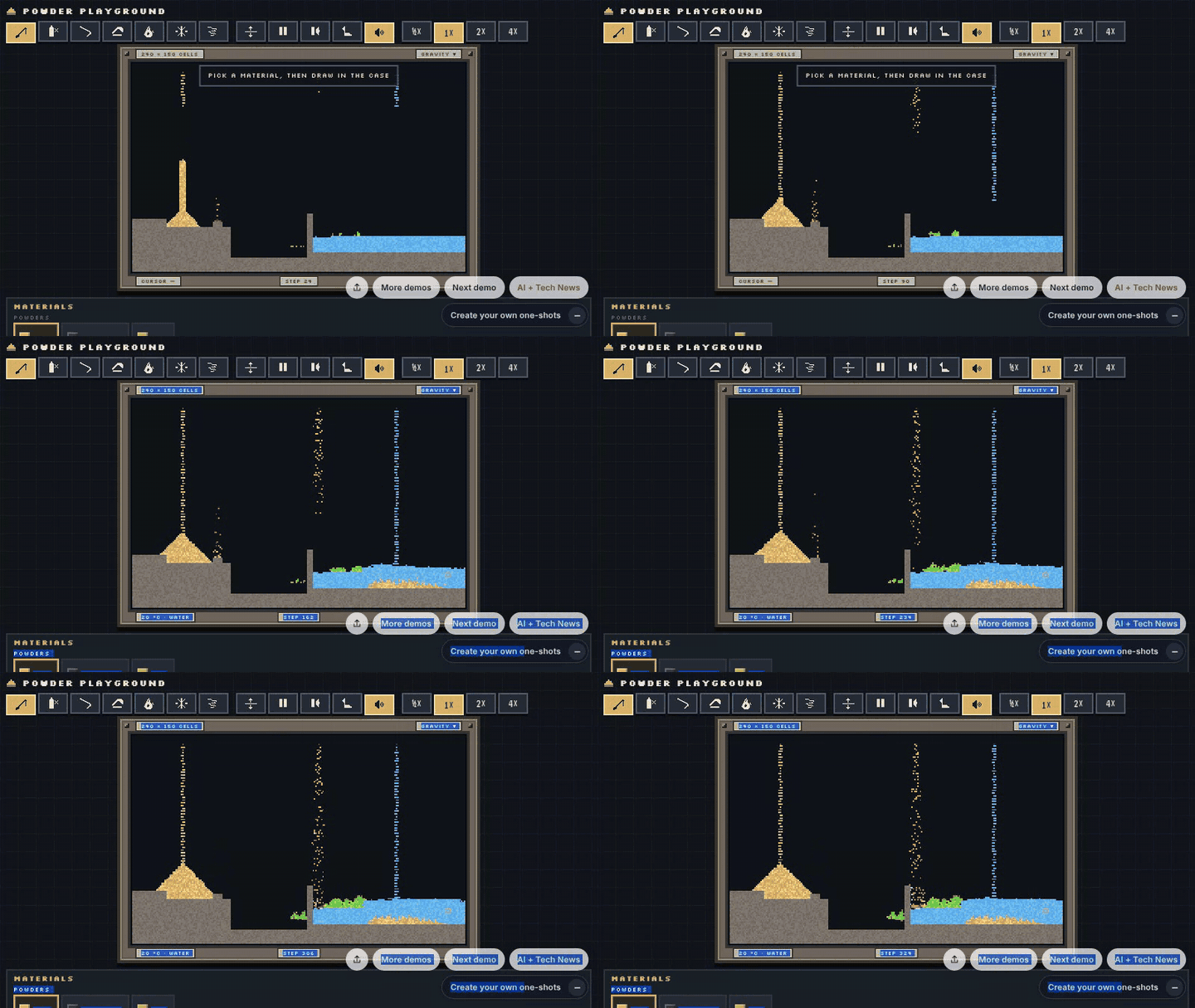
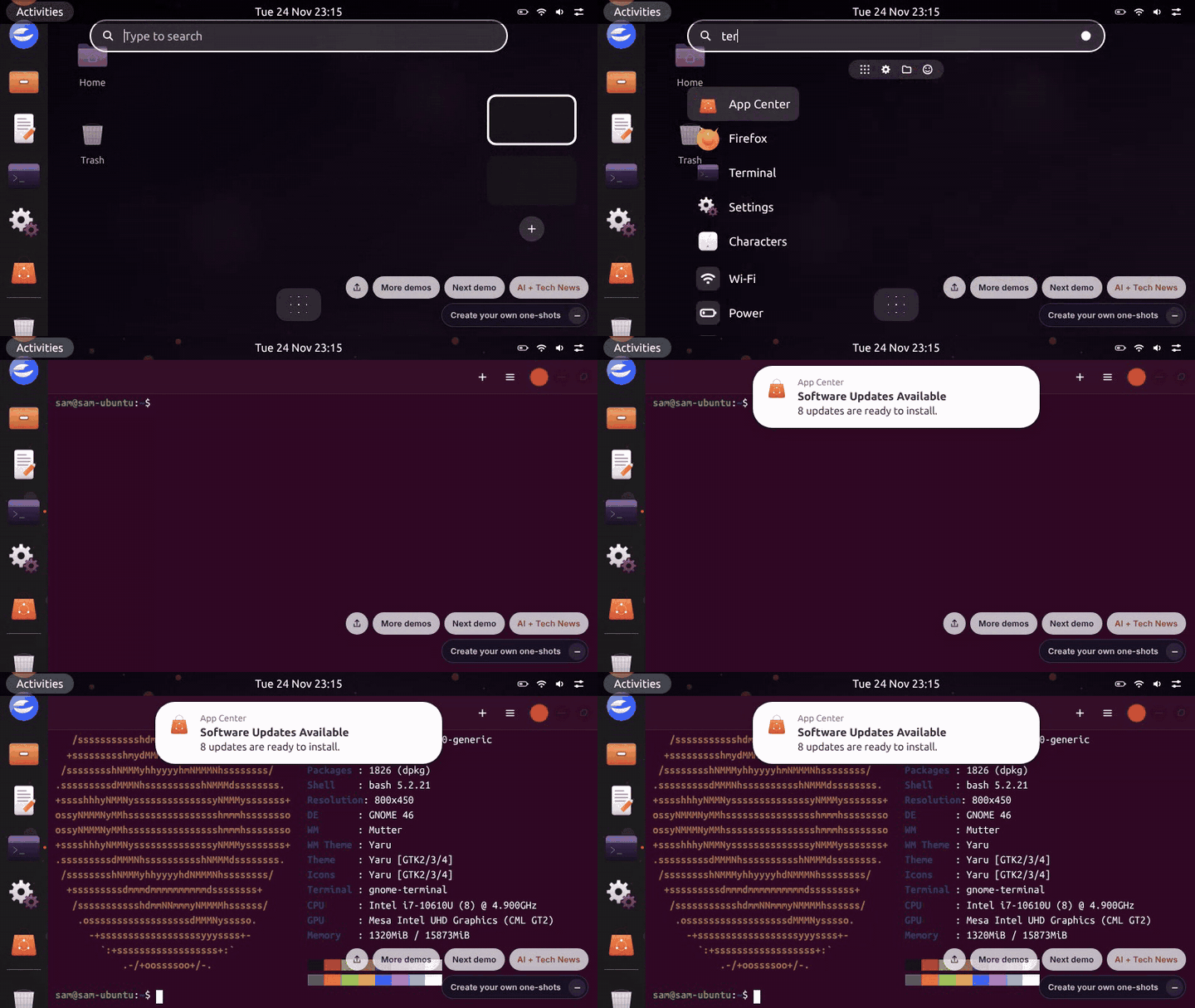
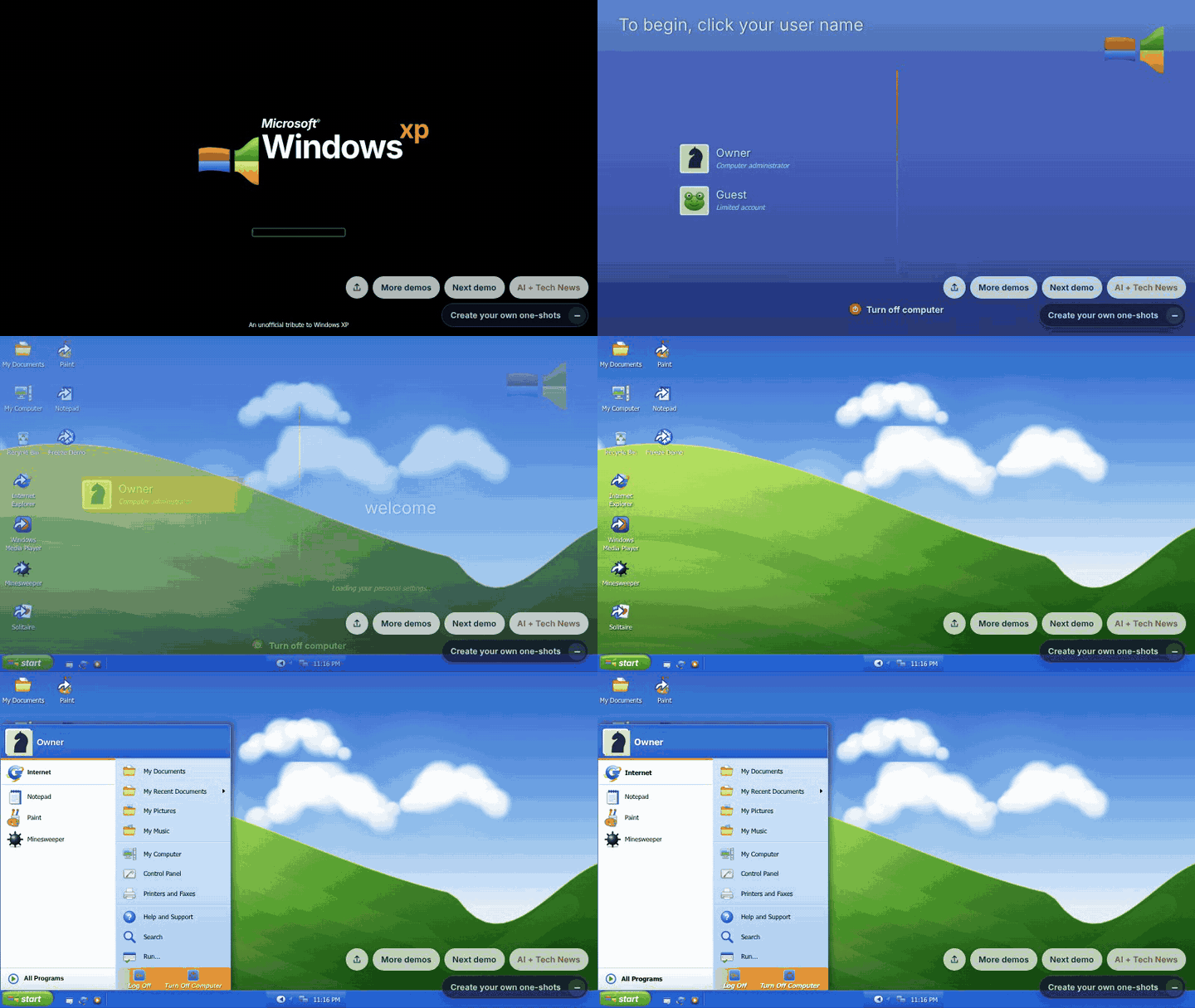
I’ve been collecting one-shot demos built with GLM-5.4, and the list is growing. The demos page hosts each one as a live, playable site. These are the ones recorded so far, captured from the live pages.




Terms used in this piece
- GLM Coding Plan
- Z.ai’s subscription for using GLM models inside coding tools such as Amp, Claude Code, OpenCode and Z.ai’s own ZCode. It doesn’t cover direct API calls from your own app.
- Loop Transformer
- A design where a group of weight-shared layers runs for several iterations, refining its own output. GLM-5.4 loops 28 layers of the GLM-5 base twice, so it reasons deeper without extra parameters, according to Z.ai.
- Credits
- The unit the plan meters usage in. Each request spends credits based on its input, cached and output tokens and the model’s multiplier.
- Peak and off-peak
- Peak is Monday to Friday, 14:00 to 18:00 Singapore time. Model usage costs half as many credits outside it, including all weekend.
- Flash
- Z.ai’s smaller, cheaper model tier. GLM-5.3-Flash was the first native multimodal GLM-5 model before GLM-5.4 added native image and PDF input to the main line.
Sources
- Zixuan Li on X, 23 November 2026, Z.ai on X and Z.ai’s GLM-5.4 blog post
- Z.ai pricing, Coding Plan overview and 30 July plan notice
- Z.ai docs: GLM-5.3, GLM-5.3-Flash and Vision MCP server
- Amp Model Routing documentation (custom model mappings and metadata overlays)
- IT Times via Tencent News, 22 November and IT Home via Phoenix Tech, 23 November
- Inference Hub, Z.ai pricing in 2026 and Bigolab, GLM Coding Plan credits
- Convika, DeepSeek vs Qwen vs Kimi for coding and Jiegec’s knowledge base, AI coding plans
- StockAnalysis, Yahoo Finance and Morningstar on Z.AI Co., Ltd. (2513)
- Bloomberg, 17 November and Latham & Watkins on the Commerce rule
- AI Engineer speaker page for Zixuan Li