Brian Chesky says almost nobody at Airbnb writes code any more, and that the company hasn’t laid off a single software engineer. The Airbnb chief executive made the claim on a bonus episode of The Economist’s Boss Class podcast, and the magazine led its promotion on X with the line.
Andrew Palmer interviews Chesky for the episode. The Economist’s page says it also covers Founder Mode, how Chesky cuts down on meetings and how generative AI keeps him company at night. That page sits behind a login, so I’ve taken the quoted line as the claim and checked it against what Airbnb has filed and said on earnings calls this year.
What Airbnb has said about its code
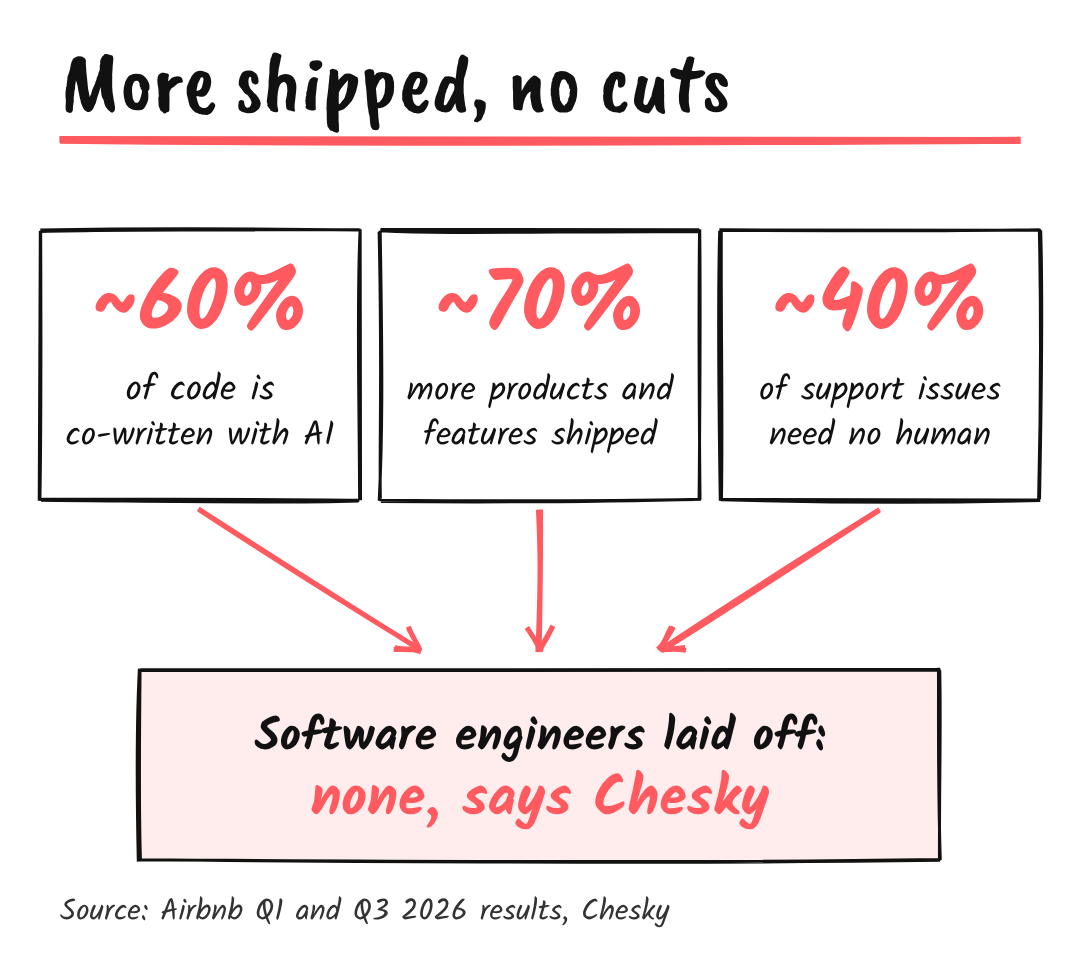
The sharpest number came with the first-quarter results in May. Airbnb’s shareholder letter said: “Nearly 60% of the code our engineers produce is now coauthored with AI—roughly twice the industry average, by our estimate.” The filed figure is a majority, not everything, and it counts code written with AI rather than code no human touches. The podcast line goes further than the letter does.
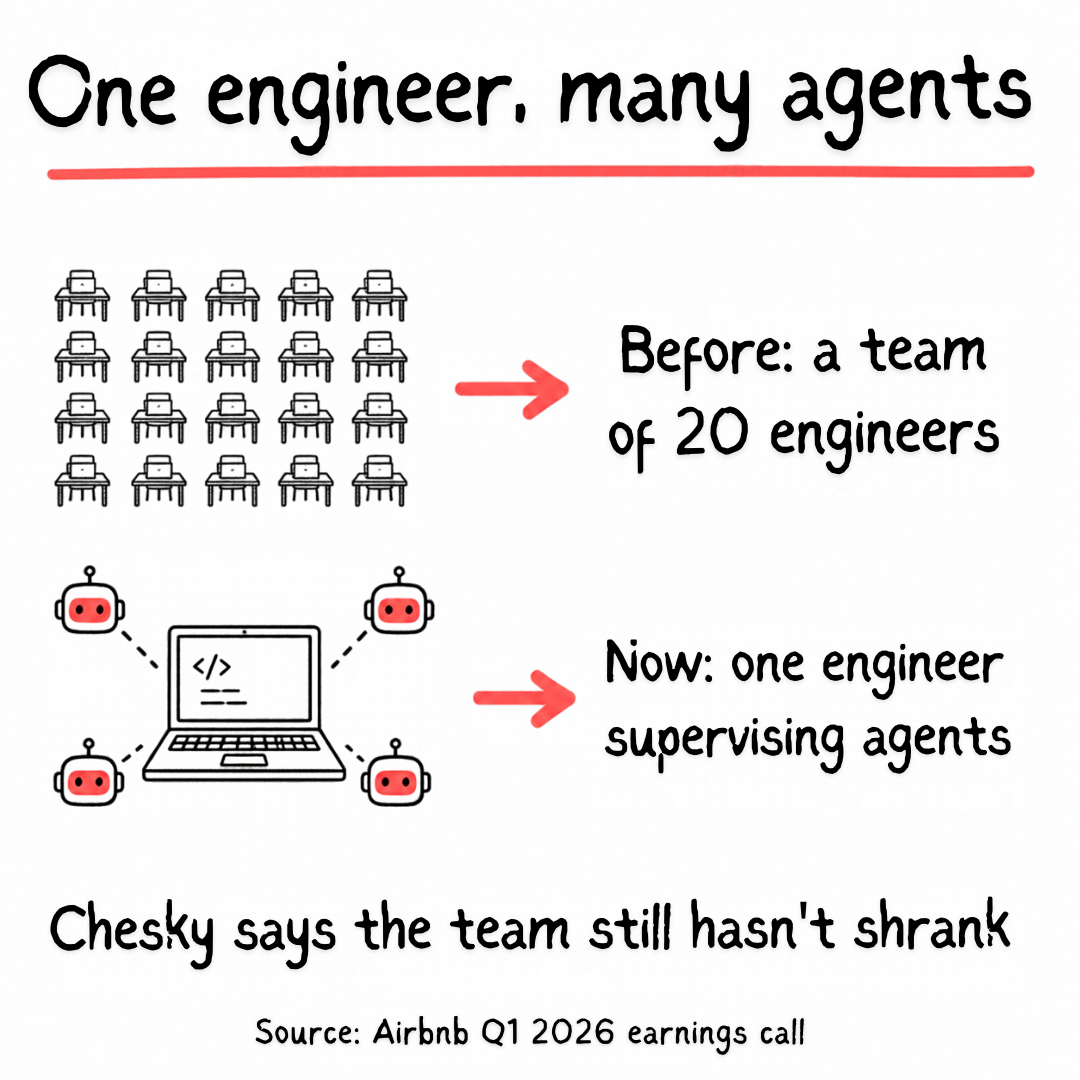
On that call Chesky described how the work changes: “where you might have needed a team of 20 engineers before, an engineer can now spin up agents to do a lot of work under supervision.” He also said, “I’m seeing, like many of our design managers and engineering managers, going back to coding or using Claude Code.” The picture is engineers who direct agents, and managers who pick the keyboard back up.
What shipped
By the third-quarter call on 5 November, output was the story. Chesky said: “In Q3 alone, we shipped more than 50 products and features, nearly 70% more than a year ago, because of AI.” Revenue grew 19% to US$4.9 billion, Airbnb’s fastest growth in more than three years. Chief financial officer Ellie Mertz put part of the margin gain down to “operating leverage from AI-driven efficiencies and customer support.”
Support is where Airbnb shows the clearest saving. About 40% of customer support issues were resolved without a human agent in the quarter, up from a third in the second, and support cost per booking fell more than 17% year on year. In August Chesky told CNBC that product-development time had fallen by roughly 60%, that Airbnb was shipping about 80% more features than a year earlier, and that it would spend “a lot more” on AI tokens than planned.
The no-layoffs claim
About 8,200
Airbnb employees at the end of 2025, per its annual report
About 13,000
Third-party workers, mostly handling community support contacts
About 9,000
Revelio Labs’ estimate of Airbnb staff by mid-2026
The annual report puts Airbnb at about 8,200 employees on 31 December 2025, and says general and administrative payroll rose that year in part because of “an increase in headcount.” Revelio Labs, a workforce data firm, estimates about 9,000 by mid-2026, with engineering the second-largest group at roughly 3,300. That’s the firm’s estimate, not an Airbnb number.
Chesky’s line on jobs has been steady all year. In January he told CNBC that AI had changed his hiring plans “not as much as I thought”. You don’t need as many people with AI to do a job, he said, but AI “accelerates the growth of your business”, so the two “kind of net out.” In August he said headcount was roughly flat while AI spending rose sharply. In May he declined to say how team structures would change: “What the implications are about how we structure our teams in the future, it is way too early to say.”
Airbnb hasn’t published an engineering headcount, so the claim that no software engineers have been laid off rests on Chesky’s word. I found no report of an Airbnb software engineering layoff in 2026.
How other companies compare
The “twice the industry average” comparison is Airbnb’s own estimate. Others report large shares too. The Economic Times reported in May that Shopify’s president said about half of its code is AI-generated and that Google put its figure at 75%. Spotify said in February that its best developers hadn’t written a line of code since December. Not every company kept its people: Coinbase announced a 14% workforce cut in May as it flattened its structure.
What to watch
- Airbnb’s next annual report, which gives year-end headcount.
- Whether Airbnb ever breaks out engineering headcount, which is the only way to test Chesky’s claim.
- Airbnb’s own AI travel agent, due to start rolling out in the first half of 2027.
Sources: The Economist, Boss Class; The Economist on X; Airbnb Q1 2026 shareholder letter; TechCrunch on the Q1 call; The Economic Times; Airbnb Q3 2026 results; Airbnb Q3 2026 call transcript; CNBC, August; Skift, January; Airbnb 2025 annual report; Revelio Labs; TechCrunch on Spotify.