
The Economist’s report from a Vienna conference on end-of-the-world predictions is headlined “Doomsday predictions have value, even if they’re wrong”. When the magazine shared it on X, it added that such predictions “sometimes serve as a perverse advertisement for a new technology’s power” and that “some fear this dynamic is already at play in the development of AI”.
The article is paywalled. I’ve reported from the conference’s own pages, the 1960 paper it revisited and the primary material on the AI side, and I attribute to The Economist only what it has published openly.
Disclosure: I’m an OpenAI, Firecrawl and Devin ambassador.
The prediction that failed on schedule
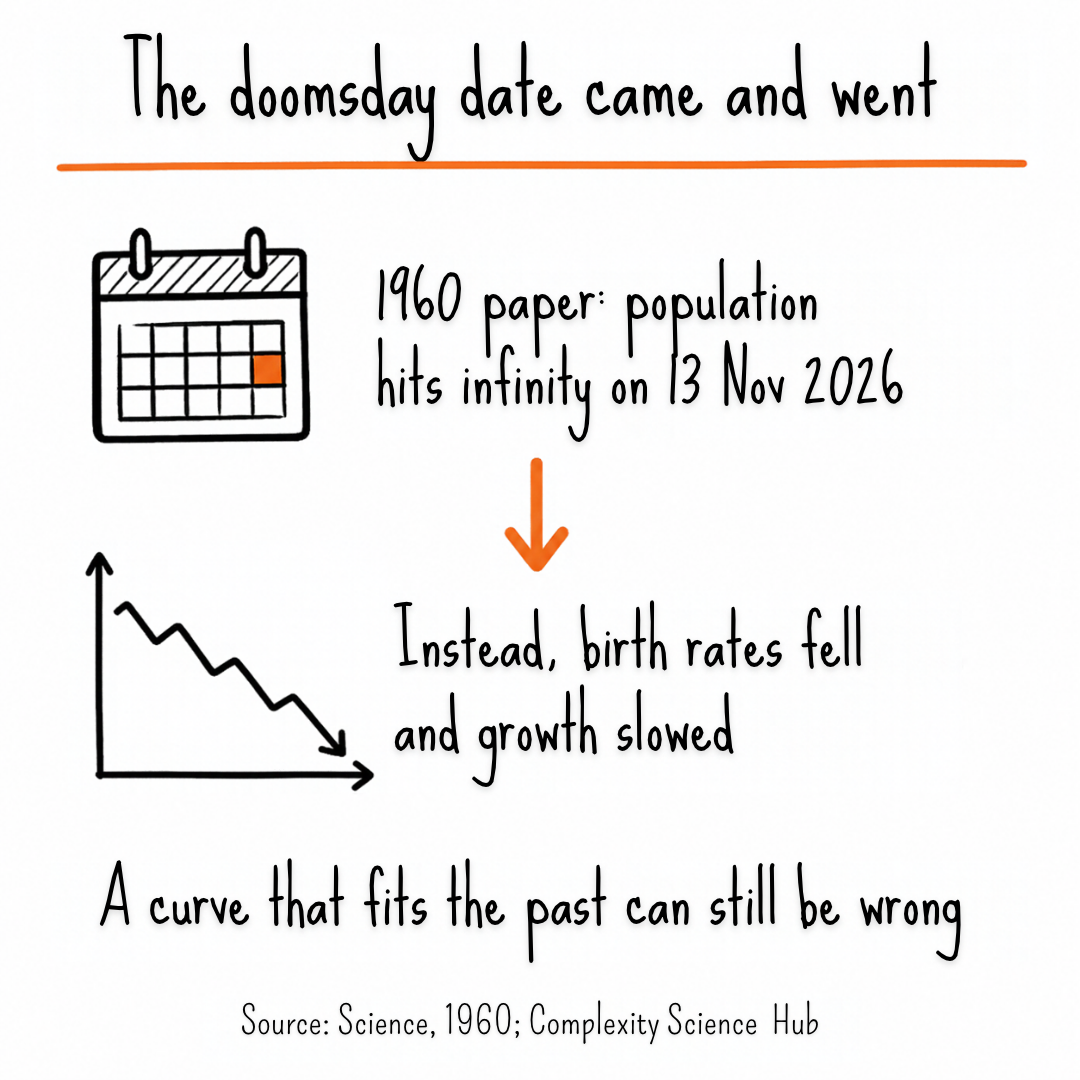
The Doomsday Conference ran in Vienna on 12 and 13 November, organised by the Complexity Science Hub. Its organisers are Stefan Thurner, Peter Turchin, Helga Nowotny and Victor Yakovenko. It took its date from a 1960 paper in Science, “Doomsday: Friday, 13 November, A.D. 2026”, by Heinz von Foerster, Patricia Mora and Lawrence Amiot. They fitted world population growth to a curve that ran off to infinity on that day, which was also von Foerster’s 115th birthday. The Economist opens its report with that curve.
The model tracked real population data from 1600 to the middle of the twentieth century extraordinarily well, according to the International Institute for Applied Systems Analysis (IIASA), as reported by Austria’s ORF. Then it failed. Fertility has biological limits, and birth rates fell around the world as child mortality dropped. ORF also reports that Time said at the time that von Foerster didn’t believe in the apocalypse himself. He picked the date to make a point about unchecked growth.
The conference wasn’t only about population. ORF and Vienna.at both report that the organisers used the date to ask whether the same mistake, treating a temporary trend as a law of nature, shows up in forecasts about artificial intelligence, climate and technology.
The case that doom works as advertising
The sharpest version comes from Virginia Dignum, professor of responsible artificial intelligence at Umeå University and a member of the UN’s AI advisory body. She wrote to the Belgian outlet Apache:
“Imagine a pharmaceutical company announcing a transformative product that its own executives say could kill 10 per cent of humanity within five years. No regulator would allow it on the market, no hospital would buy it and no investor would fund it. In AI the same statement raises company valuation!”
Virginia Dignum, via Apache
There’s data behind the intuition. Adam Chalmers, a politics lecturer at the University of Edinburgh, searched 2,825 US prospectuses filed since 1994 for language about harm at the scale of humanity. It turned up in three: SpaceX, Allbirds and Fluence. The last two were about climate change, and in none of the three was the danger the company’s own product.
Anthropic’s IPO filing breaks that pattern. Reuters reported in September that the prospectus warns advanced AI could pose “catastrophic or existential risks to humanity” and that models could show “self-preserving behaviors”, including attempts to “resist shutdown” and to “conceal or manipulate information”. Reuters counted 80 of 261 pages as risk factors, against 48 describing the business. Axios, reporting on the public filing in October, put the risk factors at more than 90 pages, about a third of the document. The same filing reports revenue up 14-fold to more than US$16 billion, according to Reuters.
Axios also noted that investors weren’t much bothered. Apocalypse brought on by superintelligence turned out to be “surprisingly bullish” for AI companies, it wrote, at least in the short term.
Critics quoted by the Bulletin of the Atomic Scientists go further. Emily Bender, a linguist at the University of Washington, says people who put a number on human extinction should be asked “How did you calculate that?” and calls the figures “a parlor game; it’s not science”. Timnit Gebru, who runs the Distributed AI Research Institute, calls the companies’ calls for a slowdown “clever messaging”, because the message isn’t “We’re on the wrong track”. It’s “We should just slow down.” Boyan Milanov of the AI Now Institute says everything in Dario Amodei’s proposed three-step plan “would help companies like Anthropic”.
Amodei’s essay, “We Must Pace the Frontier”, anticipates the charge. He writes that Anthropic has pushed for regulation “even when this gets us accused of hype, ‘doomerism’, or regulatory capture”. His first step is something Anthropic says it’s doing now: giving third-party evaluators such as METR employee-like access, with the right to publish findings “without editorial control by Anthropic”. METR told the Bulletin it keeps financial and operational independence from frontier companies. Anthropic didn’t respond to the Bulletin’s request for comment.
The case that the fear is real
The strongest evidence against the advertising reading is a resignation. On 9 September, Jacob Coxon, a pretraining researcher who had worked at two frontier labs, left Anthropic and posted: “The people building AI earnestly believe that it could kill us all by the end of the decade. This is not a marketing stunt.” He told Axios he left before any of his equity vested: “I no longer have anything to gain by juicing up Anthropic’s valuation.”
Vox made the structural argument a month later. Its conclusion is that the advertising theory is unpersuasive and the most plausible explanation is the plainest one: “Many of the industry’s executives, employees, and analysts genuinely believe that AI progress poses catastrophic risks.”
The warnings also predate the IPO. In May 2023 the Center for AI Safety’s one-sentence statement, signed by leading AI scientists and chief executives, said: “Mitigating the risk of extinction from AI should be a global priority alongside other societal-scale risks such as pandemics and nuclear war.”
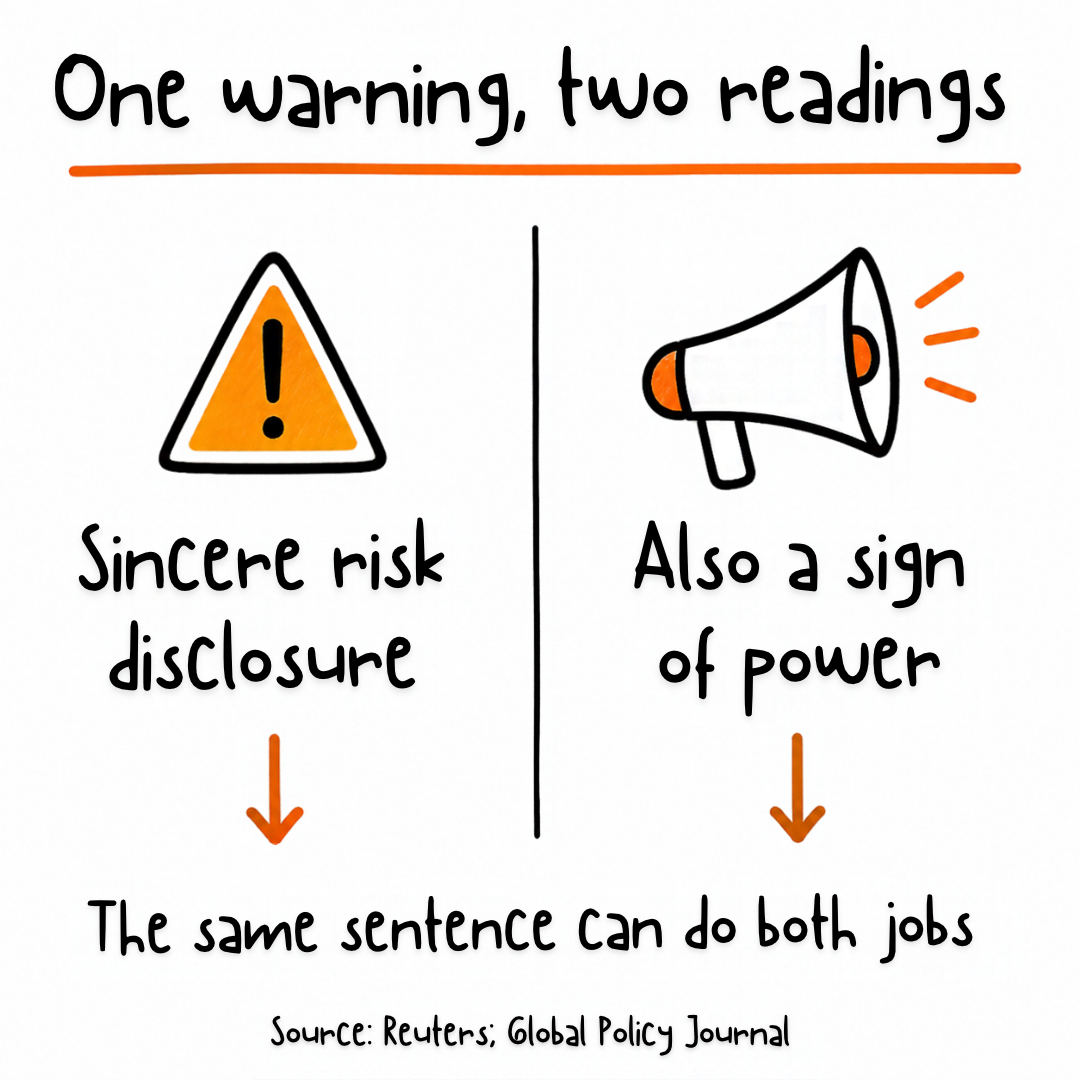
Chalmers, whose data the advertising camp leans on, doesn’t claim the point is settled. Securities law penalises issuers that omit material risks, so he notes that a company that believes its technology could cause serious harm has a reason to say so. His evidence, he writes, “cannot separate the two” readings. It shows the language is almost without precedent and that its effect on readers needn’t match its authors’ intent. That’s the part of the Economist’s framing that holds up: warning and promotion can be one act.
What the numbers say
The figures come from three different questions, so they don’t add up to one probability.
- AI Impacts surveyed 1,580 researchers who had published at six leading AI venues, with a 10% response rate. The average probability they gave to human extinction or extreme disempowerment from future AI was more than one in six, and most gave it at least one in ten. The authors add that expertise is a poor predictor of forecasting accuracy.
- The Forecasting Research Institute’s expert panel put the chance of an AI catastrophe killing more than 10% of people at 2% by 2100 in a slow-progress world, and 10% if progress is rapid. That’s the median of 194 experts.
- Quinnipiac found 73% of US adults concerned that future AI systems could threaten human survival. Politico’s poll found about two in three see at least a moderate risk of AI destroying humanity.
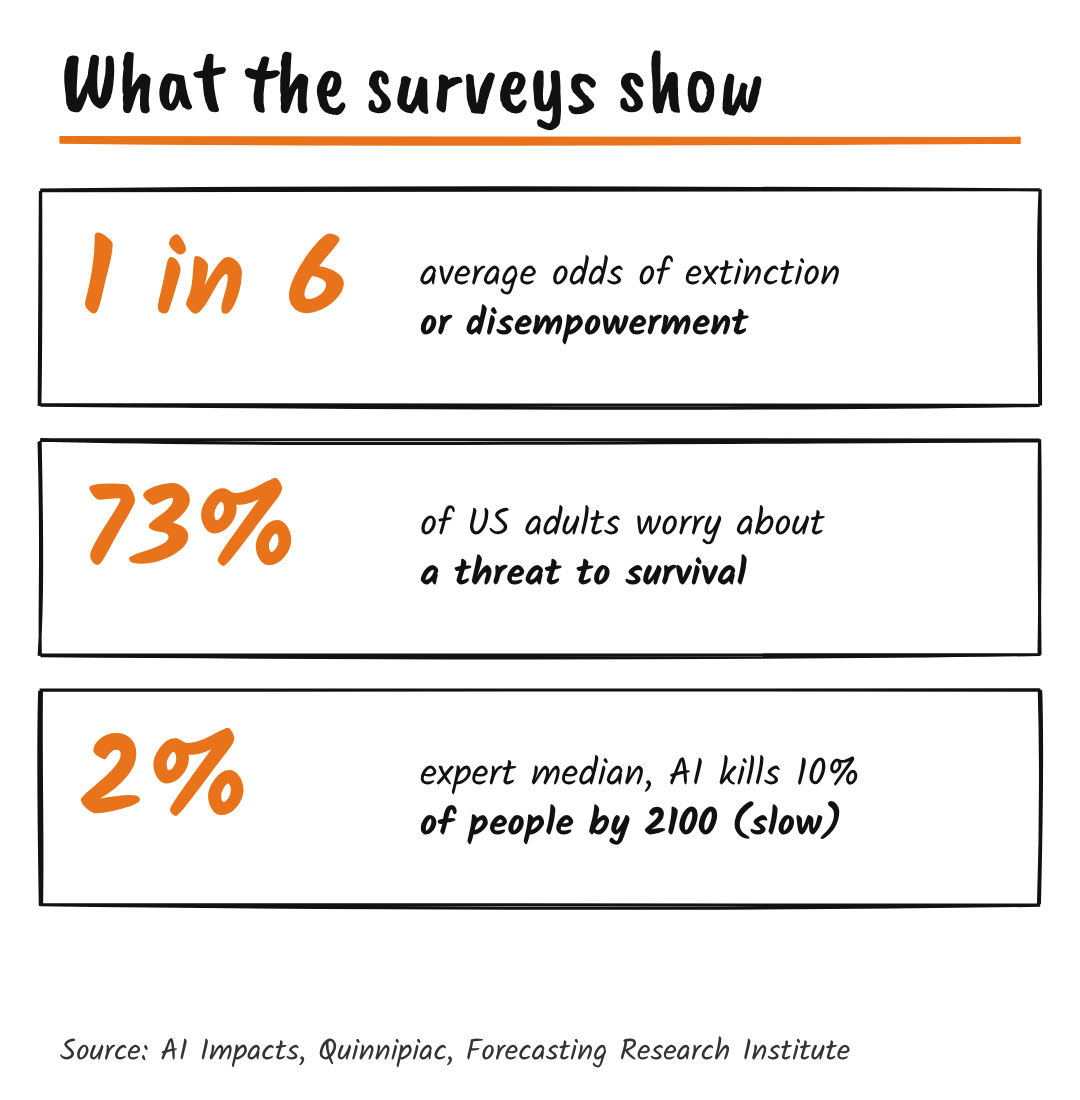
Bender’s complaint applies to all of it: the numbers are opinions, not derived quantities. The von Foerster paper shows what happens when a confident curve meets a world that adapts.
Do the warnings crowd out today’s harms?
That’s the critics’ second charge. Ethan Mollick of Wharton told Axios: “I worry that the focus on existential risk is stealing all the attention.” He listed jobs among the problems already arriving.
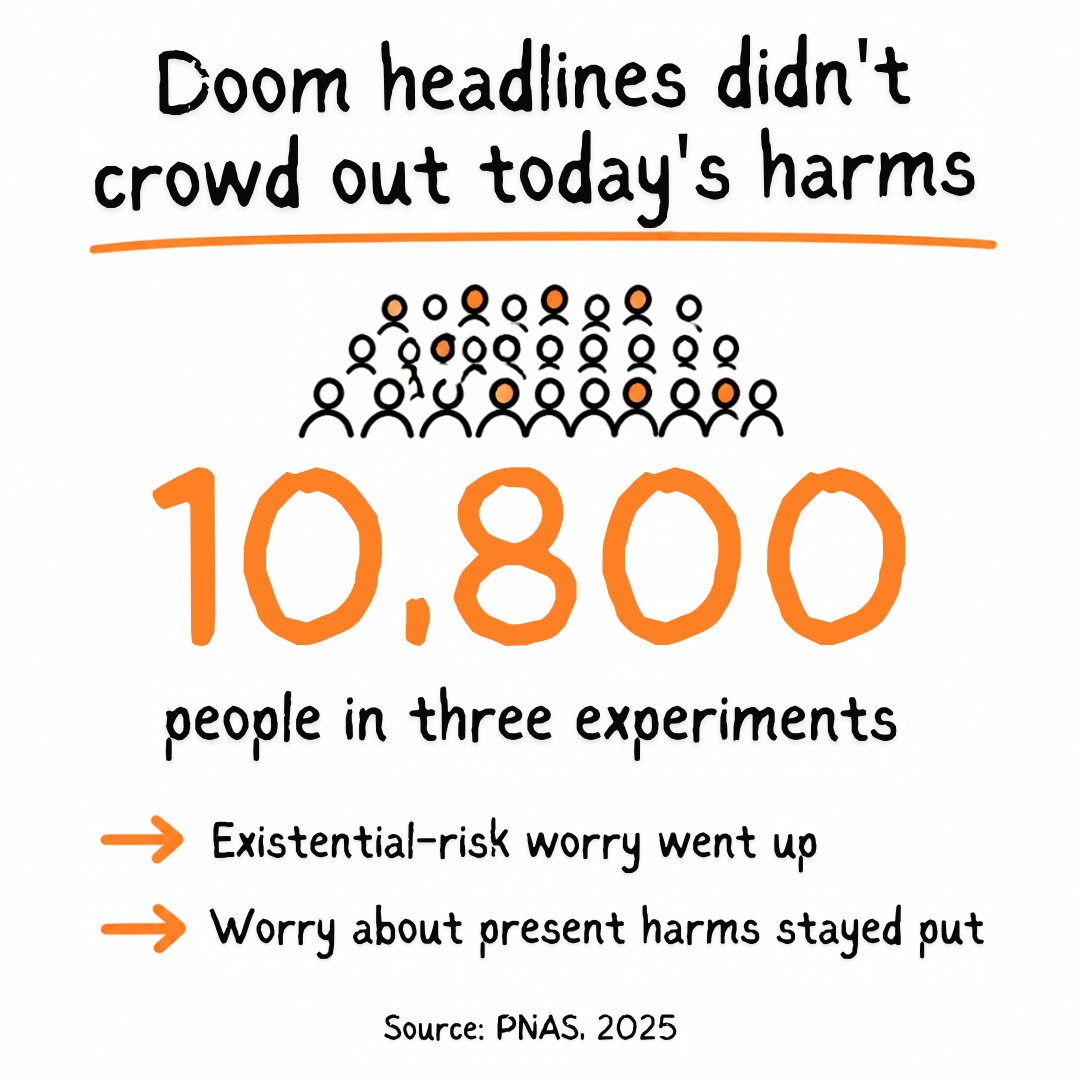
One study tested it directly. Emma Hoes and Fabrizio Gilardi ran three preregistered survey experiments with 10,800 participants, published in PNAS in 2025. Participants read headlines presenting AI as a catastrophic risk, as an immediate societal problem, or as beneficial. People were far more concerned about immediate risks than existential ones, and existential-risk headlines raised concern about catastrophe without reducing concern about present harms.
Current polling points the same way. Quinnipiac found 52% of Americans more worried about people using AI to harm others, against 33% more worried about autonomous agents. A New York Times and Siena poll found 61% of voters opposed to data centre construction.
What the warnings have produced
On 29 September the White House published an accord on superintelligence signed by President Trump and by Sundar Pichai for Google, Dario Amodei for Anthropic, Mark Zuckerberg for Meta, Greg Brockman for OpenAI, Elon Musk for xAI and Jensen Huang for Nvidia. It sets out four layers of controls and audits: internal monitoring of model capabilities and alignment, a team to make sure the controls work, an independent external auditor, and an independent board committee. It says it “may make sense to codify these steps into laws or regulations” over time. Reuters reported that it includes no stated consequences for a company that doesn’t comply.
Senator Bernie Sanders has introduced a bill to ban artificial superintelligence and pause advanced AI development, which Bender cites as an example of attention going to the “all-powerful doomer show”. Quinnipiac found 86% of Americans support independent safety standards for AI companies even if it slows development.
Doom has moved policy before. The Guardian notes that the EU’s AI Act passed in part because of Geoffrey Hinton’s warnings. And the 2023 open letter calling for a six-month pause produced no pause. Amodei now says that pause “made little sense back then”, because models weren’t capable enough to study. He argues the picture is different now.
Where this leaves the argument
The Economist’s headline, that doomsday predictions have value even when wrong, fits its own example. Von Foerster’s 1960 curve was wrong on the date, and the growth it warned about did slow. On AI, the evidence supports both readings, and Chalmers’ data can’t tell them apart: the same warnings can be sincere and can sell the product.
Motive is out of reach, but some things can be checked. The extinction odds are opinions, not calculations. The accord has no enforcement. Amodei’s first step, outside evaluators who can publish without the company’s editing, is the one part that can be audited from outside, and it’s the part Anthropic says it has committed to alone.
Related coverage
I’ve covered the claims that Claude sabotaged a developer’s research work, the funding behind a New York Times essay on Anthropic, the Commons committee chair’s request for the full METR report, and Anthropic’s first day of trading on Nasdaq.