

Yehuda Lindell, Coinbase’s head of cryptography, posted on 28 November that “rumors and speculation about cryptographic breaks need to be separated from major research breakthroughs coming out of AI labs.” His post linked to a Coinbase statement that goes further: the company says it doesn’t currently believe there’s an AI breakthrough that poses “an immediate and practical threat” to the cryptography modern systems rely on.
It answers a week of talk that AI labs hold a fast way to factor large numbers, which I covered in an earlier piece. This one covers what Coinbase said, what it rests on, and how the rest of crypto is responding.
What Lindell and Coinbase said
Lindell adds that “AI can help find weaknesses in cryptography. That’s good for security in the long run. Meanwhile, we are focused on being ready.” Lindell is a professor at Bar-Ilan University on leave, co-wrote the textbook Introduction to Modern Cryptography, and joined Coinbase in 2022 when Unbound Security, the key-protection company he co-founded, was acquired.
The Coinbase post, AI and cryptography: What we know and how we protect client assets, opens with its position:
“Despite all the rumors over the last week, we have deep connectivity across AI and cryptography and we do not currently believe that there is an AI breakthrough that poses an immediate and practical threat to the cryptography that modern systems rely on today.”
Coinbase, 28 November 2026
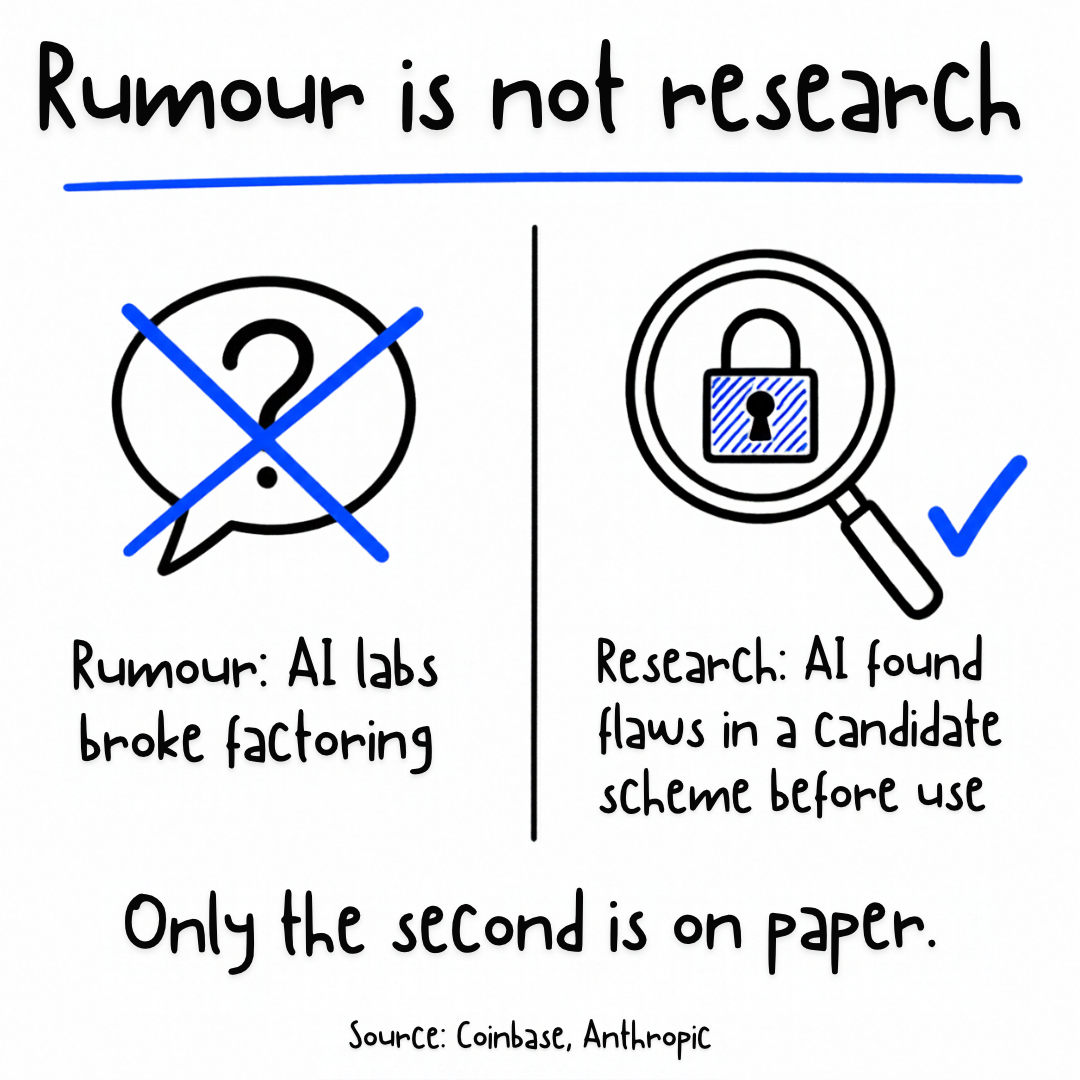
It then splits the reports in two. Rumours that AI labs found a polynomial-time factoring algorithm, “and possibly more”, have drawn attention, but “public clarifications have fallen well short of confirming such a result.” Separately, there are reports of advances in theoretical cryptanalysis, which Coinbase says have been described as posing “no imminent danger to currently deployed cryptosystems.” The broader rumours, it says, remain unsubstantiated, and it has seen “no specific, actionable information” behind them.
One real result gets a mention: “Researchers using AI have recently published a mild improvement to factoring that affects RSA (which is not used in blockchains).” Coinbase doesn’t say which work it means. The factoring papers Google Research posted on 25 November are the ones I covered earlier.
US$377 billion
Assets on Coinbase at the end of Q3 2026, by its count
About 12%
Share of all bitcoin Coinbase says it holds
4
Public post-quantum steps Coinbase lists for 2026
Where the rumours came from
The trail starts with Scott Aaronson, the University of Texas at Austin computer scientist. On 25 November he wrote that he was “virtually certain, from multiple reliable sources, that the AI labs are now sitting on one or more bombshells” in cryptography, while feeling “much, much less confident” about what they are.
On 27 November he added a comic dialogue post, Every call, in which his own character answers a reporter. He says he has “specific information that the labs will soon release a major breakthrough in theoretical cryptanalysis” that “will not lead to imminent danger for any currently deployed cryptosystems.” Separately, he says he has heard “endless rumors and speculations” about what else the labs might have, “including breaks that would cause imminent danger if they were real,” but has no “specific, actionable information there.”
Coinbase doesn’t name Aaronson, but its two key phrases, “no imminent danger” and “no specific, actionable information”, match his wording.
Why a factoring result isn’t the blockchain worry
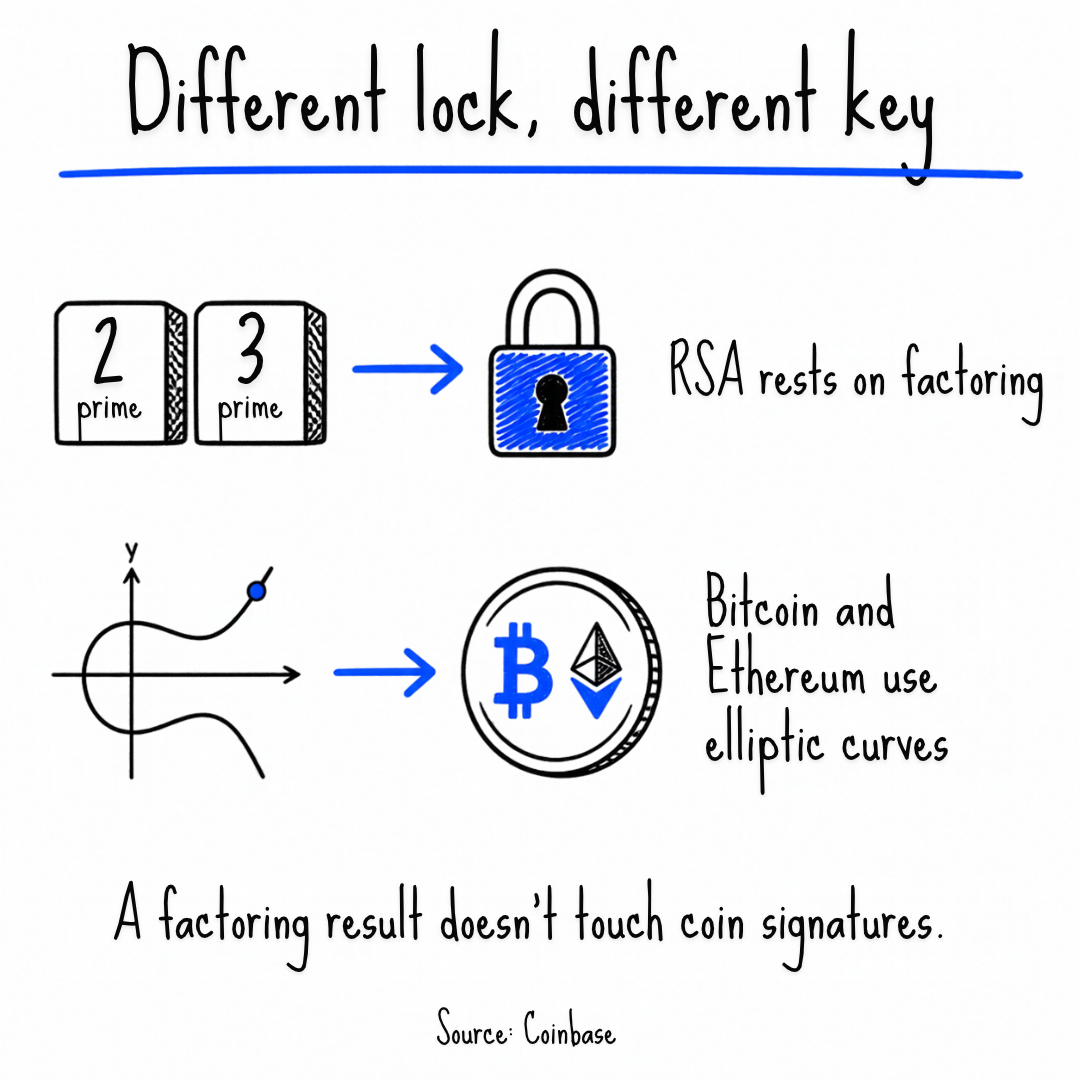
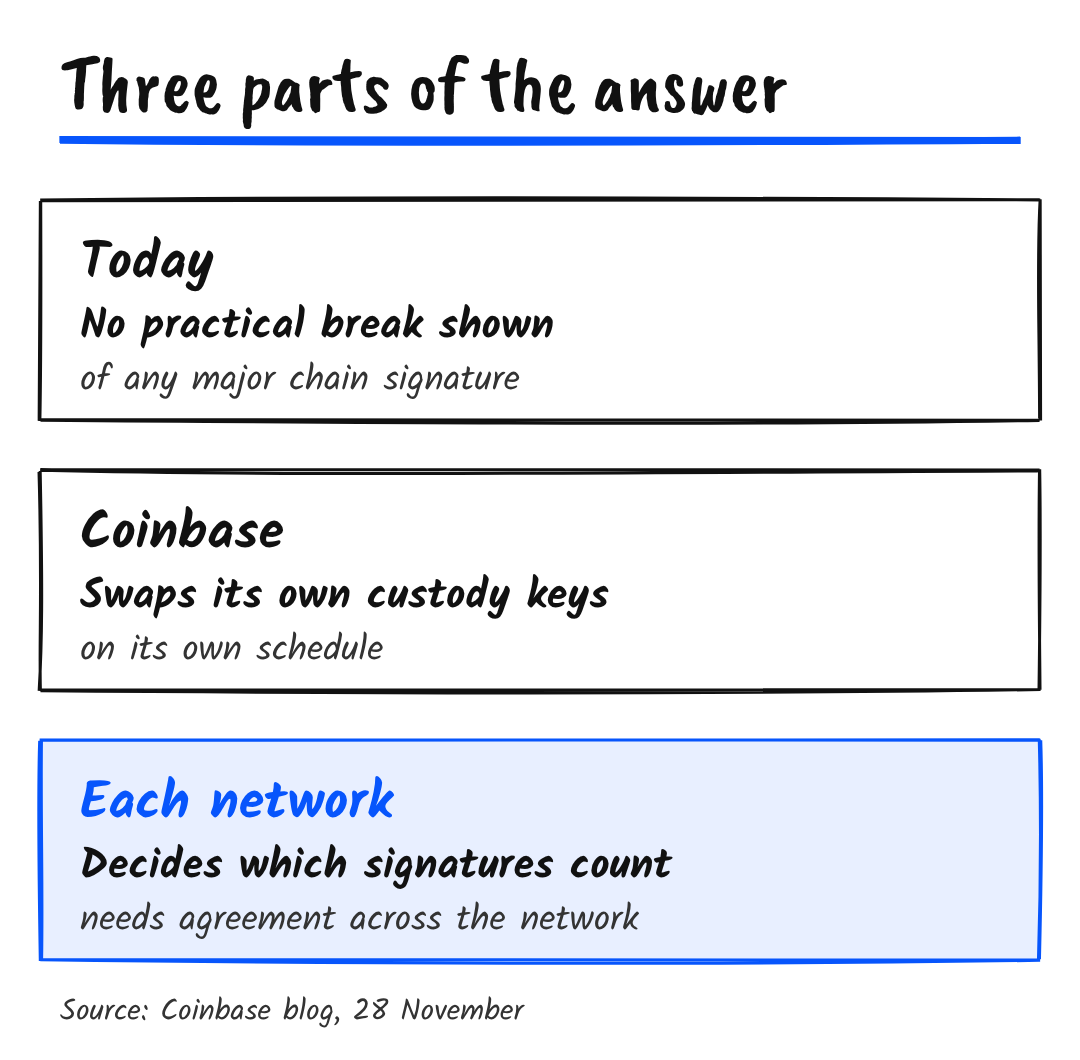
RSA’s security rests on factoring. Bitcoin and Ethereum sign transactions with elliptic-curve cryptography, which rests on a different problem. A fast factoring method would hit RSA and leave coin signatures alone, which is why Coinbase notes RSA “is not used in blockchains.” Coinbase adds that “no one has publicly demonstrated a practical break of any major blockchain’s signature scheme.” Aaronson, for his part, declined to say whether ECDSA, the scheme Bitcoin uses, is broken and told readers who want that answer to look elsewhere.
The two studies Coinbase points to
Coinbase says there’s “real progress worth paying attention to,” and links two pieces of research.
Anthropic, July. Researchers used Claude Mythos Preview to improve the best-known attack on HAWK, a candidate post-quantum signature scheme in NIST’s additional-signatures process. In about 60 hours the model cut the expected cost of a full key recovery on the small HAWK-256 size from 264 to 238, effectively halving its key strength. Anthropic says the attack is still exponential and “does not run in polynomial time,” that HAWK isn’t deployed, and that nothing in production has to change. A second result sped up attacks on a 7-round version of AES-128 by 200 to 800 times; the full cipher has 10 rounds and isn’t broken. Anthropic puts the API cost of each result at roughly US$100,000.
Google, March. Google Quantum AI’s whitepaper compiled circuits that could break 256-bit elliptic-curve keys on a superconducting quantum computer with fewer than 500,000 physical qubits in a few minutes. That’s about a 20-fold cut in the qubits earlier estimates needed. Google shared the circuits through a zero-knowledge proof so the claim can be checked without handing over a roadmap, and it points to its own 2029 migration timeline for post-quantum cryptography. No such computer exists today.
264 to 238
HAWK-256 key-recovery cost, before and after Anthropic’s attack
<500,000
Physical qubits Google estimates it takes to break 256-bit elliptic-curve keys
About 20x
Reduction in qubits against earlier estimates
Coinbase’s reading is that finding weaknesses before a design ships “is exactly what security research is supposed to do.”
What Coinbase says it has done
| Month | Step |
|---|---|
| January | Set up an independent advisory board on quantum computing and blockchains |
| April | Board’s first assessment: quantum isn’t a practical threat to blockchains today, and migration planning should start now |
| July | Announced PQ-CoreKMS, a custody key-management system built to support different post-quantum signature schemes; became a founding member of the Bitcoin Security Consortium |
| October | Published proposals for Bitcoin’s transition: start early, leave room for future signature upgrades, let wallets migrate in stages |
Coinbase says that work began with quantum computing in mind but “applies just as well to a mathematical advance, whether found by people or by AI.” The remedy is the same either way: move to new signature schemes and build cryptographic agility, the ability to switch schemes quickly. It also makes a promise: it has “not identified a credible threat to client assets,” and if it does, it will say so “publicly and promptly.”
Two limits come with that. Keeping public keys out of view, where a network’s address design allows it, can reduce exposure to certain attacks, but Coinbase says it isn’t a substitute for upgrading signatures. And Coinbase can upgrade its own systems on its own schedule, while each network decides which signatures it accepts, and changing that takes agreement across the network.
How the rest of crypto is responding
- Zcash. The Zakura infrastructure team urged users on 26 November to move funds out of the legacy Sapling shielded pool and recommended a network upgrade to disable payments into it, citing the AI rumours. It called a practical break of Sapling’s pairing-based cryptography “highly speculative.”
- Ethereum. On 24 November the Ethereum Foundation recommended Keccak-256 as the hash function for Ethereum’s hash-based cryptography, in a post framed around a “post-quantum, post-AI era.”
- Analysts. K33 Research said on 27 November that recent AI maths results haven’t shown a compromise of Bitcoin’s cryptography, though they warrant closer attention. Quantus founder Christopher Smith told Cointelegraph there’s no proof that factoring or discrete logarithms can be solved efficiently.
What to watch
- The theoretical cryptanalysis result Aaronson says the labs will soon release.
- Any update from Coinbase, which has promised to publish what it knows if it finds a credible threat.
- Post-quantum signature proposals on Bitcoin and Ethereum, since each network decides for itself.
For holders, Coinbase’s position is that nothing changes today.
Sources: Coinbase, 28 November 2026; Yehuda Lindell on X; Aaronson, 25 November 2026; Aaronson, 27 November 2026; Anthropic, July 2026; Google Research, 31 March 2026; Coinbase, 13 October 2026; Lindell’s site; Ethereum Foundation, 24 November 2026.
Disclosure: I’m an OpenAI, Firecrawl and Devin ambassador.