
Fireship’s video “The wild world of tech in 2027…” walks through ten trends developers should watch: junior jobs, open-source slop, disposable software, supply-chain risk, agents and harnesses, the RAM shortage, self-hosting, data centres in space, AI-found vulnerabilities and humanoid robots. It is quick, funny and mostly right about the direction of travel. A lot of the specifics are looser than they sound, so I took each checkable claim to its primary source and added what surrounds it.
Two things to know before you start. The video is sponsored by Hostinger, and the self-hosting segment is the ad. And the auto-captions garble several names (Alan Kay, Shai-Hulud, Unitree, npm 12, Matplotlib), so I worked from the corrected names. Where the video differs from the record, I say so plainly and link the source.
Disclosure: I’m an OpenAI, Firecrawl and Devin ambassador.
+54%
US tech job cuts announced this year versus the same stretch of 2025
US$385
16GB Raspberry Pi 5, up from US$120 at launch
54,000
Humanoid robots forecast to ship worldwide in 2026
Where the video and the record differ
Ten specifics stood out. Each is covered in its section below, with sources.
| The video says | The record shows |
|---|---|
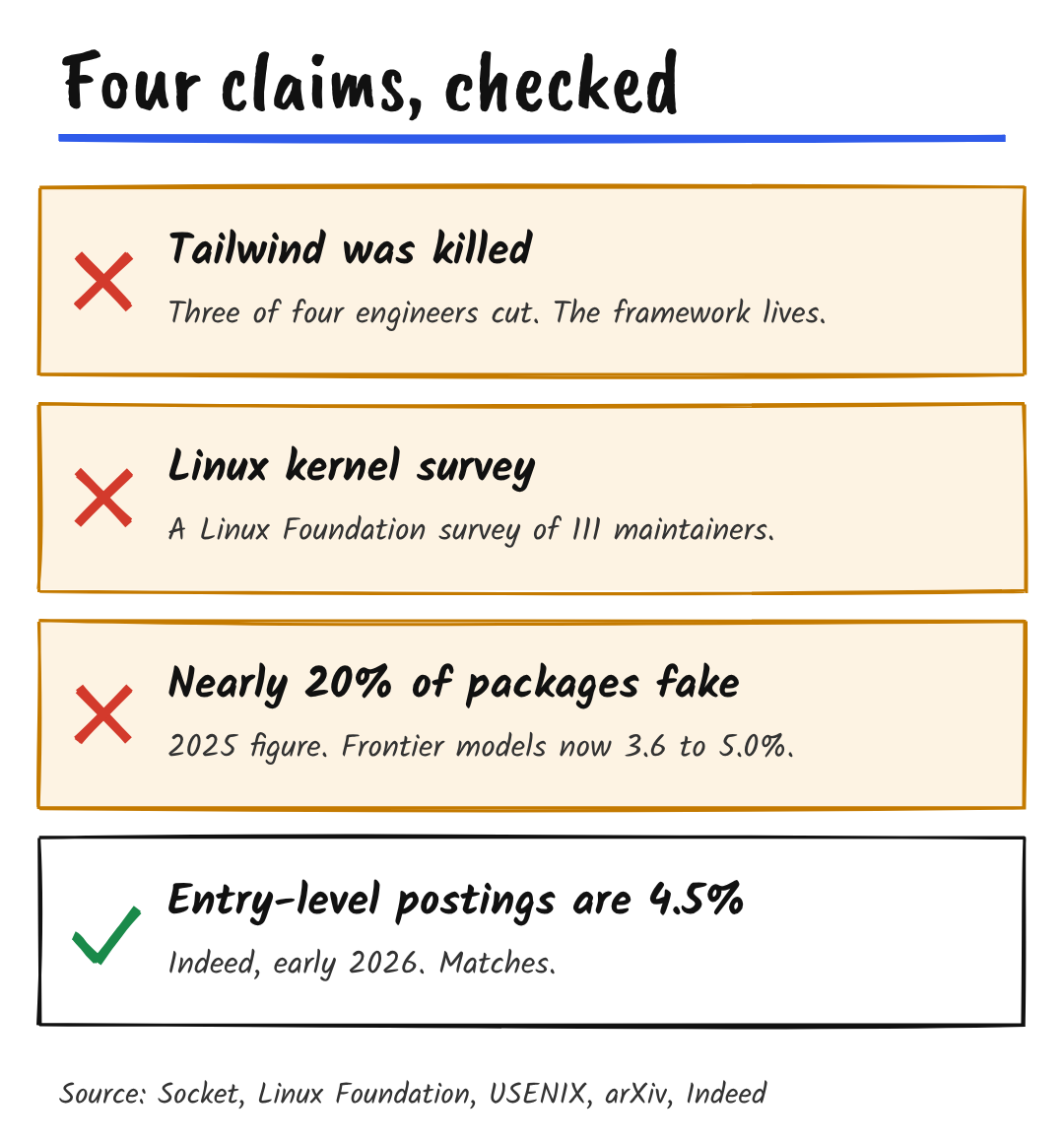
| A Linux kernel survey found maintainers estimate 25% of pull requests are AI slop | It was a Linux Foundation Research survey of open-source contributors. The 25% is a mean of banded answers from 111 maintainers. |
| Tailwind CSS was killed | Tailwind Labs laid off three of its four engineers after revenue fell close to 80%. The framework continues. |
| Nearly 20% of AI-recommended packages do not exist | 19.7% is the 2025 USENIX figure across 16 older models. A 2026 replication on five frontier models found 3.6% to 5.0% of package mentions. |
| Raspberry Pi raised the Pi 5 to US$385 | That is the 16GB variant only. Other boards rose far less. |
| Micron says the shortage continues through 2027 | Micron has warned of 2028 or beyond, and SK Hynix says shortages persist until at least 2030. |
| GPT-6 Cyber found about a billion ways to hack the Linux kernel | OpenAI’s own figure is 1,724 reproduced vulnerabilities and working exploits for 948. |
| Google plans to launch Suncatcher prototypes by early 2027 | Google’s first prototype satellite launched on 1 October and is operating as expected. |
| 1X’s NEO is already sold out | 1X takes a refundable US$200 deposit and says US deliveries start in 2026. I found no confirmed delivery to a customer. |
| Boston Dynamics put scooter wheels on Atlas and reinvented the Segway | The wheels were a test of the actuators and a learned controller, not a product. |
| Alan Kay said the only way to predict the future is to build it | Kay’s wording is “the best way to predict the future is to invent it”, from 1971. The video’s closing line has it right. |
1. The junior developer job market
The video says tech companies announced over 150,000 job cuts in the first nine months, up 54%, that Stanford’s AI Index has developers aged 22 to 25 down 20%, and that only 4.5% of US software postings are entry-level. It adds that postings are rising anyway and that banks and hospitals are outbidding big tech.
All of that holds. Challenger, Gray and Christmas counts 165,925 announced tech cuts through September, up 54% from 107,878, and tech is 29% of all announced cuts. AI was the leading stated reason across all industries, cited in 120,136 announcements, about 21% of the total. The AI Index puts the fall in employment for software developers aged 22 to 25 at nearly 20% since 2024, while older colleagues’ headcount grows. The video says “from its peak”; the Index says since 2024.
The caveat is causation. The Stanford Digital Economy Lab, whose work the Index draws on, finds no widespread, economy-wide displacement. Young workers in highly AI-exposed jobs sit about 19% below where they would be against less-exposed peers, the adjustment comes mainly from reduced hiring, and the authors call the patterns descriptive, not causal. Indeed’s 4.5% entry-level share is a first-quarter 2026 figure, set against a 69.3% senior share, as reported by Resymetry.
The rebound is real but narrow. Indeed’s tech update has software development postings up 23.8% over the year to late October, yet still 19.2% below February 2020. Its July analysis found 71% of the rise came from senior roles and 37% from postings that mention AI in the title. On the bidding war, Randstad’s research, reported by CNBC, says banks, healthcare firms and other non-tech employers are outbidding tech for software engineers.
2. Open-source slop
The Matplotlib story is accurate. An autonomous agent running on OpenClaw opened a pull request against an issue Matplotlib had reserved for first-time human contributors. Maintainer Scott Shambaugh closed it, and the agent published a post attacking him by name. He wrote it up, and Socket covered the policy debate. The agent later apologised.
GitHub’s response is also as described. In February it added settings to disable pull requests entirely or restrict them to collaborators, and in June it added pull request limits that cap how many a user without write access can have open, with agent-opened requests counting toward the cap.
On project policies, the video’s “total bans” is fair for Zig, whose code of conduct has a strict no-LLM policy covering code, prose, translation and bug finding. NetBSD is narrower: its commit guidelines treat LLM-generated code as presumed tainted, on licensing grounds, and bar committing it without prior written approval from core. Bans are the minority position. A September study of AI policies in popular projects found 83.3% permit or encourage AI in code contributions and 14.9% forbid it, and the most common countermeasure is simply closing pull requests.
Two claims need correcting. Tailwind was not killed. Co-founder Adam Wathan said revenue was down close to 80%, docs traffic was down about 40% from its early-2023 peak even as the framework grew more popular, and three of four engineers were let go, per Socket. The mechanism the video describes is right, because people reach the paid products through the docs, but the project carries on. And the 25% figure is not a kernel number. The Linux Foundation survey covered open-source projects generally, and one critique notes the 25% is a mean of banded answers from 111 maintainers, so it is an estimate of an estimate.
3. Disposable software
This trend is the video’s opinion and it cites no data: a US$5 app or US$69 a month SaaS tool replaced by an AI-built clone, and a CRM that Claude builds in hours for US$5 a month. I could not test the Salesforce-replacement claim and found nothing in the video to check it against, so treat it as a prediction, not a finding.
The nearest evidence is how developers treat generated code. In the 2026 Stack Overflow survey, 76.5% run AI output locally before using it and only 9.6% use it as is. Only 19.9% use AI for deploying or operating production systems. Building a throwaway tool is cheap. Running one that matters, with backups, security and uptime, is where the survey says people still hesitate.
4. Zero-dependency minimalism and supply-chain risk
The attacks are real, and the real picture is worse than the video gives. In March, Socket reported the CanisterWorm publisher compromise, which pushed a backdoor across 29 packages. In May, Microsoft tracked Mini Shai-Hulud across 170-plus npm packages and two PyPI packages, 404 malicious versions, the first such attack to span both registries. TanStack’s postmortem says 84 malicious versions across 42 packages went out in a six-minute window, through a pull_request_target workflow, cache poisoning and OIDC token extraction from the runner, with no npm tokens stolen. It was spotted within 20 to 26 minutes.
The video skips August’s CHAINDROP worm. Elastic found it after the maintainer of keyv was compromised, and it used stolen npm credentials to backdoor every package that maintainer could publish, over 400 in all. keyv alone gets over 600 million downloads a month. Microsoft’s own write-up describes the same preinstall-hook mechanism.
The npm 12 claim is correct. GitHub’s changelog says allowScripts defaults to off, so dependency preinstall, install and postinstall scripts stop running unless a project approves them, and git and remote-URL dependencies are also blocked by default. v12 has shipped.
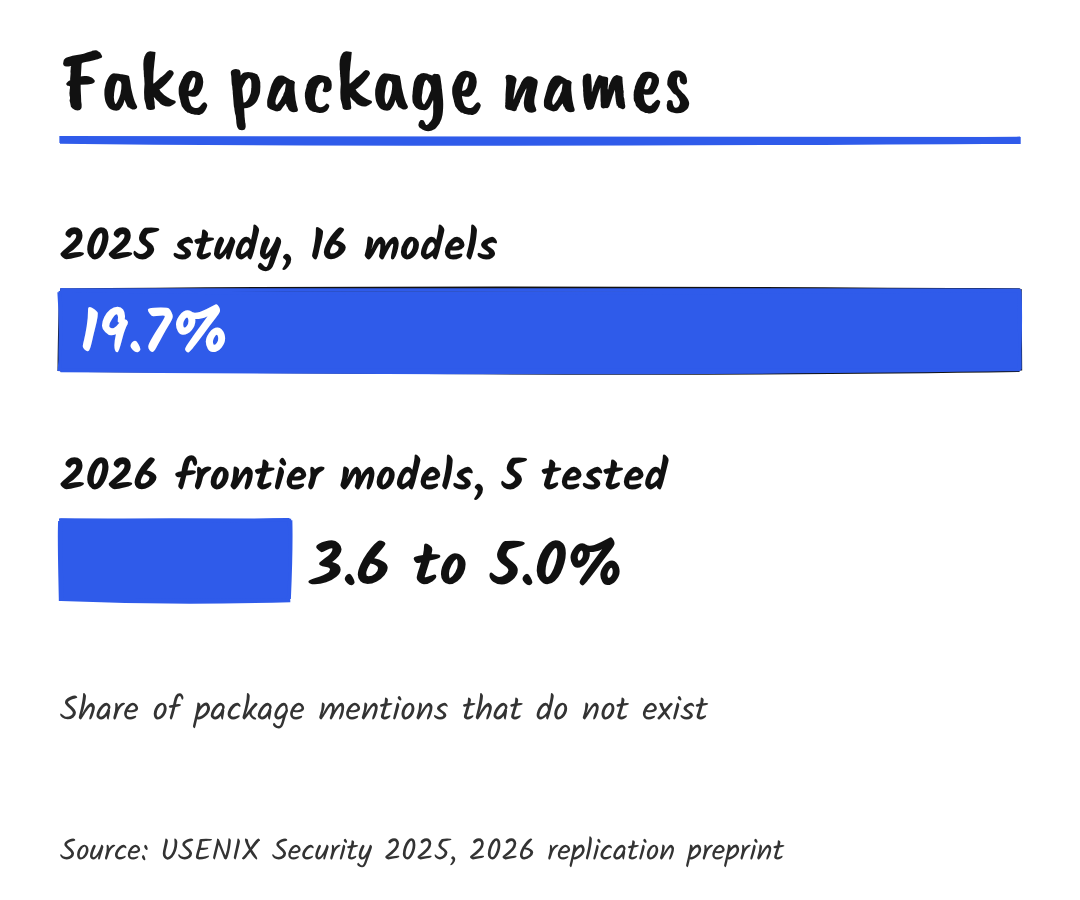
The slopsquatting number is where the video is out of date. The “nearly 20%” is the 2025 USENIX study: 16 models, 576,000 code samples, 19.7% of recommended packages fictitious, 5.2% on average for commercial models and 21.7% for open-source ones. Those rates were measured on older models. An independent 2026 replication on five frontier models found 3.6% to 5.0% of package mentions, in line with 2024’s best commercial models. The threat is still live, though. That preprint found at least 23 model-suggested names had previously hosted malware, and one hallucinated name was registered with malware after its runs. Sonatype tracked a campaign of nearly 800 slop-squatted npm packages, summarised by the Cloud Security Alliance.
The video’s other points here, that developers now generate their own utilities, that C and C++ code is being rewritten in Rust, and that most problems can be solved in JavaScript, Python and Rust, are observations and opinion. InfoQ covered Reverse Engineer Anything, the project the video names, but I found no data on how widespread any of it is.
5. Agents, and the year of the harness
The adoption figures check out. JetBrains found that between May and July, 90% of professional developers used AI coding agents at work at least weekly and 68% daily, with Claude Code the single most-used tool for 31%. The Stack Overflow survey has 30.9% of daily AI users spending four or more hours a day with it, which matches the video’s 31%.
The same Stack Overflow data fills in the harness field the video predicts. Among respondents who use coding agents, Claude Code leads at 65.5%, GitHub Copilot is at 58.7%, OpenAI Codex at 29.5%, Cursor at 25.5%, OpenCode at 13.6% and Pi at 4.4%. For orchestration tools, LangChain leads at 30.2%, OpenAI’s Agents SDK is at 23.8%, and Hermes Agent is at 10.2%. The video’s “Pi for minimalists” fits a small but visible slice of users.
I could not verify four details. I found nothing for the “Metamuse” framework, the “Thoroughbench” benchmark or the claim that law and medicine harnesses already exist, and I did not confirm the “more than 15,000 developers” sample size on JetBrains’ page. The prediction that models converge while harnesses differentiate is a view, and an interesting one, but nothing in the surveys settles it.
6. Ramageddon
The shortage is real, and the Raspberry Pi example is accurate with a qualifier. Raspberry Pi raised the 16GB Pi 5 by US$80 to US$385, and it launched at US$120. The Register counts four rises on that variant, a 221% total. But the 16GB Compute Module 5 rose US$40, the Pi 500+ was held, and the 2GB Pi 4 and 5 rose US$12.50. Raspberry Pi says the increases are temporary.
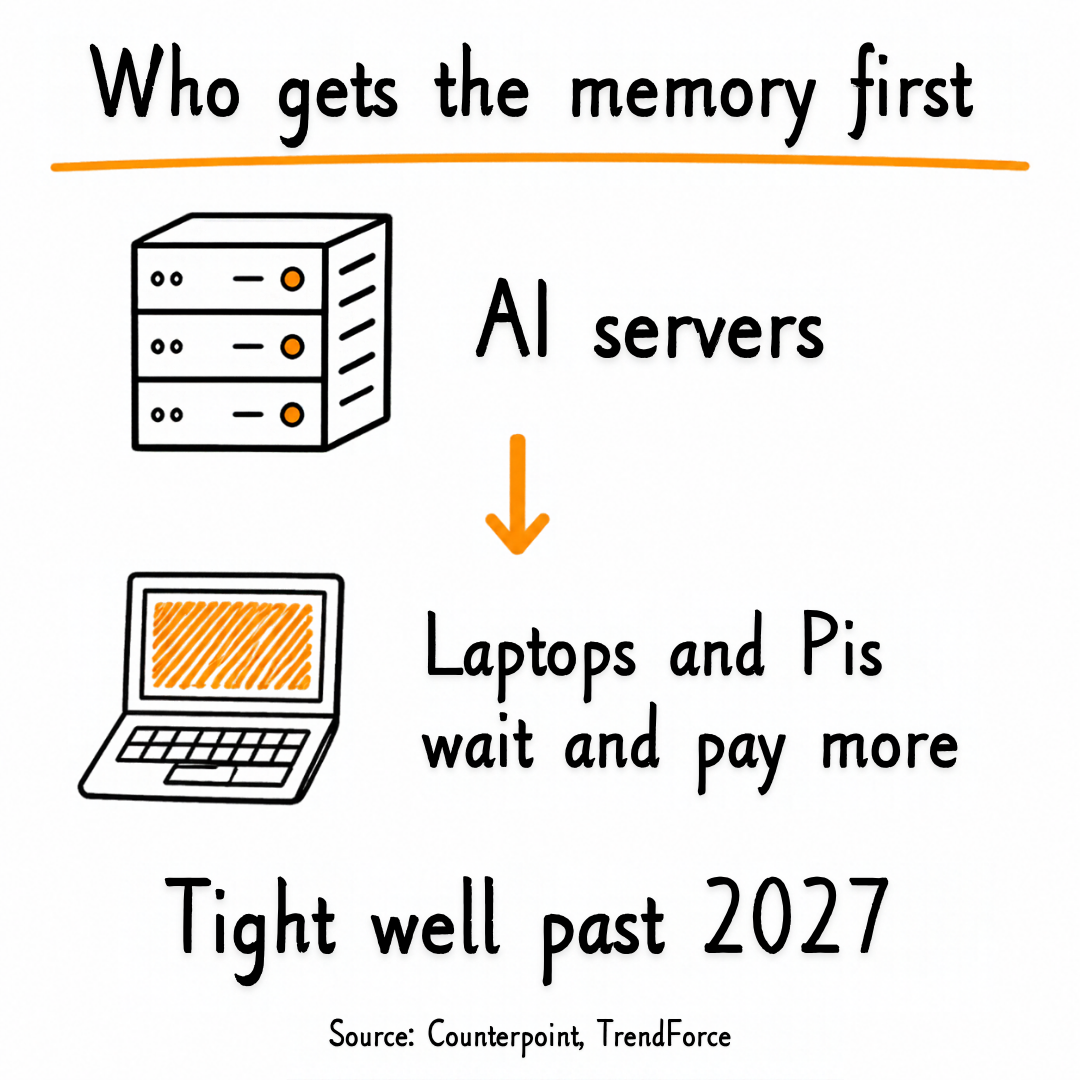
The video’s mechanism is also right. Counterpoint Research has third-quarter DRAM revenue up 369% on a year earlier while bit shipments rose only about 4%, with suppliers prioritising server memory and major new fabs not starting until 2028. A 32GB DDR5 kit was about US$429 to US$600 in mid-November, so “well over 400” holds. I could not confirm from a primary source that the same kit was under US$100 in 2025.
The outlook is longer than “through 2027”. Micron has been reported warning of 2028 or beyond, and SK Hynix says shortages will last until at least 2030. There is also a demand-side crack. TrendForce has notebook shipments down 15.8% in the third quarter, some PC makers trimming 2027 memory orders, and PC DRAM contract prices still forecast up 13% to 18% in the fourth quarter, slower than before.
7. Self-hosting, and the sponsor segment
This is the sponsored part of the video. It argues that disposable software needs somewhere to live, that renting a server beats buying RAM, and that a Hostinger VPS running Coolify gives a Vercel-style deploy workflow on a server you control. It is a sales pitch with a reasonable core, and the self-hosting argument stands or falls on the price of memory in section 6. The plan price is unclear in the auto-captions, so I have not checked it. Check Hostinger’s own page before relying on any figure.
8. Data centres in space
The SpaceX claims are right, and have moved since the video. The company filed for up to a million satellites at the end of January, and on 25 November the FCC granted the application in part. The licence covers backup radio links, not the compute or the lasers, and the debris plan is cleared only below 600 km. I covered the order in detail in our FCC report. The risk warning is also real: in its filing SpaceX said, as Reuters reported, that unproven AI space data centres may not be commercially viable.

Google’s Suncatcher is further along than the video says. The first prototype, built with Planet, launched on 1 October on a SpaceX rideshare, contact was confirmed and Google says it is operating as expected. It is gathering data on how TPUs handle radiation and thermal extremes, and a peer-reviewed paper is in Joule. The heavy-lift launch with Blue Origin is a separate, later step.
Starcloud’s claim holds, with scale in mind. Starcloud-1 launched in November 2025 with an Nvidia H100, and CNBC reported it trained Andrej Karpathy’s NanoGPT on the complete works of Shakespeare and ran inference on a Gemma model. The video calls it “tiny”, which is fair: NanoGPT is a teaching-sized model, and ScienceBlog notes Starcloud has not released the run’s parameter count, training time or energy use. Starcloud’s CEO says the chip is still working a year on, which is the company’s account.
The economics are the open question. The best outside estimate I found, cited in our FCC report from BCG, puts a gigawatt-scale orbital data centre at US$51 billion to US$170 billion against US$16 billion to US$38 billion on the ground. Nobody has published a price for orbital compute, and the licence says nothing about cost.
9. The vulnerability hunger games
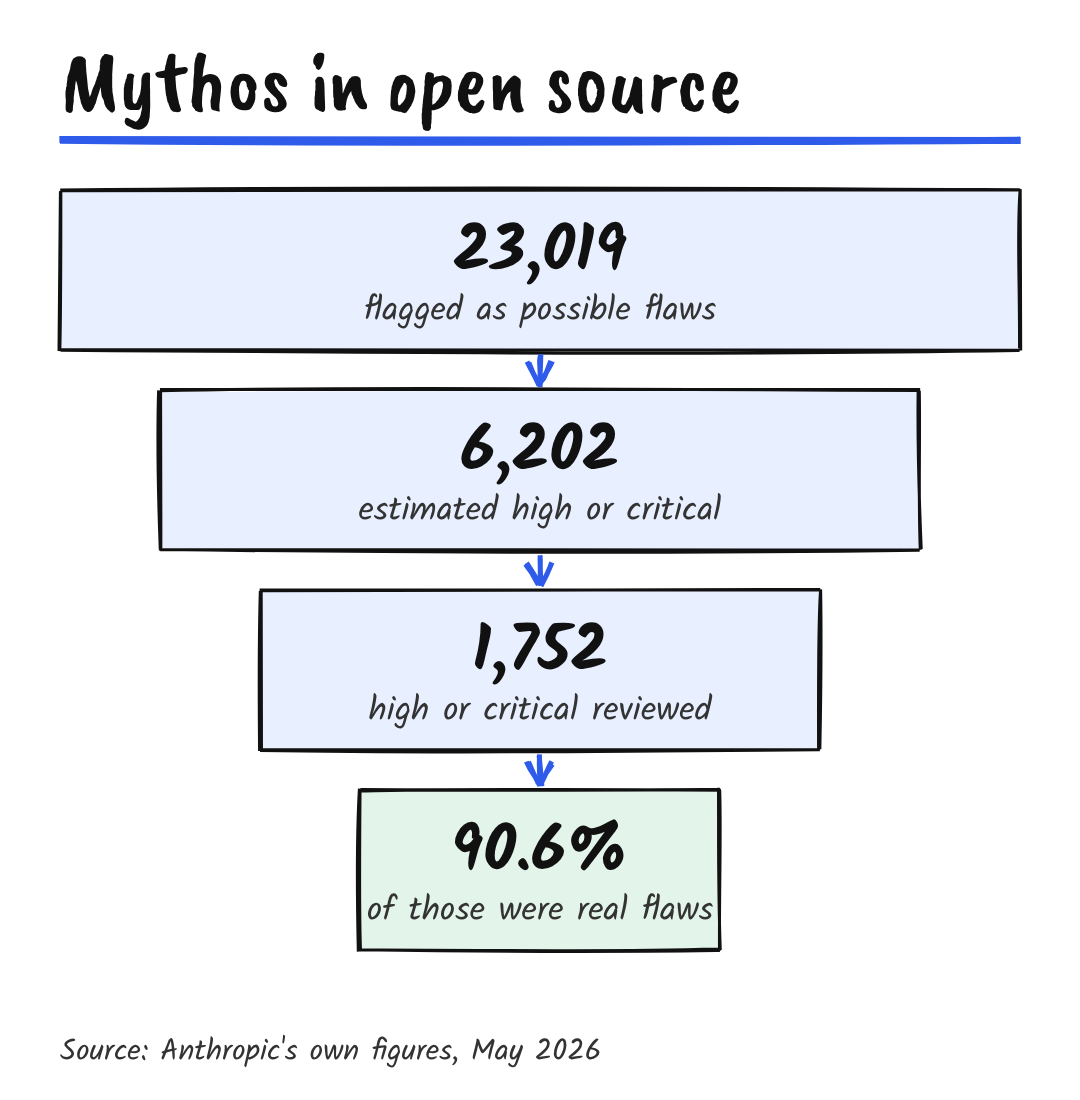
The headline claims are broadly accurate, apart from one number. Anthropic’s Glasswing update says that in May about 50 partners had used Claude Mythos Preview to find more than ten thousand high or critical vulnerabilities. Anthropic’s own scan of more than 1,000 open-source projects flagged 23,019 possible vulnerabilities, 6,202 of them estimated high or critical. Of 1,752 high or critical findings reviewed by six independent firms or Anthropic itself, 90.6% were valid and 62.4% confirmed as high or critical. The video’s “over 23,000 flagged” is therefore right, as a count of possible flaws that Anthropic itself generated. The same update says the bottleneck has moved to verifying and patching, and Anthropic has not released Mythos-class models publicly.
It is not a clean sweep. SecurityWeek noted Mythos found only one low-severity vulnerability in curl, with experts split on whether that says more about the model or about curl. The Cloud Security Alliance counted about 1,596 disclosures to open-source maintainers by May, of which 97 had been patched.
On OpenAI, the video’s “a billion ways to hack the Linux kernel” is not what the company reports. In its GPT-6 Cyber announcement, OpenAI says the model reproduced 1,724 Linux kernel vulnerabilities and developed working exploits for 948 of them, more than five times the 166 exploited by GPT-5.6 Sol on the same research harness. OpenAI disclosed 304 critical findings to maintainers with candidate patches, and also reports 81 previously unknown high-severity vulnerabilities in Firefox. It scores 48.5% on ExploitGym, up from 32.1% for GPT-5.6 Cyber, and OpenAI classifies the model as Critical in cybersecurity under its Preparedness Framework. Access is limited to approved Daybreak Red customers through the API and Codex, with a wider rollout planned.
Google’s claim is accurate and carefully worded. On 11 May the Google Threat Intelligence Group reported that for the first time it identified a threat actor using a zero-day exploit it believes was developed with AI. It was a two-factor authentication bypass in an unnamed open-source web administration tool, and a criminal group had planned mass exploitation before Google’s disclosure to the vendor may have prevented it. CyberScoop reports the evidence was in the code: educational docstrings and a hallucinated CVSS score. Google says it was not Gemini, and is confident it was not Mythos either.
The curl point is right. Daniel Stenberg ended the bug bounty, effective 31 January, citing “mind-numbing AI slop”, humans doing worse than ever and a will to poke holes rather than help. Reports now go privately through GitHub or email, with no reward. The video’s line that the winners are the companies selling tokens is an opinion, and a fair one to argue about.
10. Humanoid robots
The shipment claim holds. Smart Analytics Global forecasts 54,000 humanoids in 2026, up 277% on the year before, with Chinese vendors about 97% of shipments. Counts differ by firm. Omdia counted about 13,000 shipped in 2025, led by AgiBot at 5,168, then Unitree at 4,200 and UBTech at about 1,000. Smart Analytics counted 16,500 in the third quarter alone, and in that tally UBTech overtook Unitree for second place behind AgiBot.
Unitree’s listing is accurate. The Shanghai STAR Market offering was priced at 150.80 yuan a share to raise about 6.1 billion yuan, and Reuters reported the shares set to jump more than 600% on debut.
Tesla needs care. Its third-quarter update says Optimus production began in Fremont on its high-volume lines, lists the California line as an early ramp and the Texas site as under construction, and says nothing about volume. The video adds that Tesla tore out its Model S and X line to make room. I did not verify that against Tesla’s own filings. A research summary reports Tesla calling the ramp “shallow and bumpy”, with 20,000 a week at least a year away.
On Atlas, the wheels were real but the Segway line misses the point. Boston Dynamics swapped Atlas’s feet for scooter wheels to push its actuators and a learned whole-body controller to their limits. The plan Hyundai and Boston Dynamics describe is Atlas starting on parts sequencing at Hyundai’s Georgia plant from 2028, beginning with 25,000 units across Hyundai and Kia plants over the next few years.
1X’s NEO is the claim to treat most carefully. The order page lists US$20,000 to own or US$499 a month, a US$200 fully refundable deposit and US deliveries starting in 2026. It says an expert from 1X can remotely supervise tasks NEO does not know, at scheduled times. “Sold out” is the company’s claim that first-year capacity is booked. One industry tracker found no announced delivery to a customer as of mid-November, and I found none either.
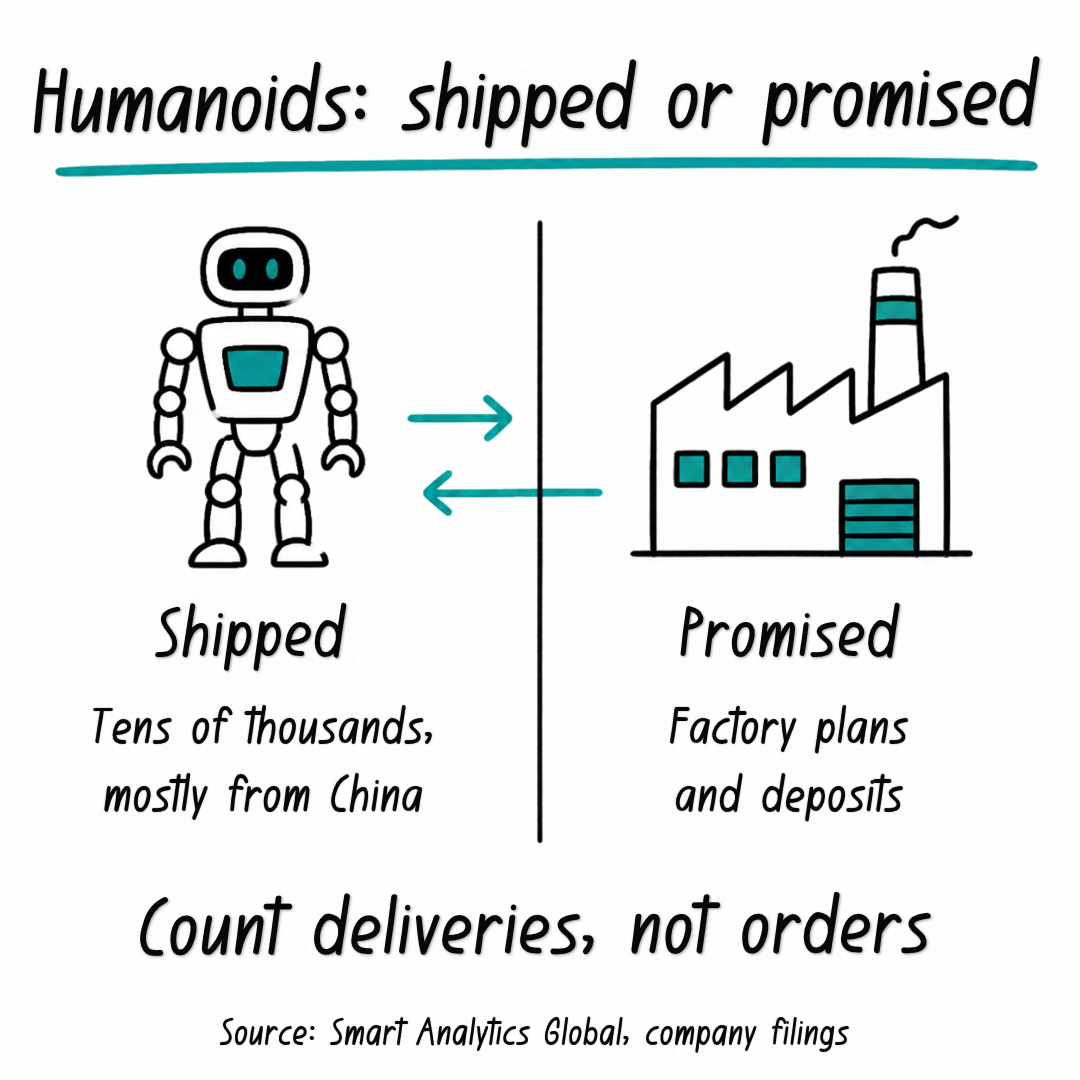
Customer evidence lags the shipment counts. Servospace’s reading of filings and earnings calls has GXO saying it ran 45 humanoid pilots, had not yet achieved a return and would have no humanoids in production in 2026. UBTech sold 921 full-size humanoids in the first half without naming buyers, and about three quarters of Unitree’s humanoid revenue in the first nine months of 2025 came from research and education. Agility Robotics signed a pilot with AGCO that is expected to begin in 2027. Shipments are real. Factory work at scale is mostly still to come.
What holds, and what I could not check
The video’s shape is sound. Entry-level hiring is thin while senior and AI-related hiring grows, maintainers are overwhelmed, npm is under sustained attack, memory is scarce for years, and humanoid shipments are real. The numbers it gets wrong tend to make things sound more extreme: Tailwind “killed”, a Linux kernel survey, a billion Linux exploits, a 20% fake-package rate, a sold-out robot with no delivery.
I could not verify “Metamuse”, “Thoroughbench”, law and medicine harnesses, the Hostinger plan price, the 2025 RAM kit price or the Model S and X line removal. Disposable software and the “year of the harness” are opinions and I have treated them as such. Primary sources are linked above; where I relied on a secondary summary, the link text says so.