MiniMax says an internal model it hasn’t released rewrote most of a closed-source decompiler in Rust, and separately unpacked 94 of 100 protected test samples when it was allowed up to eight tries. The company published the results on 28 November. It doesn’t name the program it cloned, and it says it destroyed the code, binaries and logs once the numbers were recorded.
It also says it is carefully considering whether to limit or remove end-to-end software cloning in the public release, and it tells the software industry to start building new protection. The model is internal, so I couldn’t run it. Everything below comes from MiniMax’s own post, which is in Chinese. It follows the company’s cryptanalysis results from a week earlier, and MiniMax doesn’t say whether it’s the same internal model.
Disclosure: I’m an OpenAI, Firecrawl and Devin ambassador.
2,000
sub-agent sessions
2 million
lines of Rust written
10,000
automated test cases
94%
of protected samples unpacked in up to eight tries
What MiniMax says it did
The target was a well-known closed-source tool that turns machine code into readable pseudocode, which makes it a decompiler. MiniMax calls it a benchmark product in its field and gives no name. The model got a bare kit: Ghidra, the GDB debugger, a test framework, C/C++ and Rust compilers, and a multi-agent scaffold MiniMax built. It used the analysis interfaces to work out what the target’s core binary did, split the rewrite into modules, and gave each module to a sub-agent writing Rust.
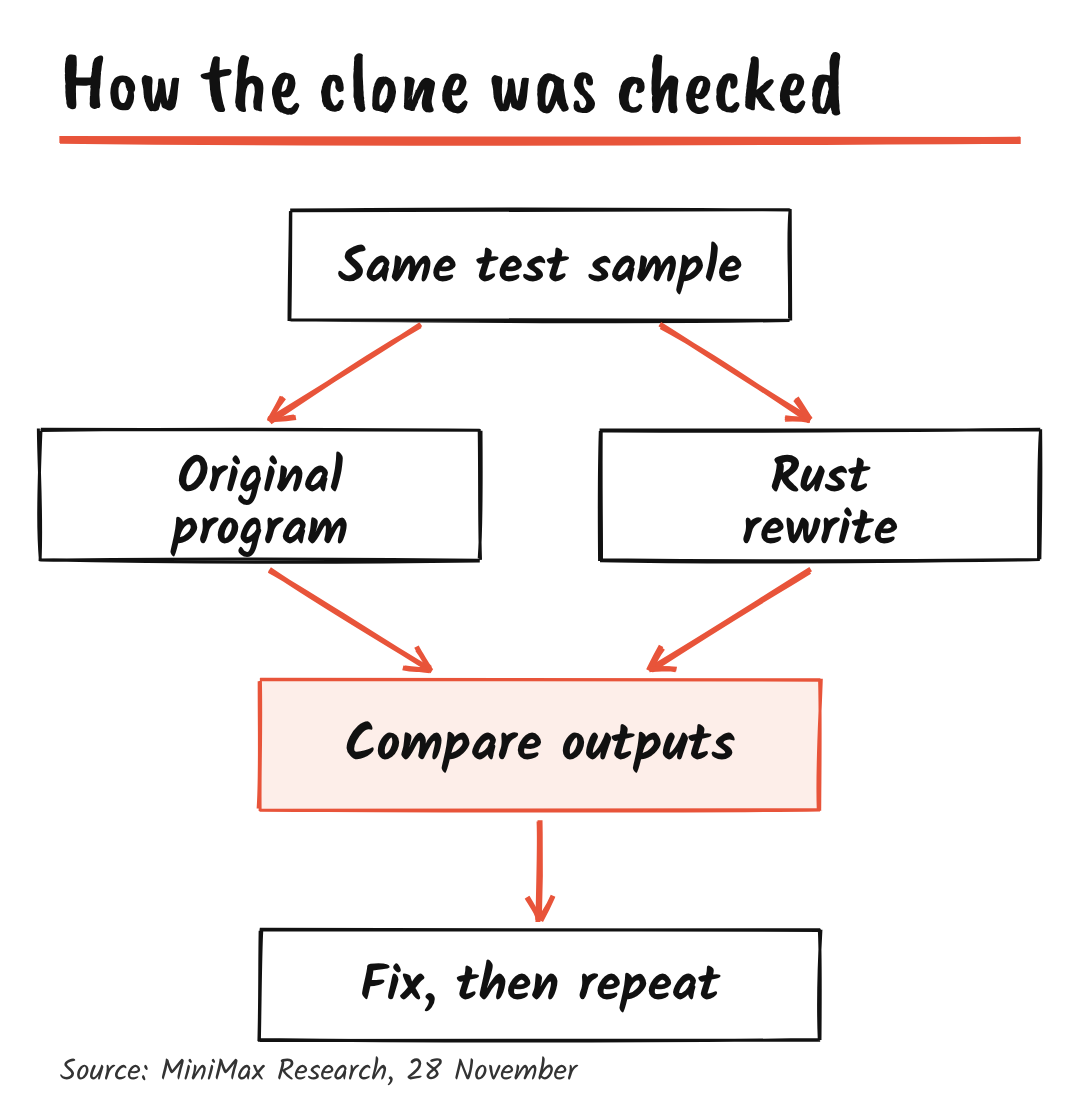
After each module, the workflow fed the same test samples to the original and the rewrite, compared the outputs and sent the code back for fixes. Each sub-agent ran in its own sandbox, and the model scheduled them recursively. MiniMax’s totals are about 2,000 sessions, roughly 2 million lines of Rust and 10,000 tests left behind.
MiniMax then ran three checks. First, the rewritten pipeline (disassembly, intermediate code, data-flow analysis, control-flow structuring, optimisation and pseudocode output) worked as a standalone Rust library through a command line and an API. Its outputs closely matched the original’s, and MiniMax says it ran somewhat faster, though it gives no timings. Second, the model wrote a lightweight graphical front end so an analyst could load a sample, browse functions and read pseudocode. Third, MiniMax compiled the Rust core into shared libraries and dropped them into the original program’s folder, keeping the original’s own interface. The program still started, loaded a binary and decompiled it.
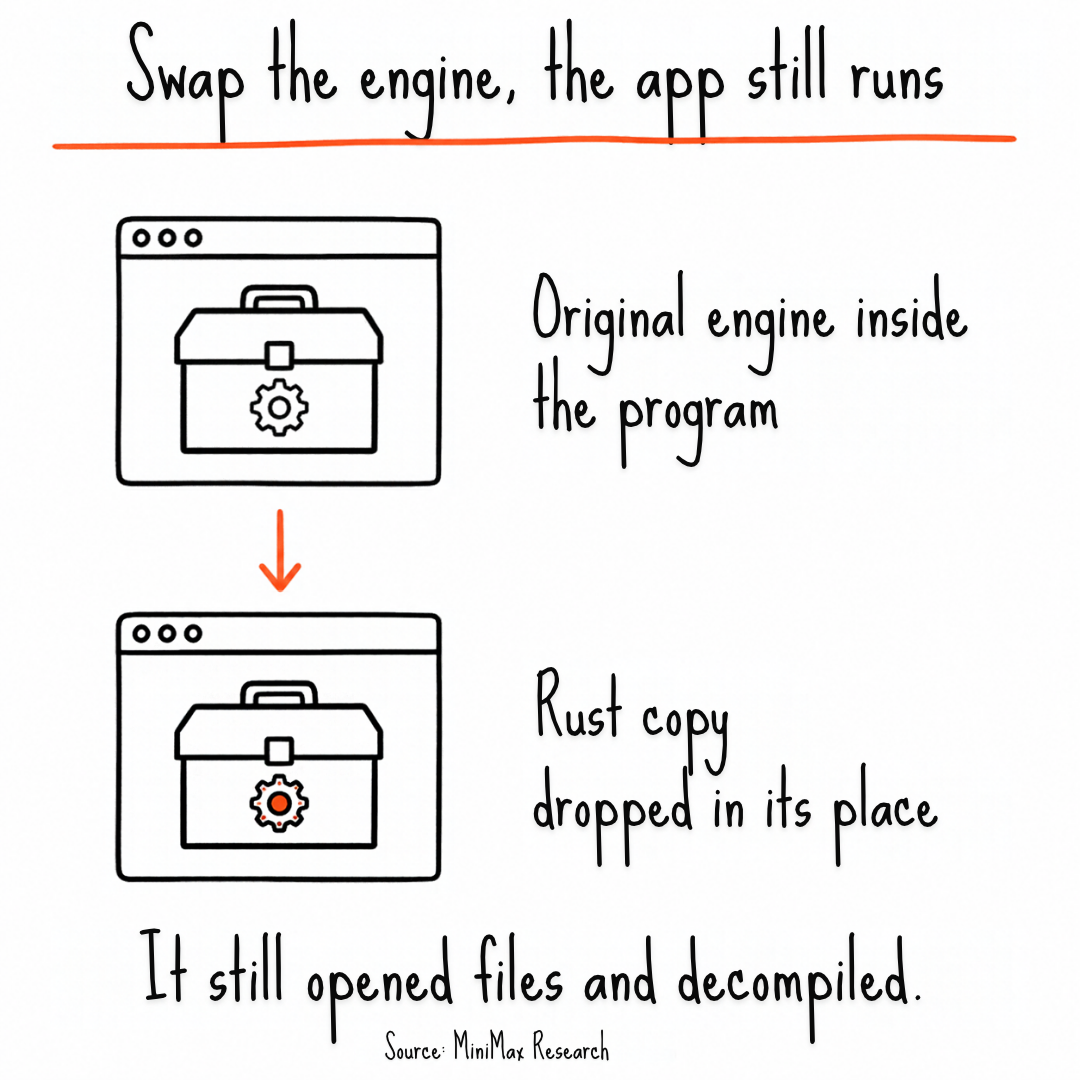
The third check is the strongest claim in the post. Matching outputs is one thing. Matching the original’s exported symbols and internal behaviour well enough that the original program accepts the copy as its own engine is another. MiniMax says the libraries covered disassembly, decompilation, compiler optimisation and data-flow analysis, and that the result is an approximate clone of most of the target’s functions, not all of them.
The protected-code test
The second test went after the other common defence. Tools such as VMProtect and Themida translate a program’s machine code into private bytecode and ship a small virtual machine to run it, so a few dozen lines of logic swell into tens of thousands of instructions with no obvious meaning. MiniMax built an internal set of 100 hard samples. It says the model, given no targeted hints, settled into the routine of a senior researcher: find the virtual machine’s entry with static tools, write GDB scripts to run the sample while watching memory and registers, isolate the loop that does the real computation, then simplify the bloated instruction stream until it reads as C or C++. The model checked its answer against the sample’s inputs and outputs and kept fixing it until the verifier passed.
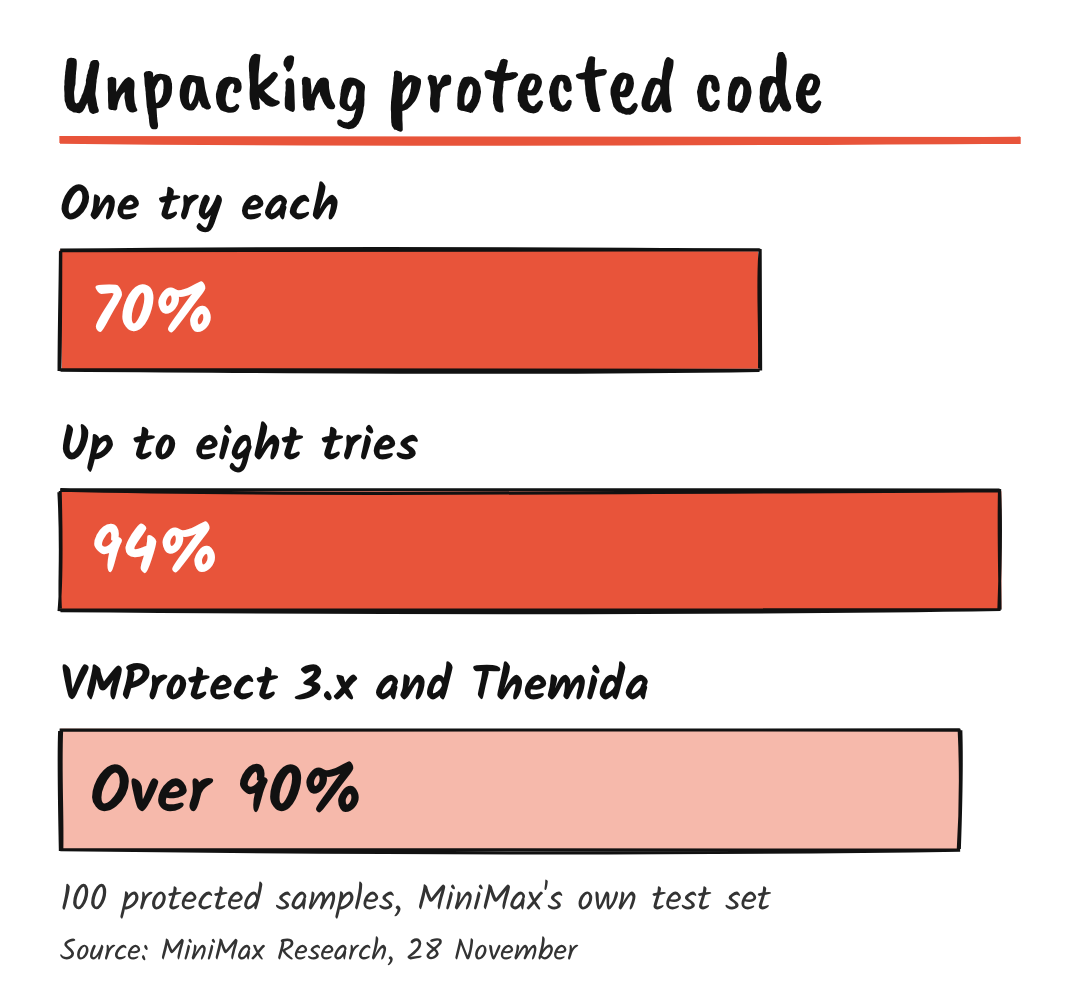
On one attempt each, the model recovered 70 of the 100. With up to eight tries and verifier feedback, it reached 94. For the samples protected by VMProtect 3.x and Themida, MiniMax says the rate was above 90% with no hints. It also says work that used to take an expert days now finishes in tens of minutes.
The post’s opening goes further and says the model’s analysis of virtualised protection has passed human experts. It offers no head-to-head with human analysts, only the pass rates above on its own test set.
Where it falls short, in MiniMax’s words
- Samples with several layers of virtualisation or strong anti-debugging cut the first-try success rate sharply, and long runtime traces sometimes fill the model’s context window and trap it in useless debugging loops.
- The clone is experimental code for specific core modules. MiniMax says it is a long way from a standalone product with the original’s wider ecosystem, cross-platform interface details and years of stability work.
- A project this size still leans on a custom scaffold that keeps the agents on set divide-and-conquer and differential-testing rails.
MiniMax adds that its previous-generation model couldn’t do any of this. Faced with a large binary or virtualised code, that model overloaded its context and hallucinated.
What can’t be checked
Nobody outside MiniMax can inspect this work. The company says it irreversibly destroyed the rewritten code, the compiled libraries, the scripts and the logs after recording its statistics, out of respect for the vendor’s intellectual property. The target is unnamed and the test set is internal. The post doesn’t say whether MiniMax held a licence for the program or whether its maker knew. The engineering totals, the interface compatibility and the pass rates are all the company’s own figures.
MiniMax also stresses that this was a pre-release risk evaluation, and that the internal version doesn’t represent how its public models behave.
Prior art, and a sceptic
Automated unpacking of virtualised code isn’t new. A paper posted to arXiv in March, Pushan, deobfuscated more than 1,000 binaries, including samples protected by VMProtect and Themida, and turned them into C pseudocode without runtime traces. A researcher at back.engineering published a static devirtualiser for Themida in May and reported output functionally identical to the original on its examples. What MiniMax claims is different in kind: an agent doing it without hints, inside a much larger clone job.
Agents wired to disassemblers are already in the open, too. REA, an open-source project, plugs Ghidra, IDA and Hopper into coding agents through MCP so an agent can study an app and rebuild one of its features. Microsoft security researcher Dongkwan Kim argued in October that what an AI reads out of a binary “isn’t the original. It’s code with the blanks filled in plausibly.” His point is that models fill gaps from memory as well as from the binary, so a clean-looking copy can carry the original’s expression, and nobody has a good way to measure where recovery ends and inference begins. MiniMax’s drop-in test speaks to that, since the copy had to behave like the original’s own engine.
How other labs handle it
MiniMax’s public model already lists the skill. At the launch of M3.1 Flash in October, the company said its internal security experts saw strong results in code auditing, patching, penetration testing, malware analysis and reverse engineering, and the model scored 82% on CyberGym. The closed labs treat the same work as something to gate.
| Lab | What it offers | How access works |
|---|---|---|
| OpenAI | GPT-5.4-Cyber, announced in April, adds binary reverse engineering so defenders can analyse compiled software without its source | Limited deployment to vetted defenders, then Daybreak tiers, with reverse engineering listed under authorised offensive testing. GPT-6 Cyber went first to select approved Daybreak Red customers |
| Anthropic | Its generally available models carry conservative cyber safeguards that block most cyber work, and reverse-engineering malware sits in the Defense tier of its Cyber Verification Program | Verified tiers for security teams, with Claude Mythos going to a vetted group through Project Glasswing |
| MiniMax | Public M3.1 Flash lists reverse engineering; an internal model clones software | No access programme named. Limiting end-to-end cloning in the formal release is under consideration |
One difference matters. The closed labs gate through accounts and classifiers that run on their own servers. MiniMax has released M3 as open weights and says M3.1 Flash weights will follow, and a refusal layer on an API doesn’t travel with a weight file. Any limit on cloning in an open release has to be built into the model through training. The Cloud Security Alliance, drawing on UK AI Security Institute findings, estimates that open-weight models trail closed frontier models on offensive cyber tasks by roughly four to seven months, so gating delays a capability without keeping it scarce.
Is cloning software legal?
MiniMax’s post is about risk, not law, and it cites no legal analysis. The rules that apply are older. Copyright protects how a program is written, not what it does, so building your own program with the same functions is generally allowed while copying its code is not. US courts have held that disassembling a program to reach its unprotected functional elements can be fair use, in Sega v Accolade in 1992 and Sony v Connectix in 2000 for an emulator. The Supreme Court’s 2021 Google v Oracle decision kept fair use central for software and cited both cases.
The EU is stricter. Directive 2009/24/EC lets a lawful user decompile a program without the owner’s permission only when that is indispensable to make an independently created program interoperate, and it bars using what’s learned to build something substantially similar in its expression. In the US, the DMCA separately bans circumventing access controls, with a narrow interoperability exemption, and a licence that forbids reverse engineering can still be enforced against the licensee. The Electronic Frontier Foundation’s reverse engineering FAQ sets out how each of these can bite.
Those rules grew out of people studying a program to work with it. A model that rewrites most of a competitor’s product function by function, then slots into the original’s own folder, sits at the far end of that line. I found no court ruling on an agent-built clone like this one. MiniMax’s destruction of the output stops a clone shipping, but it doesn’t answer whether the study phase was allowed. That turns on the target’s licence and the jurisdiction, and MiniMax names neither.
What MiniMax wants next
MiniMax says closed source and static obfuscation can no longer protect client-side logic by themselves, and urges the industry to develop new software protection quickly. It points to moving high-value logic onto servers, using hardware trusted execution environments and building protections aimed at how models reason. It hasn’t said it has removed the cloning ability, only that it is considering limiting or removing it in the formal release. It also invites software makers, protection vendors and academic groups to share findings and test benchmarks through [email protected].
What to do with it
- Don’t rely on closed source or off-the-shelf virtualisation alone. Licence checks, private protocols and embedded keys sat behind those defences in MiniMax’s test, and most of the samples fell.
- Move the valuable logic to a server. Code that never ships to the client can’t be run under a debugger by an agent.
- Security teams doing authorised binary work should apply to the gated programmes. OpenAI’s Daybreak and Anthropic’s Cyber Verification Program are where this capability currently lives.
- Watch MiniMax’s release terms. Whether the formal release limits end-to-end cloning will show in the model’s behaviour and its usage policy.