
Investor Gokul Rajaram says Anthropic’s Team plan has a cliff at its 150-seat limit. In a post on X on 28 November (US), he wrote that a company with 150 people on Team pays US$60,000 a year, and that adding one more employee moves it to Enterprise, where 151 people pay US$1.36 million. The cliff is real. His two numbers don’t match what Anthropic publishes, though, and the second is a worst case, not a price.
I went to Anthropic’s own pricing and help pages, its Claude Code cost guide and the pricing pages of GitHub, Cursor and Microsoft to see what the step at seat 151 costs, and how other vendors handle the same move from a team plan to an enterprise one.
In this piece
- What changes at seat 151
- Where the US$1.36 million comes from
- What a seat actually draws
- Who pays less
- The brakes Anthropic gives you
- How the peers bill the step up
- What the bill depends on
There must be a better way to smooth this transition for companies. Otherwise CFOs will actively start looking for alternatives.
Gokul Rajaram, on X
What changes at seat 151
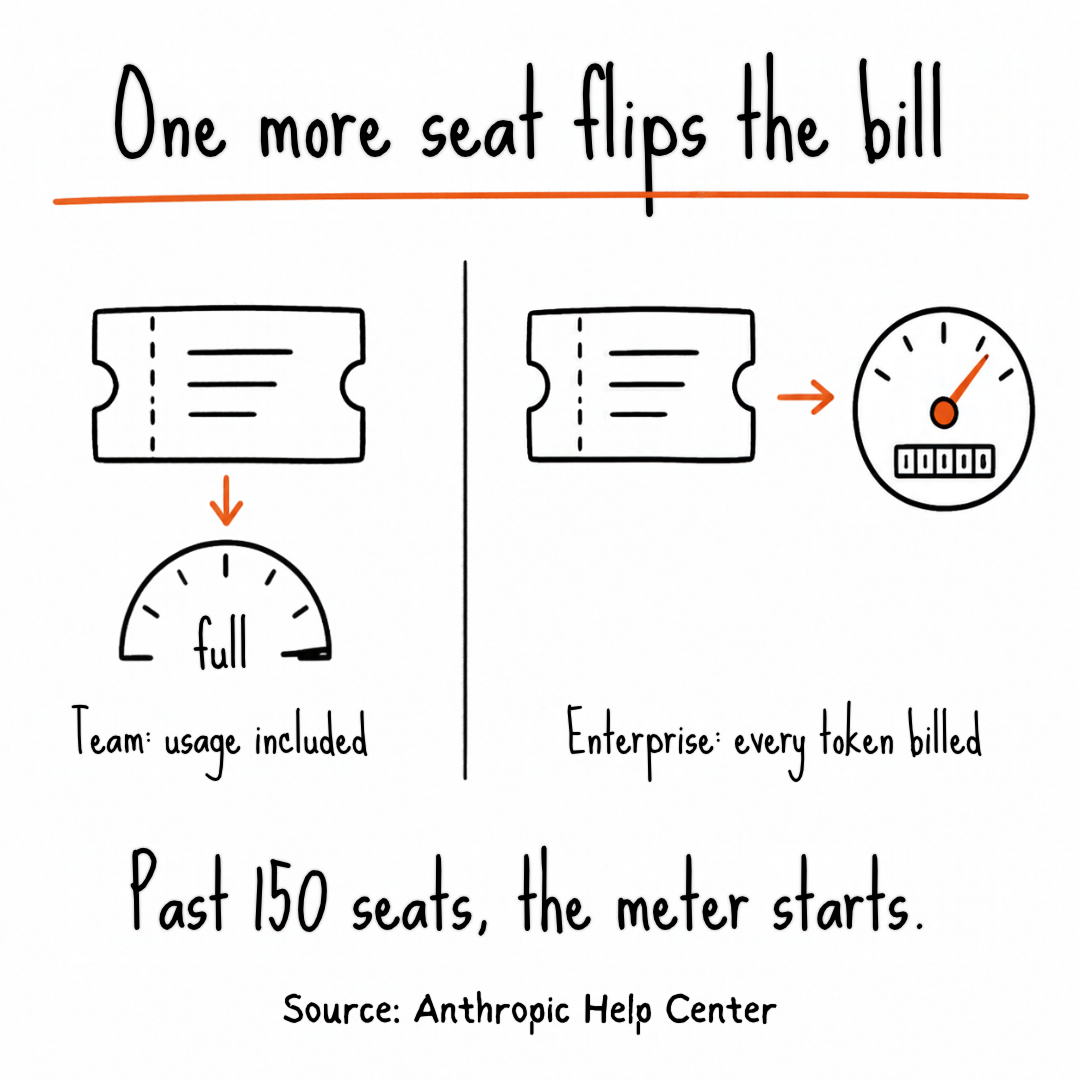
Anthropic’s Team plan takes 2 to 150 seats. A Standard seat is US$20 a month on annual billing and a Premium seat is US$100, and each seat includes a usage allowance with five-hour and weekly limits. The help article says an organisation that needs more than 150 seats can upgrade to Enterprise.
Enterprise works differently. Anthropic’s Enterprise article says the seat fee “only covers access to the platform and doesn’t include any usage”. Every token across Claude, Claude Code and Cowork is billed at standard API rates on top of the seat. The seat is US$20 a month, billed annually, according to Anthropic’s Enterprise page.
| What | Team | Enterprise |
|---|---|---|
| Seats | 2 to 150 | 20 minimum self-serve, 50 through sales |
| Seat price, annual billing | Standard US$20, Premium US$100 | US$20 |
| Usage | Included, with five-hour and weekly limits | None included; every token billed at API rates |
| Spend controls | Optional usage credits past the limits | Spend limits for the organisation, each group and each person |
| Monthly API credits | Team plans can claim them | Enterprise isn’t eligible |
| Admin and security | Admin spend controls | Adds SCIM, audit logs and custom data retention |
Where the US$1.36 million comes from
The figure isn’t Rajaram’s own. It comes from a LinkedIn post by Ignacio Gabaldón, a head of product, which Rajaram attached to his tweet as a screenshot. Gabaldón’s arithmetic runs like this. 150 people on Team cost US$36,000 a year at US$20 each. On Enterprise the seat is the same US$20, but every token is paid at API prices. He takes a seat used to its limit to be worth about US$729 a month in tokens, using an estimate from Wokey across 283 Team seats. At that level 151 people come to about US$1.36 million a year, US$1.3 million more than before.
Three things in that chain matter.
- It’s a ceiling. Gabaldón says so himself: “Most people won’t use it that hard.”
- Rajaram’s US$60,000 for 150 Team seats isn’t Anthropic’s list price for 150 Standard seats, which is US$36,000, the figure in the screenshot he attached. A mix of 125 Standard and 25 Premium seats comes to exactly US$60,000. Rajaram didn’t say which mix he meant.
- The “Confirm plan change” panel in the screenshot, with its “37x” warning, is labelled “Illustration · list prices, heavy use”. It’s a mock-up, not Anthropic’s screen. I haven’t bought or changed a plan, so I haven’t seen the real confirmation step.
Rajaram’s tweet states US$1.36 million as what 151 people “now pay”. Anthropic doesn’t charge that. Enterprise has no fixed price for a company, because usage is metered and the bill follows it.
What a seat actually draws
Anthropic’s own numbers give a more usual range. Its Claude Code cost guide says enterprise deployments average about US$13 per developer per active day, or US$150 to US$250 per developer a month, and that costs stay under US$30 a day for 90% of users. Put 151 seats at US$20 plus US$150 to US$250 a month each and the bill is US$308,000 to US$489,000 a year. That’s between about eight and fourteen times the US$36,000 Team figure, and well short of US$1.36 million.
Those numbers describe developers on Claude Code, the heaviest surface. Anthropic’s Enterprise consumption guide says Claude Code and Cowork consume tokens at a significantly higher rate than standard chat, so a company where most staff use chat sits below them.
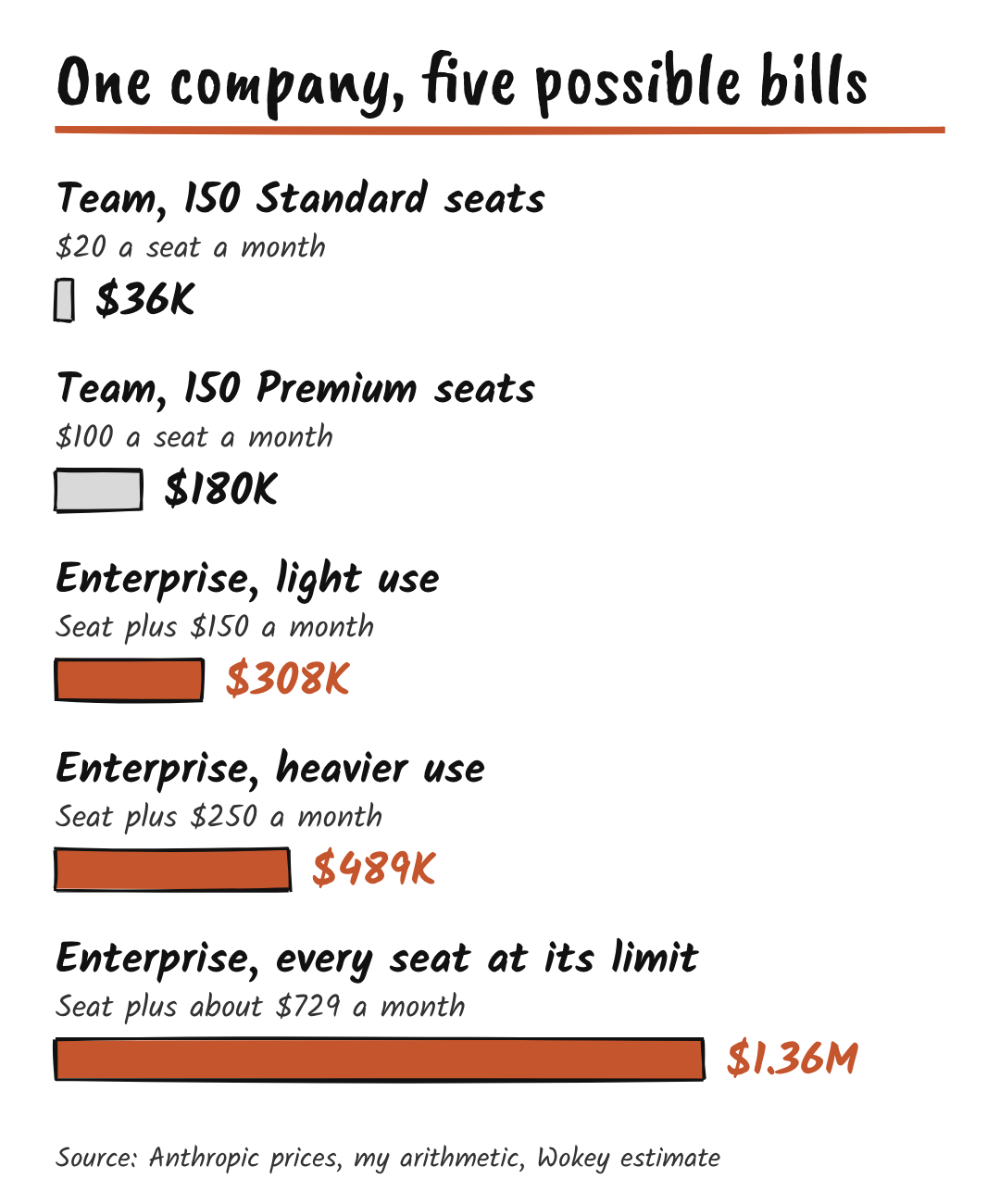
The US$729 comes from Wokey, a pay-as-you-go Claude gateway. It measures what a full week of a Team seat’s limit is worth at official API prices. For the week to 23 November it put a Standard seat at about US$716 a month and a Premium seat at about US$3,570, against fees of US$20 to US$25 and US$100 to US$125. Those are Wokey’s estimates from accounts behind its gateway, not Anthropic figures. On Team, the seat caps what a person can draw. On Enterprise, only a spend limit does. I covered the same gap between a flat fee and API prices for Max in an earlier piece.
Who pays less
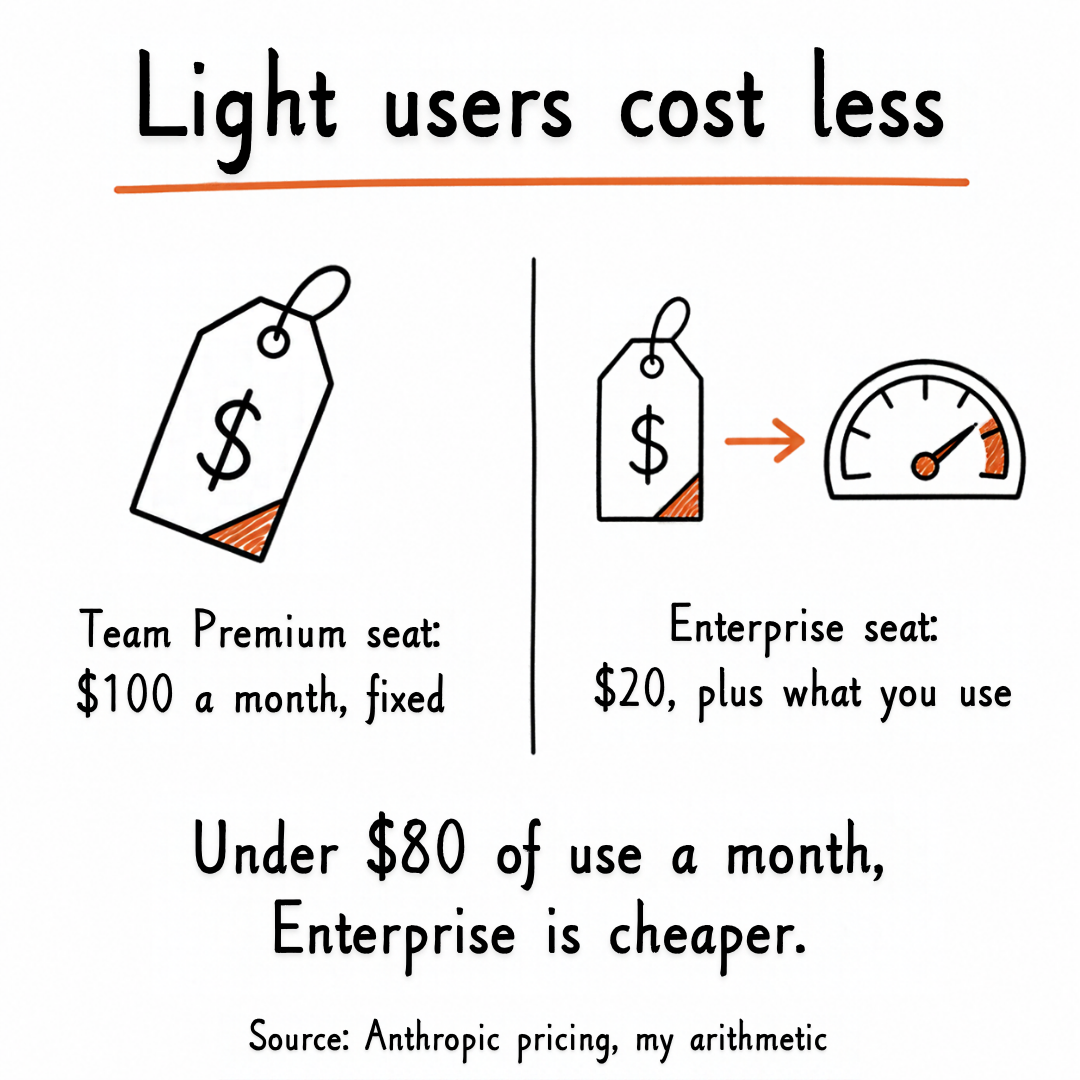
The cliff doesn’t only run one way. Against a Premium seat at US$100 a month, an Enterprise seat at US$20 costs less while a person’s usage stays under US$80 a month. On monthly Premium billing at US$125, the line is US$105. Against a Standard seat, Enterprise always costs more, by the amount of usage. So a company with mostly lightly used Premium seats can pay less after the move, and one with Standard seats and heavy Claude Code users pays far more.
The brakes Anthropic gives you
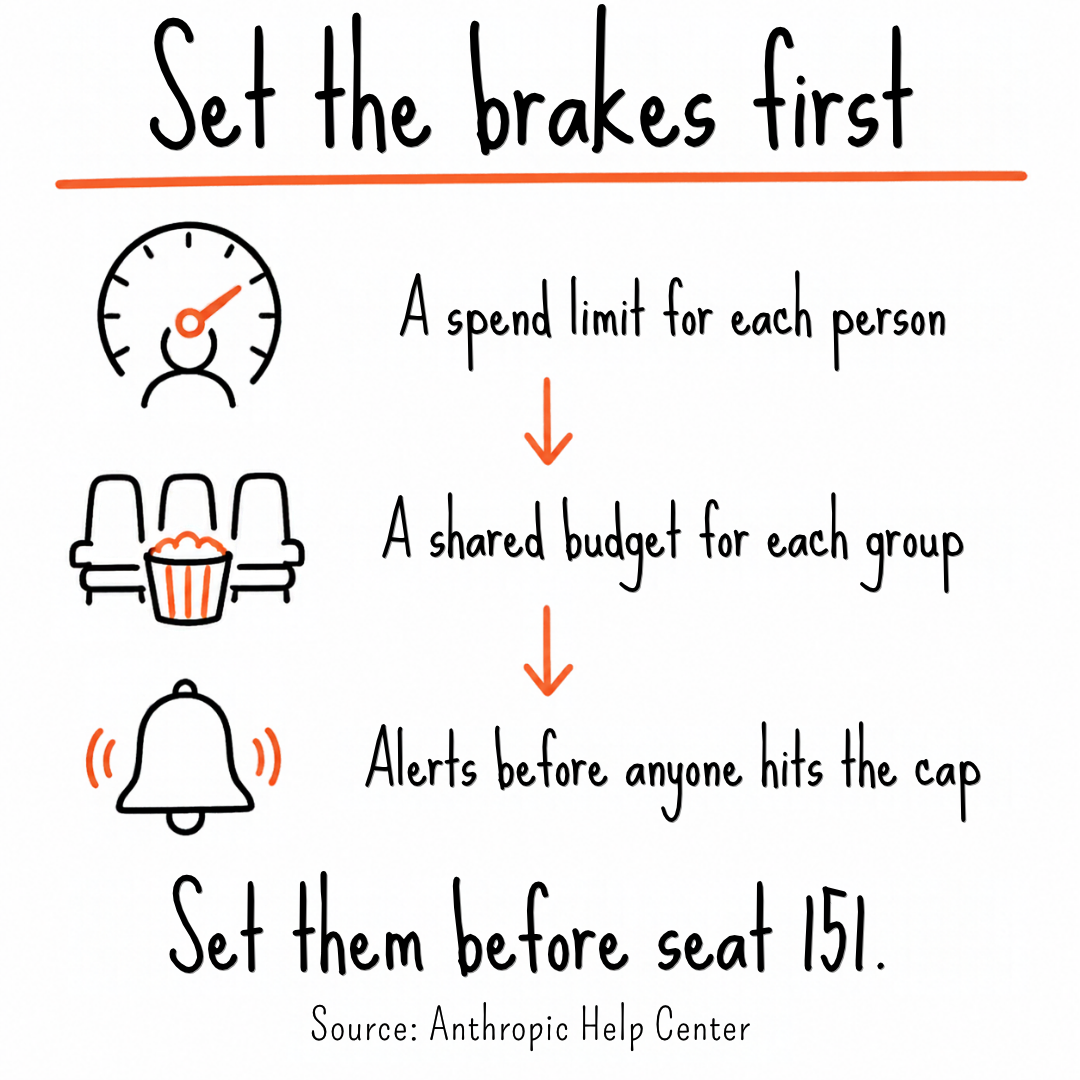
Enterprise bills what’s used, but Anthropic’s pages describe three controls. Admins can set spend limits for the organisation and for each person. Groups can have pooled monthly budgets, and billing admins get alerts at 50%, 75%, 95% and 100% of a pool, with organisation-level alerts at 75% and 90%. The Usage page shows how often members hit their limits, with a forecast.
How hard those limits bite depends on how the account is bought. Self-serve Enterprise buys usage as credits upfront, and usage stops when they run out until an owner buys more. Sales-assisted plans are billed monthly in arrears, so the spend limit is the ceiling there. The migration steps ask for a per-user spend limit and a starting usage balance.
One thing is lost in the move. Enterprise plans aren’t eligible for monthly API credits, and new ones stop at migration. Credits already claimed stay usable until they expire.
How the peers bill the step up
Seat plus metered usage is now the common shape for AI work tools. The difference is where each vendor puts the line.
| Vendor | Team tier | Next tier | How usage is billed |
|---|---|---|---|
| Anthropic | Team: Standard US$20, Premium US$100 a seat, usage included | Enterprise: US$20 a seat | All usage at API rates, no allowance |
| GitHub Copilot | Business: US$19 a seat with 1,900 credits | Enterprise: US$39 a seat with 3,900 credits | Credits pooled across the organisation; past the pool, US$0.01 a credit. Code completions use none |
| Cursor | Teams: US$30, US$100 or US$200 a seat | Enterprise: custom, with pooled usage | Weekly pool for Cursor’s own models; third-party models at API list price from prepaid credit |
| Microsoft | Microsoft 365 Copilot Business: US$21 a seat | Copilot on enterprise plans | Everyday AI included; Cowork, Code and Autopilot use Copilot Credits |
GitHub’s included credits equal the seat price at a cent each, so US$19 buys 1,900 credits and the allowance grows with the seat. Moving from Business to Enterprise is a US$20 step. GitHub also sells a model with no allowance, Copilot access: a US$0 seat for users on GitHub Enterprise Cloud, with metered usage billed from the first use. It’s optional. GitHub’s documentation says existing Business and Enterprise plans remain supported and that transitioning is voluntary.
Anthropic’s Enterprise is the same metered model, but it’s the only route the Team help article names for an organisation past 150 seats. In the GitHub and Cursor pages I read, no seat count flips the billing model. Anthropic has also retired the older Enterprise seat types: organisations on Chat and Chat + Claude Code seats move to the single Enterprise seat at their next contract renewal.
What the bill depends on
Rajaram’s point stands: the step from 150 to 151 seats changes how a company is billed, and Anthropic’s pages don’t describe a bridge, such as phased billing or a transition discount. Its pricing page offers a tailored quote through sales. How big the step is depends on what each person draws, not on the seat count.
For a company close to 150 seats, the pages above point to four steps.
- Measure before you move. Anthropic’s cost guide suggests a pilot group, and the spend report in organisation analytics shows estimated spend per user and per model once usage credits are on.
- Price three cases: your measured average, Anthropic’s US$150 to US$250 a month for Claude Code developers, and every seat at its limit.
- Set per-person and group limits before adding seat 151, and decide whether you want the self-serve prepaid model or a sales-assisted contract billed in arrears.
- Ask sales for a quote. Enterprise also adds SCIM, audit logs and custom data retention.