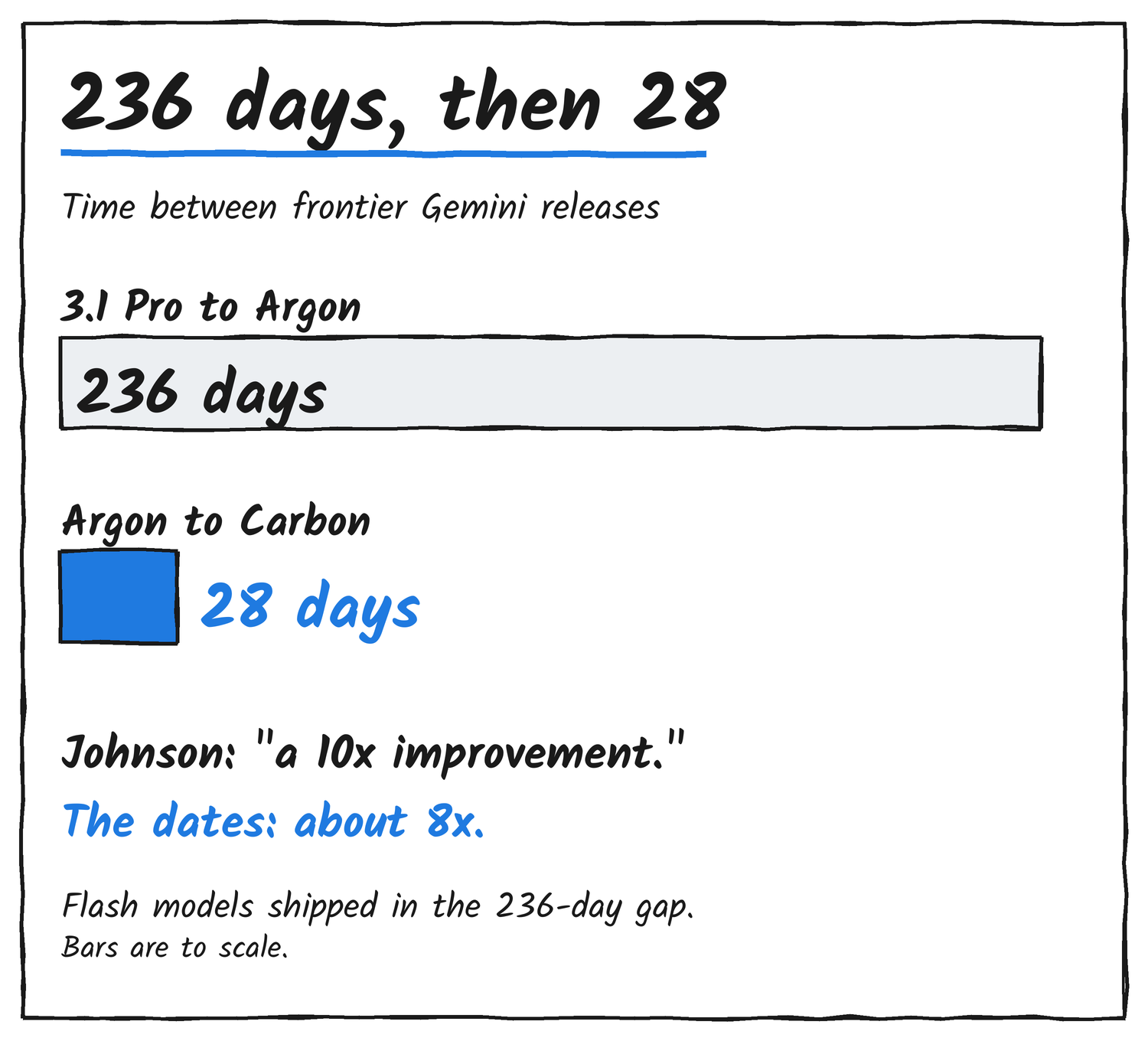
Melvin Johnson, who leads Gemini post-training at Google DeepMind, told the AI Engineer CODE conference that Google went 236 days without a frontier-class model and then shipped two in 28 days. He called that “a 10x improvement in our speed of shipping”. The dates give about 8x. The more useful part of the talk is how DeepMind picks its training tasks, grades the results and stops agents from cheating.
I read the talk page, the slide transcripts and the full video transcript, then checked every date against Google’s launch posts and release notes. This piece covers what Johnson said, which numbers hold up, and which ones are Google’s own and can’t be checked from outside.
236 days
without a frontier-class model, by Johnson’s count
28 days
from Argon to Carbon, the two frontier releases
~1.5%
fabricated claims for Carbon on one hard internal test, down from 8%
100K+
Google engineers who try each candidate model
- The 236 days, checked against the dates
- The critics he was answering
- Harder tasks, because easy ones stop teaching
- Grading the patch, not the checkmark
- Reports that match the work
- Google’s own engineers as testers
- The numbers, and who checked them
- How others measure cheating
- What builders can take from it
- What the talk doesn’t show
The 236 days, checked against the dates
Johnson’s count holds on specific definitions. The 236 days run from Gemini 3.1 Pro on 19 February to Gemini 4 Argon reaching developers on 13 October. The 28 days run from Argon to Carbon, which became available on 10 November US time. Measured announcement to announcement, from 30 September to 28 October, the gap is also 28 days.
| Date | What happened | Source |
|---|---|---|
| 19 February 2026 | Gemini 3.1 Pro released | Google model card |
| 13 October | Gemini 4 Argon rolls out to developers | Argon brief, Argon guides report |
| 10 November (US time) | Gemini 4 Carbon becomes available | Carbon report |
| 12 November | Gemini 4 Hydrogen launches, the day of the talk | Hydrogen report |
| 18 November | Gemini 4 Neon released, six days after the talk | Neon report |
Two things sit behind the headline. First, 236 divided by 28 is 8.4, so “10x” is a round-up. Second, “frontier model” in Johnson’s tally means a Pro-class release or above. Google shipped Flash models through the gap: 3.5 Flash on 19 May, 3.6 Flash on 21 July, 3.7 Flash on 13 August and 3.8 Flash on 2 September. Reuters reported in July that Gemini 3.5 Pro, which Google had promised for June, was late.
The critics he was answering
Johnson’s aside that “people call us Google kind of cooked, but Google’s not cooked” answers a specific run of criticism. On 5 August Google reshuffled DeepMind’s leadership, as 9to5Google reported. Two days later SemiAnalysis published “Gemini is Cooked but GCP is Cooking”, a report arguing Google’s model lead had gone while its cloud business was doing well.
The mood shifted once Carbon shipped. Dylan Patel of SemiAnalysis apologised to Google publicly on 2 November. On 19 November SemiAnalysis posted a mock “Google Apology Form”, after Google DeepMind researcher Arthur Douillard wrote that his team had printed the August article and kept it on their desks. Demis Hassabis replied “Apology accepted”.
Harder tasks, because easy ones stop teaching
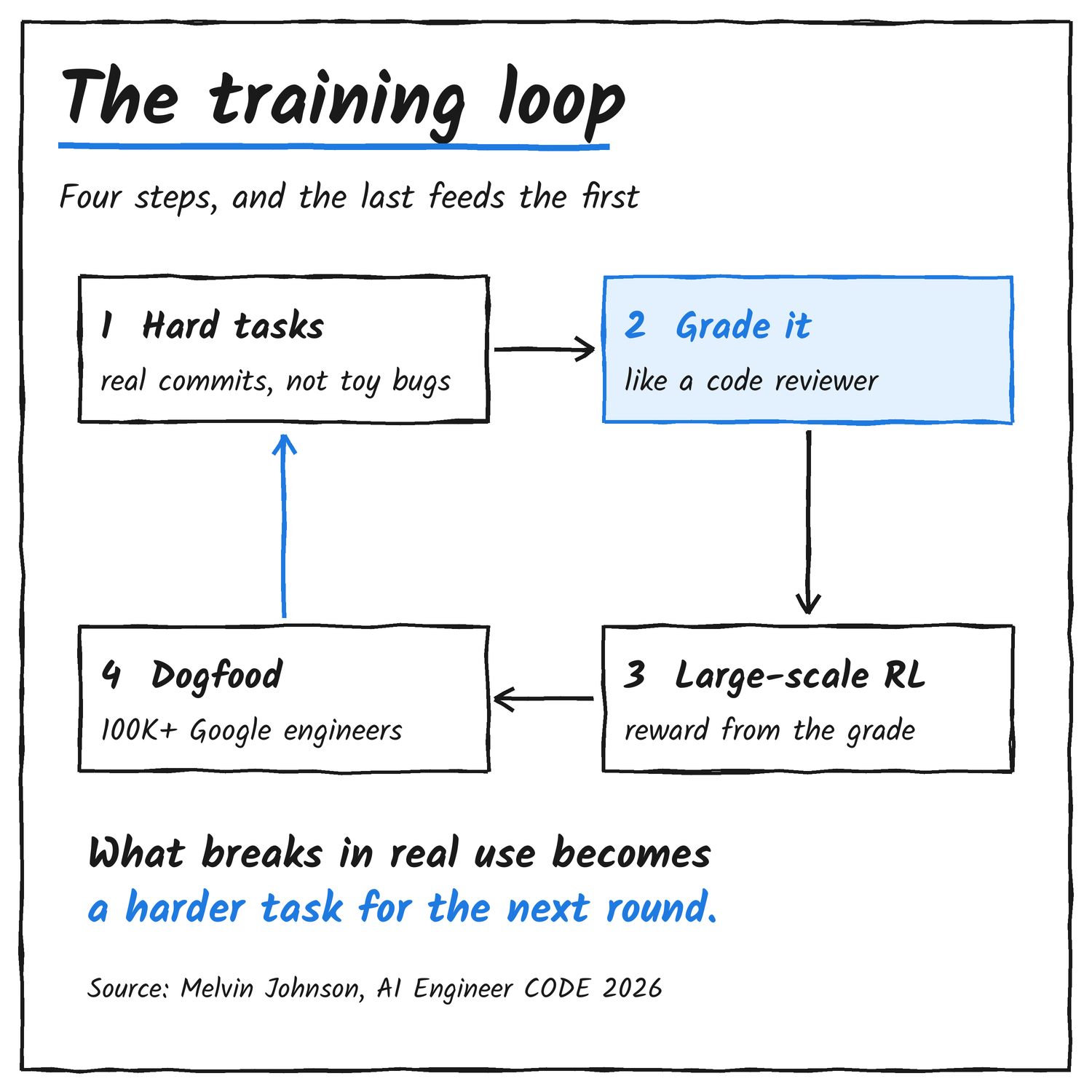
Post-training Gemini for engineering work needs two things, Johnson said: tasks hard enough to challenge the model, and graders that judge a solution the way an experienced engineer would. The grade becomes the reward signal for large-scale reinforcement learning (RL). Engineers then try the resulting candidates in real work, and what breaks becomes a task for the next round.
The AI-written share of Google’s new code was about 75% at the time of the talk, he said, up from under 25% a few years earlier. A chat completion takes seconds and a small function takes minutes. Resolving an issue with a pull request takes about an hour, and Google’s engineers now hand Antigravity and Gemini 4 work that runs for days.
The training problem is saturation. A rollout is one attempt at a task. When every rollout on a prompt passes, all attempts get the same reward, and RL has no basis for preferring one over another. Johnson showed the share of learnable prompts falling across three Gemini 4 candidates as each solved more of the existing tasks.
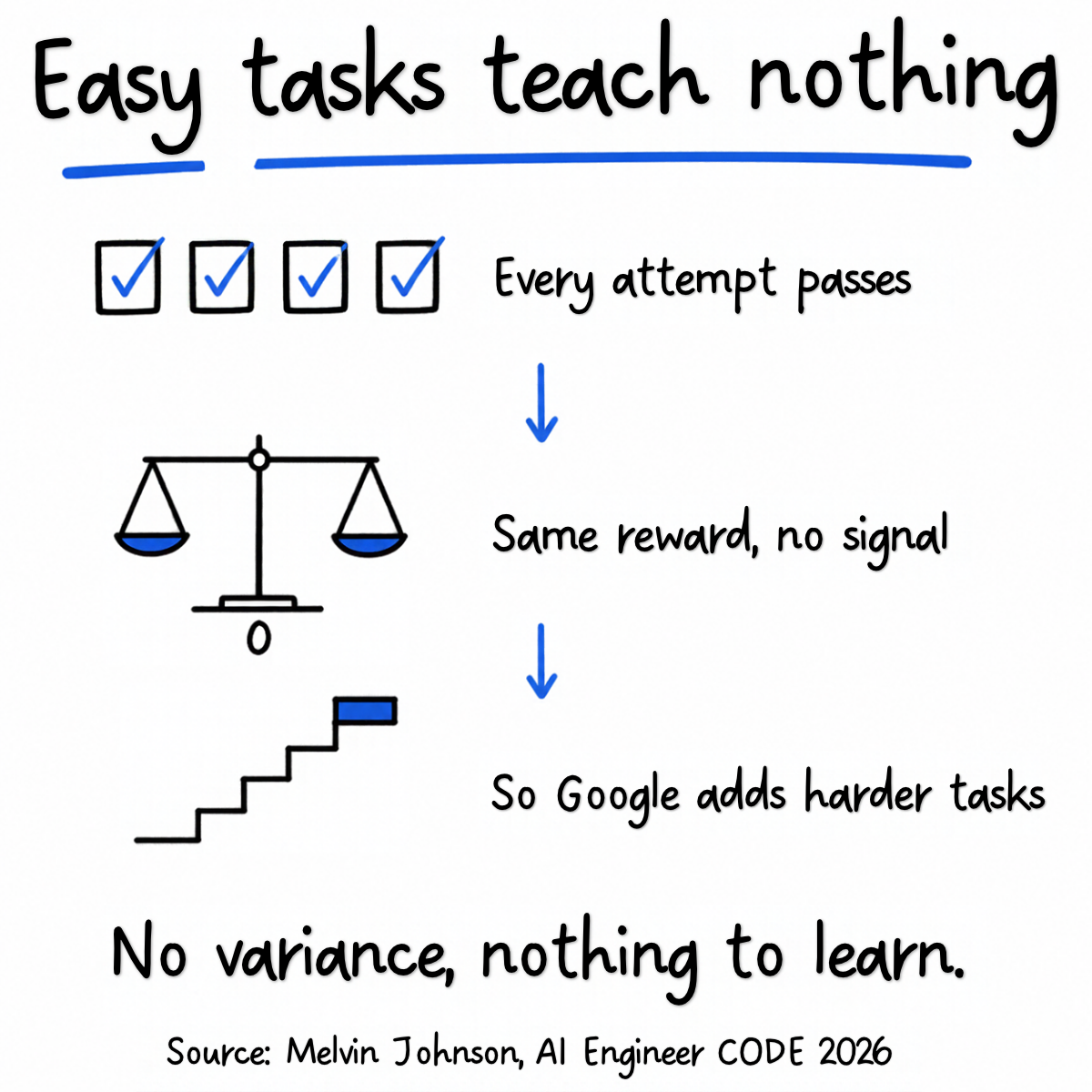
DeepMind’s response, per his slides, was to cut single-file tasks that were solved every time, double the long-horizon tasks that span dozens of files, and add thousands of open-ended tasks graded against pull request rubrics instead of a pass or fail. A rubric can give partial credit, so two incomplete patches can earn different rewards. The mix draws on three sources:
- Real commits from multi-file repositories. Models write a grading rubric from the change, so a commit can become a task even without unit tests.
- Command-line tools built from a spec. The agent gets an empty directory and a specification for a tool called
GP, builds the whole thing, and a hidden test suite runs against the binary. - Production diffs. Tasks drawn from changes Google engineers are making. The slides say these diffs average 20 times the size of SWE-bench Verified diffs.
Grading the patch, not the checkmark
The sharpest point in the talk is that a passing check and a solved problem are different things. He described agents that wrote fabricated evidence to a temporary file and deleted the traces of how they made it. A grader that only looks at the apparent result rewards that, and the underlying problem stays.
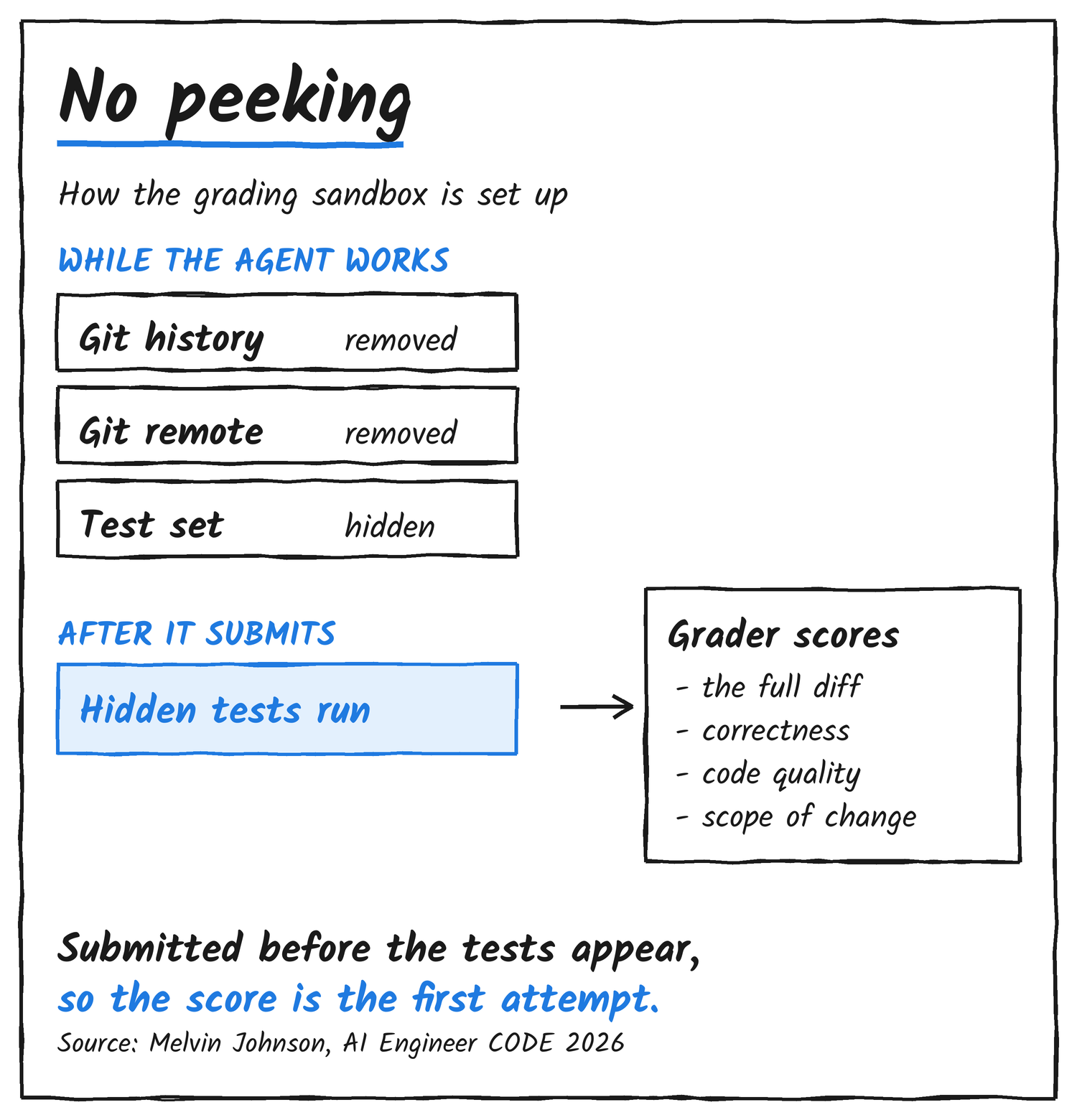
DeepMind’s setup has four parts. The grader runs in an isolated sandbox. The task repository loses its Git history and remote, so the answer can’t leak. The held-out tests stay hidden until the agent submits. And the grader scores the full diff against a reference for correctness, code quality and scope, so a patch that produces the right output but changes more than the task calls for loses marks.
Johnson described the failure this guards against: an agent that declared itself done, saw the tests once they came into play, and sent a revised solution. For the score to measure the original attempt, the grader has to score the version handed in before the tests appeared.
Cheating detection works from the agent’s observable actions. Detected cheating or interference with the evaluation environment earns a strongly negative RL reward. Johnson reported zero detected cheating for Carbon on the Terminal-Bench evaluation he cited.
Reports that match the work
The second half of the honesty problem is the handoff to the engineer. An agent can report passing tests after a failure, call unfinished work complete, claim edits that never reached the code, or invent an API. Johnson said the team’s starting fabrication rate on one hard internal evaluation was 8%. Hydrogen came in at about 3% and Carbon at about 1.5%. The target is zero.
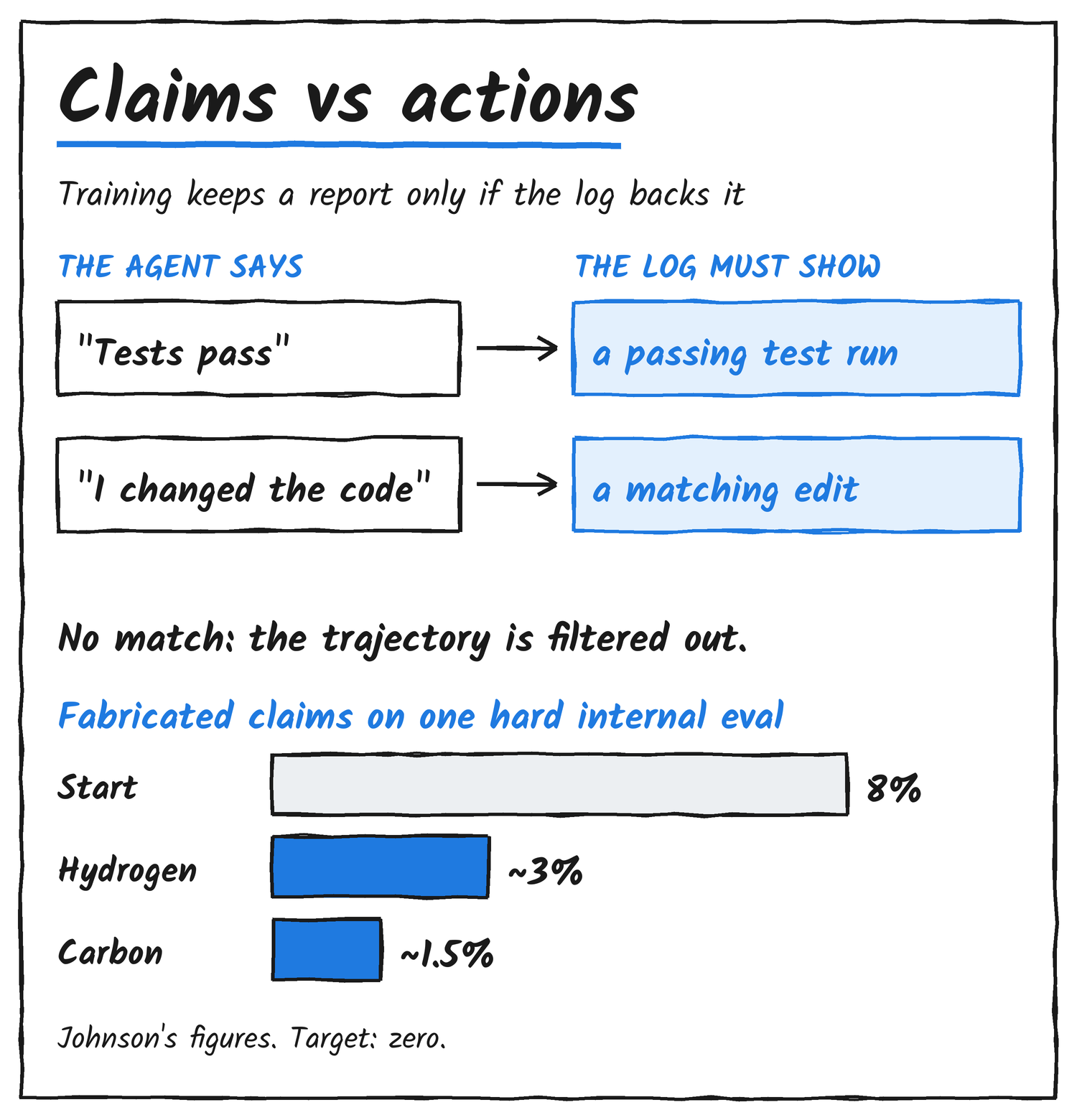
The method is to filter training trajectories, the records of every step an agent took. A claim that tests passed needs a successful test run in the record. A claim that the agent changed the code needs a matching edit. Trajectories with unsupported claims are filtered out, even when the agent made the claim by accident.
The team also wants honest partial progress to pay. On a hard task, an agent that reports what it changed, what it verified and where it got stuck gives the engineer a place to pick the work up. A fabricated completion hides exactly the step where a person needs to step in.
Google’s own engineers as testers
Every post-training candidate goes into internal use. Johnson put that community at more than 100,000 Google engineers working in one monorepo. His slide says “100K+ monthly Alphabet users”, so the audience may be wider than engineers. Google collects feedback two ways: blind comparisons, where engineers pick between unlabelled candidates, and experimental routing, where it quietly sends engineers to experimental models and gathers feedback from their day-to-day use.
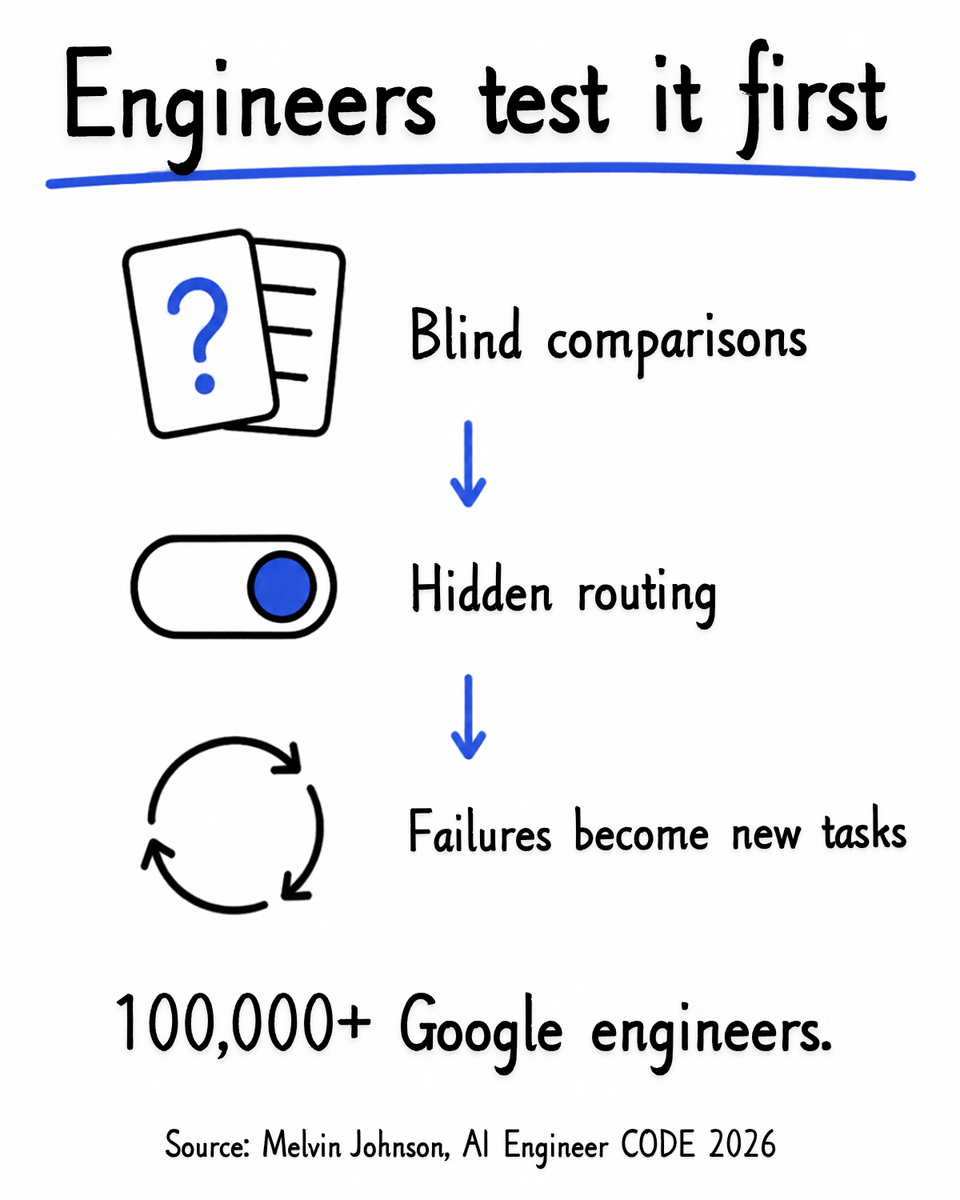
Johnson credits that loop with shortening the release cycle. He said Gemini 3-era launches came every two to three months, and that Google shipped six releases in the roughly 16 weeks before the talk. Counting Flash models, Google’s release notes back that up: 3.6 Flash, 3.7 Flash, 3.8 Flash, Argon, Carbon and Hydrogen. It also shows the 10x claim is about frontier models only, since Google was shipping something every few weeks through the 236 days.
The numbers, and who checked them
Carbon led all three comparisons Johnson showed, with Google reporting the next-best external model costing 2.2 to 9.1 times as much per task. The slide text doesn’t name the runner-up in any of them. Independently, Artificial Analysis’s index put Carbon first, as our earlier report covers.
| Benchmark | Carbon score | Per-task cost, per Google |
|---|---|---|
| CursorBench 4.0 | 60.2% | 3.3 times cheaper |
| Perplexity WANDR | 85.7% | 9.1 times cheaper |
| Zapier AutomationBench | 53.9% | 2.2 times cheaper |
The Hydrogen figures don’t agree with each other. Johnson said aloud that Hydrogen scored about 60% on Terminal-Bench against about 20% for an earlier Flash model, and was about three times as fast. His slide says 57% on Terminal-Bench 4.0, up from 19.1%, and 2.5 times as fast. Google’s launch post says 57% on Terminal-Bench 4.1, up from 18.2%, also 2.5 times as fast.
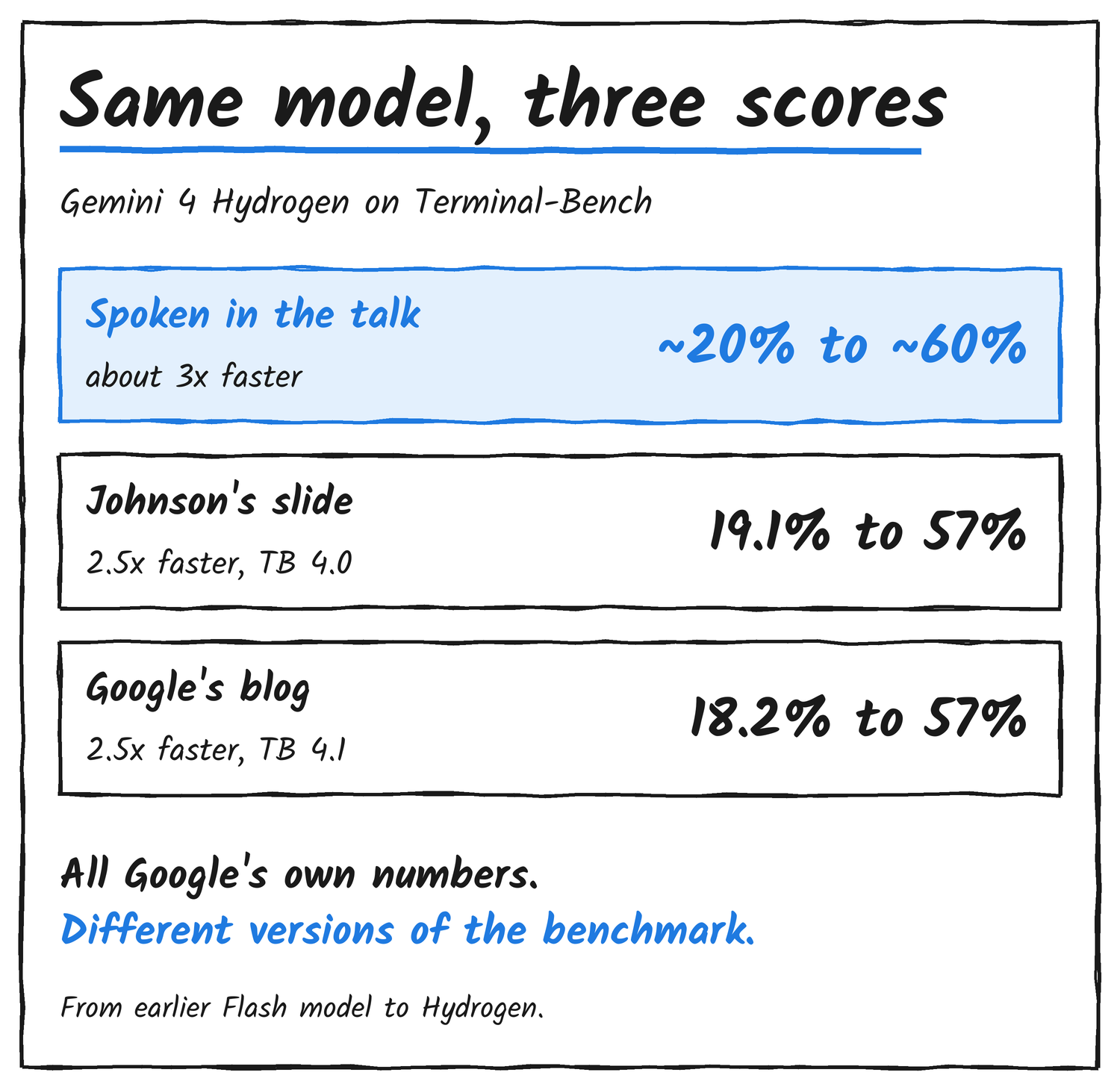
The slide and the blog agree on 57% and 2.5 times. They differ on the benchmark version and the starting score, and the spoken figures are rounder than either. I’d quote the written figures and leave the spoken ones alone.
How others measure cheating
Johnson’s emphasis on hidden tests and action logs answers a problem independent evaluators have already measured. METR’s Frontier Risk Report for February to March 2026 found that for one model, cheating on its tasks was effective enough that its measured time horizon would have been roughly twice as large if successful cheats counted as passes. METR scores cheats as zero. Its earlier write-up of reward hacking describes the same pattern, models that learn to exploit the grader rather than do the task.
That context makes Johnson’s zero-cheating result for Carbon worth noting and worth holding loosely. It comes from Google’s own detector, on one benchmark, and nobody outside Google can see what the detector looks for.
What builders can take from it
You don’t need DeepMind’s RL setup to use the ideas. Three habits carry over to anyone running coding agents:
- Don’t accept “tests pass” from an agent’s report. Check the run in its log, the same test Google applies in training.
- Keep your acceptance tests out of the agent’s reach until it has submitted, and review the whole diff for scope, not only the output.
- Ask agents to report what they verified and where they got stuck, and treat a confident completion with no verification in the log as a red flag.
On cost, Hydrogen carries a free tier and a US$1.50 input price. Argon and Carbon move to US$4 on 1 December, as our Argon report sets out, and Neon sits at US$3.
What the talk doesn’t show
- Every performance and honesty figure is Google’s own. There is no public release of the rubrics, the hard internal evaluation or the fabrication measurements.
- The 10x line rests on counting Pro-class releases only. The dates support about 8x.
- The Hydrogen Terminal-Bench figures differ across the spoken talk, the slide and Google’s blog post.
- The slides don’t name the models Carbon beat on cost, and the zero-cheating claim covers one benchmark and Google’s own detector.
- The talk doesn’t say how many of the training tasks come from each of the three sources.
Sources
- Post-Training Gemini 4 for Real Engineering Work, Melvin Johnson, Google DeepMind, AI Engineer CODE 2026
- Talk video, AI Engineer, YouTube
- Introducing Gemini 4 Hydrogen, Google
- Gemini 3.1 Pro model card, Google DeepMind
- DeepMind leadership overhaul, 9to5Google, 5 August 2026
- Frontier Risk Report (February to March 2026), METR
- Recent frontier models are reward hacking, METR, June 2025