A post on X by Chubby (@kimmonismus) summarised “the important numbers” from Situational Awareness LP’s fifth investor letter and linked a copy. The letter is Leopold Aschenbrenner’s Q3 2026 update to the investors in the AI-focused fund, dated 24 November and about 165 pages long. I read all of it, checked the post against it, then checked the letter’s figures against the sources it cites.
The letter is marked confidential and not to be forwarded without the fund’s written consent. I reached it through a Drive link posted publicly on X. I’m quoting it sparingly and I’m not linking or hosting the file. Its Q3 numbers match what the Wall Street Journal reported from a letter it obtained: a 65% loss after fees for the quarter.
Disclosure: I’m an OpenAI, Firecrawl and Devin ambassador.
Most of the post’s numbers are in the letter, and most of the letter’s numbers match their sources. Four don’t match cleanly: a late-August figure presented as current, a chip timeline that mixes tapeout with first results, a range cut down to its midpoint, and a forecast written as a measurement. The letter’s own account of the July loss is more detailed than anything published so far.
What the letter says about the fund
The fund started in November 2024 with a bit over $100 million. The letter says its net asset value was a bit over $4 billion at the open of 2026 and had multiplied nearly tenfold by the end of June, about 90% of that from profit and loss. Then came July.
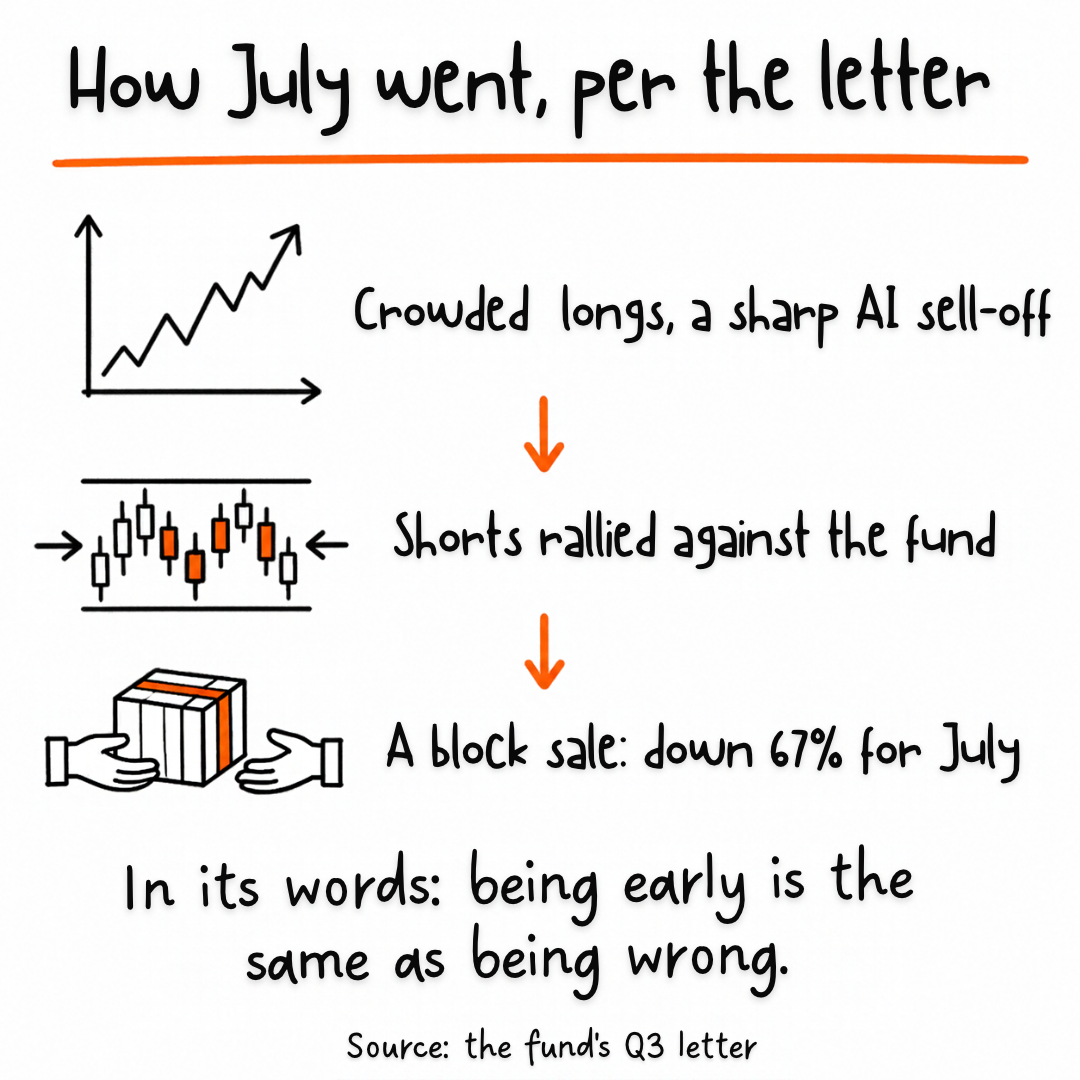
The fund entered the month about 1.6 times long and 1 times short. Many AI stocks fell more than 50% and some of its largest longs fell more than 60%. Hedges meant to move alongside the longs didn’t: a short in Micron against a long in Hynix fell about 30% while the long fell 55% to 65%. A separate short book, built on the view that Claude Code and Cowork would hurt software, IT outsourcing and consulting firms, rallied 30% to 50% against the fund.
On 29 and 30 July the fund ran a block trade that covered all of its shorts and sold roughly half of its public long exposure. It says it removed any reliance on prime broker leverage, and that it finished July down 67% net. The letter names no buyer and doesn’t mention margin calls. Reuters and Bloomberg, citing sources, reported that Citadel bought most of the fund’s public stock holdings and that lenders were making margin calls. “Most” and “roughly half” are different measures and the two accounts don’t line up.
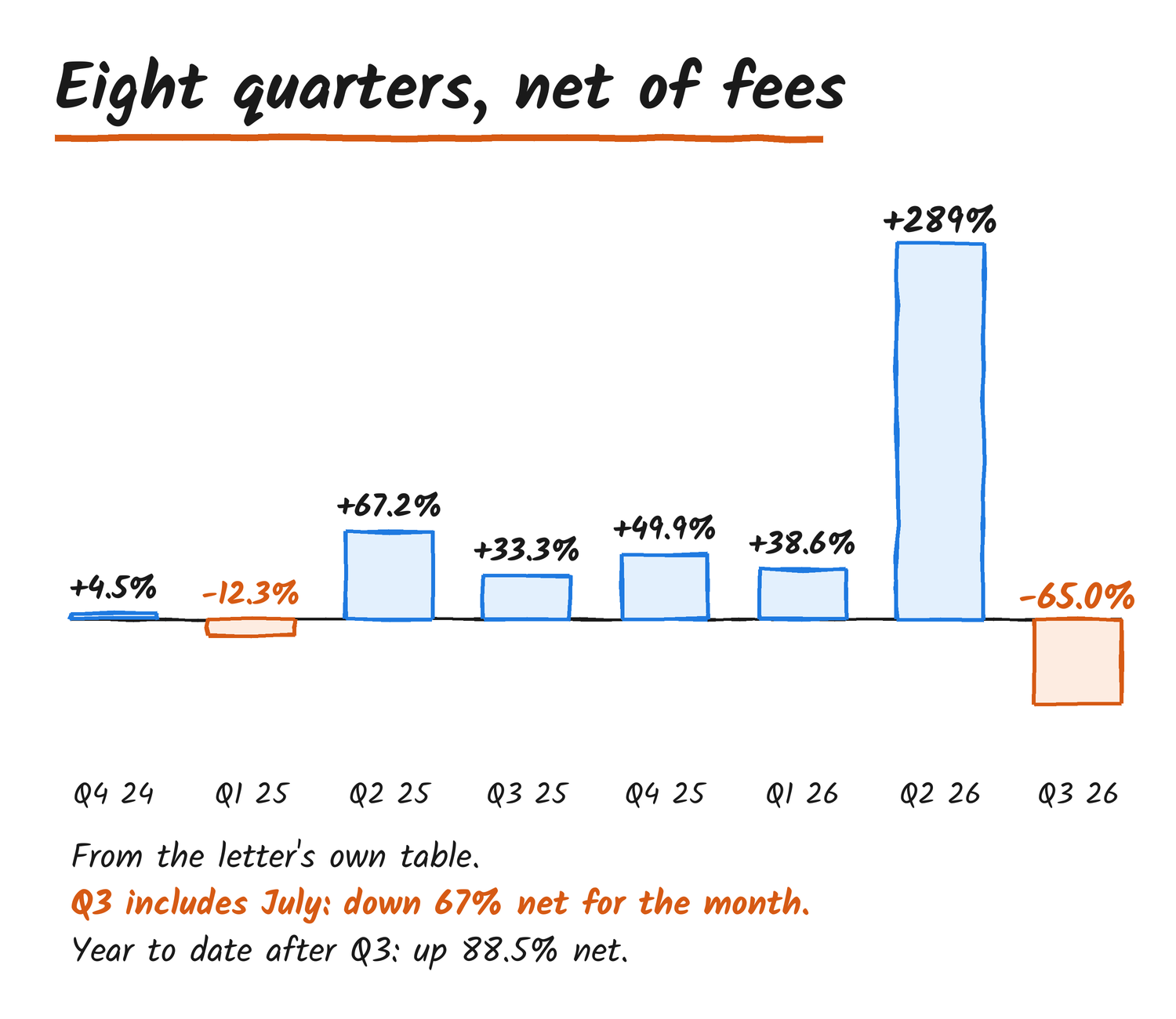
The quarter as a whole came in at -65.0% net, which leaves the fund up 88.5% net for 2026 so far. The lessons section says July “exposed a failure in how I built the fund”. It describes a fund that grew from a small price-taker into one of the biggest players in its market within months, and it says “being early is the same as being wrong”. The letter calls the late-July moves self-catalysing: each loss made the next one harder to manage.
What changed since: the book is fully paid for, with no financing leverage. The fund is building a second-line risk function and a formal risk governance framework, and it has grown from three people to nearly 30, including compliance, treasury and security staff. The letter says Aschenbrenner and partner Carl have nearly all of their net worth in the fund. After the Anthropic listing the letter puts the portfolio back at its usual balance of about 70% public and 30% private.
The fund’s 13F for the quarter shows reported holdings falling from about $20 billion at the end of June to about $1.6 billion at the end of September, as CNBC reported. A 13F lists US-listed long positions and options at their underlying value, and leaves out shorts, private stakes and non-US listings, so it shows only part of the book.
The post, checked against the sources
The post makes four claims: AI is speeding up AI research, with agents logging 19 hours of work per researcher hour at Anthropic; METR says Anthropic is improving about twice as fast; the 2027 forecast is a median of three years of progress in one; and the next paradigm is “virtual departments” of hundreds to thousands of agents. It ends with “RSI has started.”
| The post says | The letter says | The source says |
|---|---|---|
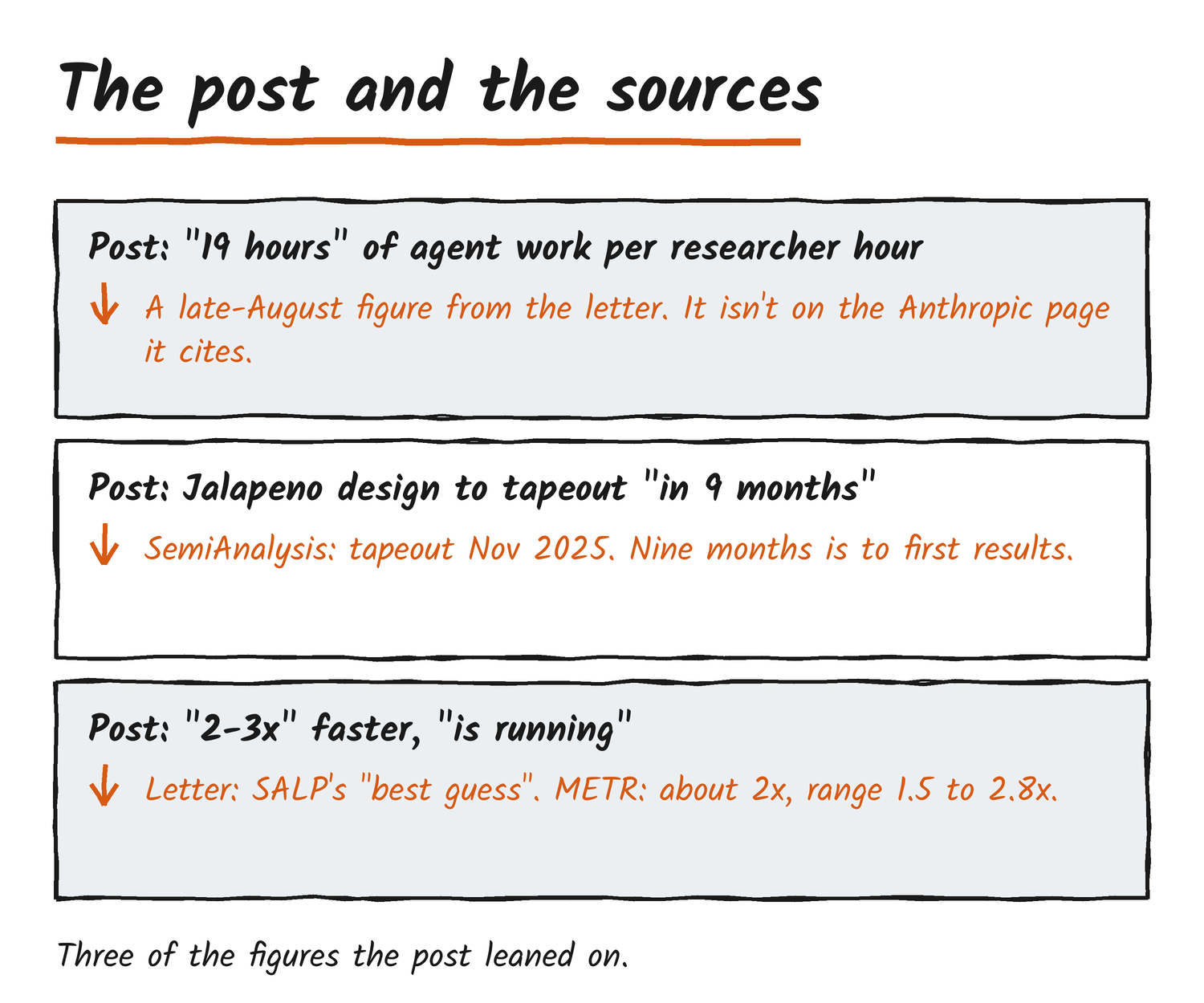
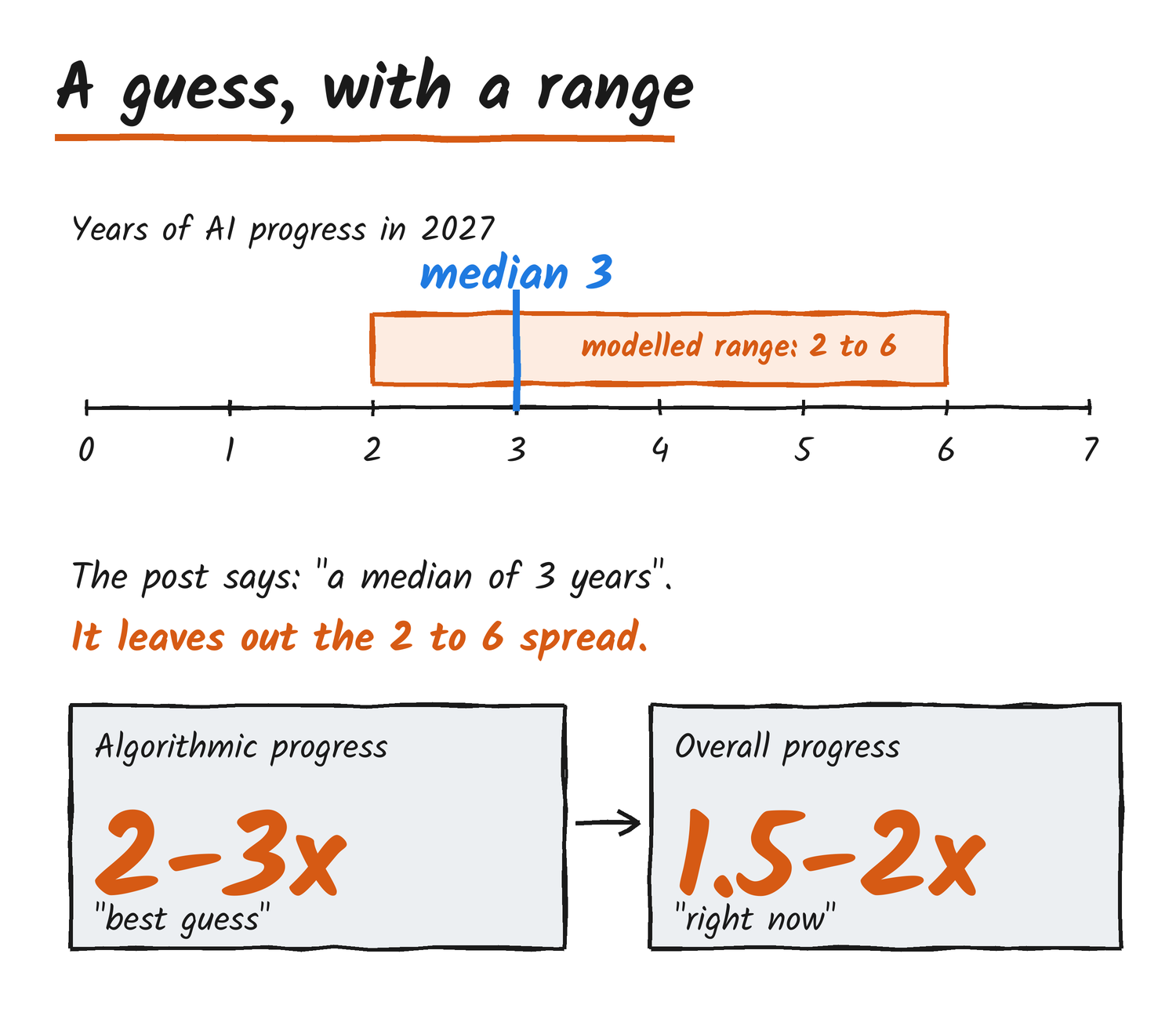
| Algorithmic progress runs 2-3x faster, overall progress 1.5-2x | The fund’s “best guess”, triangulated from the evidence, for the last couple of months | METR puts Anthropic’s capability progress at about twice the March 2024 to October 2025 rate. Its benchmark estimate is 1.9x with a 95% interval of 1.5x to 2.8x, and it wouldn’t be surprised by 1.3x or 3x. |
| Agents log 19 hours of work per researcher hour | A late-August figure: six agent hours per human hour company-wide, 19 per researcher hour, up from about 0.2 in February | Anthropic’s page says agent hours outnumbered employees’ hours six to one by August, counting runtime including inference and tool use against a 40-hour week. The 19 and 0.2 figures aren’t on that page. |
| Code shipped per engineer is up more than 45x since 2024 | Cites Anthropic’s S-1 | The S-1/A says average daily code contributed per engineer in Q3 2026 was over 45 times the 2024 average, and that Claude wrote over 90% of it. It measures volume of code. |
| METR says about 80% of the speed-up is due to AI | Same | METR says “a majority (perhaps ≈80%)” and calls it a judgment given with substantial uncertainty. |
| Anthropic’s S-1 says it may soon hit its RSP threshold of more than 2x acceleration | Quotes “may imminently meet” | The filing says the threshold may be met based on expectations for future models, and says it hasn’t designated any current model as exceeding it. The “more than 2x” is the letter’s gloss on the policy, not filing text. |
| A median of three years of AI progress in a single year | 2 to 6 years of 2024-equivalent progress in 2027, median 3, from the fund’s internal model | The range is dropped in the post. |
| OpenAI’s Jalapeño went to tapeout in nine months | Tapeout in nine months, against one and a half to two years for a typical accelerator | SemiAnalysis says it taped out in November 2025, about 16 months after hiring began, and that nine months is the time to first results after tapeout. The one-and-a-half-to-two-year figure isn’t in the article, and the chip ships in 2027. |
| A 10,000-agent OpenAI swarm worked on Navier-Stokes | Same | OpenAI’s page says the work involved “on the order of 10,000 concurrent agents”. |
| RSI has started | “RSI (recursive self-improvement) is starting.” | The tense changes in the post. |
The 45x figure, the METR estimate, the RSP wording and the 10,000-agent run hold up. The 19-hours figure, the chip timeline, the median without its range and “has started” don’t hold as the post states them. The post also leaves out two caveats the letter itself makes. METR thinks Anthropic staff’s self-reported 12x uplift is an overestimate, and OpenAI’s logged experiments are only 1.68 times its 2025 baseline over four weeks to 18 October, according to OpenAI’s own page. The letter calls how far experiment compute limits the gain from more code its biggest uncertainty.
What the letter claims beyond the post
The letter’s central argument is that the market and the AI labs disagree about 2027. It reads buy-side revenue forecasts as pricing 0.3 to 0.6 times a normal year of AI progress, and it puts buy-side expectations for Anthropic’s run-rate revenue at $120 billion to $200 billion by the end of 2027. The fund’s own forecast is combined lab revenue above $1 trillion at the end of 2027. Both sides are forecasts. The letter says that within a year either the fund or the market will have a lot of egg on its face, and that it has almost certainly got important parts of the story wrong.
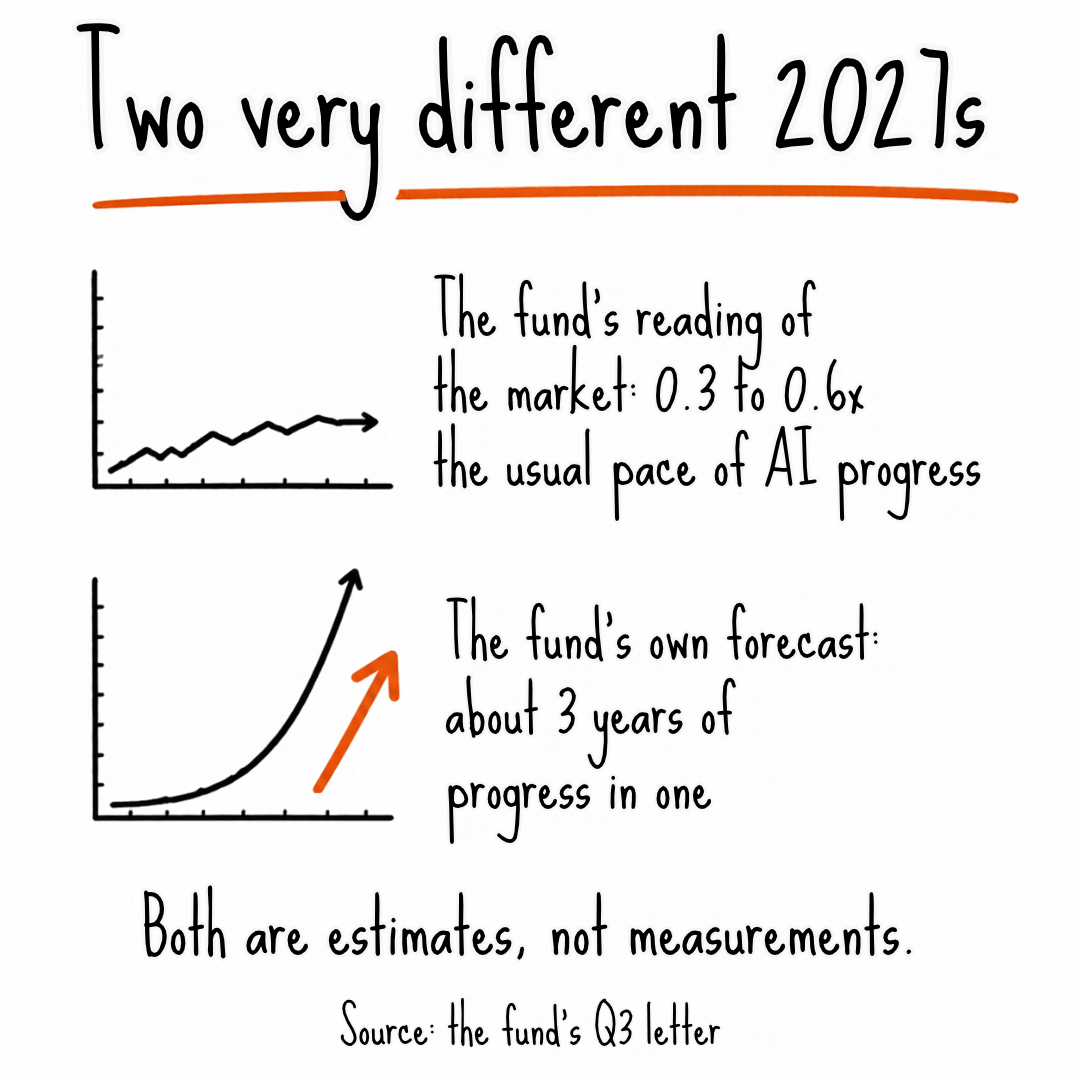
The fund’s positions gain if its forecast is right. The letter is open about that: Anthropic was by far its largest private investment, and it also describes a large memory-chip position. That is a reason to read the forecasts as an investor’s case, not a neutral estimate.
Anthropic’s own filing complicates one line. The letter calls Anthropic highly profitable. The S-1/A reports a GAAP net loss of $104.0 billion for the first nine months of 2026, driven by a $94.3 billion change in the fair value of convertible notes and similar instruments, and a GAAP operating loss of $1.26 billion. It also reports adjusted operating income of $4.1 billion, a 12% margin, and $6.6 billion of positive operating cash flow. “Highly profitable” fits the adjusted and cash-flow figures and doesn’t fit the GAAP ones. The letter’s $81 billion run-rate figure for October doesn’t appear in the filing text I downloaded, where the run-rate field is blank. Q3 revenue was $17.0 billion. Anthropic listed on Nasdaq on 19 November, priced at $83 a share, and raised $81.3 billion. Reported market value at listing ran from about $1.4 trillion to about $2 trillion depending on whether diluted shares are counted.
I couldn’t match the letter’s Hynix figures, a 16-fold rise and a two-thirds fall, to any published price data.
Aschenbrenner’s record
The letter’s author is the one making the forecasts, so the author’s record is part of the context. These are documented cases only, each with its source.
| Case | What was said or done | What happened |
|---|---|---|
| The 2024 essay | Situational Awareness was published in June 2024 with forecasts on compute, power, government and security. | An independent scorecard by Philipp Dubach finds the technical and infrastructure calls mostly held, among them test-time compute, power as the binding constraint and gas plants for clusters. The political ones mostly didn’t: no government takeover of the labs, no trillions in appropriations, export controls loosened. Dubach calls the verdict provisional because some deadlines run past 2027. |
| OpenAI, April 2024 | OpenAI fired Aschenbrenner, citing leaking. Aschenbrenner said the “leak” was a brainstorming document shared with three outside researchers, and that the real cause was a security memo. | Fortune reports an OpenAI spokesperson said the security concerns raised “did not lead to” the separation. The New York Times reports Aschenbrenner later acknowledged sharing a document with outside researchers and said it held no confidential information. |
| FTX Future Fund | Aschenbrenner worked at the philanthropic arm after Columbia, graduating at 19. | The fund collapsed in November 2022. Fortune notes there is no evidence its staff knew the money was stolen. |
| Fund returns, 2025 | Reports described a first-half gain of 47% after fees against 6% for the S&P 500, and a full-year gain of more than 200% from one investor. | The letter’s table puts 2025 at 193.3% net and 247.5% gross. The 47% first-half figure is from the WSJ via PYMNTS. |
| July 2026 | The fund went into July about 1.6 times long and 1 times short, with lenders and backers in the background. | It finished down 67% net. The WSJ reported some backers had earlier warned about leverage and were frustrated by the fund’s communication. Reuters reported Jane Street took a $15 billion hit tied to the fund, and that Citadel later shed more than 80% of the bets it bought, both from sources and an investor letter. |
The compute and power calls have a record of holding. The handling of leverage and liquidity is what the letter itself calls a failure. Both facts sit in the same document.
Where the speed-up claim stands
The fund isn’t the only source on AI speeding up AI. METR’s estimate of about twice the earlier pace, with an interval of 1.5x to 2.8x, is the best-documented number, and the letter’s own 1.5x to 2x overall figure sits inside it. Anthropic’s own page on recursive self-improvement says it is “not there yet” and treats compounding gains with humans directing as the most likely of three scenarios. OpenAI’s page shows a smaller gain in experiments than in code. The letter’s three-years-in-one forecast is the fund’s model of what comes next, and the sources agree only on the speed-up that has already happened.
I ran no models for this piece. It rests on reading the letter and fetching each cited page.