Google’s Gemini team published a deep-research skill that tells a coding agent to split a hard question across parallel subagents, check primary sources and write a cited report. I installed it in OpenCode and ran five models through four jobs with the skill left alone, with it named in the prompt and without it. The main thing I found is that it mostly doesn’t switch itself on. Left alone, the models loaded it on three of ten research runs and never on a simple lookup. When I named it, every model loaded it, the reports got longer, and a blind Claude judge preferred the skill’s version in nine of ten verdicts.
Disclosure: I’m an OpenAI, Firecrawl and Devin ambassador, and GPT-6.2 Sol is one of the models in this test.
What the skill is
The skill lives in google-gemini/demolab, a library of experimental skills from the Gemini team, under the Apache 2.0 licence. Google’s README says it is not an officially supported Google product. The skill is short: one SKILL.md with five numbered steps and no scripts. In plain terms it says to orient first, split a broad question into three to five separate angles, hand each to a subagent with a budget of about a dozen searches, make them check primary sources and quote their key numbers, cancel any worker that stalls, and finish with a cited report that has a two-sentence summary and an Unresolved section. Narrow questions get answered directly or with two subagents at most, and the skill says not to use it for simple lookups.
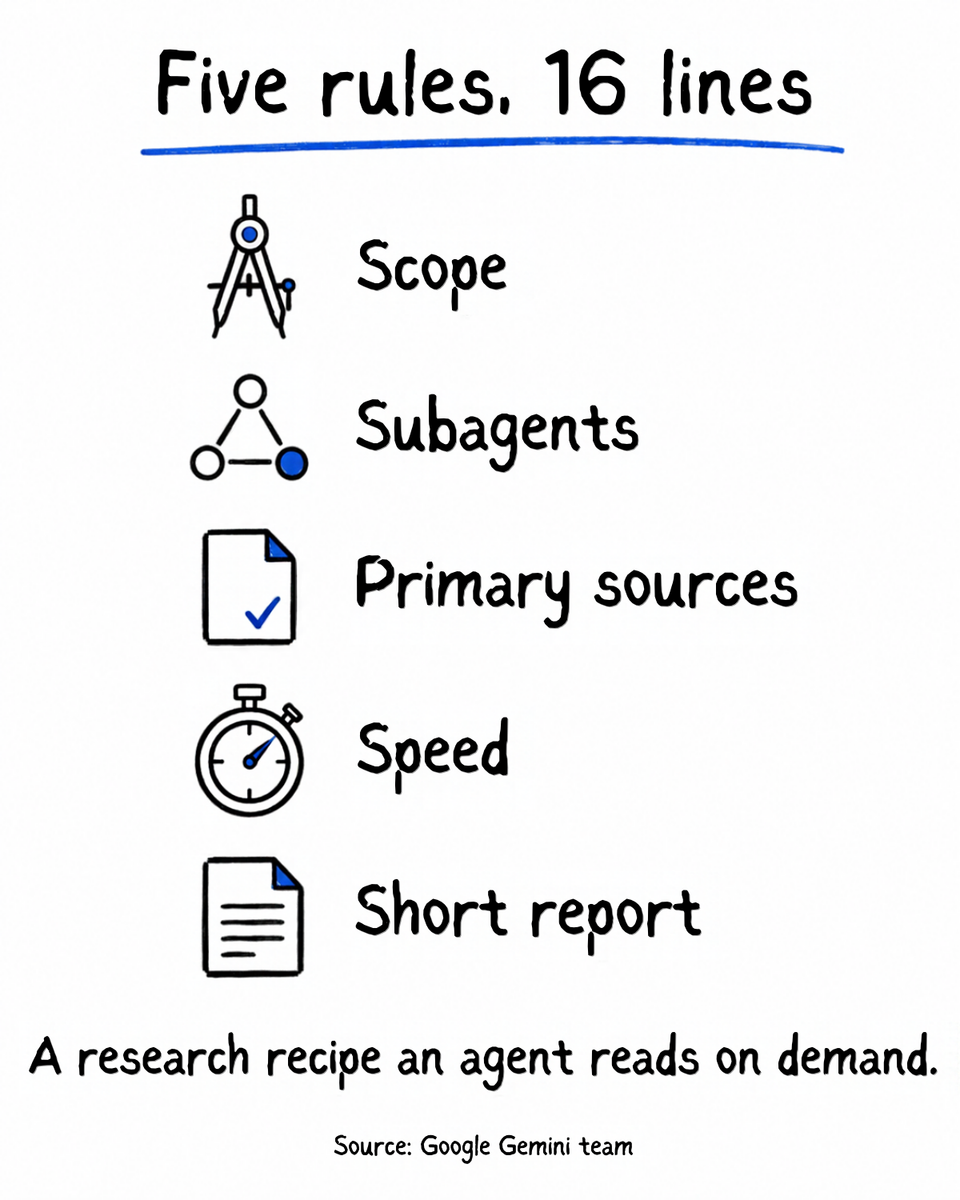
Google’s README says judges preferred output made with it more than 90 percent of the time across hundreds of blind evaluations with Gemini 4 models. It doesn’t publish the method or the data, so later in this piece I ran a small blind check of my own.
How I tested it
I installed the skill with the README’s command into a fresh OpenCode 1.19.6 home and ran everything headless with web search switched on.
npx skills add google-gemini/demolab --skill deep-researchThe field was Kimi K3.1 Pro through Synthetic, DeepSeek V4.1 Flash through Morph, Claude Haiku 5.5 and GPT-6.2 Sol through their own APIs, and Gemini 4 Neon through Google’s. Every task ran with no skill installed, with the skill installed but not mentioned, and, for the research tasks, with the prompt prefixed by “Use the deep-research skill for this. ” My first batch of runs couldn’t see the skill at all because of a folder bug in my harness, so I threw it out, fixed it, confirmed each run’s visible skills and redid everything. These are the four prompts, word for word. The first is a simple lookup the skill says to skip.
Which open-source licence is the GitHub repository google-gemini/demolab released under?Research how Google prices and sizes its three Gemini 4 models Carbon, Neon and Hydrogen. For each one I need the launch price per million input tokens and per million output tokens, the context window, and any price change Google says is coming. Use Google's own announcement posts as your sources and cite each figure with a link.Research the Gemini 4 model family (Argon, Carbon, Hydrogen and Neon). For each model I want what Google says it is for, its launch price, where developers can get it, and the benchmark claims Google makes for it. Use Google's own announcement posts as your primary sources and cite them with links. Then add a short section on what you could not confirm.Research how Google prices and sizes its three Gemini 4 models Carbon, Neon and Hydrogen: launch price per million input and output tokens, context window, and any price change Google says is coming. Use Google's own announcement posts as sources. Then write the findings as a single self-contained web page saved as report.html in the current directory: a heading, a two-sentence summary, a comparison table, a bar chart of the prices drawn in inline SVG, and a sources list with links.I ran Gemini 4 Neon with its output limit raised and its thinking set to low in OpenCode’s config. Each model got one run per setup, so a rerun could shuffle the details, and I treat the patterns below as leads rather than a ranking.
It rarely loads itself
OpenCode shows a model the skill’s name and description, and the model decides whether to open it. On the lookup, none of the five did, which is correct. On the research prompts that didn’t mention the skill, only DeepSeek and Gemini 4 Neon ever opened it. Name it, and all five did.
| Prompt | Skill installed | Models that loaded it |
|---|---|---|
| Simple licence lookup | Not mentioned | 0 of 5 |
| Price research and broad survey | Not mentioned | 3 of 10 runs (DeepSeek, Neon) |
| Broad survey and report page | Named in the prompt | 10 of 10 runs |
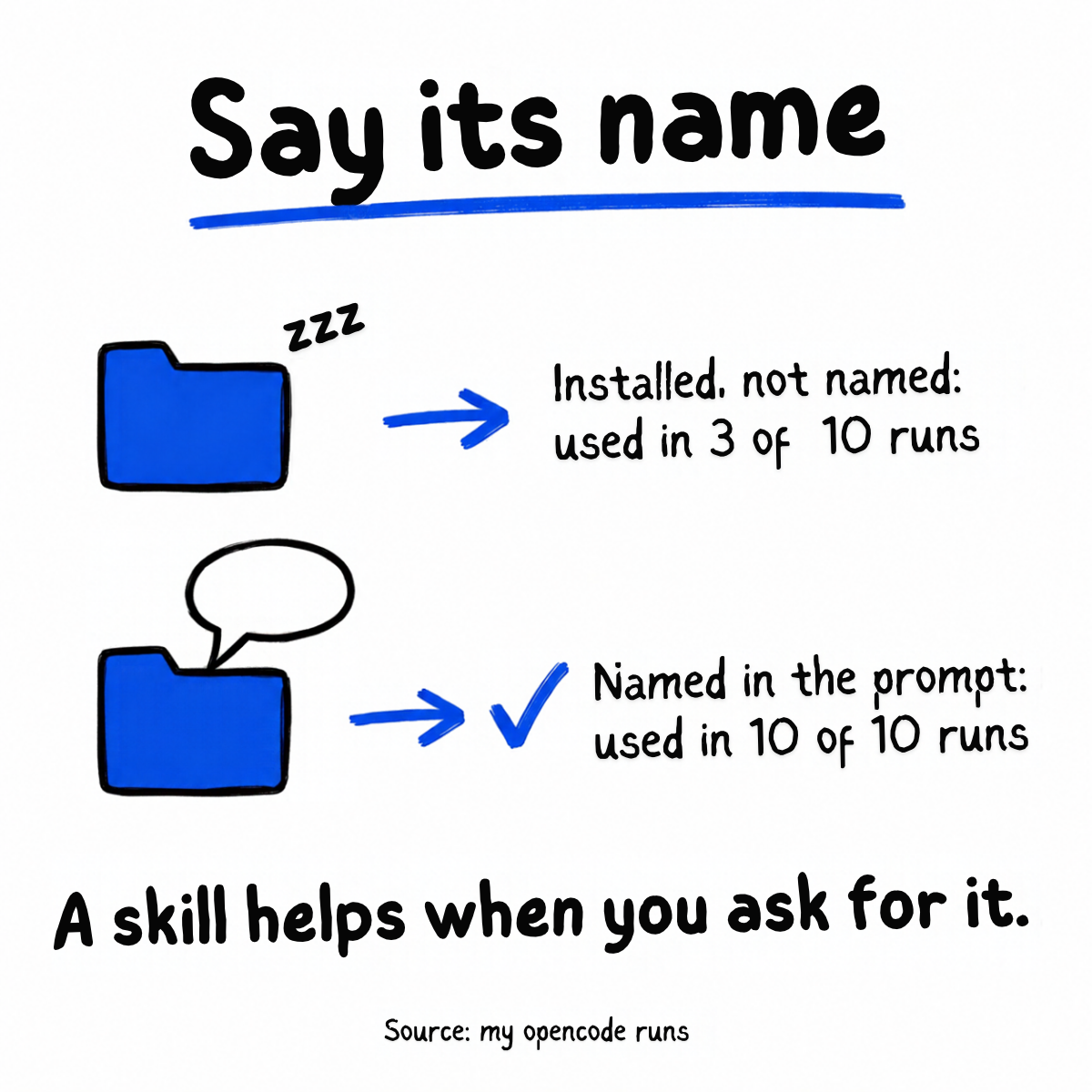
That matters because the skill’s whole pitch is that the agent decides when a question is big enough. In my runs it mostly decided no, even on the survey of four models. If you want the research team, say “use the deep-research skill”.
What changes when you name it
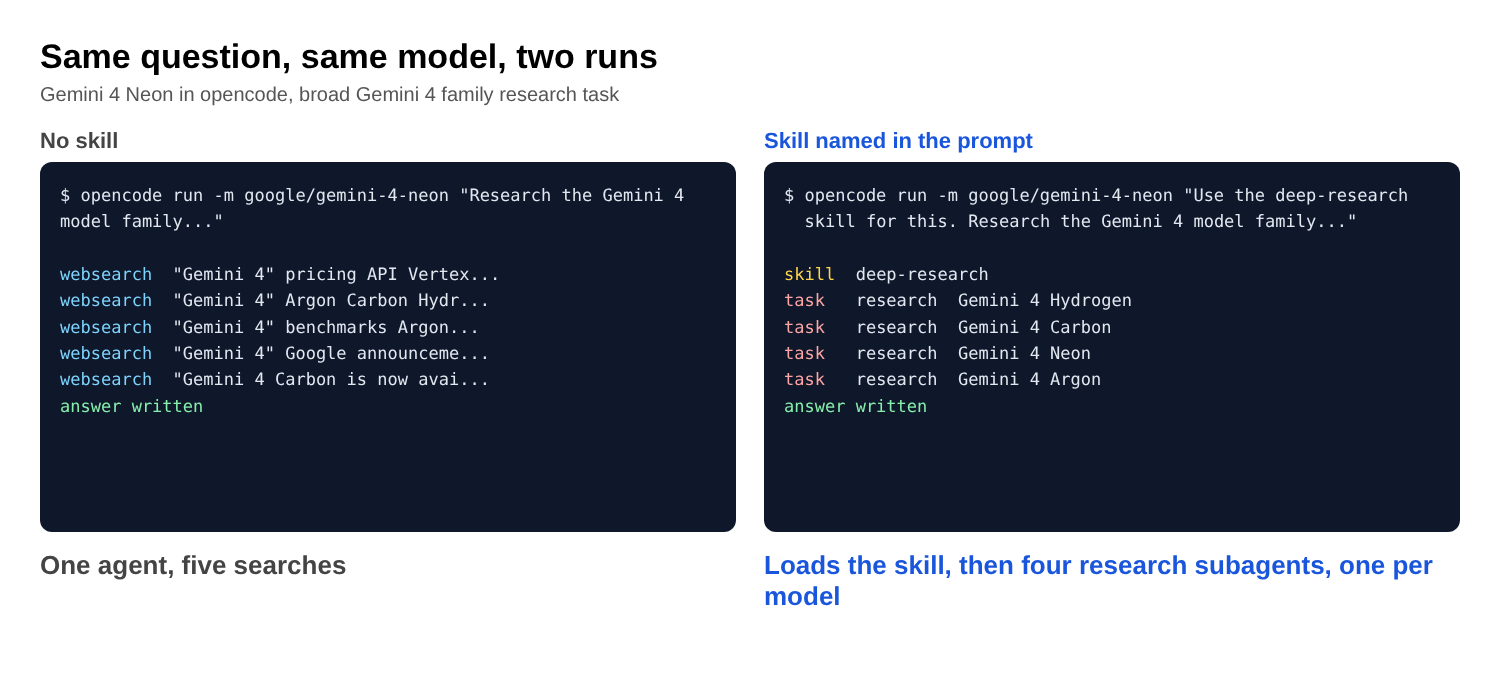
Here is the broad survey, no skill against skill named. This is the clearest picture of what the skill does to the way a model works, and it changed with the model.
| Model | No skill | Skill named | Subagents when named | Report length |
|---|---|---|---|---|
| Gemini 4 Neon | Under a minute, searches only | About 2 minutes | 4 | About 40% longer |
| GPT-6.2 Sol | Under a minute, searches only | About 1.5 minutes | 3 | About a third longer |
| Kimi K3.1 Pro | About 12 minutes, already used subagents | About 10 minutes | 5 | About 40% longer |
| DeepSeek V4.1 Flash | About 1.5 minutes | Under a minute | 0 | Similar |
| Claude Haiku 5.5 | Under a minute | Under a minute | 0 | Similar |
Neon and Sol went from quick direct searching to a lead-and-workers setup and took more than twice as long for a longer report. Kimi was already fanning out to subagents without any skill, so for Kimi the skill mostly changed the report. DeepSeek and Haiku read the skill and then researched on their own, as before. DeepSeek got faster, but I can’t say why from one run. The skill suggests three to five angles for a broad topic, and Neon’s four and Kimi’s five sit inside that.
Simple facts were right for every model with or without the skill: launch prices, context sizes and where to get each model. The one fact that wobbled was Carbon’s price rise on 1 December, which Google puts in a footnote. Haiku is a good example of the skill’s Unresolved section at work. Without the skill it said it didn’t know when Carbon’s introductory price ended. With the skill named, it reported that a third-party comparison said $4 and $20 from December but that it couldn’t confirm that from Google. Neither run read the footnote, and the second at least flagged the gap properly.
The report pages
The fourth task made each model write its findings as a web page, so I could look at the result. Both of these got every number right. In each pair the no-skill page is on the left.
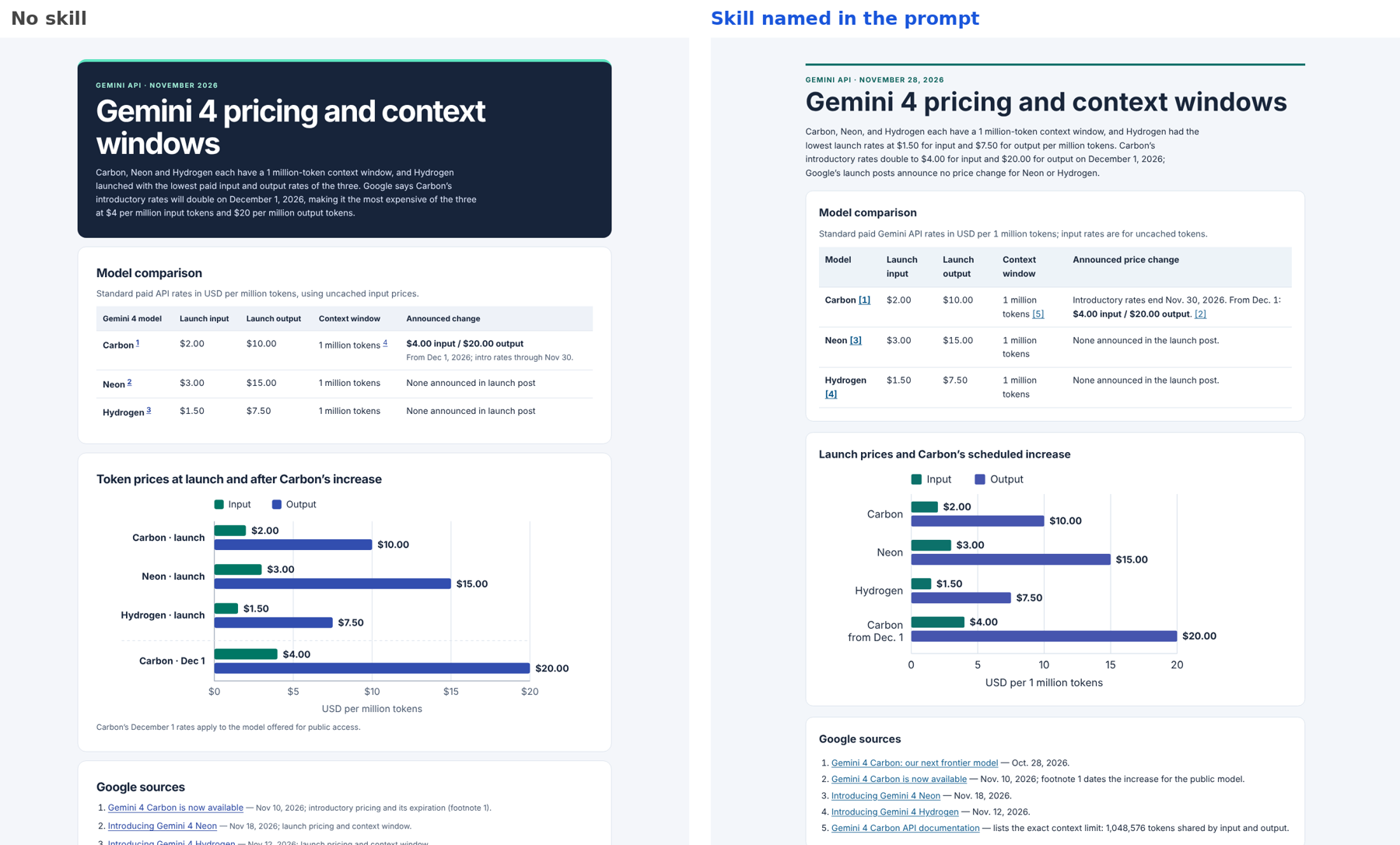
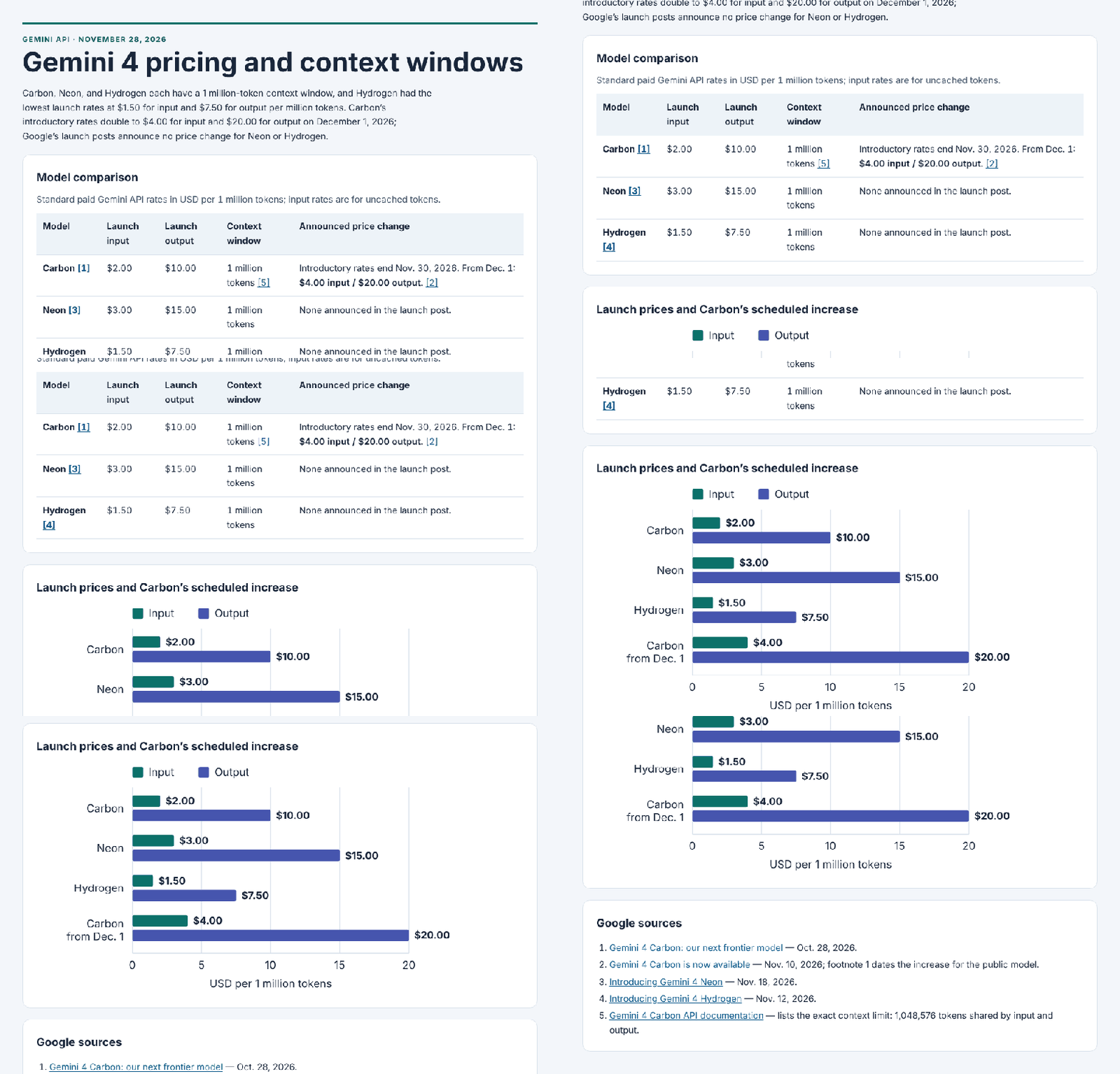
Sol’s skill page is plainer, but it added a fifth source, Google’s own API documentation, to pin down the exact context limit, and it dated each source. Both pages show Carbon’s December increase in the chart.
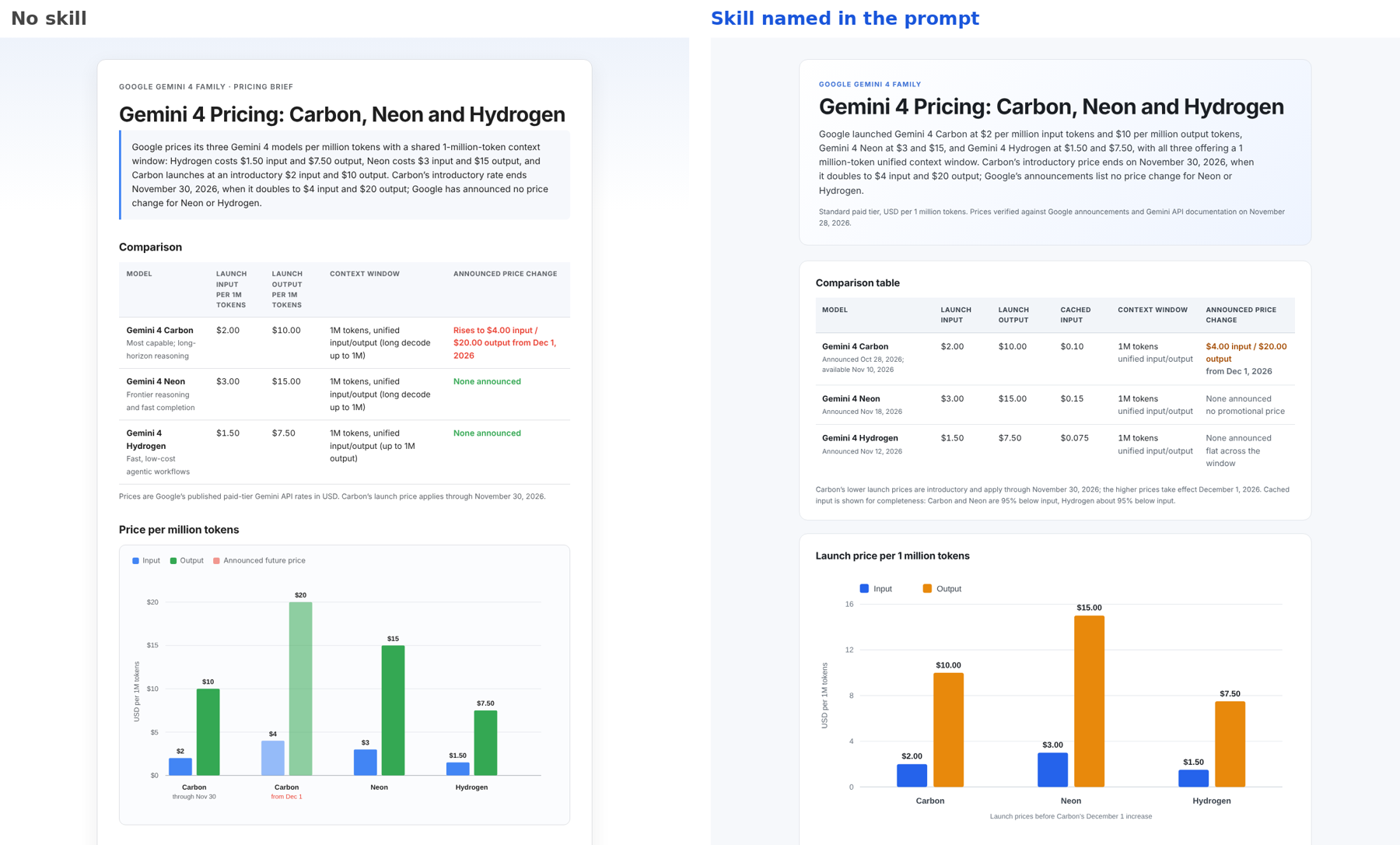
DeepSeek’s skill page added a cached-input column and a line saying the prices were checked against Google’s announcements and API documentation. It also lost something: its chart shows launch prices only, while the no-skill chart had a lighter bar for Carbon’s December increase. So the skill added verification and cut one useful detail from the chart, and the page that looks more careful isn’t strictly the more complete one.
A small blind check
To test Google’s claim in miniature, I took the two survey reports from each model, no skill and skill named, and asked Claude Opus 5.5 to pick the better one without telling it which was which. I then swapped the order and asked again. The judge’s instructions, trimmed to the rules it applied:
Which report would a careful reader prefer? Judge on: accuracy of figures against what the request asked, use of primary sources with working-looking links, completeness for every part of the request, clarity and a useful note on what could not be confirmed.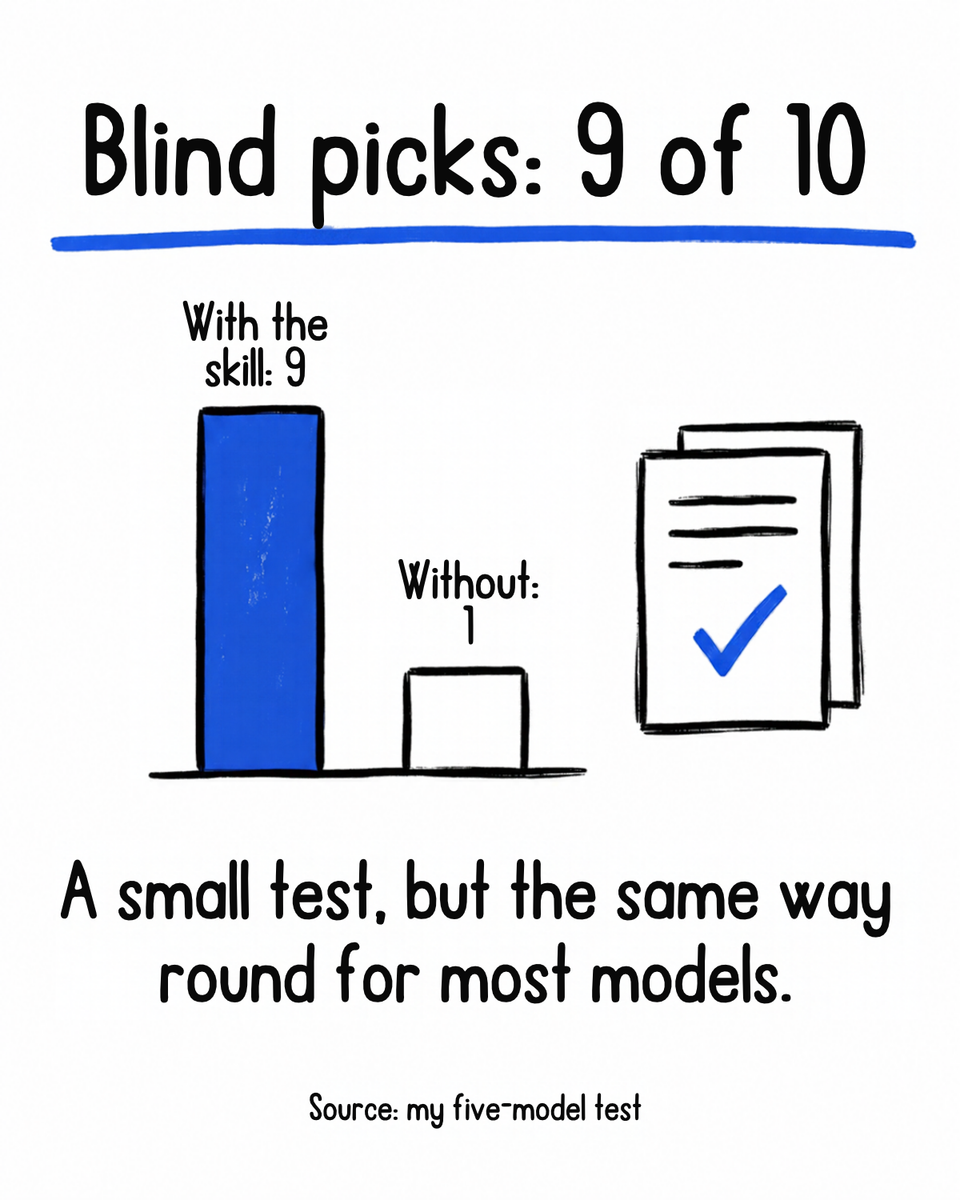
It chose the skill’s report in nine of ten verdicts. The odd one was DeepSeek, where swapping the order flipped the pick, so that pair was close. This leans the same way as Google’s claim, but ten verdicts on five pairs is tiny, the judge is a model that tends to like longer and more structured reports, and the skill’s reports were longer. It supports the direction and nothing more.
What I couldn’t test
I used one run per setup, so a rerun could change the order. I didn’t test the skill inside Google’s own agent tools, where a dedicated research subagent exists, so my subagents were OpenCode’s general ones. I didn’t check every claim in every report against its source, only the prices and context sizes. I didn’t measure cost, and I didn’t test the skill on topics outside Google’s own announcements.
Where that leaves the skill
It does what it says, if you ask for it. Named in the prompt, it got models to split the work, write longer cited reports and flag what they couldn’t confirm, and a blind judge liked the results. It doesn’t make a model smarter, since the simple facts were right without it, and it won’t kick in by itself. I’d name it for a broad survey where the extra minutes are worth a deeper report, and skip it for anything a single search answers. If you use it, check the chart and the footnotes yourself, because the skill added care in one place and dropped a detail in another. For more skill tests, see my runs of Inkworks and Papercraft.